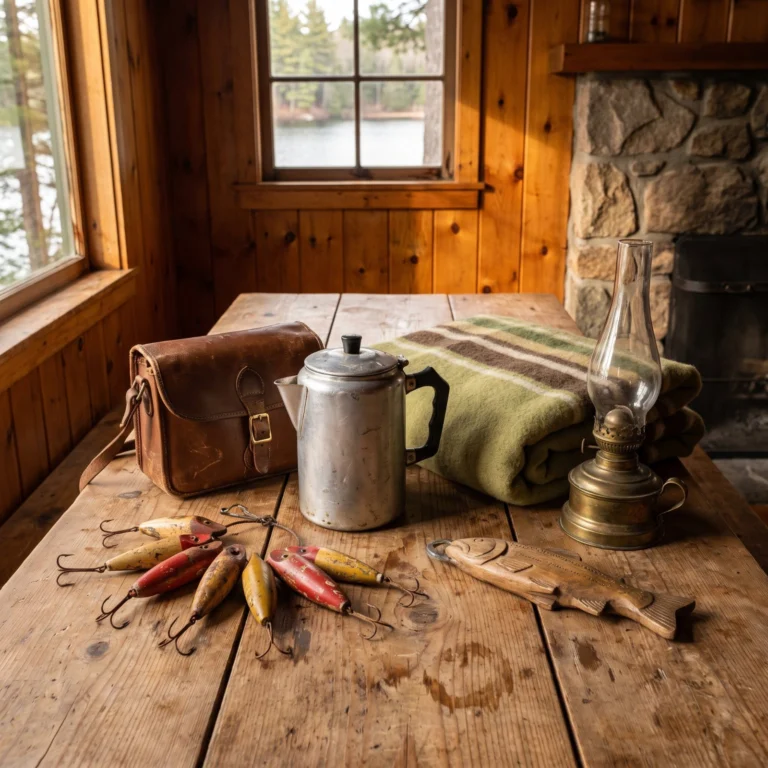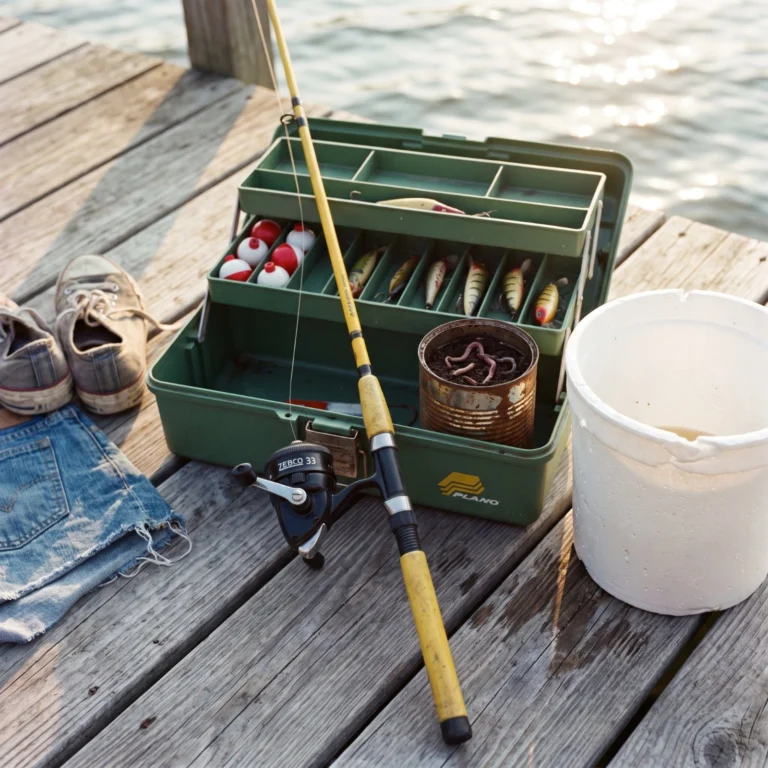
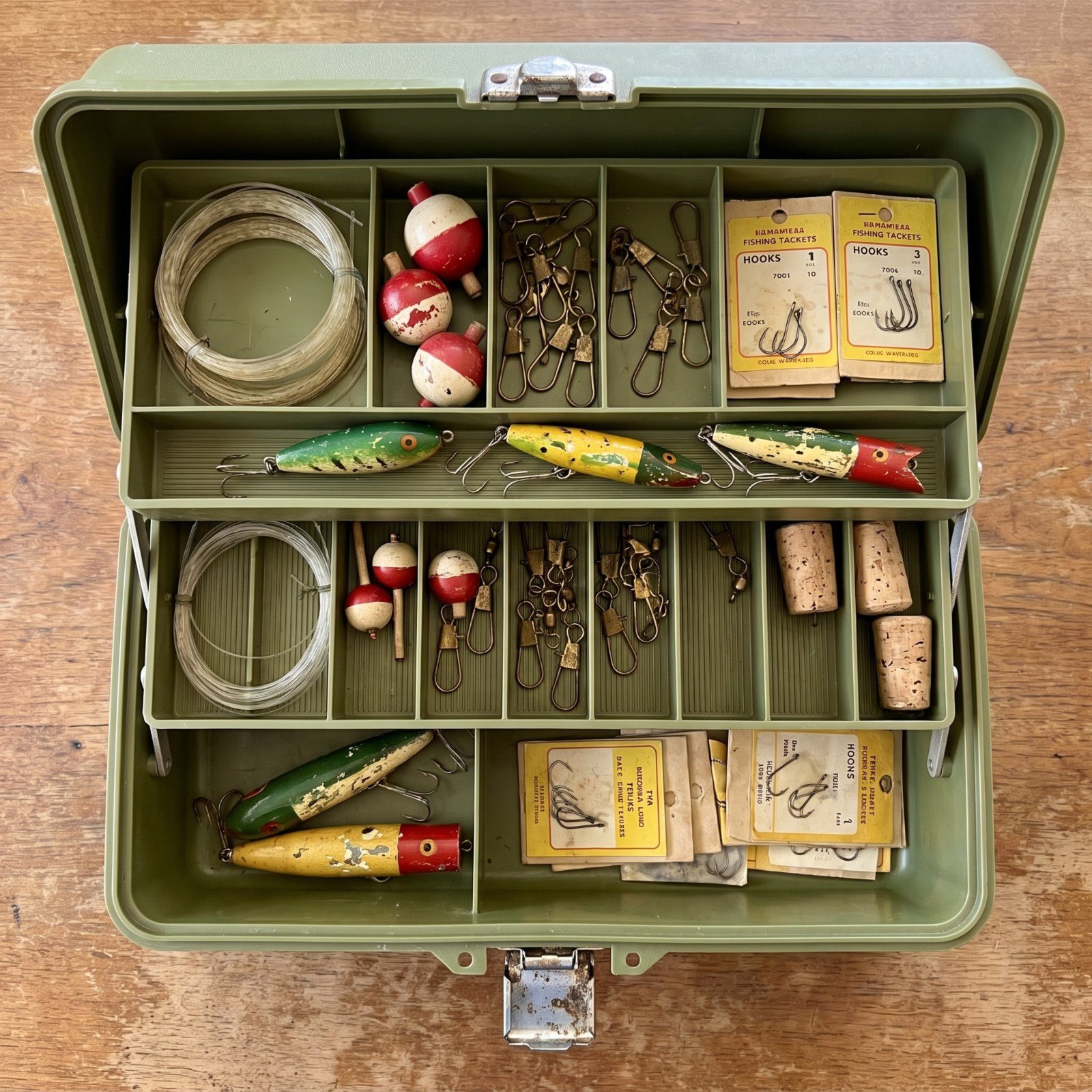
Pop the lid on a tackle box packed away since Nixon left office and the smell hits first. Rubber, dried pork rind, a little rust, the faint chemical tang of old line dressing. Inside is a vanished world. Half of it would baffle anyone who grew up on spinnerbaits and soft plastics, because these were the odd little tools a serious angler leaned on before electronics and modern materials made them obsolete. Some were genuinely clever. A few were mild cons. All of them tell you how people actually fished fifty years ago, back when solving a problem on the water meant reaching into a tray instead of a phone.
Please note that some of the images in this article were created with the assistance of AI.
37. The Worm-Blower Syringe That Floated a Nightcrawler Off the Bottom
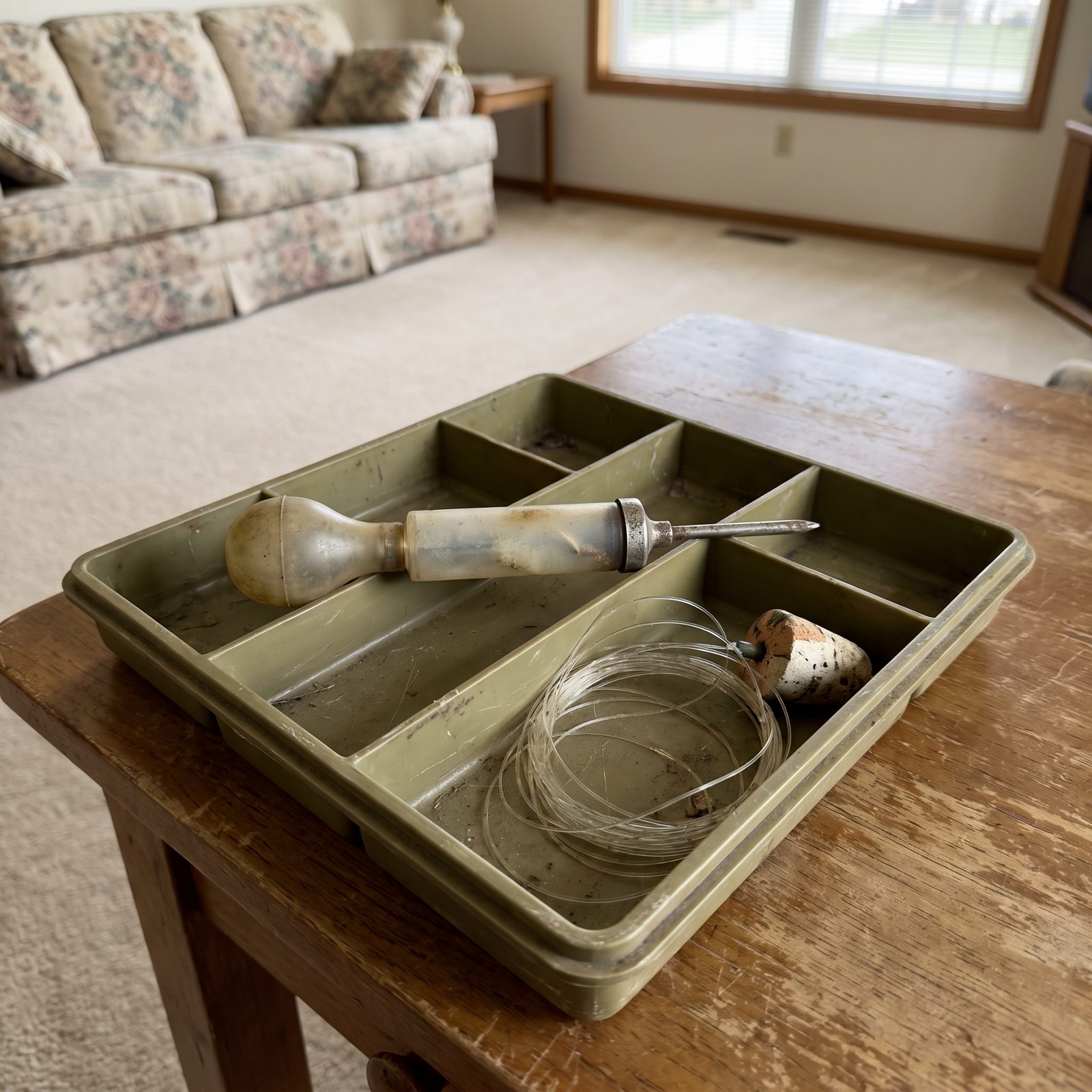
Clever little thing, almost extinct now. You’d press the blunt needle into a nightcrawler and pump a shot of air inside, and the worm would ride up off the bottom instead of lying flat in the muck where catfish and carp couldn’t see it. Walleye guys on a slow drift swore by it.
The problem nobody mentions is that you popped half your worms doing it. Inject too much and the crawler bloats and tears on the hook. It took a feel you only got after ruining a dozen. Soft plastics made the whole trick pointless, since a floating jighead does the same job without the surgery.
36. A Tin of Line Dressing for Braided Casting Line
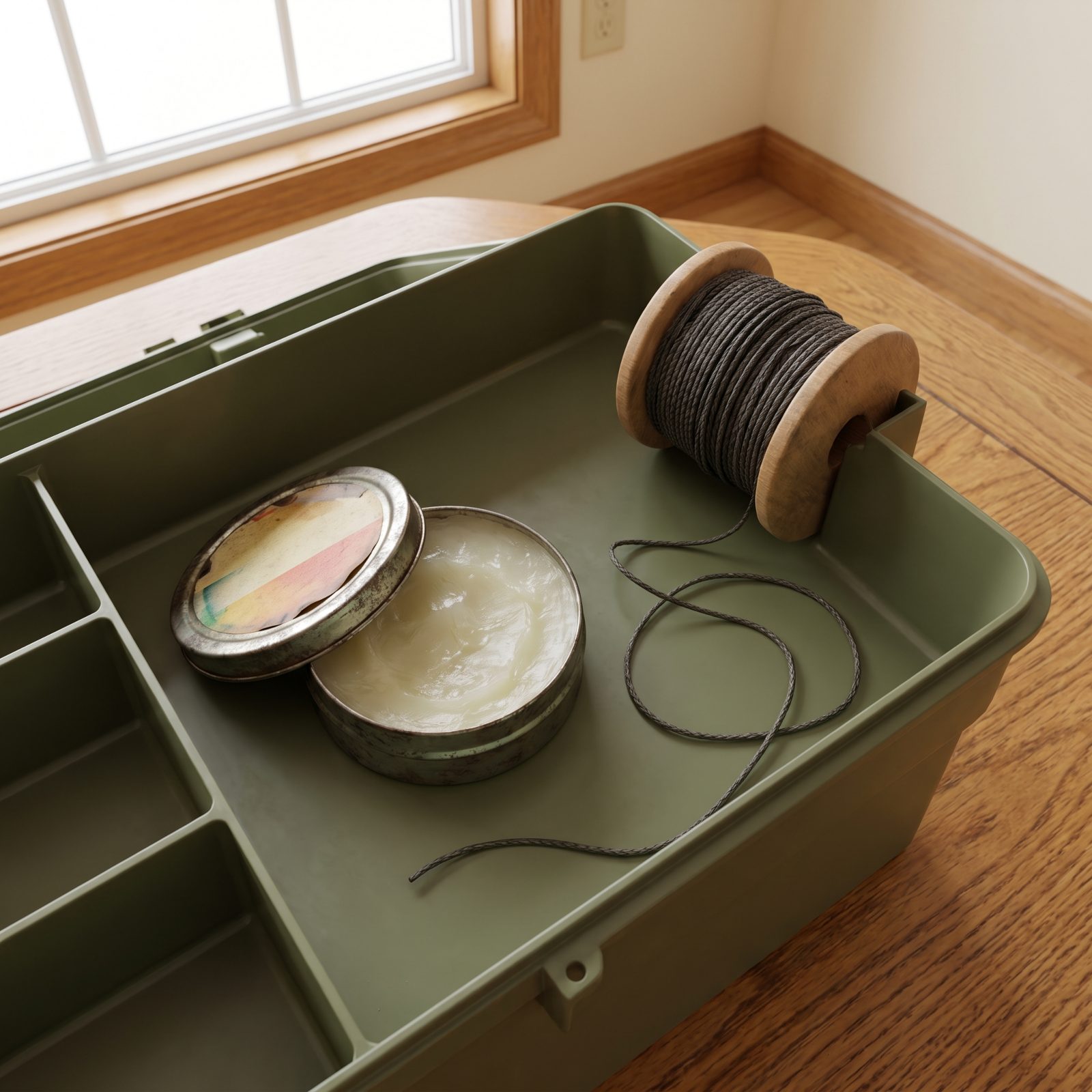
Before monofilament took over, plenty of anglers were still throwing braided Dacron or old linen casting line, and that stuff drank water like a sponge. Wet braid got heavy, sank, rotted, and backlashed worse. So you rubbed a waxy dressing along it, same idea as fly line grease, to float it and shed water.
Nobody carries this anymore. Almost nobody fishes water-absorbing braid on a baitcaster these days, and once modern coated braid arrived the whole category of problem just disappeared. But in a 1975 box this little tin was as routine as split shot.
35. A Metal Tube of Rod-Ferrule Cement for Field Repairs
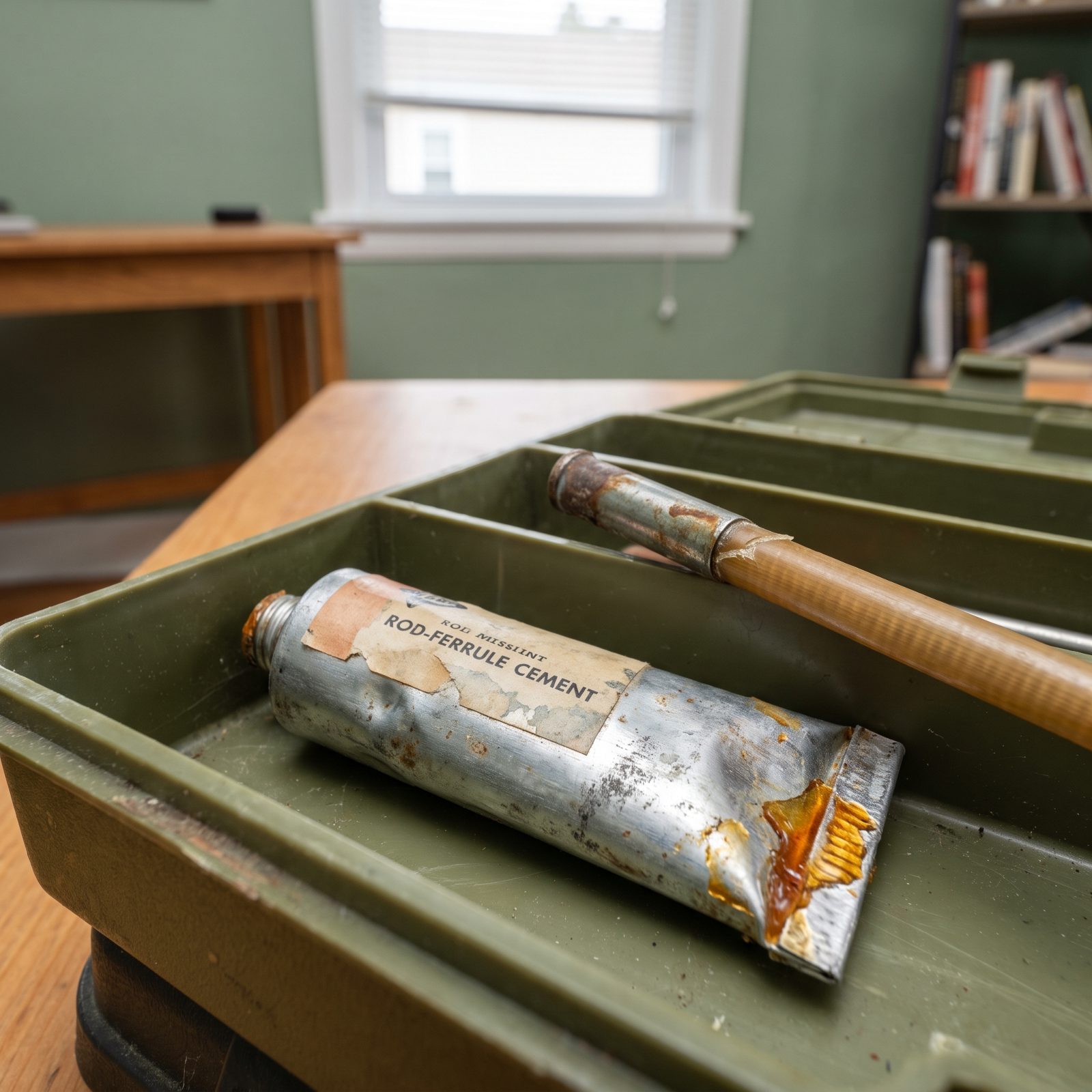
A loose or lost rod guide, or a ferrule that spun on the blank, could end a trip fast. This heat-set cement, a stick or tube of ferrule glue, was how you fixed it. You’d warm the metal with a match, melt a little cement on, seat the part, and let it cool.
Honestly, this one took patience most people didn’t have on a riverbank. Heat it too much and you scorched the blank. Too little and the guide popped off on the next cast. The repair held better at the kitchen table than in the field, which is the exact opposite of what you wanted.
34. The Heavy Metal Plug Knocker That Freed a Snagged Lure
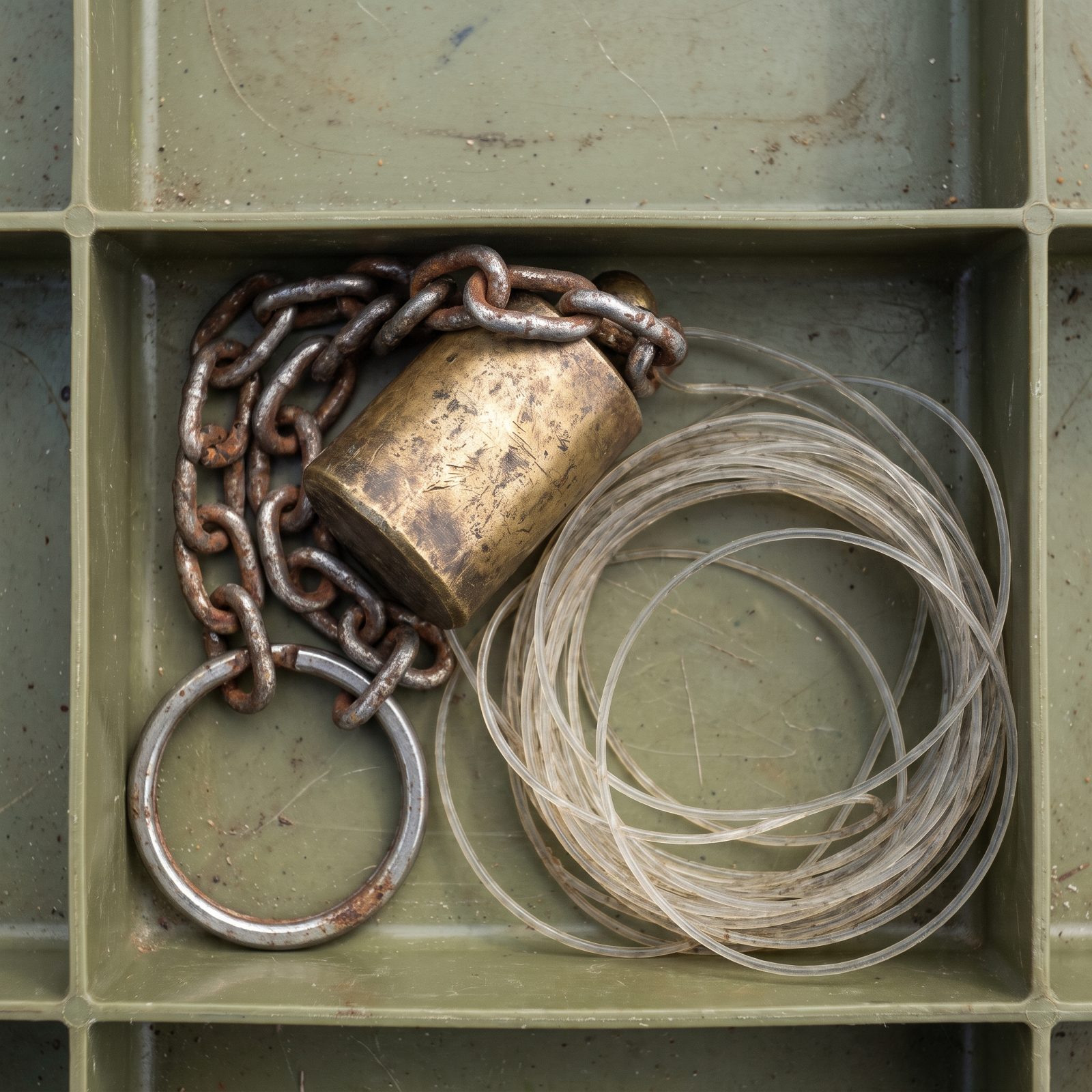
A good wooden plug cost real money in 1975, so you didn’t just break off and shrug. The plug knocker was a chunk of weighted brass that clipped around your taut line and slid down it, and the weight banging against the snagged lure usually knocked it loose.
It worked best straight down off a boat. From shore, at a bad angle, it mostly just gave you a workout. Bass guys fishing timber and dock pilings got their money back on this one fast. Lose two plugs it couldn’t save and it still paid for itself on the third it did.
33. A Clip-On Depth Plummet for Setting the Float Just Right
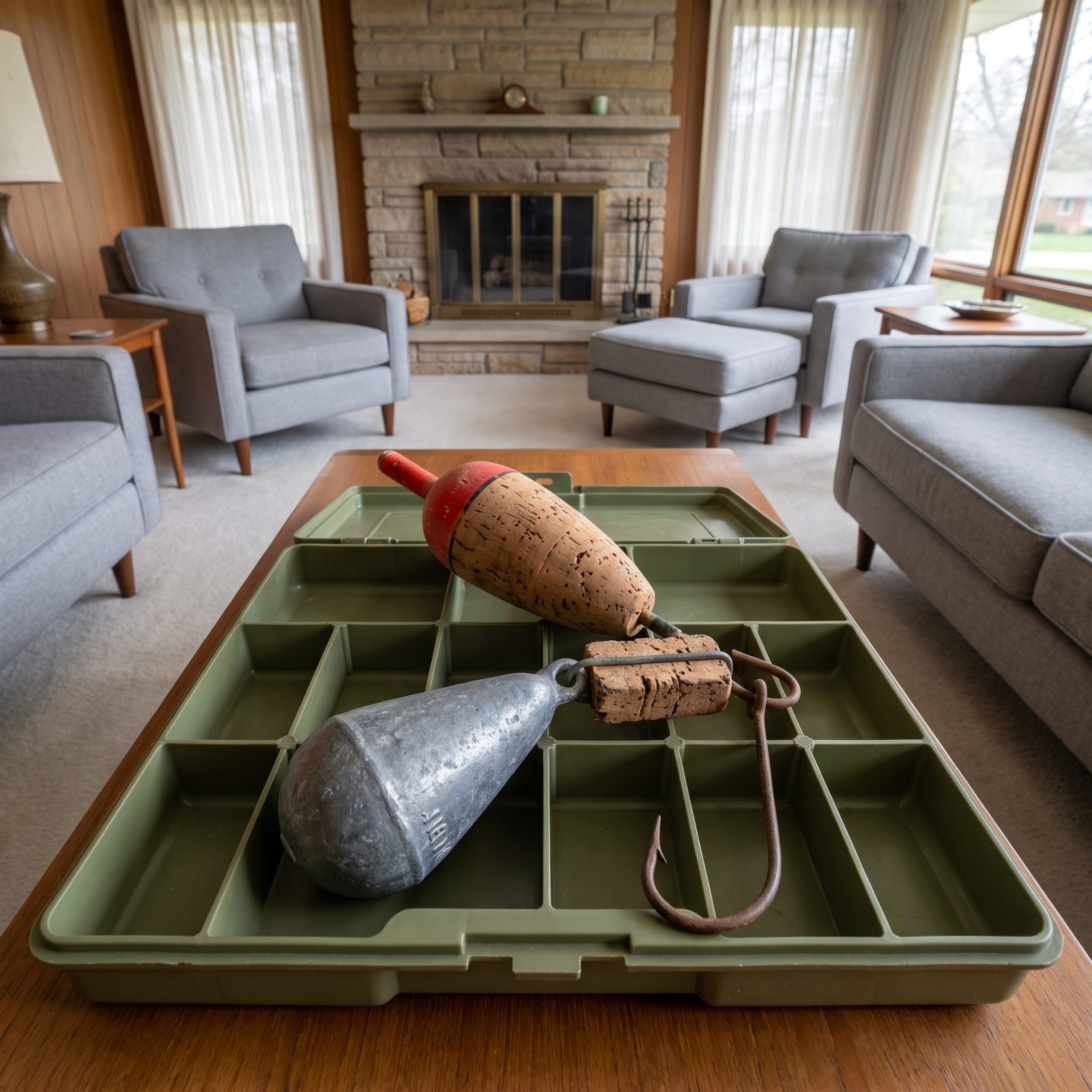
Big-bait anglers chasing heavy fish lived and died by this. A depth plummet was a hefty lead weight, nearly as big as the float itself, that you clipped onto your large baited hook, dropped it, and watched where the float settled. The moment the float lay flat or ducked under you knew the exact depth, so you could set your bobber to hang the bait right in the strike zone.
Sonar killed it for boat anglers. But for someone fishing a bank with a cane pole, a plummet still tells you more about one spot than a flasher ever does. Simple, cheap, genuinely useful. It deserved better than to vanish.
32. A Glass Jar of Uncle Josh Pork-Rind Trailers
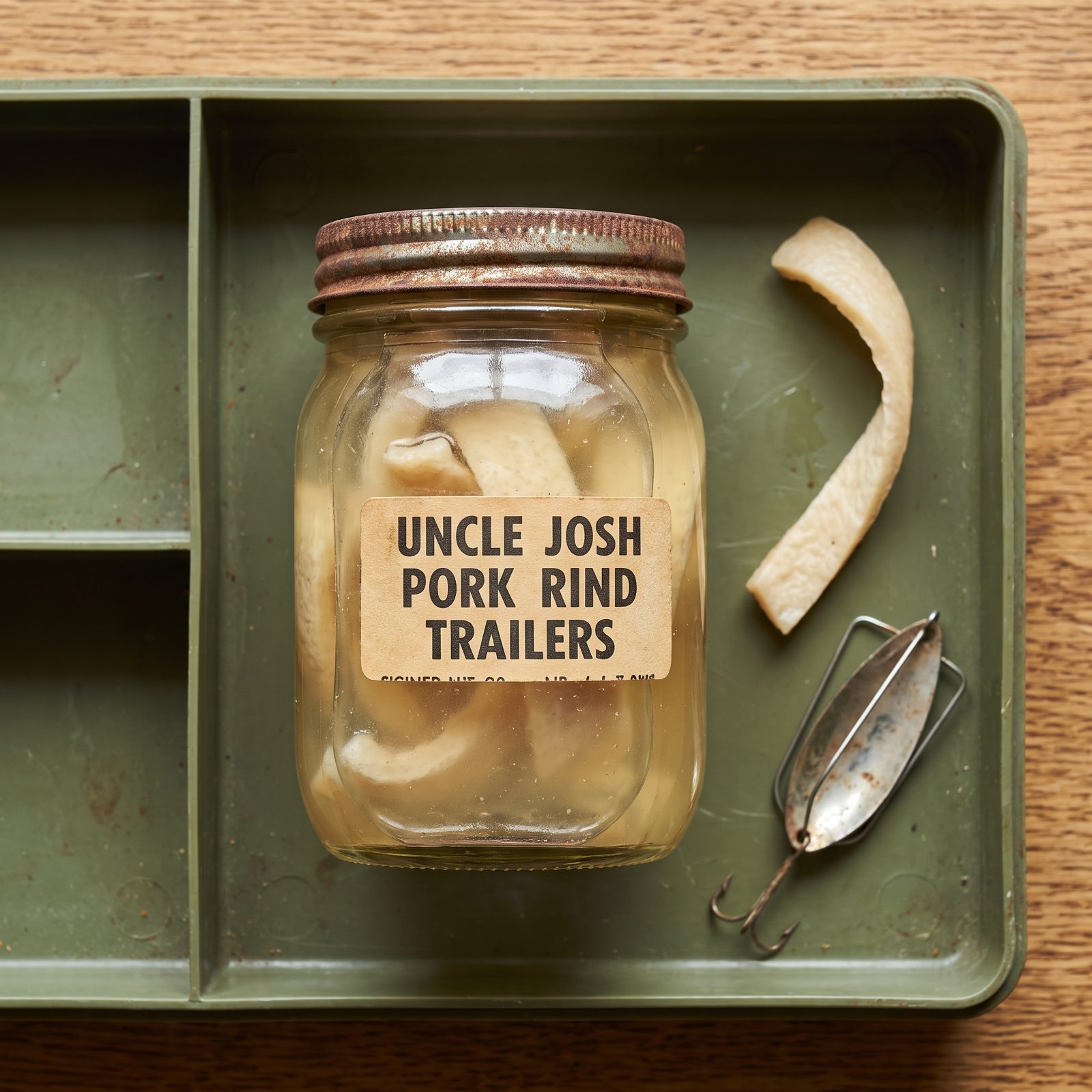
This is the one brand genuinely worth naming, because Uncle Josh pork rind WAS the category for about a century. Real pork skin, die-cut into frogs, strips and eels, packed in brine in a pint-size mason jar. You threaded it onto a spoon or jig and it gave the bait a soft, wiggling tail that soft plastics couldn’t match for feel.
The jar smelled like regret if the lid dried out. And it did dry out, constantly. Leave a trailer on your hook overnight and it turned into a shriveled chip. Synthetic trailers won because they never die in the sun. But plenty of old hands still insist nothing works a frog over lily pads like real rind.
31. A Clear Casting Bubble for Throwing Flies on a Spinning Rod
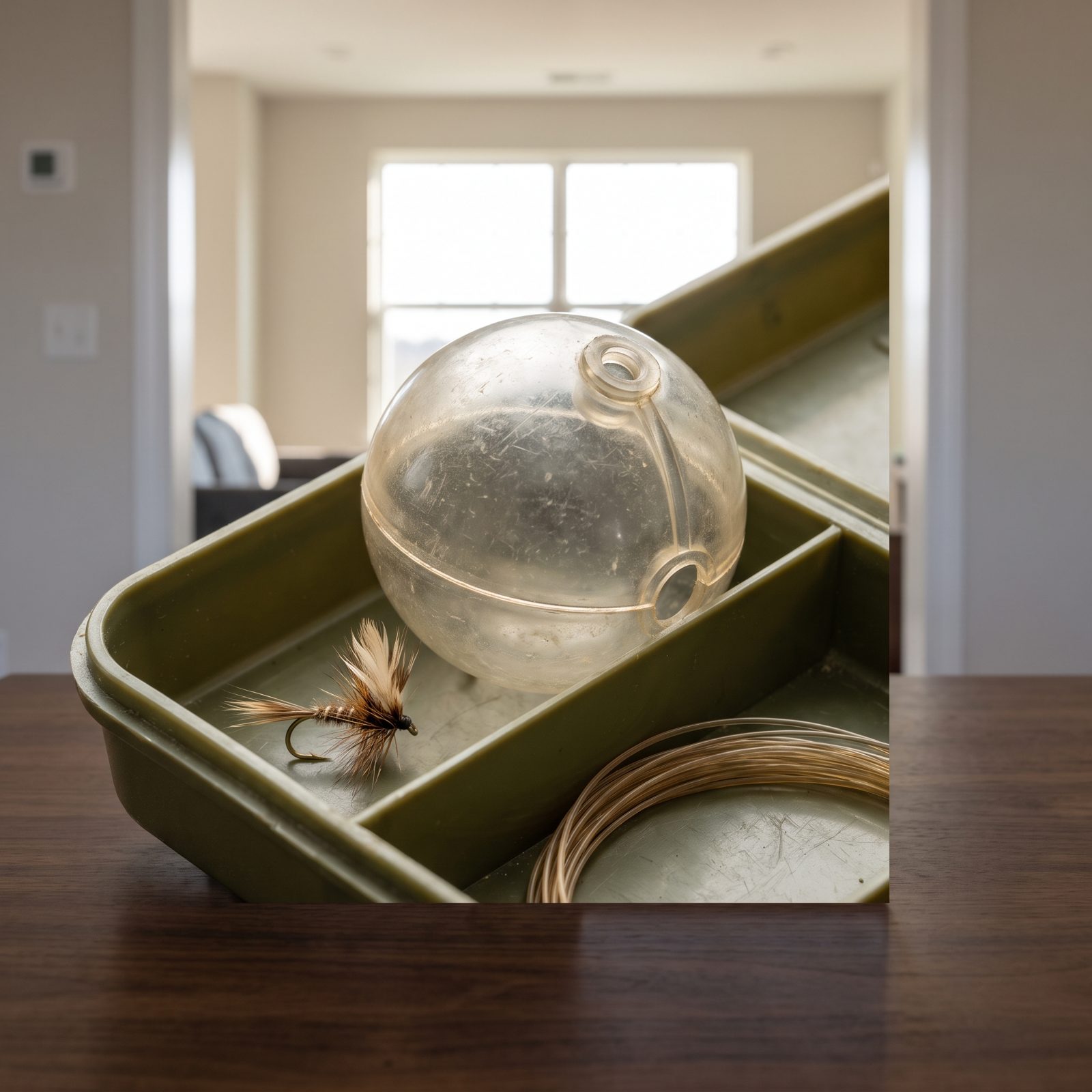
Not everyone owned a fly rod, but everyone wanted to fish a dry fly when trout were sipping off the top. The casting bubble solved it. A clear hollow ball you filled partway with water for casting weight, then trailed a fly or tiny bait a few feet behind it on a spinning outfit.
Fill it about a third and it rides half-submerged, nearly invisible to the fish. Fill it too full and it splashes down like a rock and spooks everything in the pool. That single adjustment separated the people who caught trout with one from the people who just scared them off.
30. Reusable Pinch-On Rubber-Core Sinkers
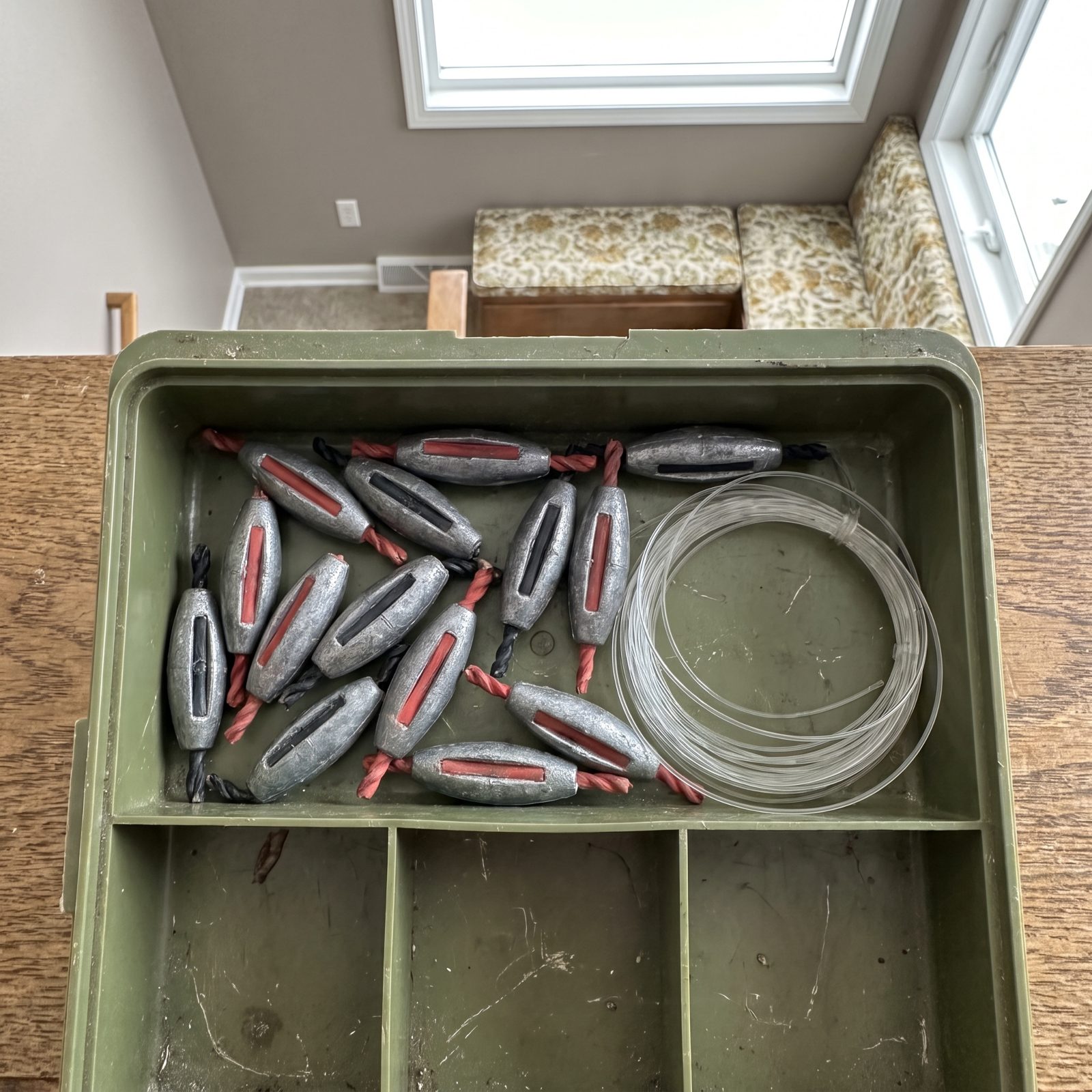
Smart design, still around but far less common. A torpedo of lead with a rubber core running through it. You threaded your line through the rubber core, gave each end of the rubber a half twist in opposite directions, and it locked on without you crimping lead onto the line or re-tying anything.
The beauty was you could slide it up and down the line or pull it off entirely without nicking the mono. Pinch-on split shot, the other option, mashed the line flat and weakened it right at the weight. The rubber core was gentler. It just cost a bit more, which is why most people cheaped out on plain split shot anyway.
29. Spare Hooks Pushed Point-First Into a Bottle Cork
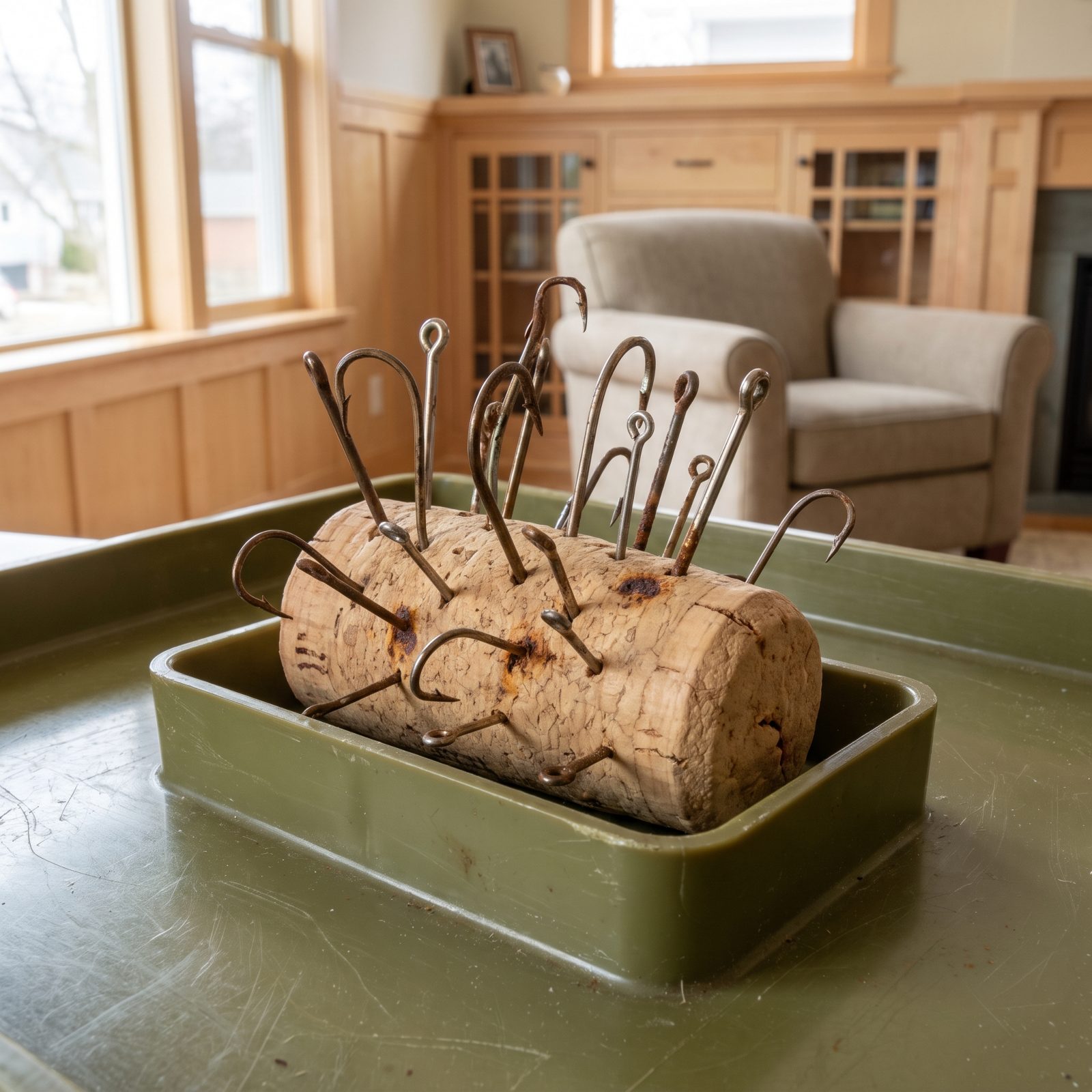
Not a product you bought. A fix every angler figured out on his own. Loose hooks in a tray are a menace: they tangle, they rust against each other, and they find your thumb in the dark. So you stuck them into a wine cork or a chunk of foam, point first, and the whole mess stayed organized while the points stayed sharp.
It’s the kind of small, homemade solution that tells you a box belonged to someone who actually fished. Store-bought hook boxes existed. The cork was better, cost nothing, and kept every hook in plain sight.
28. Cardboard Packets of Ready-Snelled Hooks
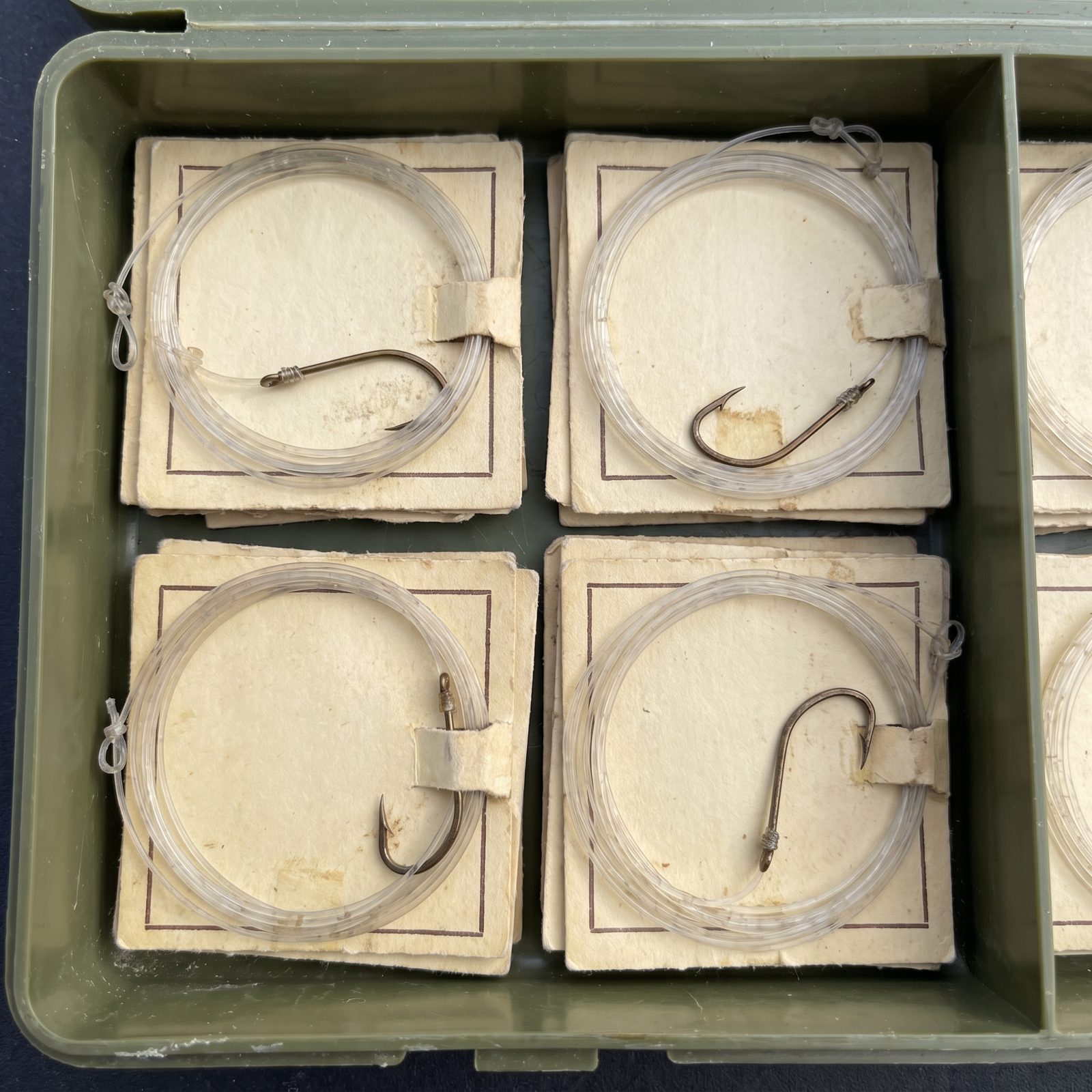
For anyone who wanted everything in one place, these were a gift. A coil of leader line wound neatly around a cardboard card, with the hook already snelled on, thread-wrapped at the eye, and a loop tied at the other end. You looped it onto your line and you were fishing, no knots and no extra trip to the tackle shop required.
The catch, and there was always a catch, was that those coiled leaders were often cheap mono and the hooks weren’t always great. A good fish could snap the line or straighten a soft hook. Convenient for bank-fishing with kids and bait. Less so when something serious ate your worm.
27. The Long Metal Hook Disgorger That Saved Your Fingers
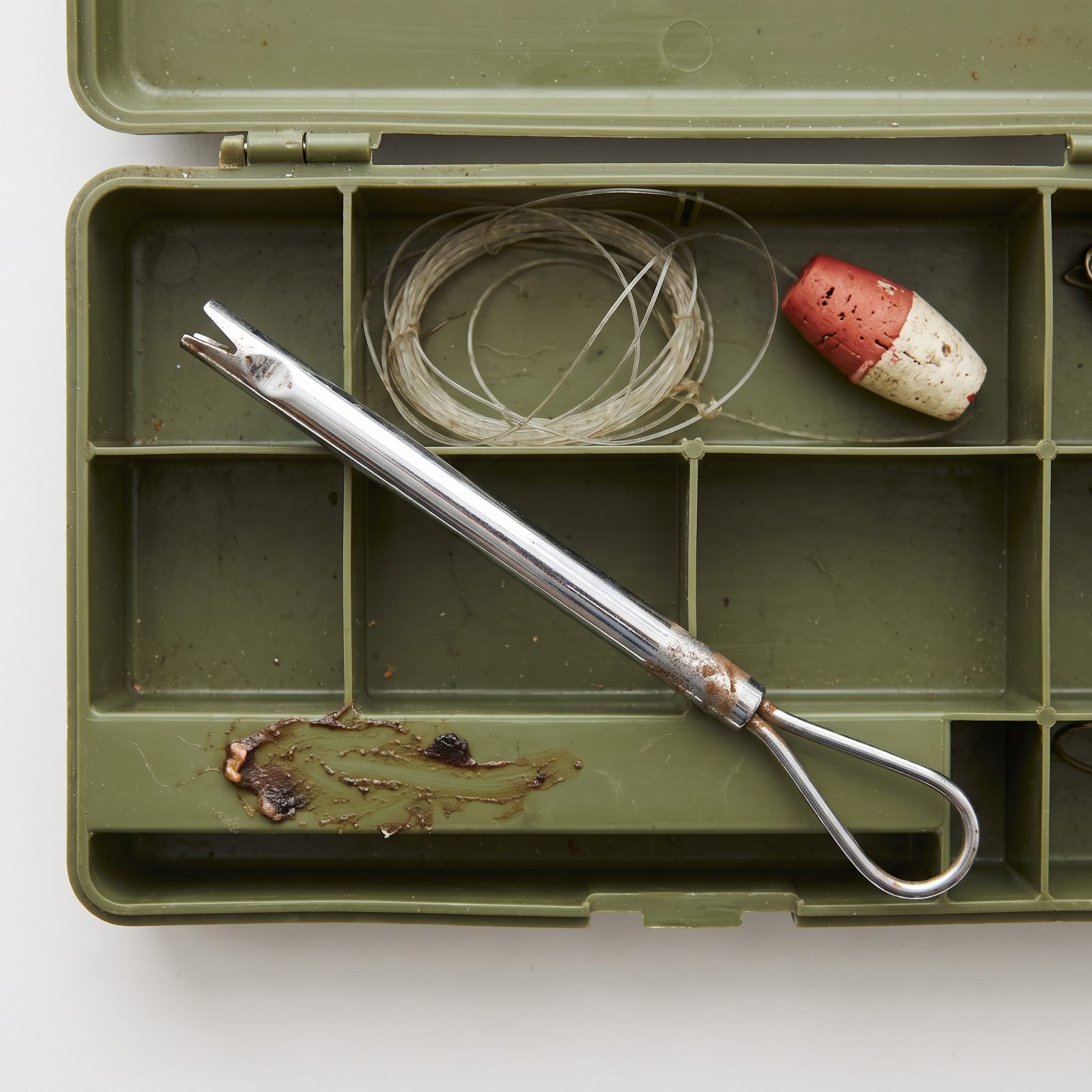
Before anyone owned needle-nose pliers that didn’t rust shut, this was the tool. You slid the long notched shaft down the line, pushed against the hook bend, and popped it free from a fish that had swallowed deep. Crappie and perch were the usual customers.
Most folks used it wrong, if we’re being honest. You weren’t supposed to yank — you were supposed to let the slot do the work and back the barb out the way it went in. Done right, it kept your thumbs clear of a thrashing panfish and the fish alive enough to release.
26. The Tiny Tube of Reel Oil Nobody Replaced Often Enough
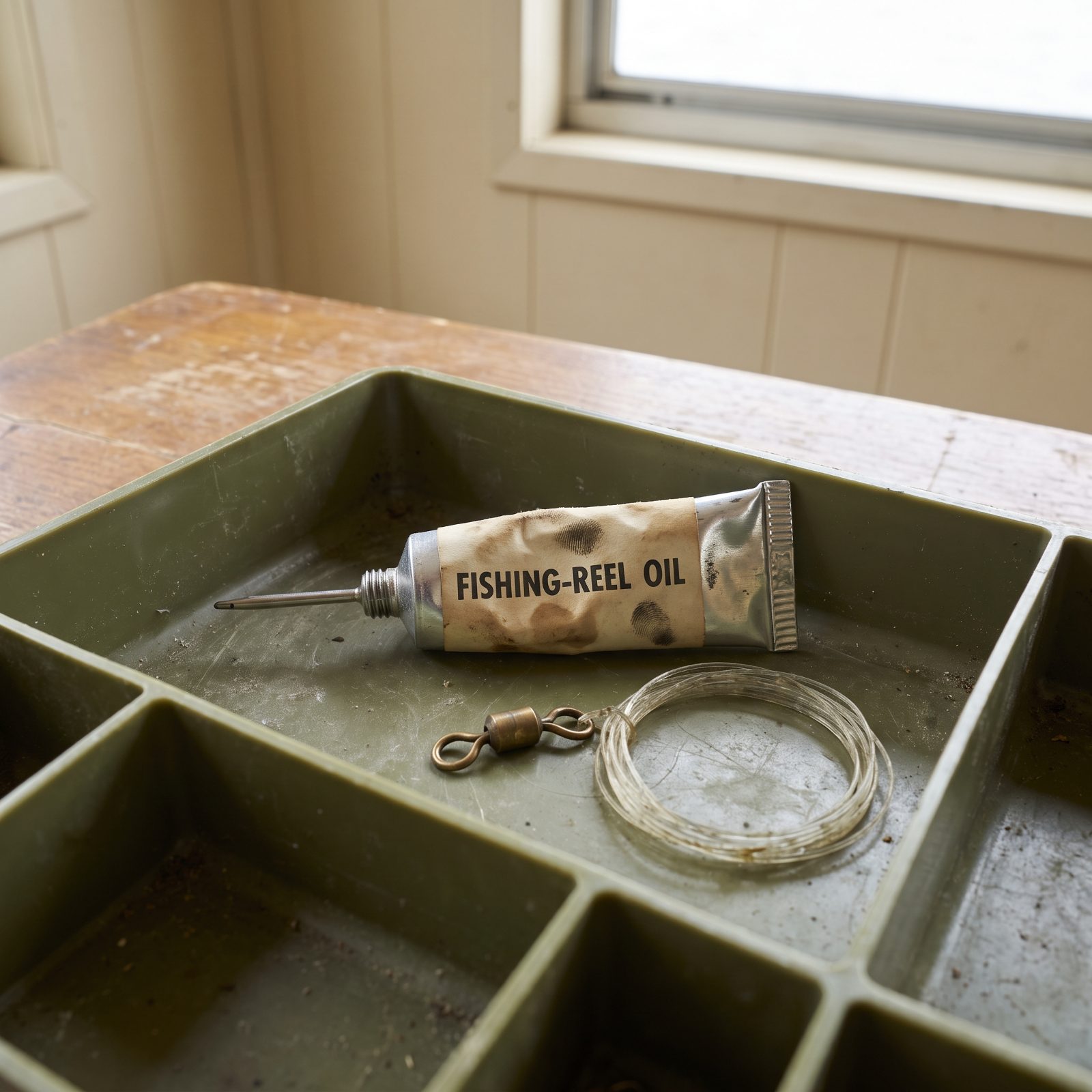
Smaller than a lipstick, and somehow it outlasted three reels.
One drop on the spool shaft, one on the handle bearing, and a baitcaster that screeched like a screen door went quiet for a whole season. The problem was always the same — people over-oiled. A fat bead grabs dust and sand, and now you’ve made grinding paste for the inside of your reel.
25. The Pocket Carborundum Hone That Made Dull Hooks Bite Again
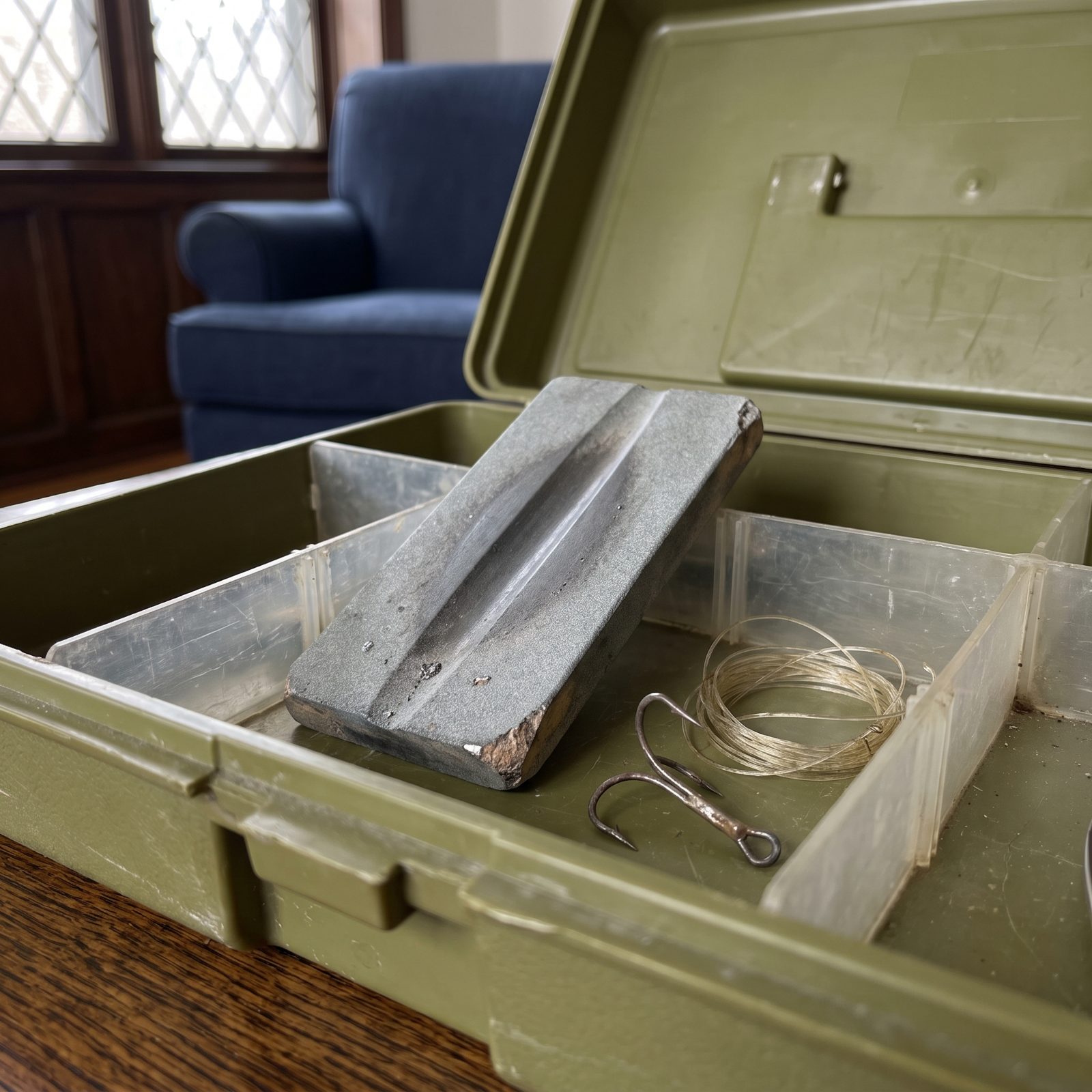
Drag a thumbnail across a hook point. If it skates instead of catching, that hook is dull — and a dull hook loses fish you never even felt.
This flat gray stone fixed that in seconds. A few strokes toward the point, both sides, and the groove worn down the middle of the stone told you how many hooks it had rescued over the years.
24. The Round Split-Shot Dispenser With Rotating Compartments
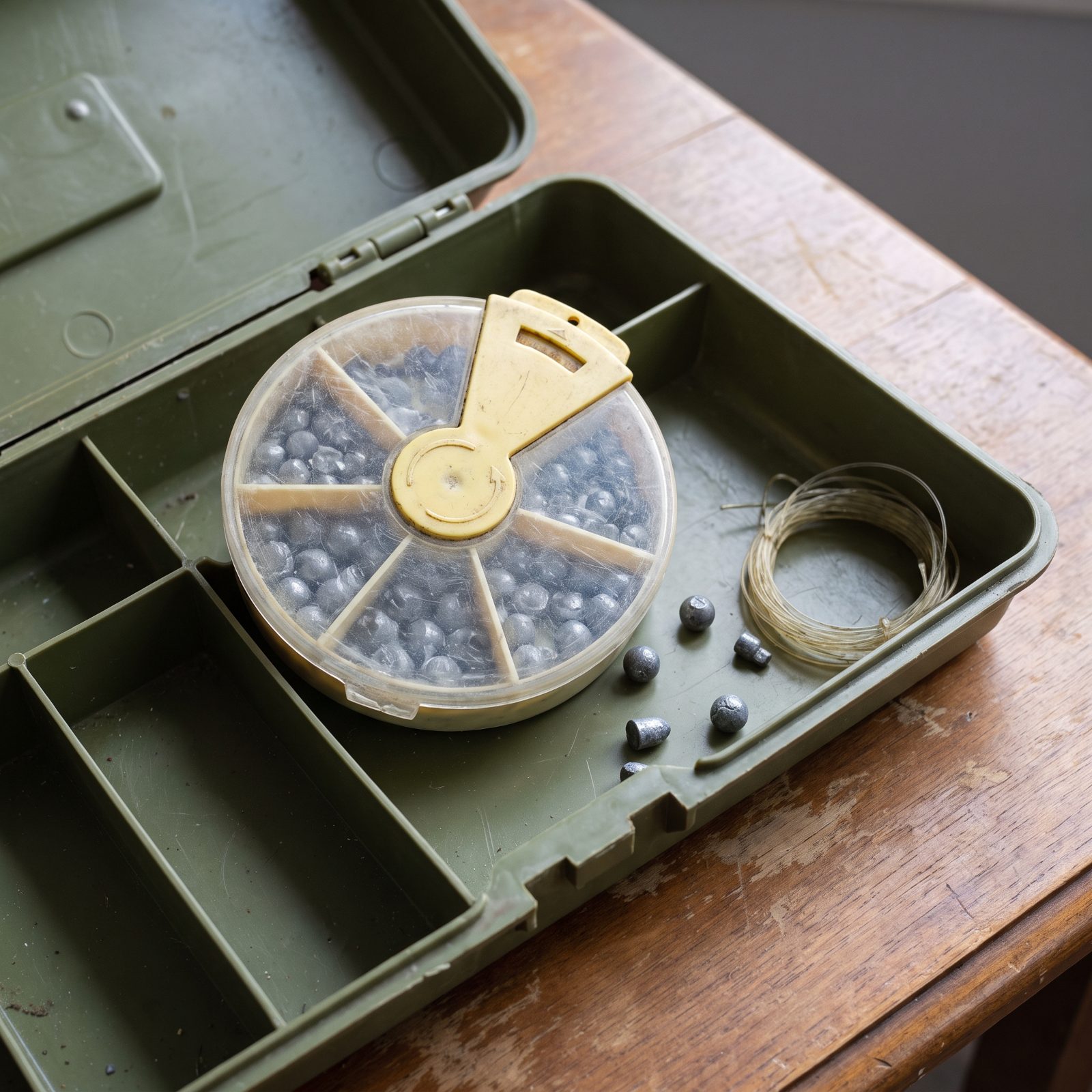
You know the sound. That little plastic wheel clicking as you rotated it to the next size, lead shot rattling in their wedge-shaped bins.
Tiny ones for a wary trout, fat ones to hold bottom in current — the whole range lived in a container the size of a drink coaster. The rotating lid meant you could grab one without spilling the other five sizes across the floorboards.
Pure lead, of course. That changed later, but in 1975 nobody thought twice about pinching a soft gray split shot shut with their back teeth. A habit worth leaving in the past, that one.
23. Pre-Rigged Wire Leaders for Pike and Pickerel With Teeth
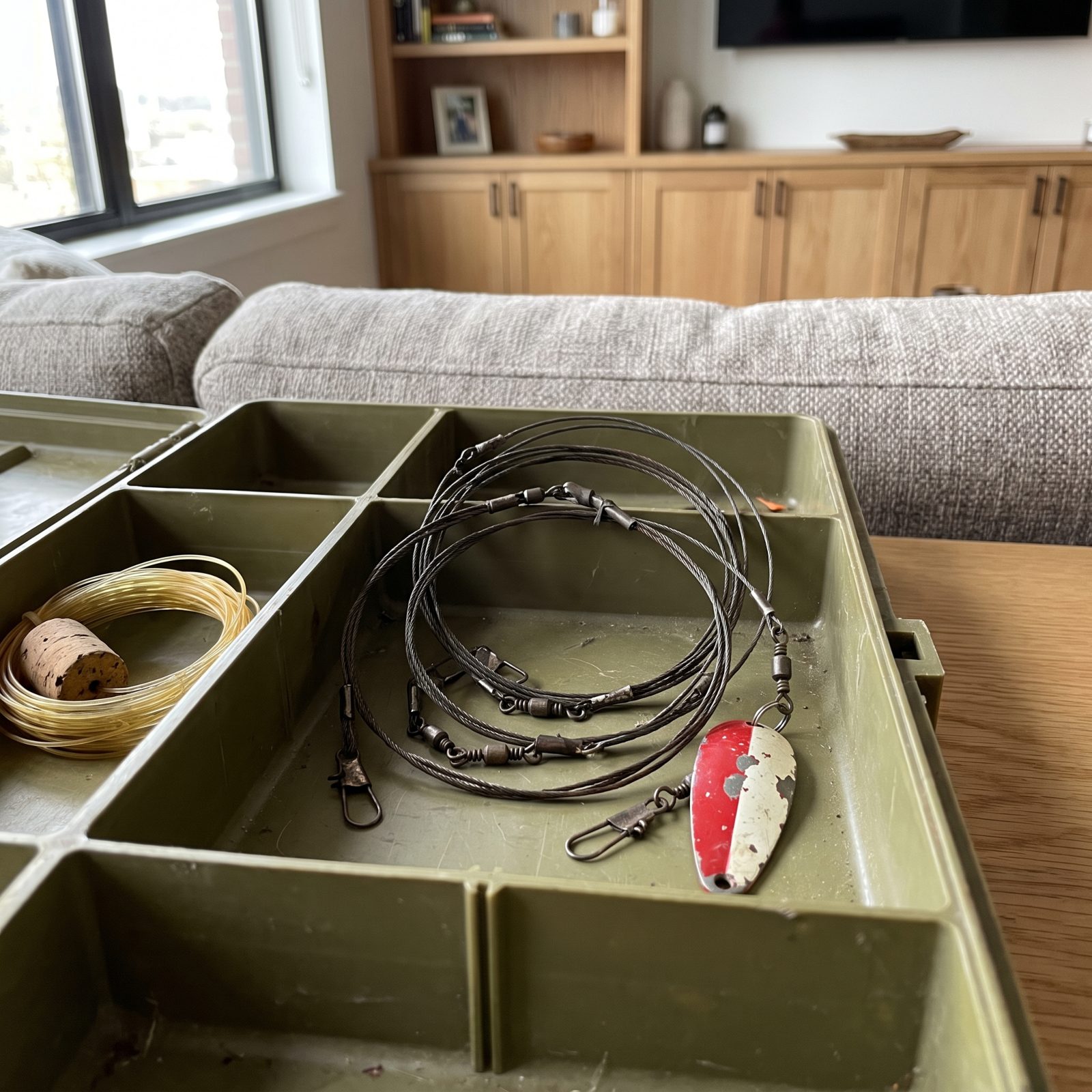
A northern pike’s teeth will shear through monofilament like thread. That’s not an exaggeration — it’s the first lesson a pike teaches you, usually right as the fish is swimming off with your favorite spoon.
These long coils of heavy braided steel cable, wound several turns each with a swivel on one end and a snap on the other, sat between your line and your lure so that didn’t happen. Pickerel, muskie, big toothy fish in general.
The downside was real. Wire spooks a line-shy fish in clear water, and it kinks. One sharp kink and the leader’s done, which is why a stocked box carried several.
22. Replacement Treble Hooks Rattling in a Hinged Metal Tin
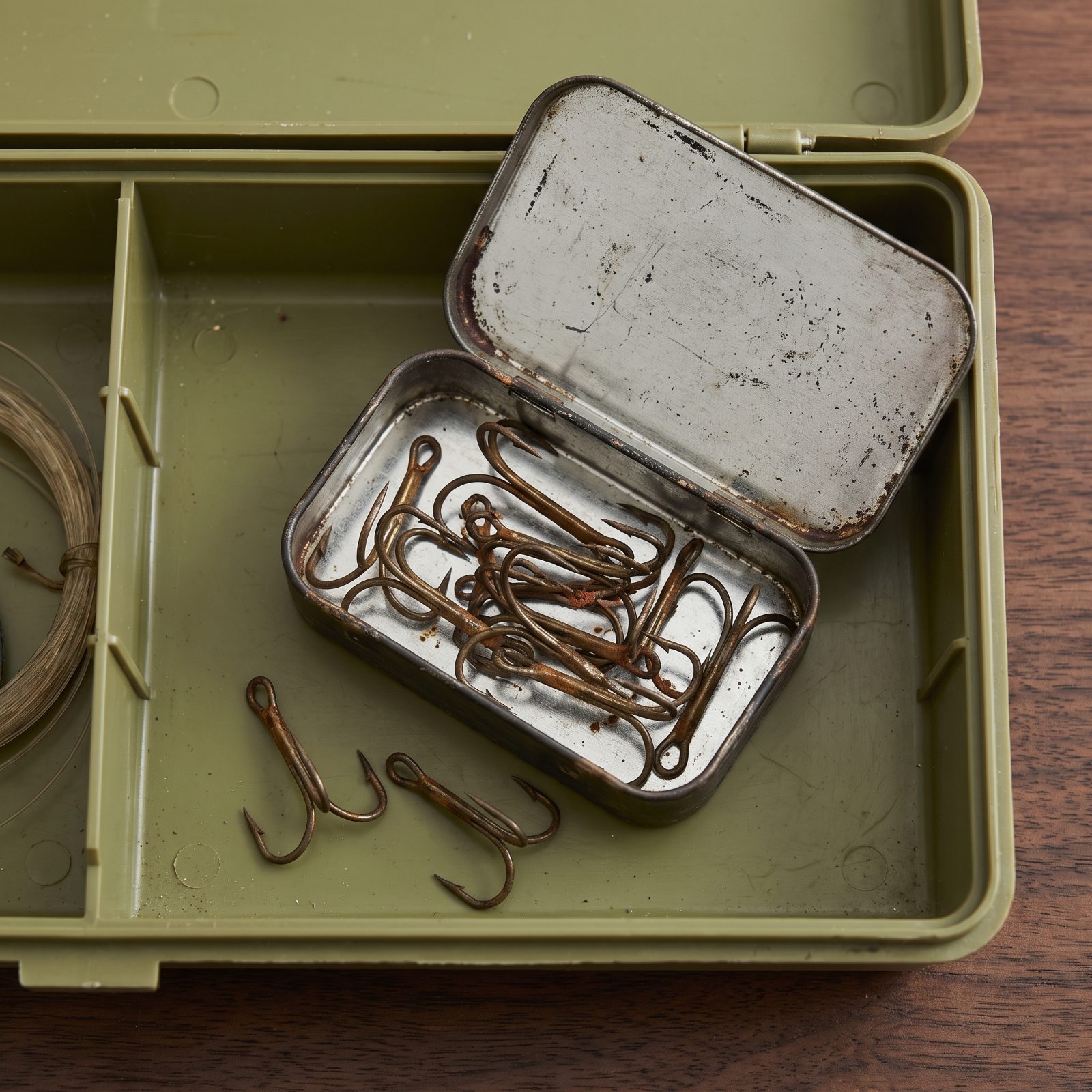
That little metal tin had a sound all its own when you shook it. Bronze trebles sliding over each other, a dozen sharp points looking for a thumb.
Why carry loose trebles? Because the hooks on a wooden plug rusted or bent long before the lure itself wore out. Swap on a fresh treble and a beat-up old bass plug fished like new.
21. The Red-and-White Spring-Clip Bobber Everyone Learned On
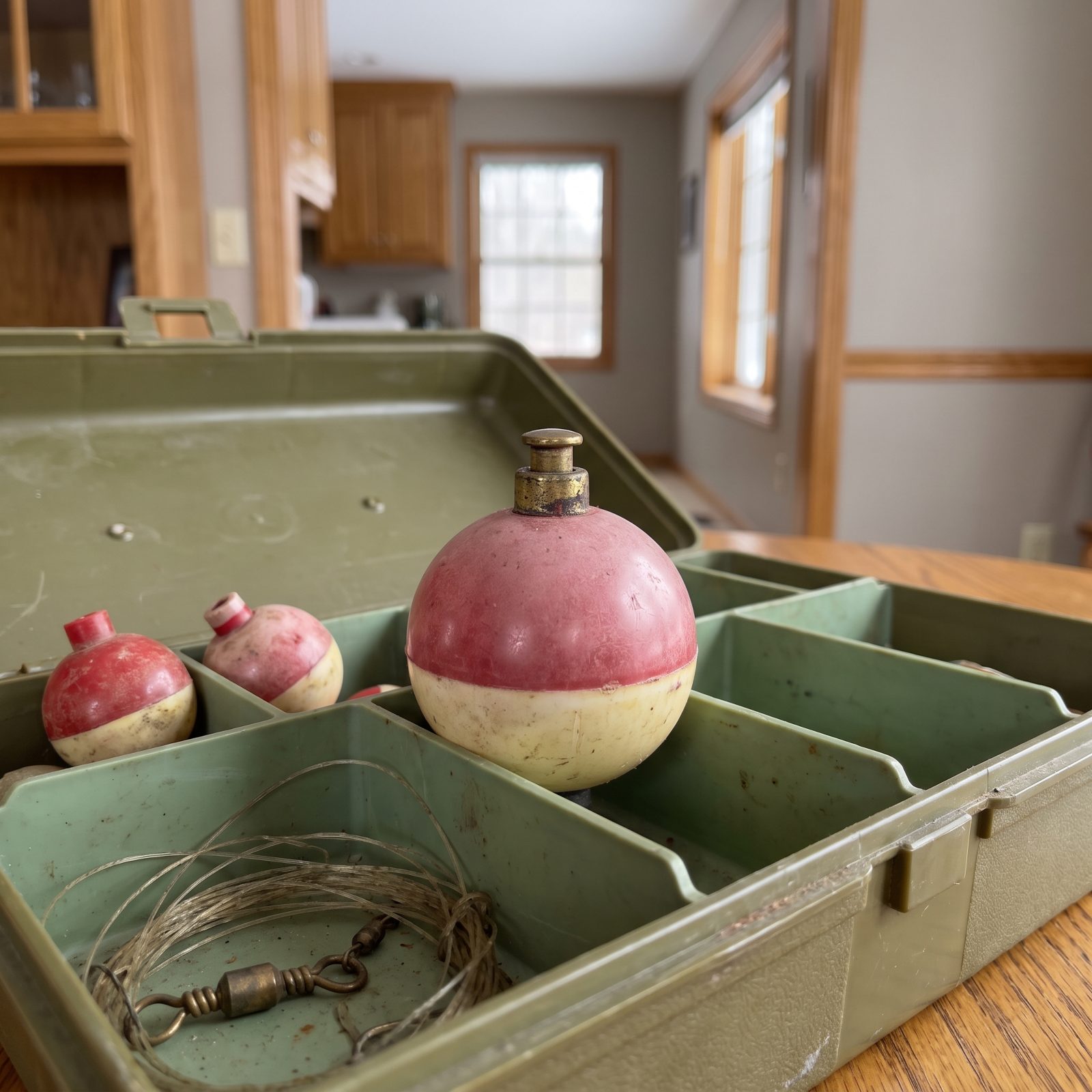
If you fished as a kid, this is the thing you picture first.
Press the brass button on top, a little hook pops out the bottom, you slip your line under it and let the spring snap it shut. The red half rode above water, the white half below, and when that red dot plunged under, your heart did too.
Grown anglers keep making the same mistake, though — fishing a bobber the size of a golf ball for bluegill. A fish has to pull that whole float under before it feels the bite, and a cautious panfish won’t. Smaller is almost always better.
20. A Pocket Spool of Clear Nylon Monofilament for Field Repairs
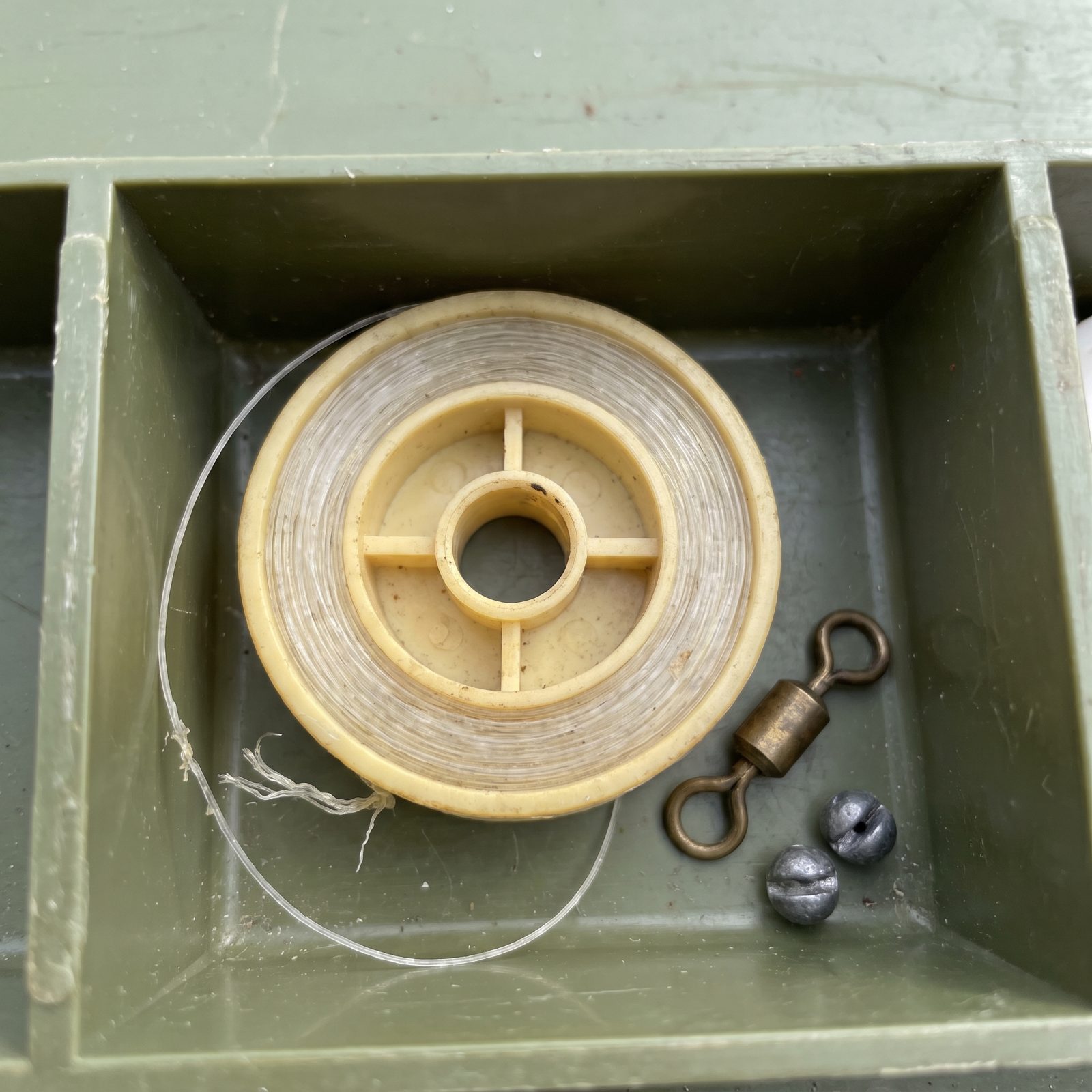
A palm-sized spool, filling most of its compartment in the box, there for the moment your main line frayed or you needed a quick leader.
Nylon mono was the line everyone trusted then, and for good reason. It stretched, which forgave a hard hookset, and it was cheap enough to cut away and retie without a second thought.
One catch worth knowing: old mono goes bad. Sunlight and heat turn it brittle, and a brittle pocket spool that’s lived in a hot garage for a season will snap on a decent fish. The stuff was cheap for a reason. Replace it.
19. Brass Barrel Swivels With Safety Snaps for Fast Lure Changes
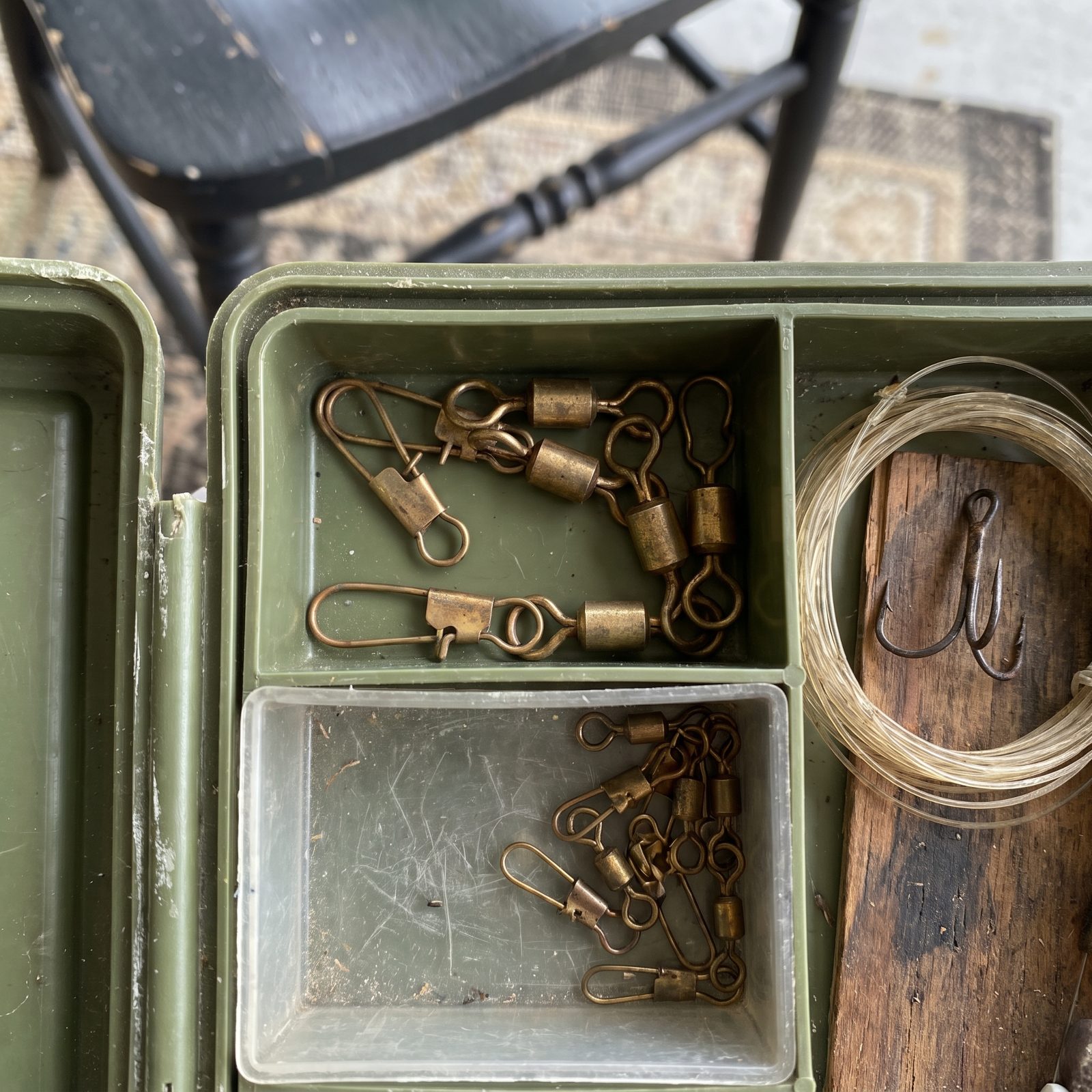
The little workhorse. A brass barrel that spins to kill line twist, with a snap on the end so you could change lures without retying every time.
Spinners and spoons were the guilty parties. Fish one for an hour and your line winds up corkscrewed, and a twisted line tangles on every cast. The swivel let the lure spin while the line stayed straight.
18. Sliding Egg Sinkers for Bottom Fishing
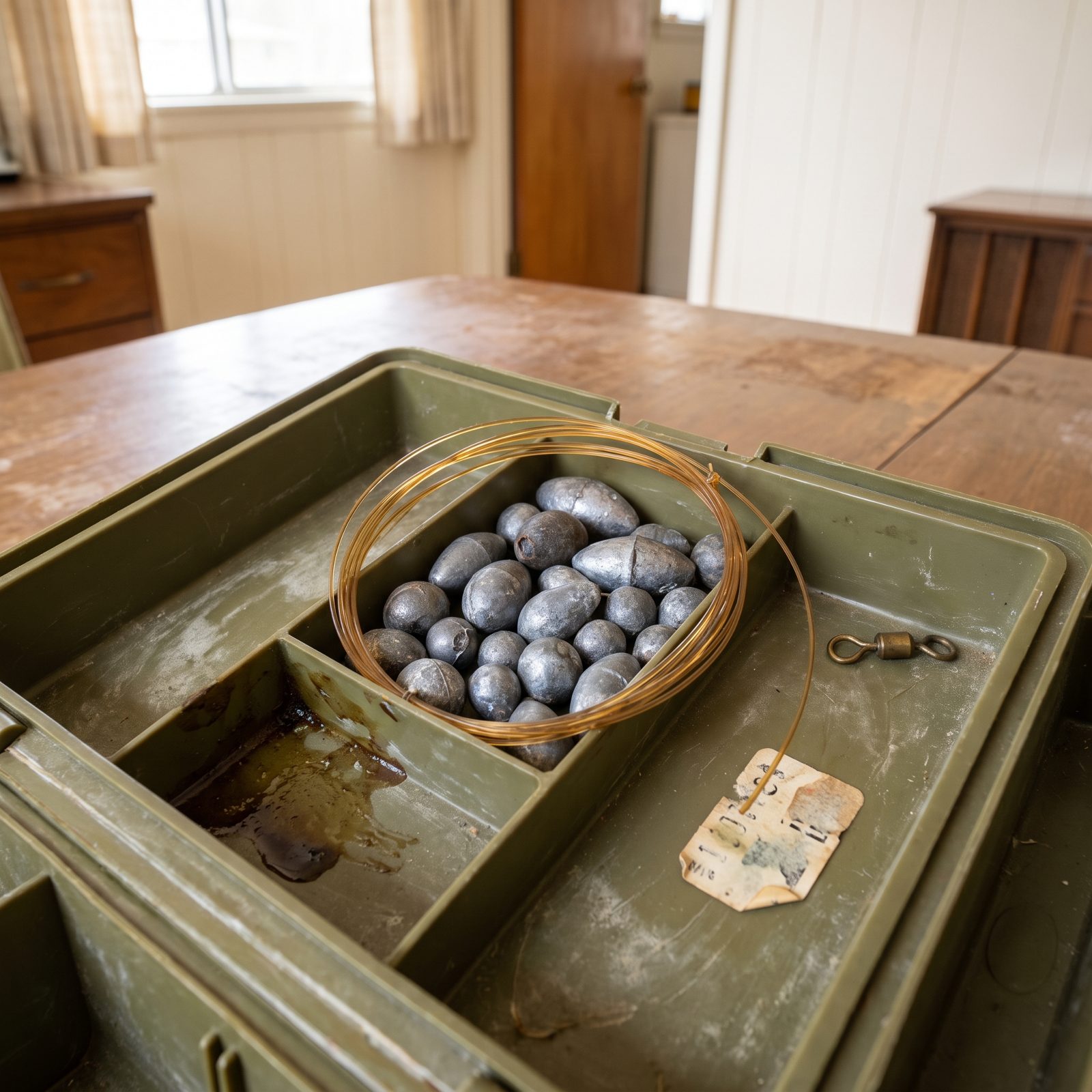
The humble egg sinker never got a nickname, and that tells you something. It just worked. Line threads straight through the hole in the center, so a fish picking up your bait on the bottom feels weight for only a second before the line slides free. Catfish, carp, bottom-feeding bass — all of them hate resistance, and most would drop a bait the second they felt it.
A box in 1975 held a handful in graduated sizes, because the right one depends on current and depth, not preference. Too heavy and you lose feel. Too light and your bait washes downstream before it ever settles.
17. Fine-Wire Aberdeen Hooks for Minnows and Panfish
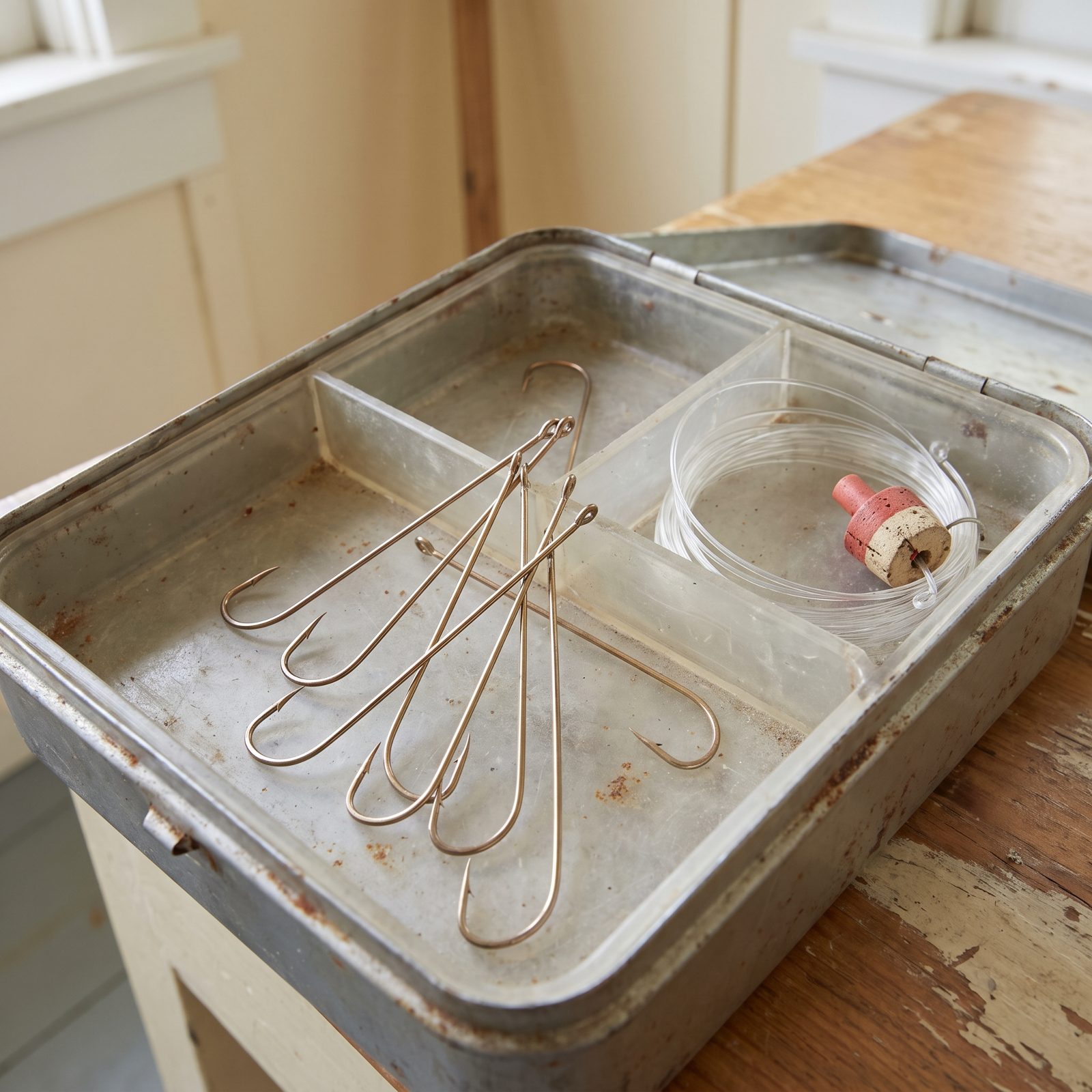
Thin wire does one job better than anything thicker: it keeps a live minnow alive. The light gauge slides through a minnow’s back without tearing it up, so your bait keeps swimming and keeps drawing strikes. Panfishermen loved these because the fine point sinks home with almost no pressure.
There’s a trick to the softness, though. Hang up on a stump and a steady pull bends the Aberdeen open, and your rig comes back. You lose the hook’s shape but save the whole setup. Bend it back by hand and you’re fishing again.
16. Offset Worm Hooks for Soft-Plastic Rigging
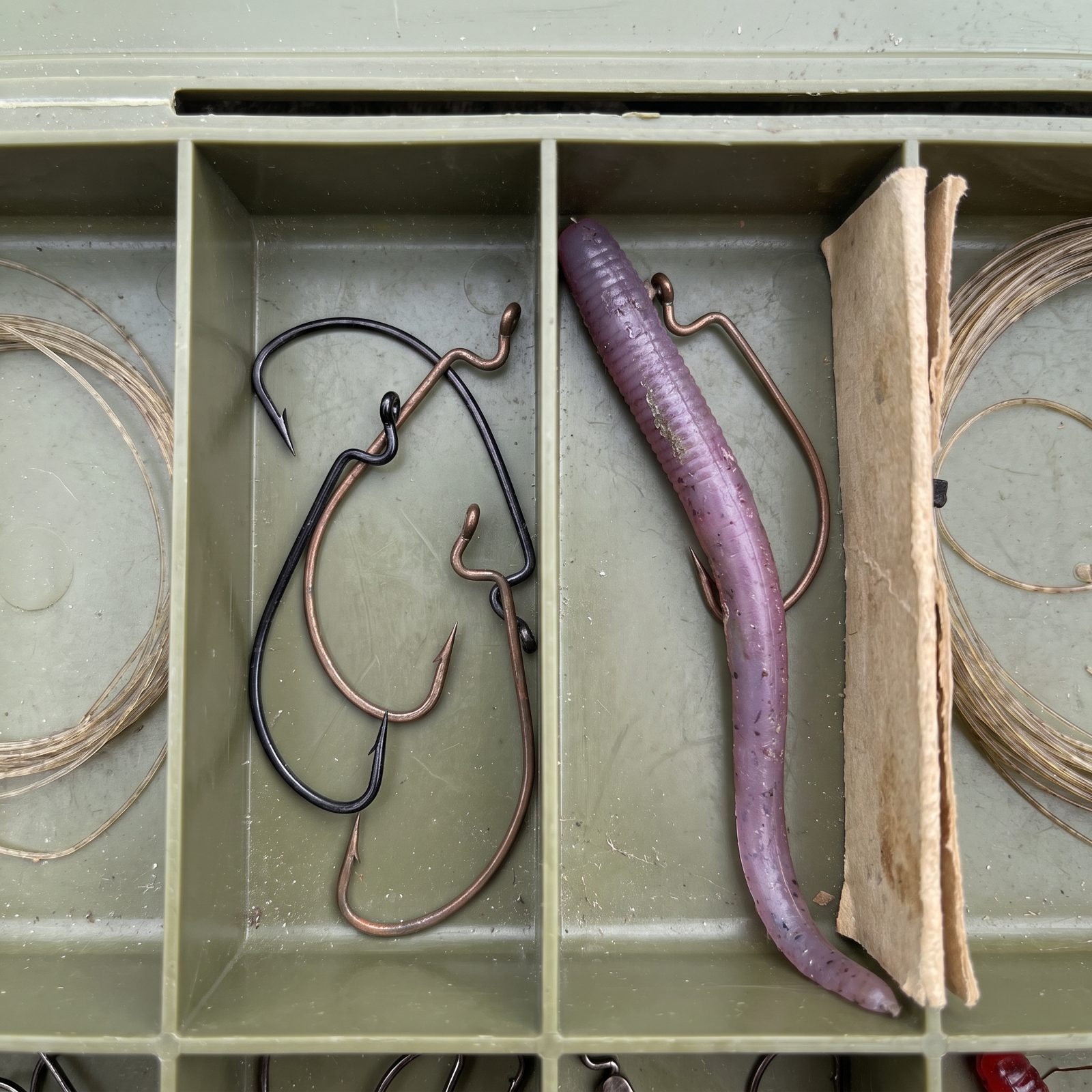
That little step-down bend behind the eye is the whole invention. It holds the head of a plastic worm in place so the body hangs straight, and it lets you bury the point back into the soft plastic. Weedless. Drag a rig through brush, lily pads, and laydowns that would snag a bare hook on the first cast, and it comes through clean.
By 1975 this was the backbone of plastic-worm fishing for largemouth. Rig it Texas-style with a slip sinker and you could put a worm places most anglers were too nervous to throw.
15. A Pack of Creme Scoundrel Plastic Worms
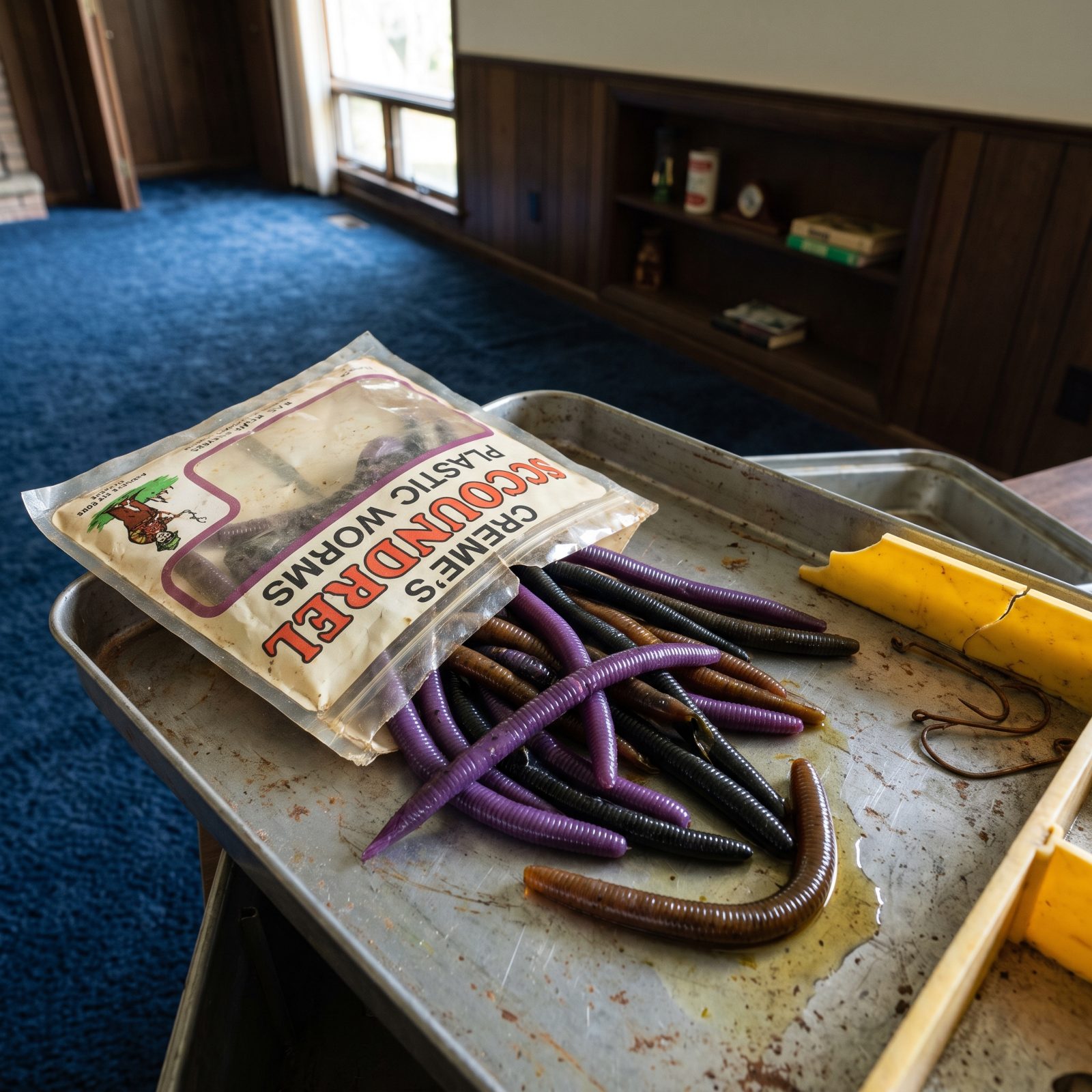
The soft plastic worm changed bass fishing, and Creme started it. By the mid-seventies the Scoundrel was a staple — a simple straight-tail worm that came in grape, black, and that greasy motor-oil brown everybody swore by. Nothing fancy. It didn’t need to be.
The magic was the fall. Rigged weightless or with a light slip sinker, the worm sinks slow and natural, and a bass eats it on the drop more often than not. Watch your line, not your rod tip. The strike shows up as a twitch or a sideways swim before you ever feel it in your hands.
14. Mister Twister Curly-Tail Grubs
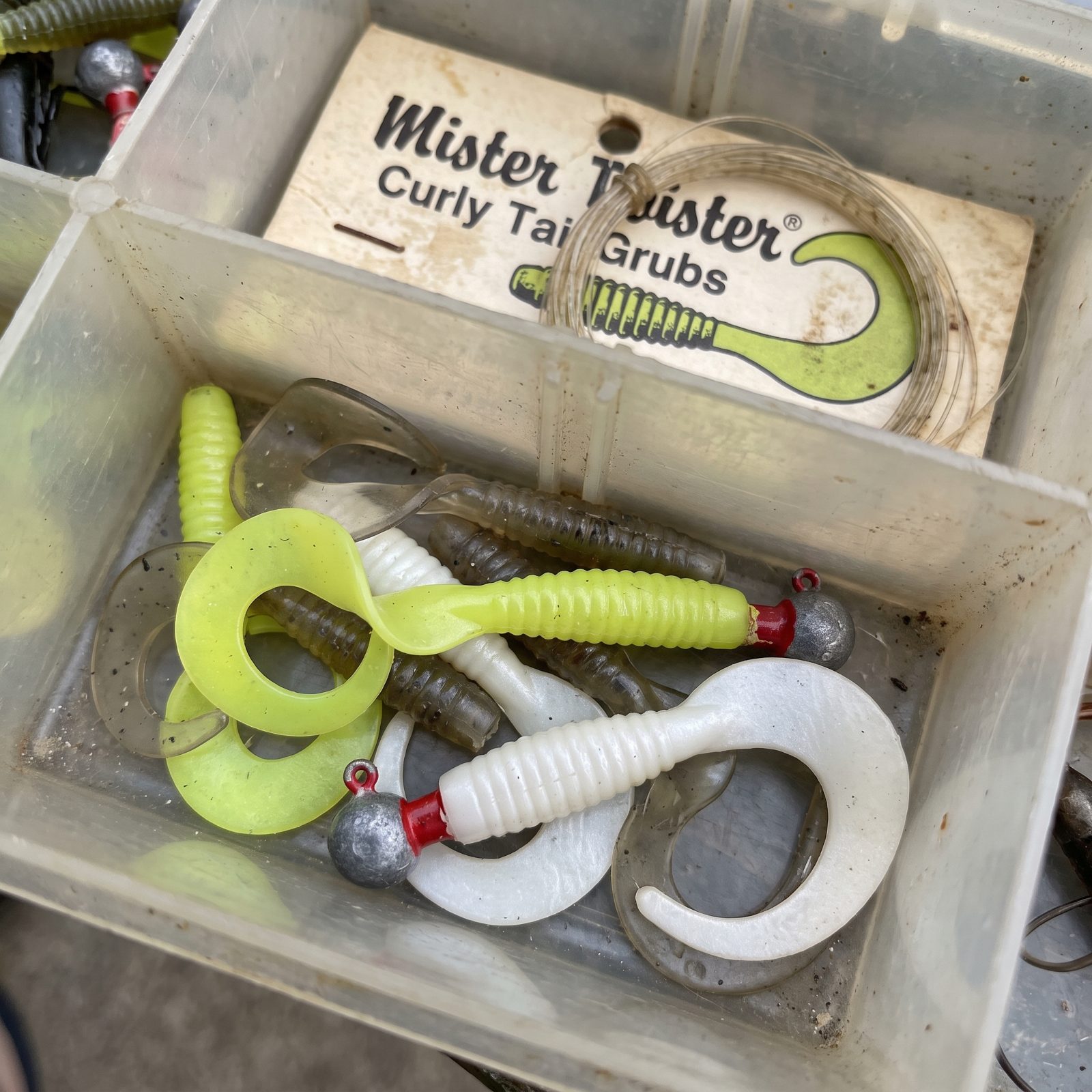
The curly tail was a genuine leap. That thin ribbon of plastic flutters on the drop and kicks on the retrieve at almost any speed, which means even a dead-slow crawl looks alive. Before it came along, a grub just sat there looking like a grub.
Pop one on a lead jighead and you had a lure that caught everything that swims — crappie, bass, walleye, white bass on a feeding run. Chartreuse for stained water, white for clear, smoke when nothing else worked.
13. A Johnson Beetle Spin
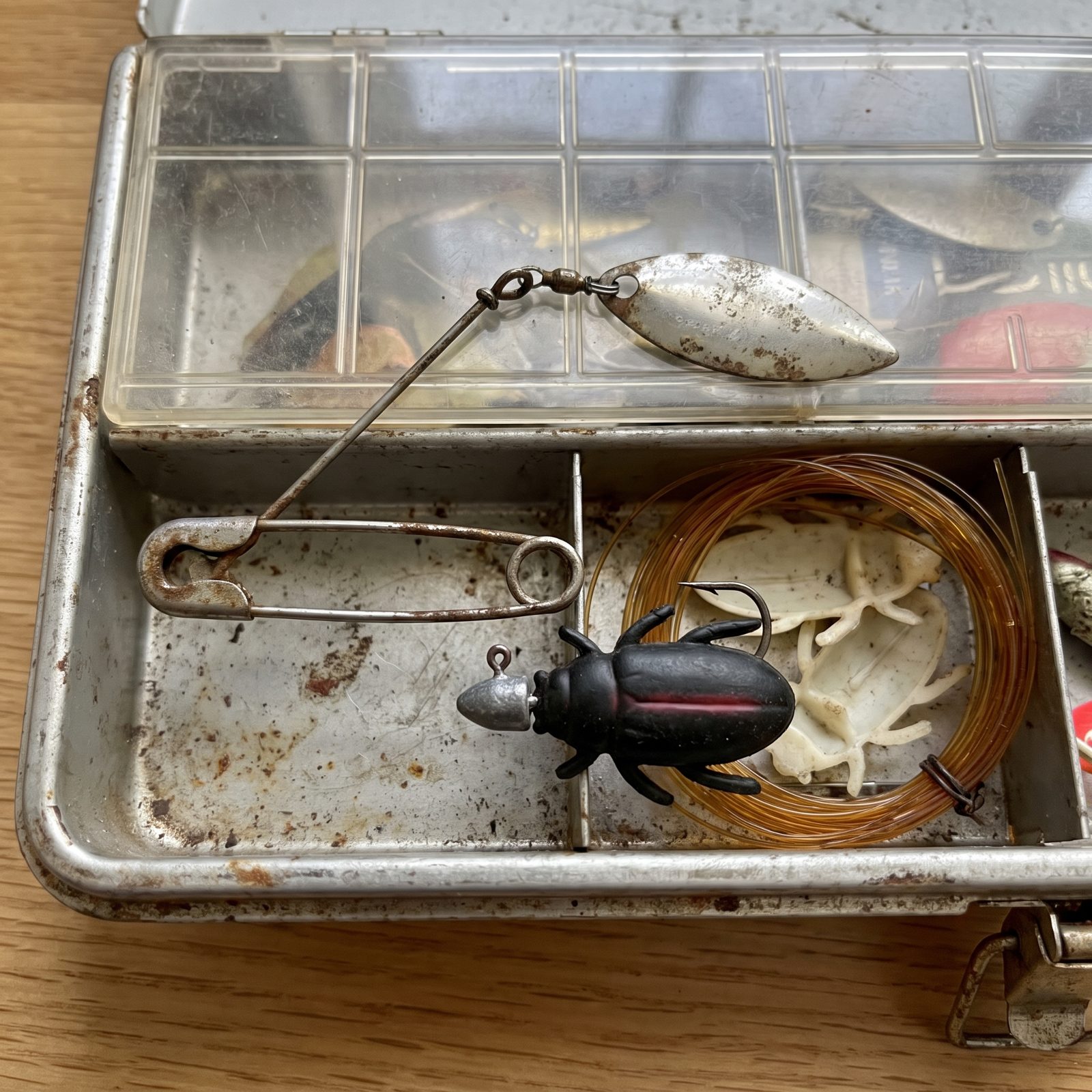
Give a new angler one lure and let it be this one. The Beetle Spin is almost impossible to fish wrong — a safety-pin spinner arm, a flashing blade, and a soft beetle body on a jighead. Cast it out and reel it in slow. The blade does the rest.
Panfish crush it. So do small bass. That black-with-a-red-stripe body was the one in every kid’s hand around the dock in 1975, and it still catches just as well today.
12. A Johnson Silver Minnow Weedless Spoon
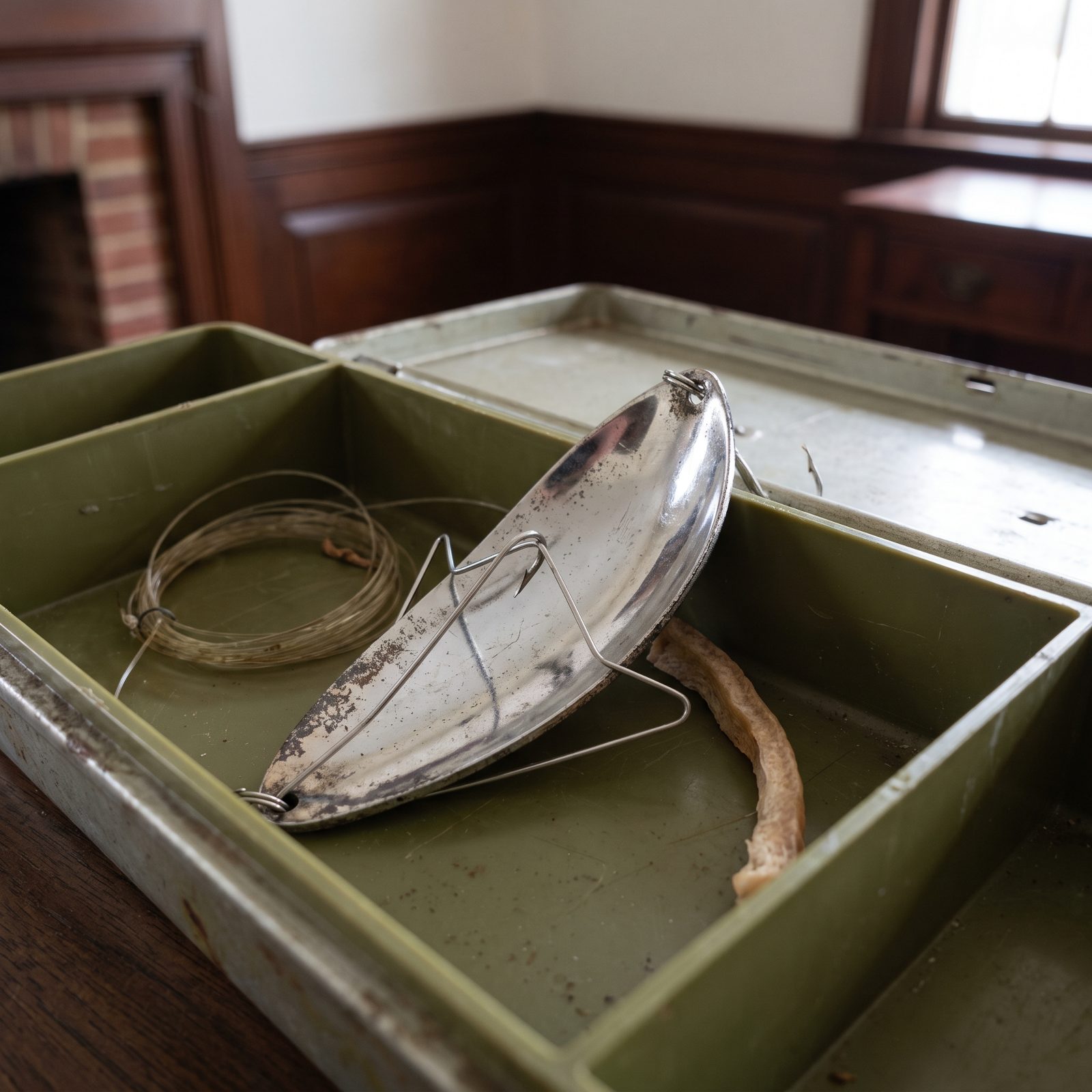
Pure flash, and a design so good nobody has improved it in a century. The Silver Minnow is a curved chrome spoon with a single hook tucked behind a wire weedguard, and that guard is what makes it special. Throw it into the thickest slop — pads matted so tight you can barely see water — and reel it right over the top without fouling.
A strip of pork rind on the hook adds wiggle and slows the fall. Pike and bass hiding in heavy cover come up through the salad to hit it.
11. A Rubber-Skirted Safety-Pin Spinnerbait
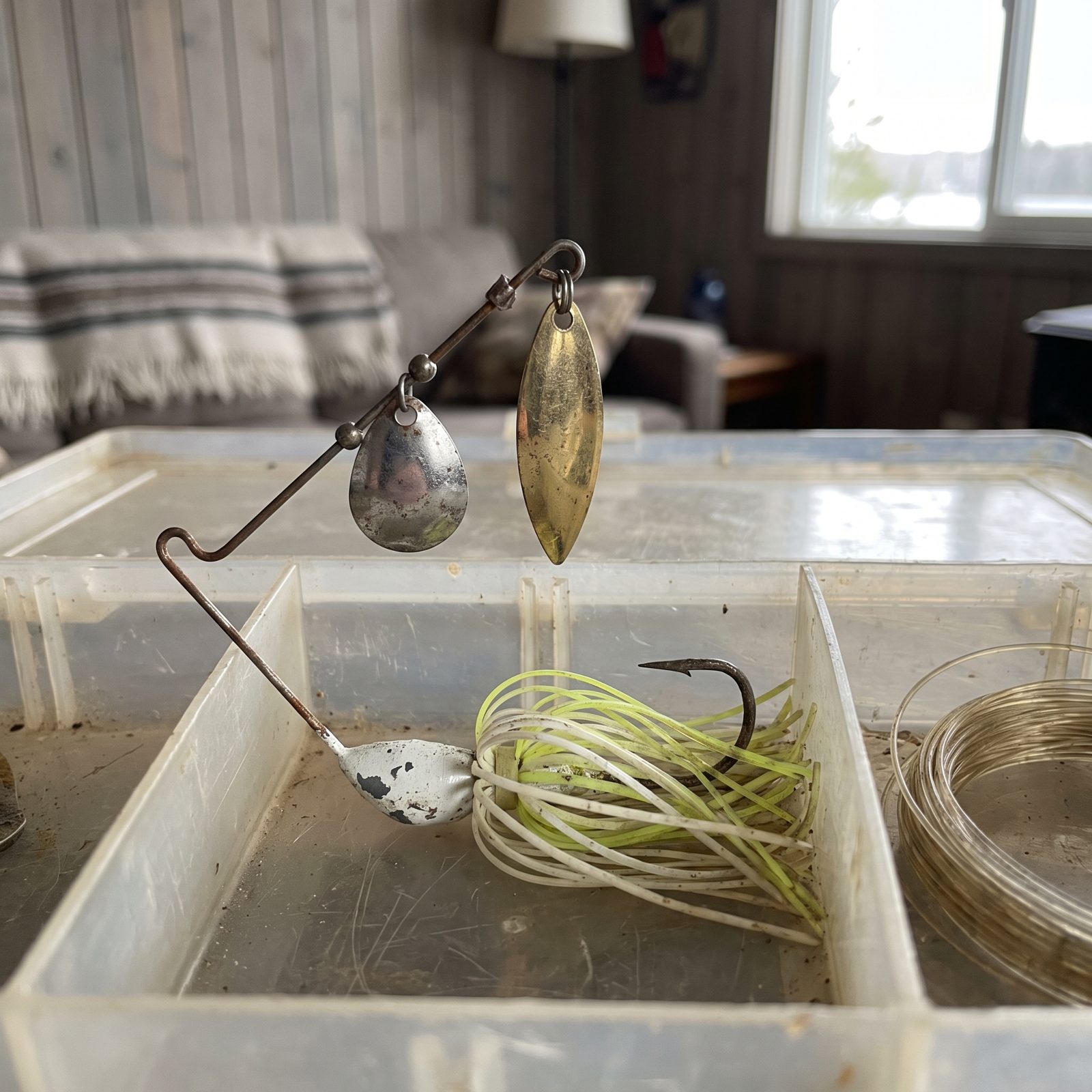
The spinnerbait looks like nothing in nature, and it catches bass better for it. Blade up top throwing flash and vibration, a lead head and hook down below hidden in a rubber skirt, all held on a bent-wire arm that bounces off cover instead of hanging on it. Run it fast, slow-roll it deep, or buzz it across the surface — it fishes however you want.
Rubber skirts came before the silicone kind, and they had a different pulse to them. The strands breathed and flared when you paused the retrieve, and that flare drew a lot of reaction strikes.
10. A Mepps Aglia Inline Spinner
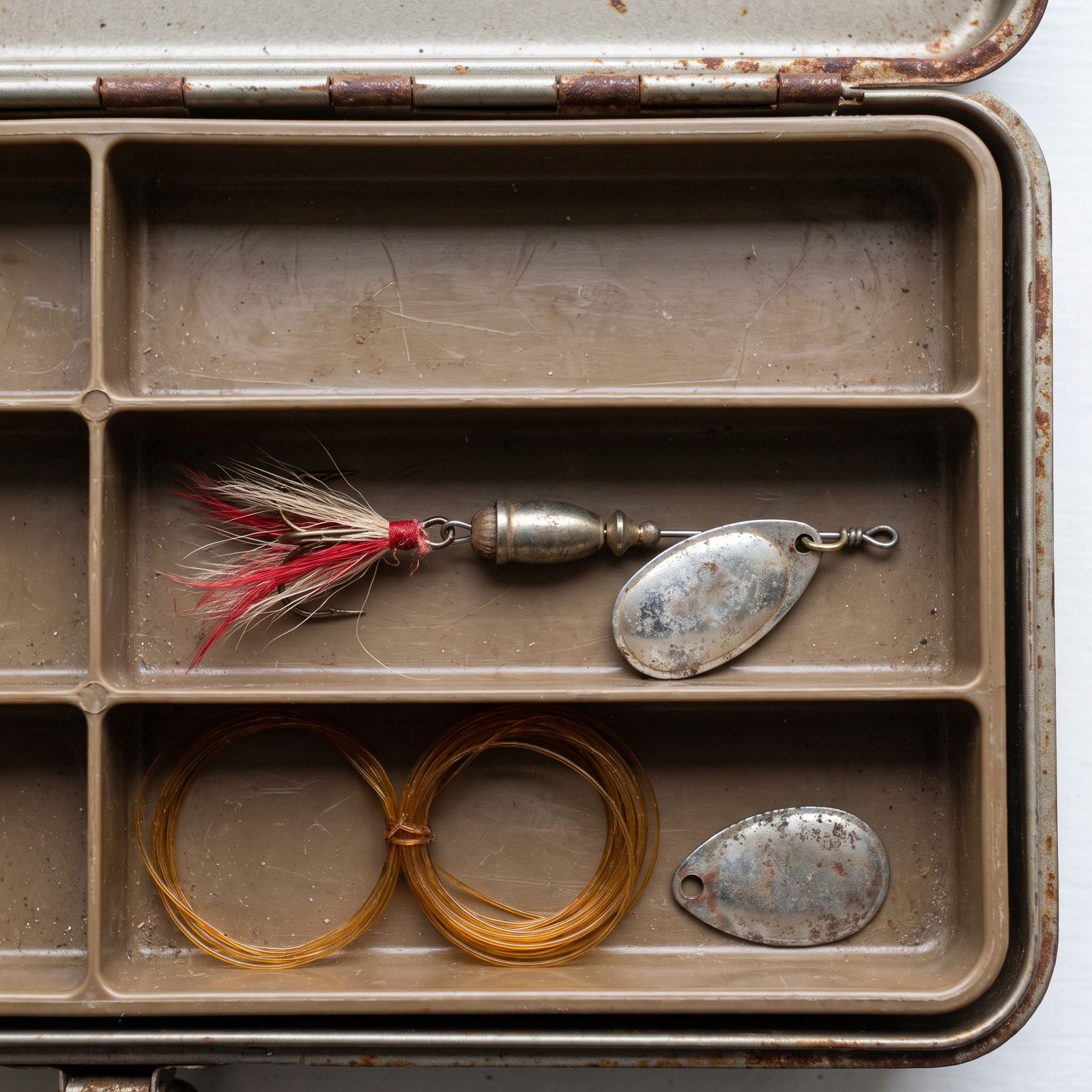
Trout fishermen have a short list of lures they actually trust, and the Aglia sits near the top of it. The blade spins on a straight wire the instant it hits the water, even on a slow retrieve — which matters in the cold creeks where trout live and the current does half the work for you.
That French blade turns at a wide angle, throwing a thump as much as a flash. Add a dressed treble and you’ve got a lure that’s caught more stream trout than anybody could count. A number two silver blade is the one that stays in the box forever.
9. An Arbogast Hula Popper with a Rubber Skirt
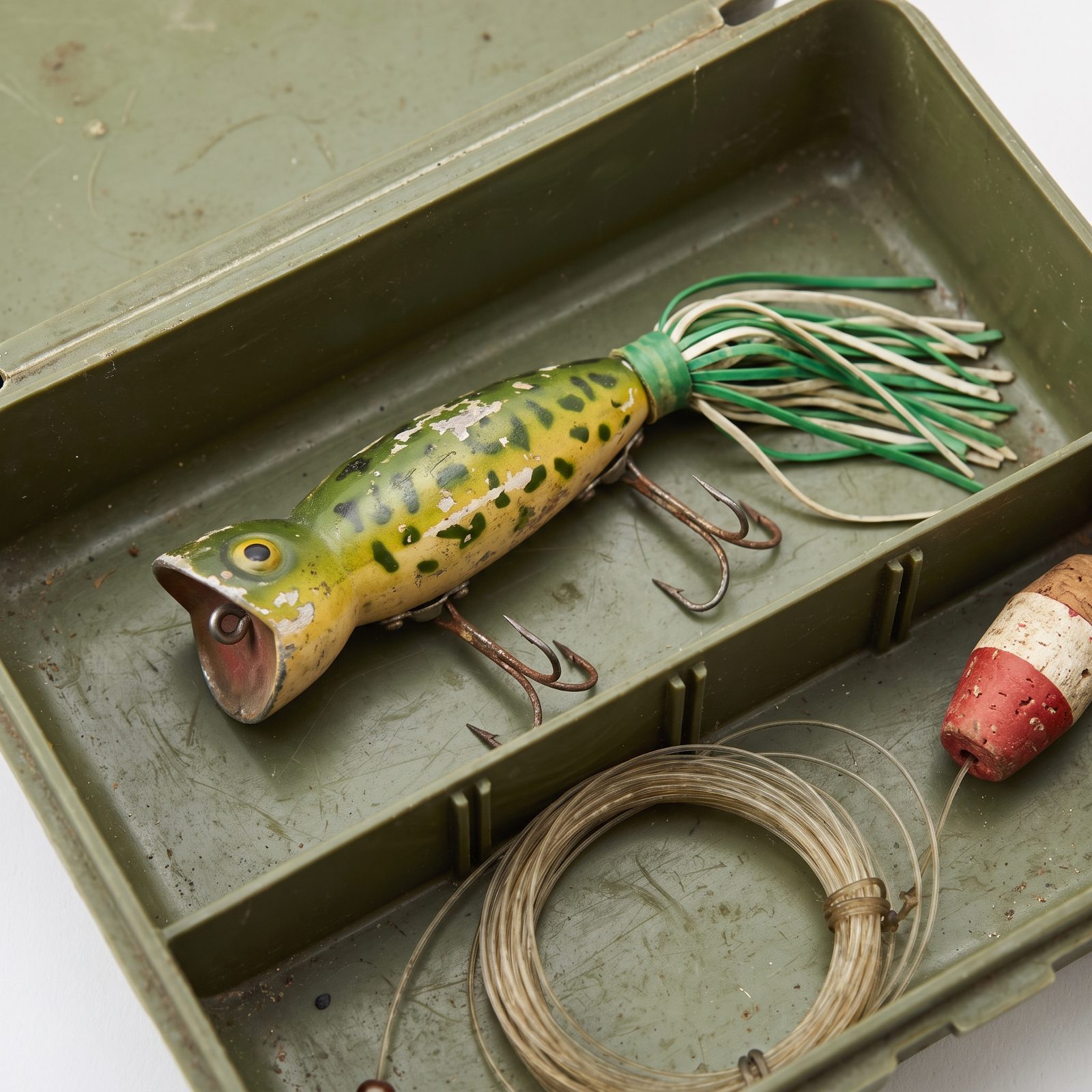
Nothing in fishing beats a bass blowing up on a topwater at dawn. The Hula Popper is how generations learned that lesson. Twitch the rod and the cupped face chugs and spits water, and the rubber hula skirt keeps shimmying through the long pause after — which is exactly when a bass usually eats it.
The pause is the whole game. Cast it near a lily pad, let the rings settle, give it one pop, and wait. Wait longer than feels right. That frog-pattern body sitting dead still is what gets slammed.
8. A Zara Spook for the Walk-the-Dog Retrieve
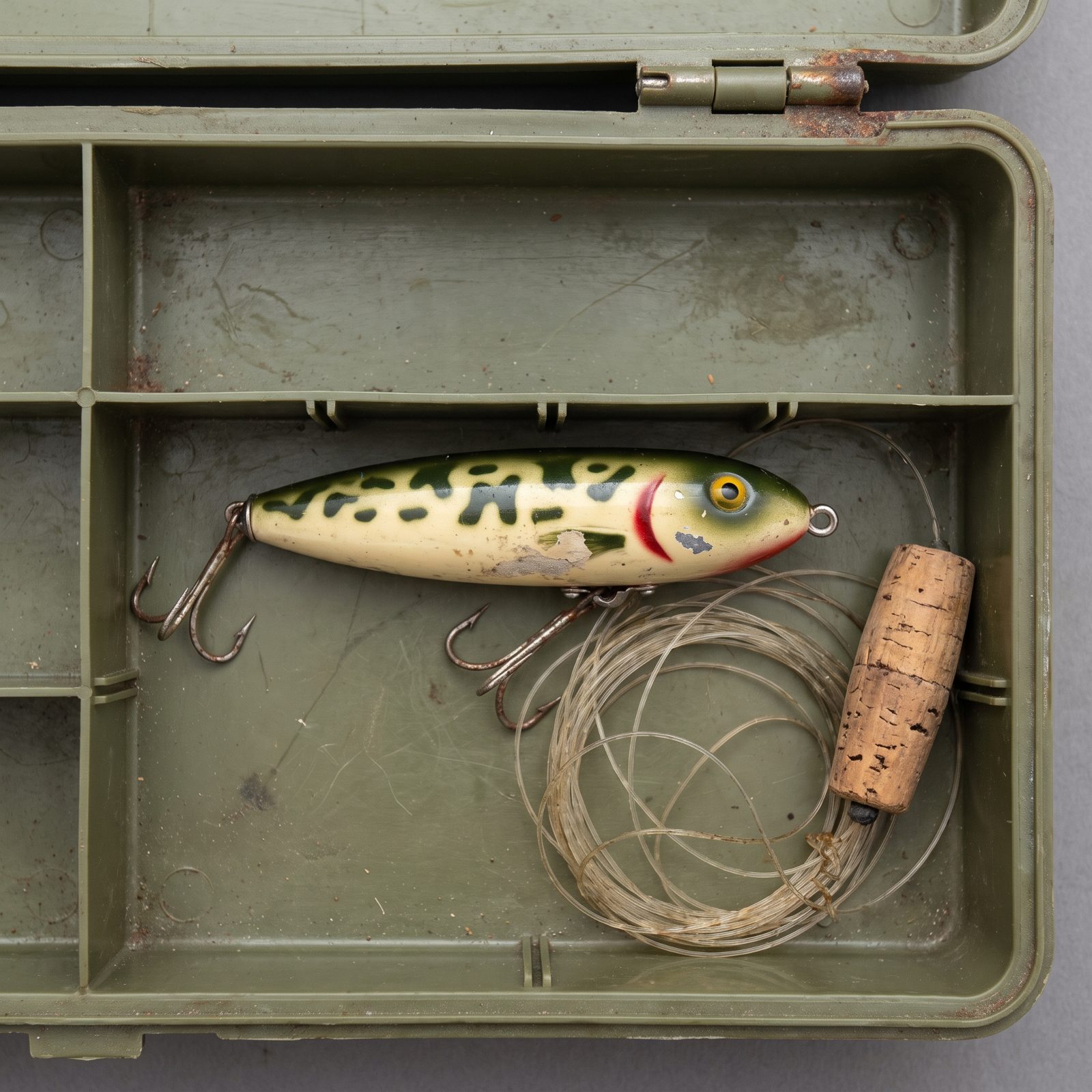
The Spook never did anything on its own. Cast it out, let it sit, and it just floats there looking confused. The magic came from the angler’s wrist — a rhythm of slack-line twitches that made it slide side to side across the surface like a wounded baitfish. Old-timers called it walking the dog, and plenty of men never got the cadence right.
By 1975 the cigar-shaped plug had been fooling bass for decades. The strikes were violent and visible, which is the whole reason topwater fishing ruins you for anything calmer.
7. A Cotton Cordell Big O Crankbait
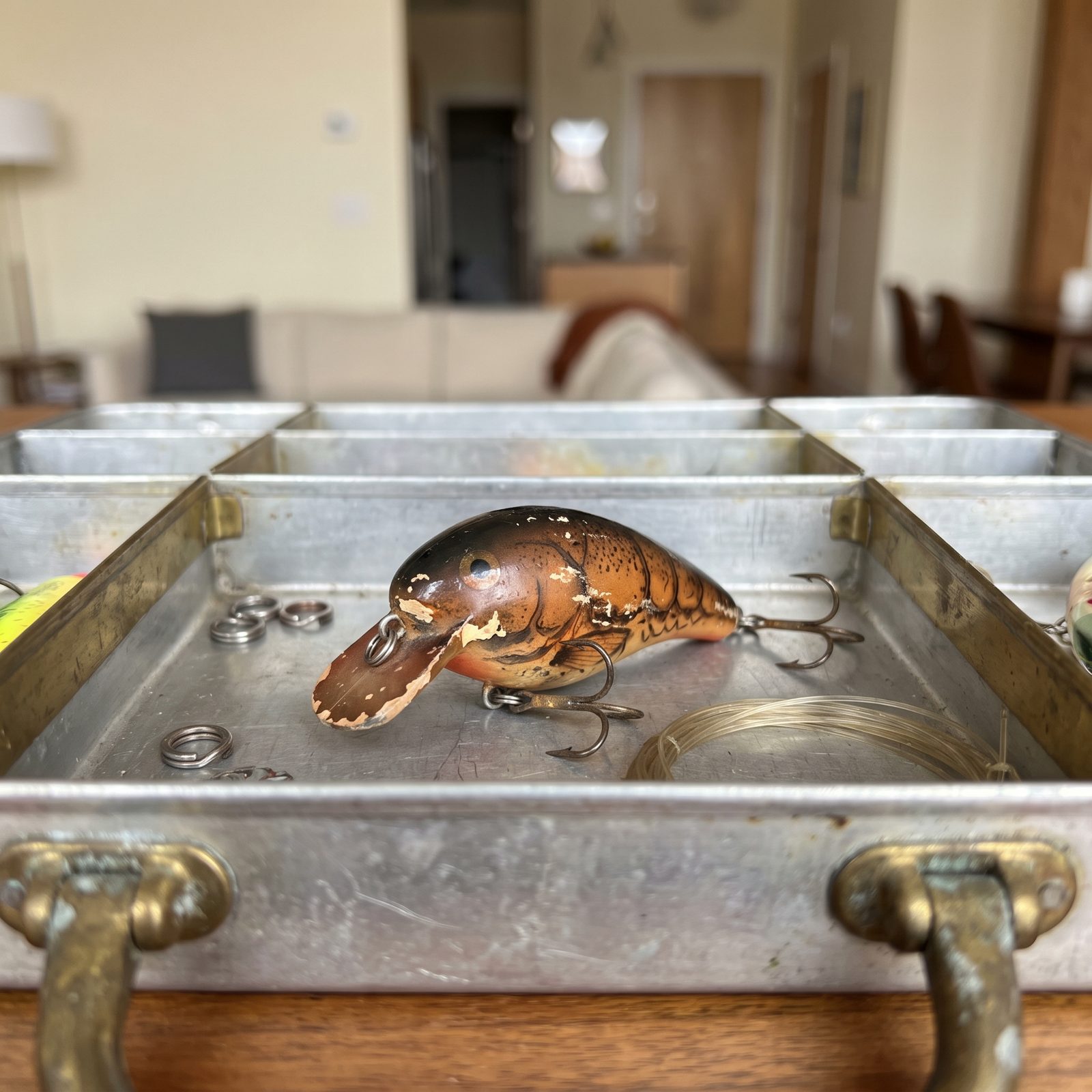
Fat, round, and almost comically short, the Big O looked like something a kid carved — which is nearly the truth. The original was hand-shaped from balsa by a Tennessee man, and once the bass went crazy for the wobble, the plastic production versions came flooding in.
What made it matter was that square lip. It gave the bait a wide, hunting wiggle on a steady retrieve, so you could cover a lot of water, bump it off stumps, and let the deflection trigger a reaction strike. It kicked off the whole fat-crankbait craze that followed.
6. A Rapala Original Floating Minnow
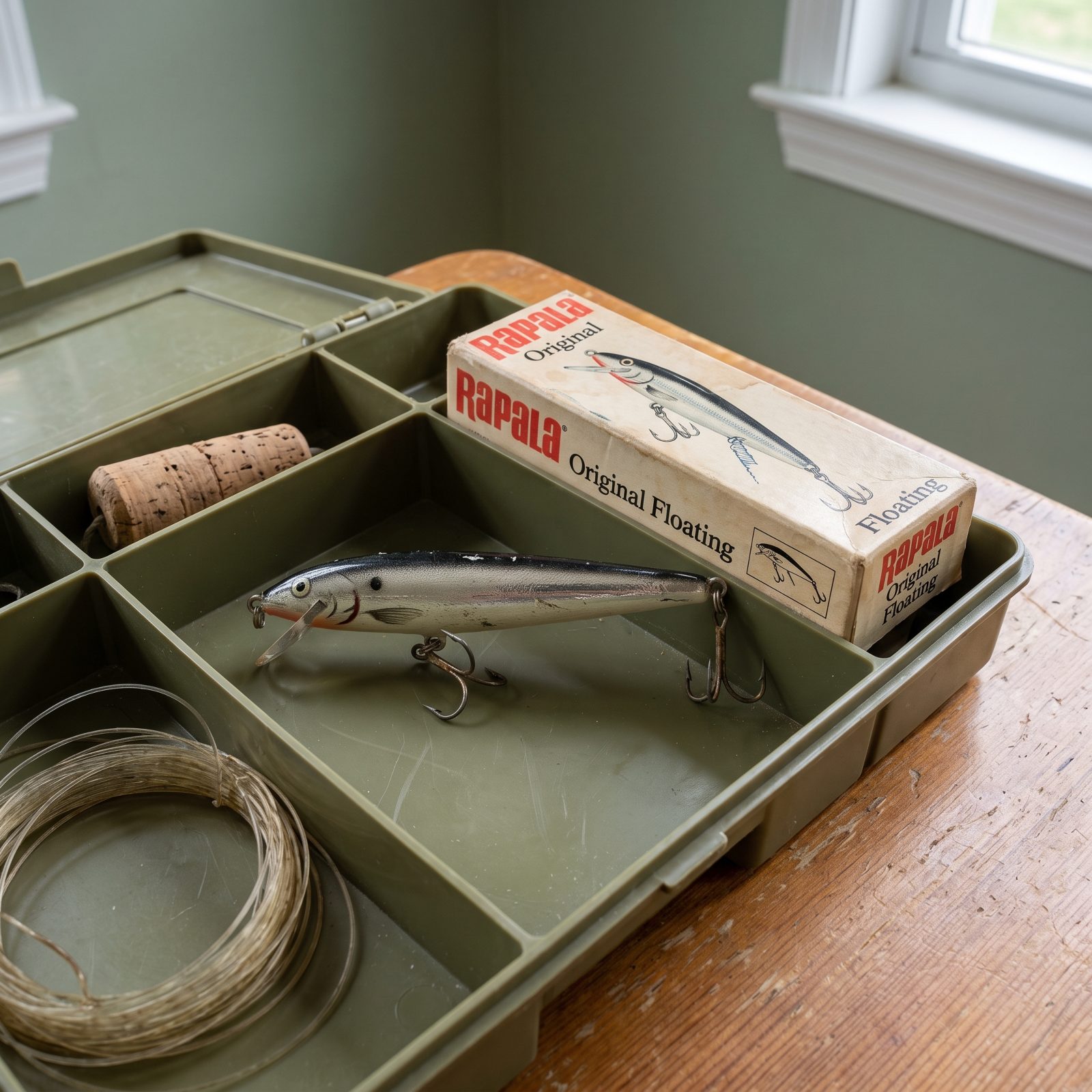
If a 1975 box held one lure that bridged every species, it was this one. The balsa minnow floated at rest and swam with a tight, lifelike shimmy on the slowest crank — light enough to cast on a flyrod, convincing enough to fool trout, bass, walleye and pike.
What people got wrong was horsing it. The Rapala worked best twitched gently, left to pause, allowed to rise. Patience was the real ingredient.
5. Rust-Spotted Needle-Nose Pliers
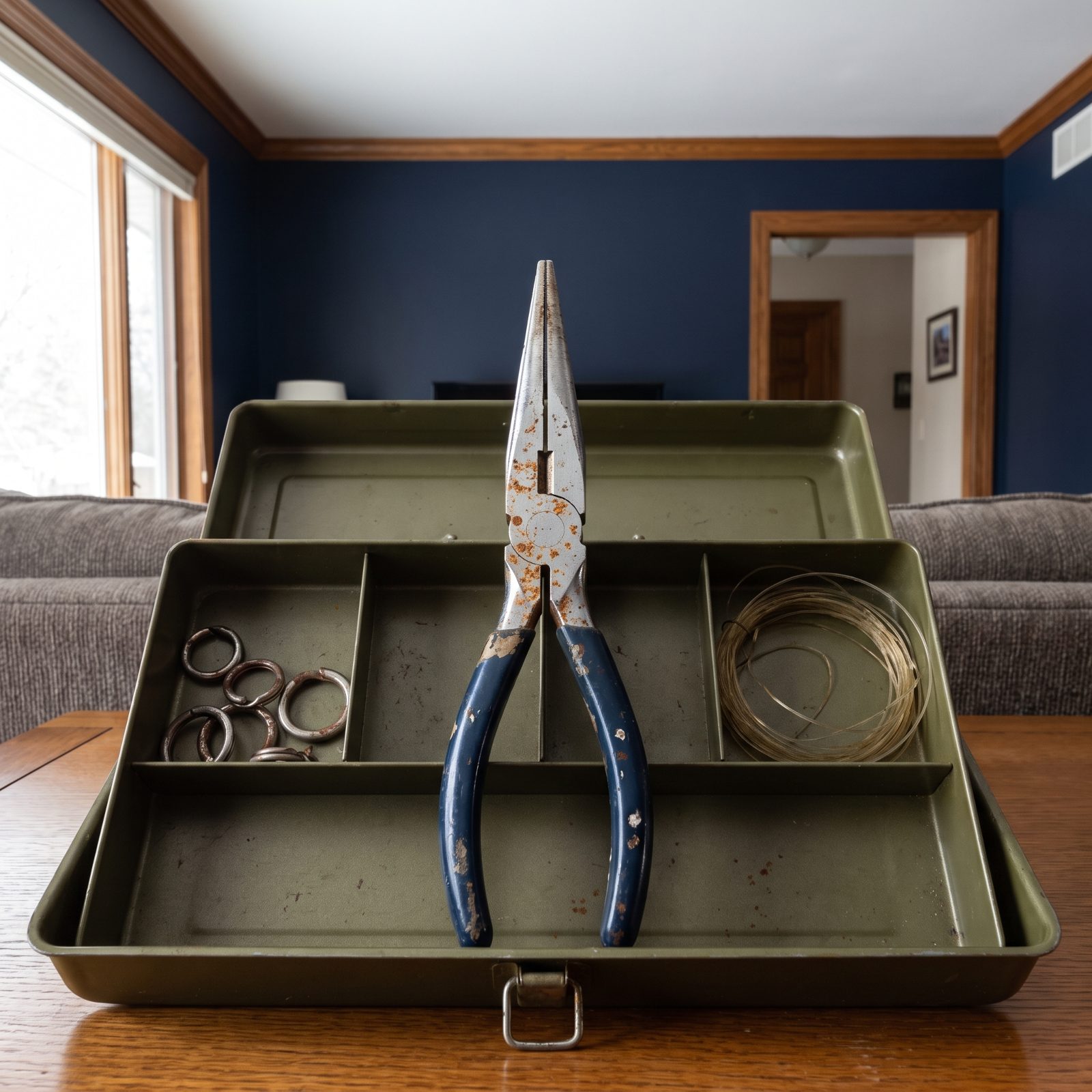
Every honest tackle box has a pair of these, and every honest pair has rust. The pliers lived at the bottom under the wet lures, took on water all season, and came out spotted by July. Nobody cared much. They still pulled hooks.
Those long jaws reached down a toothy fish’s throat so your fingers never had to, and the squared-off block near the pivot pried open split rings and bent wire leaders — one tool doing the ugly work no bare hand should.
4. Fingernail Clippers Used as Line Cutters
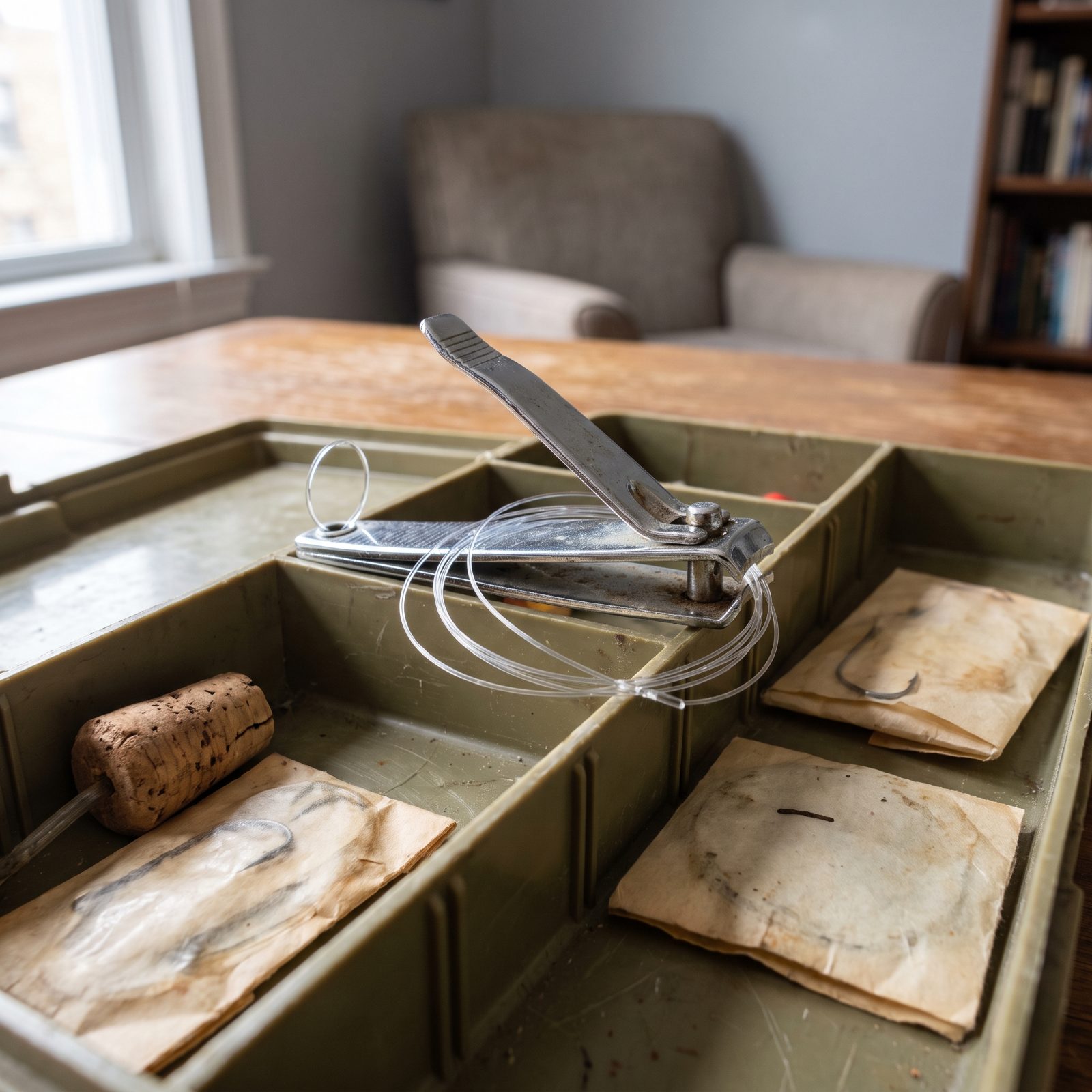
Nobody advertised this one. A drugstore fingernail clipper is a near-perfect monofilament cutter — clean snip, trims the tag end flush to the knot, fits in a shirt pocket, costs almost nothing.
Plenty of anglers in 1975 skipped the fancy line snips entirely. The clipper did the job better, and if it got lost in the lake muck, you shrugged and grabbed another from the bathroom drawer.
3. A Chain Fish Stringer with Metal Snaps
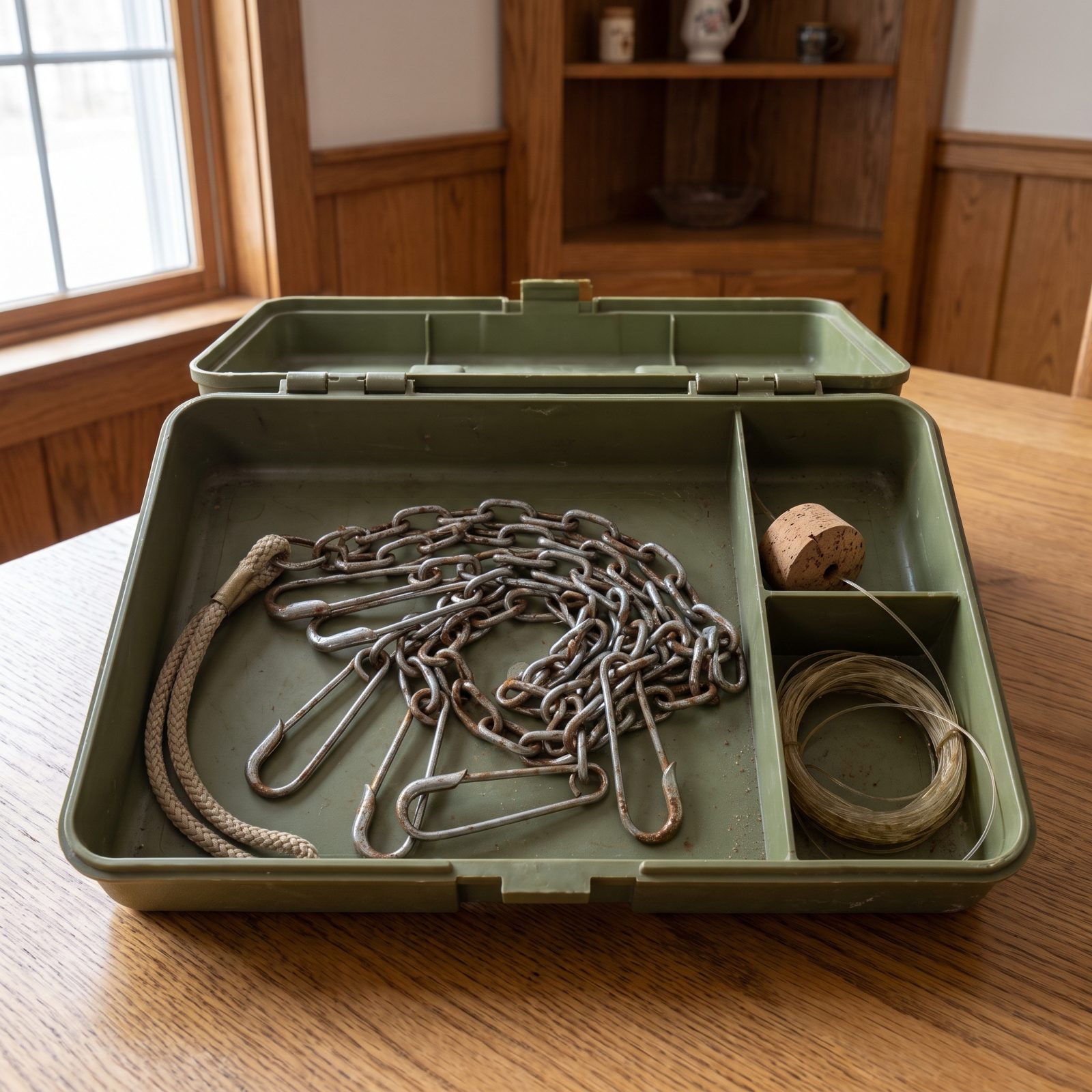
Before livewells were standard, you kept your catch alive on one of these. The chain dropped over the side, the big metal snaps went through a fish’s lip, and dinner swam in place until you went home.
The metal snaps were everything. Rope stringers tangled and let fish wriggle free, but the chain kept each one separated and the heavy snaps held even a thrashing catfish.
It rattled in the box like loose change and smelled like the lake forever.
2. A Folded 1975 Fishing License in a Plastic Sleeve
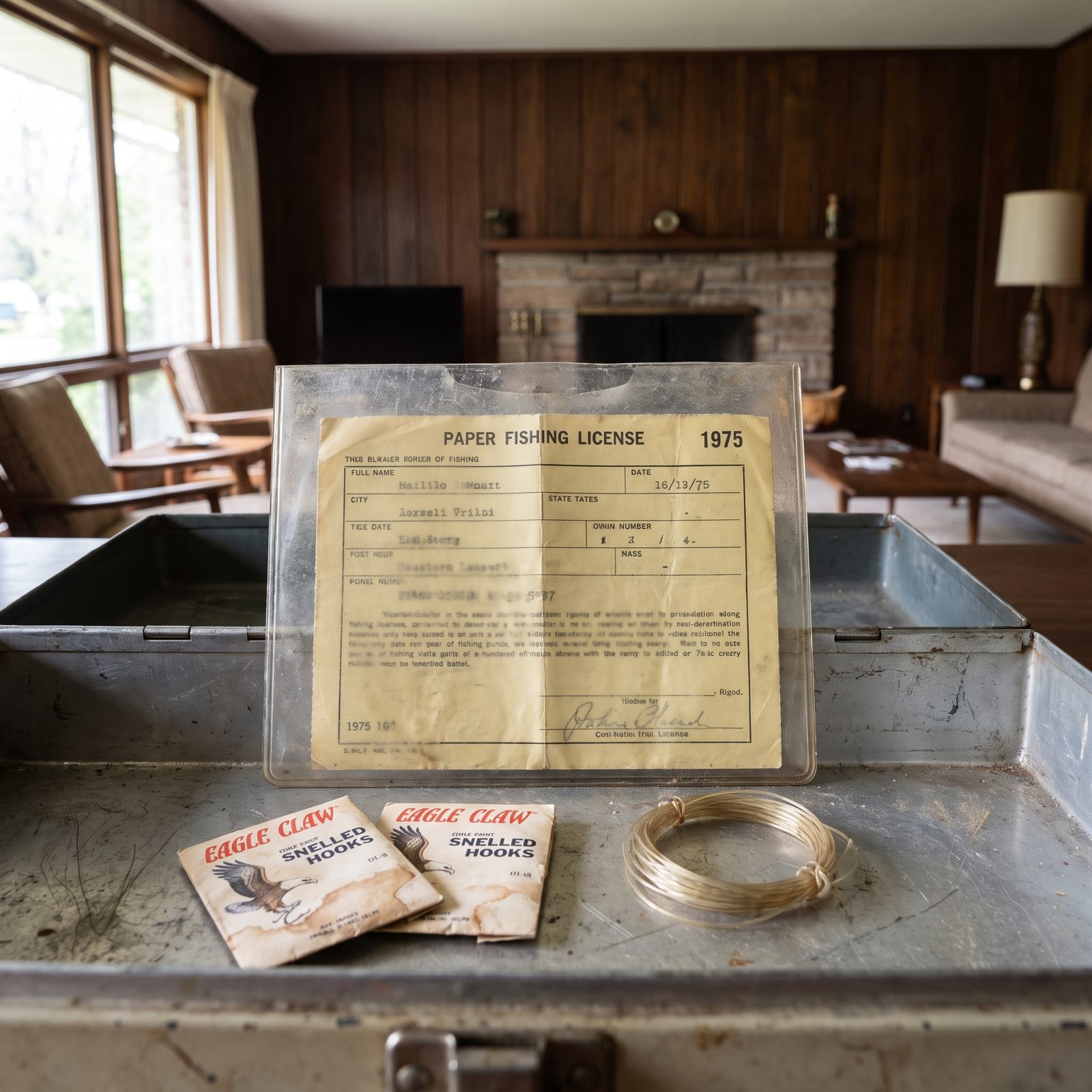
Propped upright against the open tackle box, creased down the middle, flat behind its cloudy, scuffed plastic sleeve — the license nobody wanted the warden to ask about but everybody kept handy. The paper yellowed by midsummer and the ink faded where thumbs touched it most.
Costs and rules varied by state, same as now, usually a few dollars for a resident season. The sleeve kept it dry through rain and spray, because a license run through the wash was a story you only told once.
1. A Little Bottle of Anise-Scented Fish Attractant
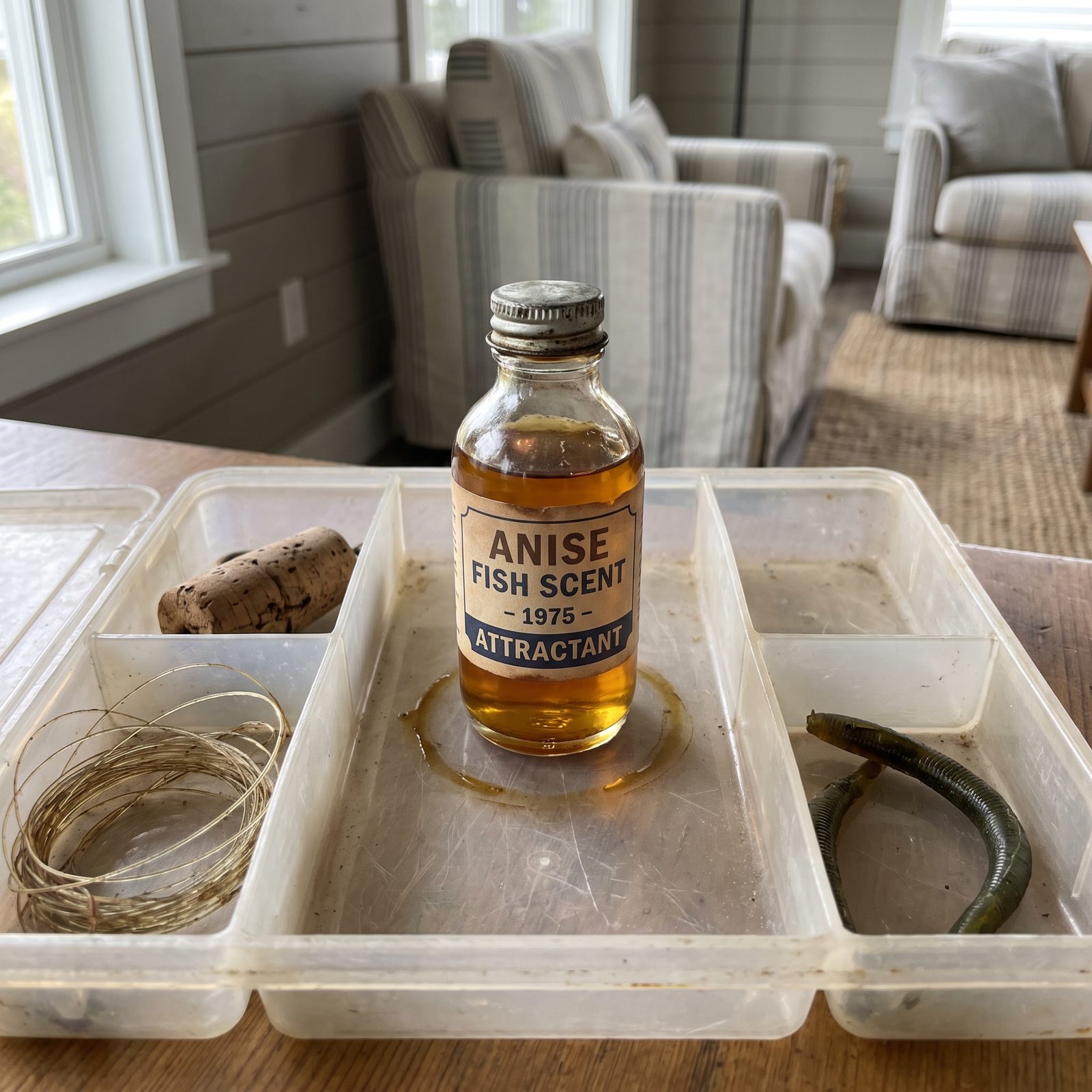
Pop the cap and the whole box smelled like black licorice. That was the point. A drop of anise oil on a plastic worm was supposed to mask human scent and tempt a wary bass into holding on a half-second longer.
Does it work? Honestly, the jury was out in 1975 and it still is. The bottle sat in nearly every box anyway — half faith, half habit.