
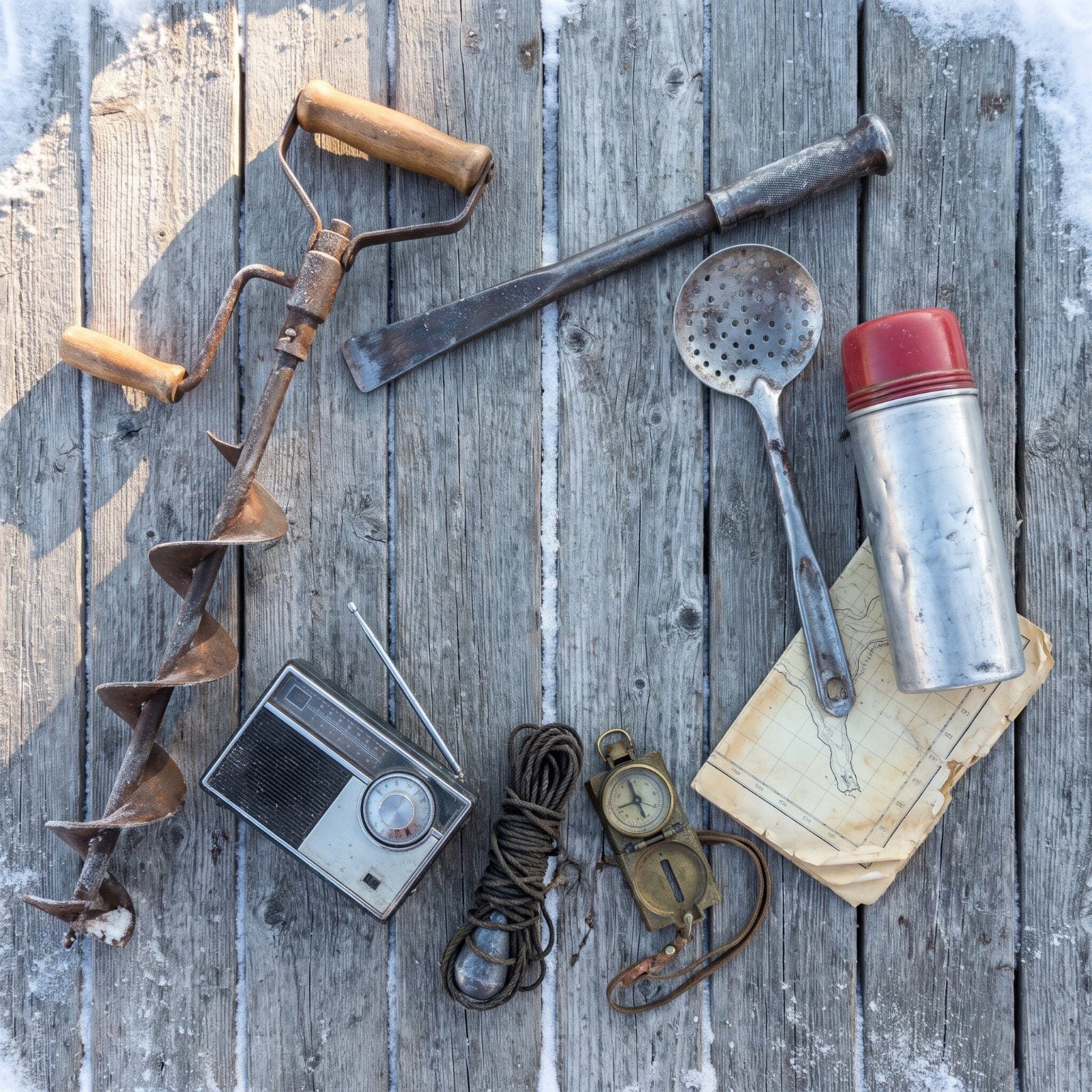
Nobody checked a screen before walking onto the ice. You walked out because the AM radio said the cold was holding, you lined up a bent birch on shore with a water tower behind it, and you drilled by hand until your shoulders quit. Everything had weight. Everything could freeze, fail, or flood your boots. The men who fished those hard Februaries on Mille Lacs, Lake Winnebago, Simcoe and a thousand nameless farm ponds carried wood, steel, and a little stubbornness. This is the kit that ran the show, and what each piece quietly replaced.
Please note that some of the images in this article were created with the assistance of AI.
42. Hand Augers Supplied All the Drilling Power
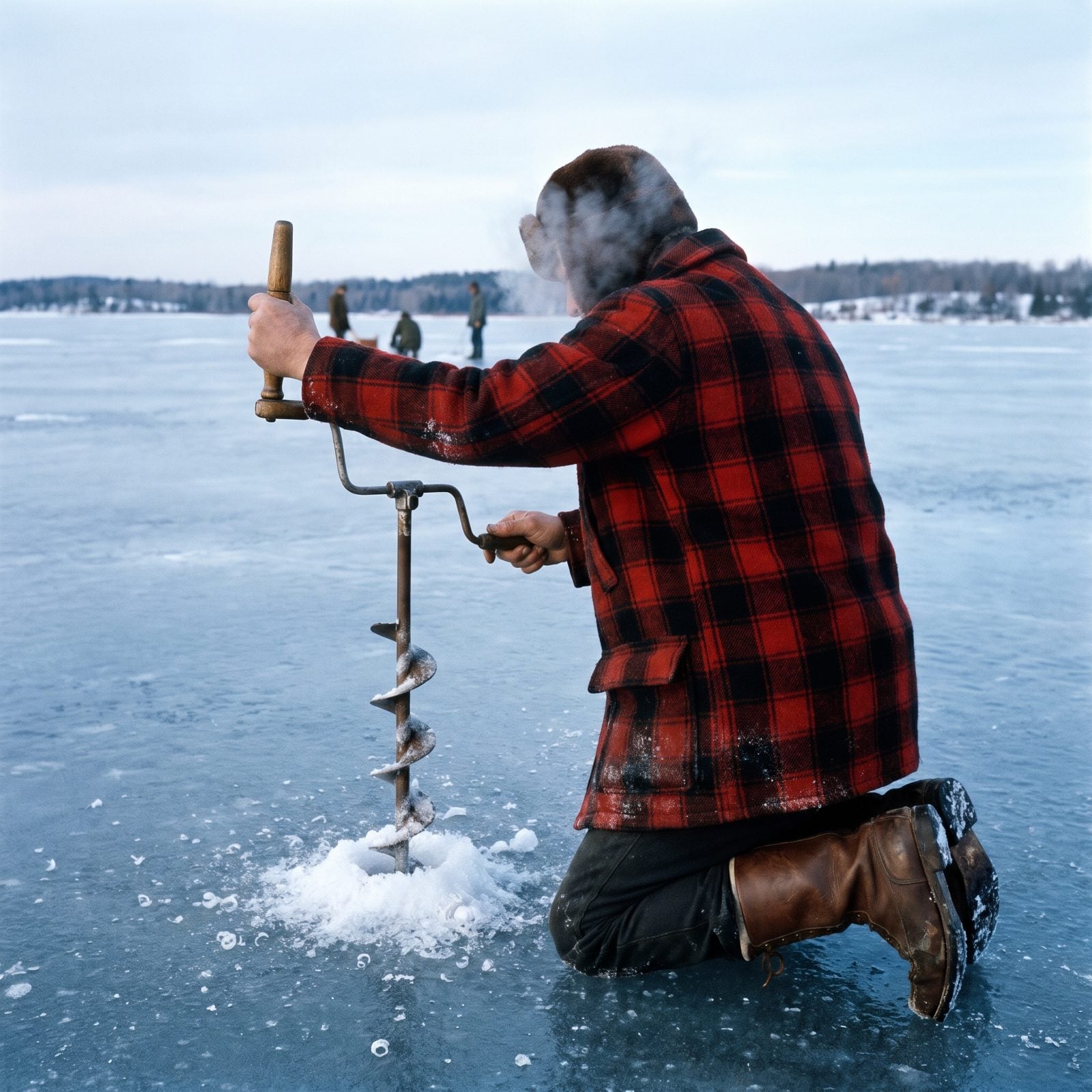
Every hole started with your own arms. A hand auger was a steel spiral with a crossbar handle, and it asked for everything you had. Six inches of ice, fine. But thirty inches on a late-February lake would have you stopping twice, blowing on your knuckles, and quietly questioning the whole plan.
The blade was the whole game. A sharp one sliced; a dull one skated and polished the ice instead of cutting it. Men kept a file at home and guarded their edge like a kitchen knife.
41. Spud Bars Sometimes Cut the Entire Hole
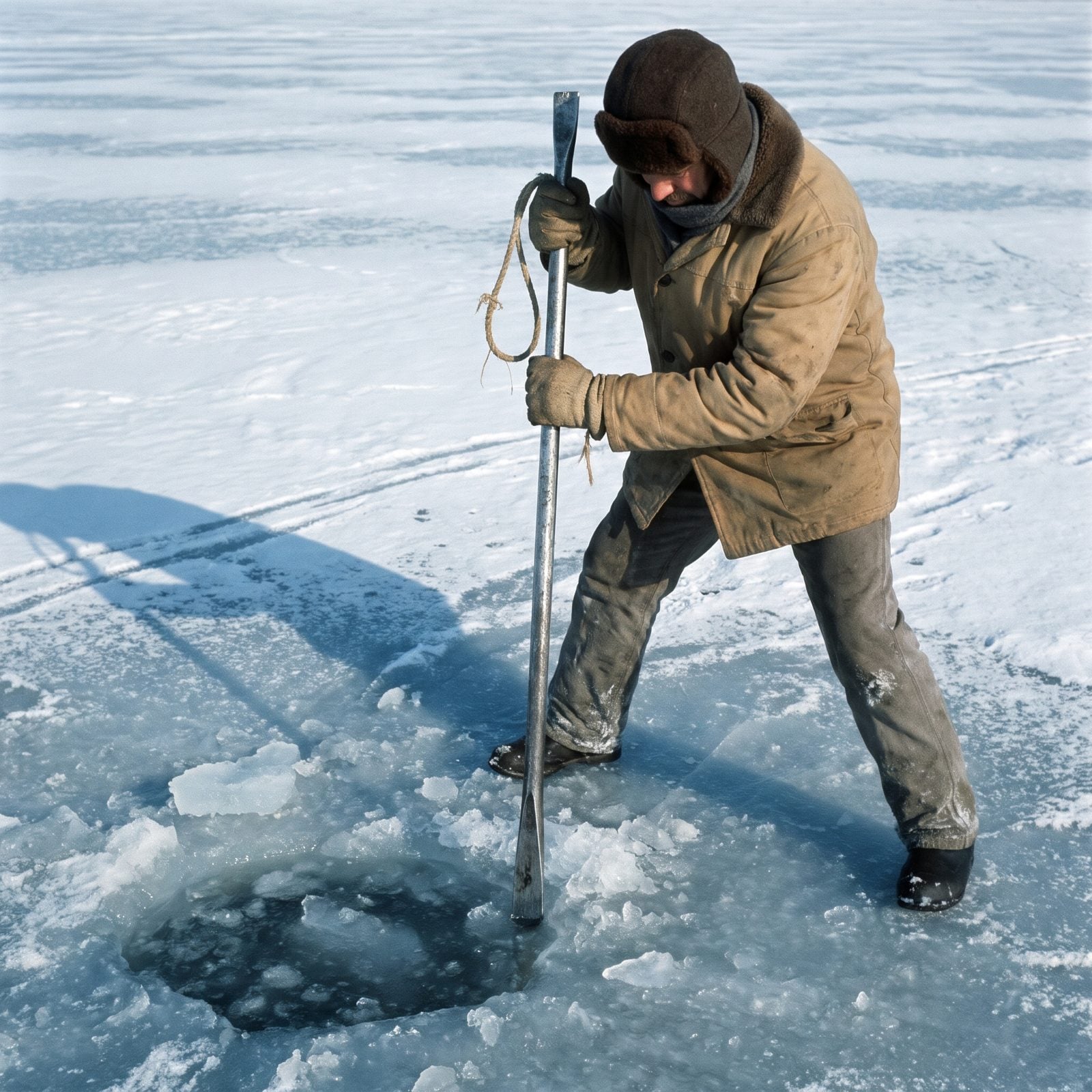
Before the ice got thick, the spud bar ruled. A heavy iron rod with a flat chisel on the end — you’d stab straight down and let gravity and muscle break through. On three or four inches of early ice, a few good chops opened a hole faster than threading an auger.
That rope loop on your wrist mattered more than it looked. Lose your grip and the bar sinks forever.
Thinking back on 65 winters on the ice, a longtime ice-fishing columnist writes “As for the spud bar, it could be used making an ice hole in thicker ice, because you just pounded it up and down chipping away at the ice, kind of like a manual hand jack hammer.”
40. Metal Ice Skimmers Were Essential, Not Optional
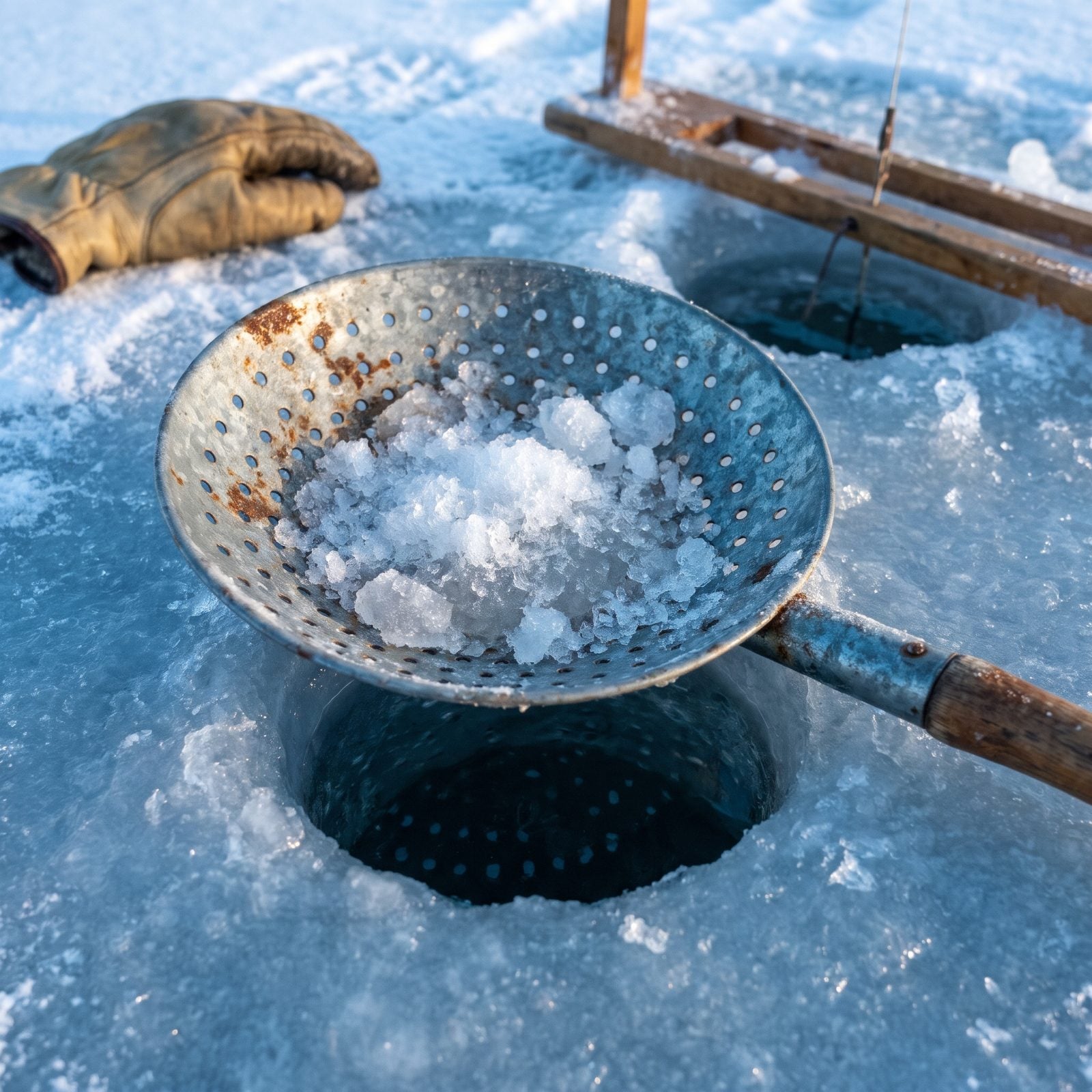
A skimmer looks like nothing — a perforated metal cup on a stick. Leave one in the truck and your whole day falls apart.
Open water skins over fast in a stiff wind, and slush builds up around your line. The skimmer scooped it out, let the water drain through the holes, and kept your line running free. Without it, you were clawing the hole open with your bare hand or a mitten you then had to wring out.
Remembering how he started ice fishing as a boy, a veteran outdoors editor writes that “since we had no shelter, we had to constantly skim the newly forming ice out of the hole.”
39. Frozen Holes Had to Be Chopped Open Again
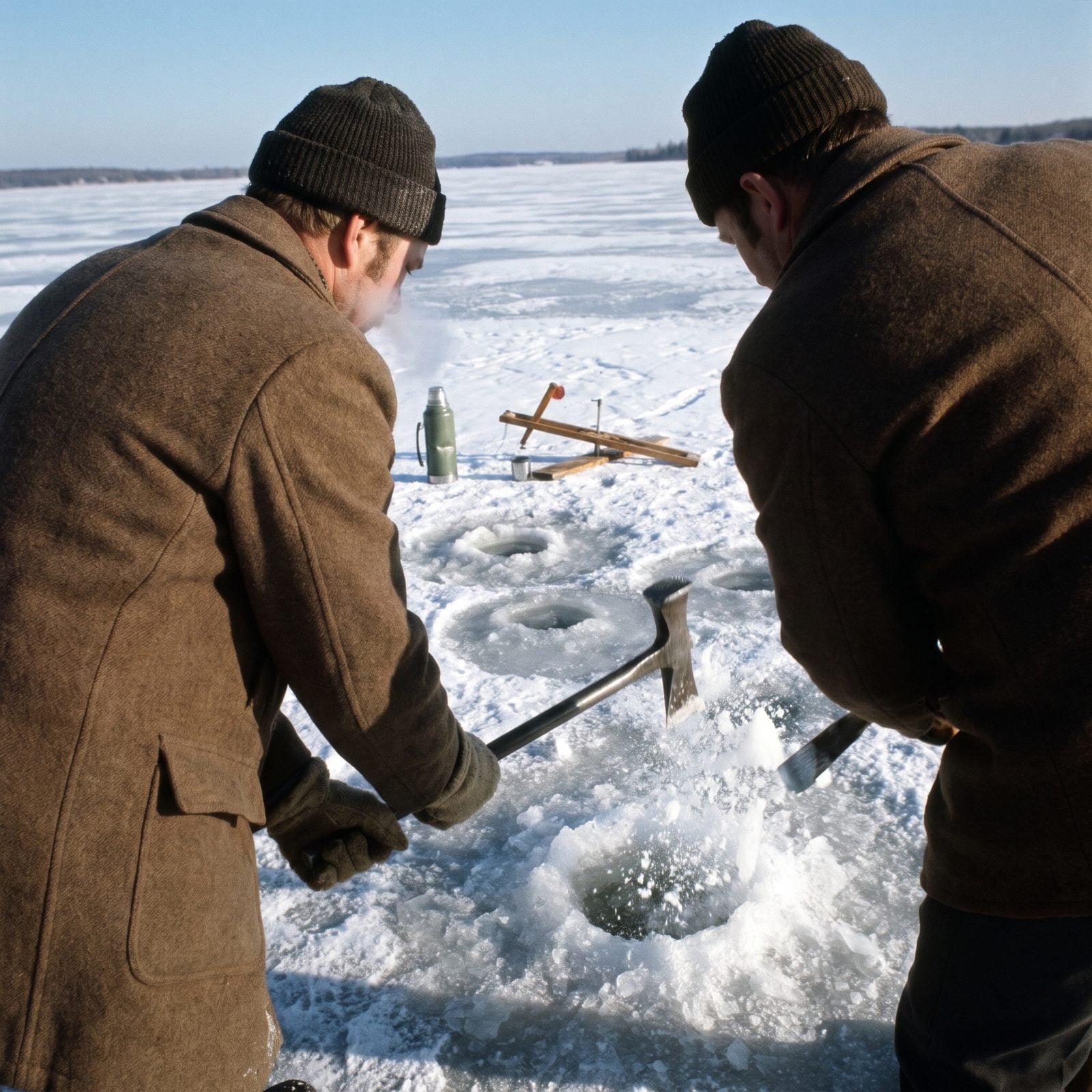
Step away for coffee on a twenty-below morning and your hole was gone. Not narrowed. Gone, capped with an inch of fresh ice.
So you reopened it — a few chops with the spud or the auger blade, a scoop with the skimmer, and you were back in business. On the coldest days men re-cleared every hole every ten or fifteen minutes, which is why so many of us fished inside a canvas or plywood shanty with a little heat. Cheaper than losing a limb to frostbite over a bluegill.
38. A Weighted Cord Served as a Depth Finder
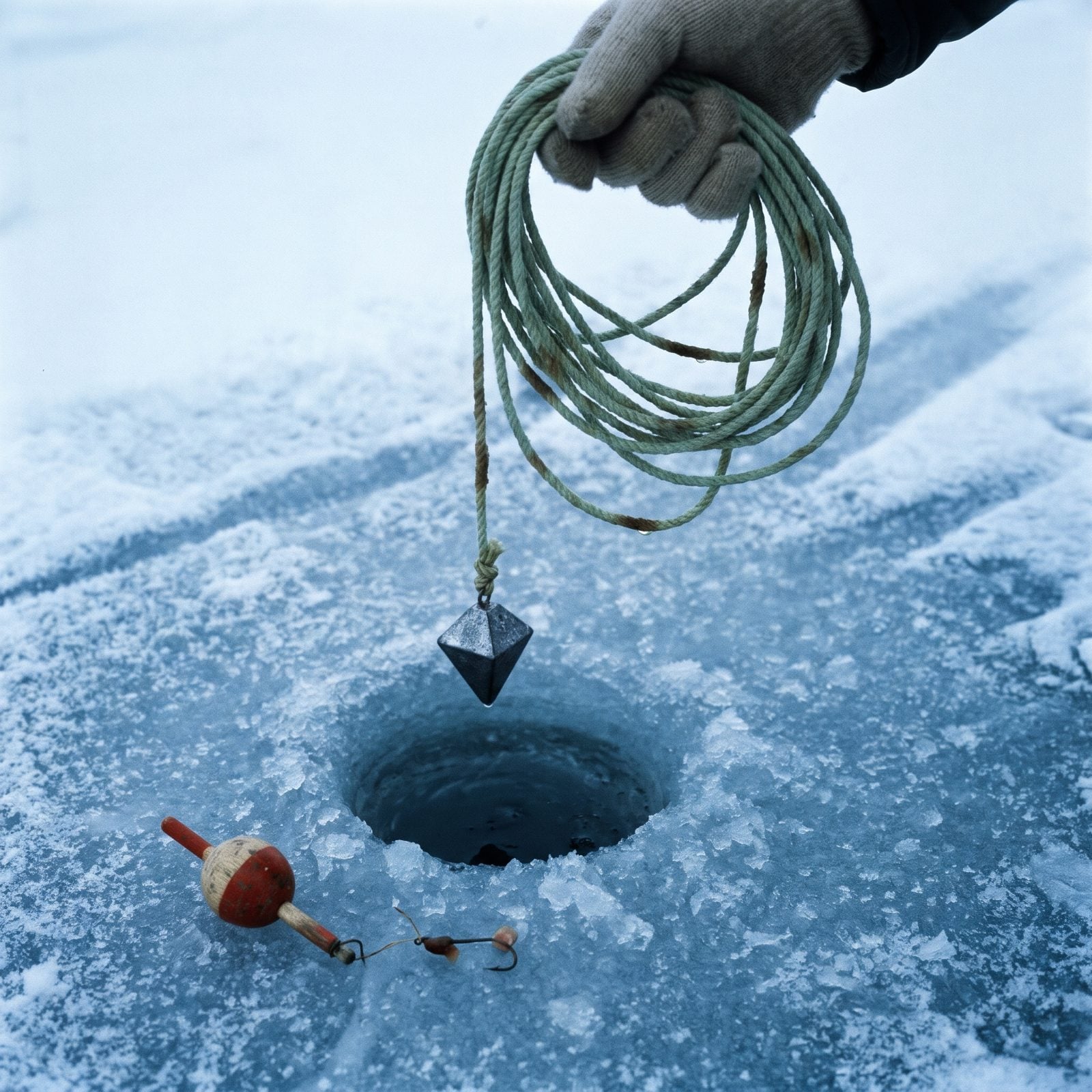
No sonar. No flasher screen blinking red. Just a sinker on a string.
You tied a heavy weight to a marked cord, dropped it till it hit bottom, then counted the marks or your arm-spans to read the depth. Pull it up slow and you could feel the difference between a hard sand flat and soft mud by how the weight settled. Men learned a lake’s contours one hole at a time, and the good ones carried that map in their heads for decades.
37. Paper Lake Charts Replaced Digital Mapping
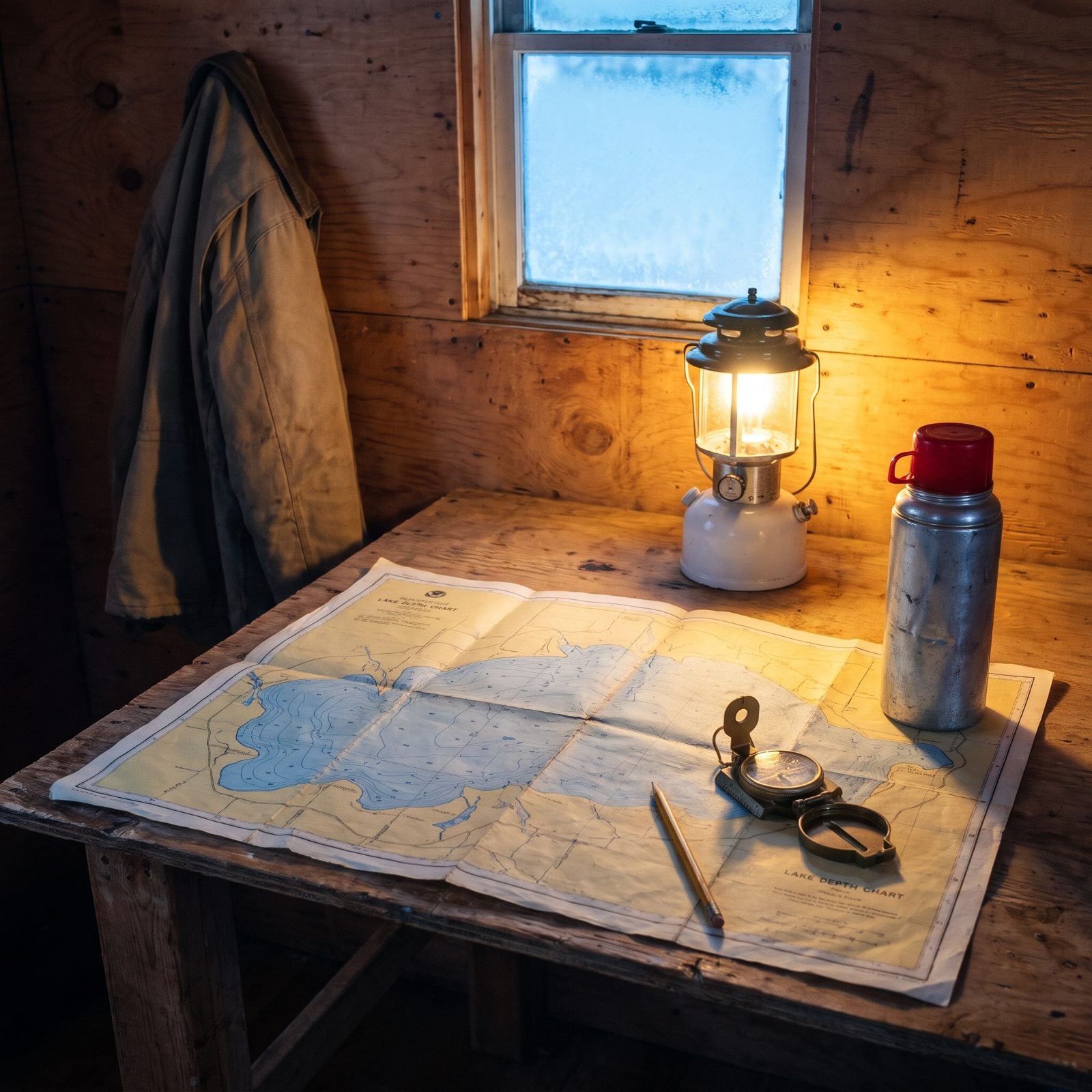
The lake map lived folded in a coat pocket, soft at the creases from a hundred openings. Contour lines, depth numbers, the shape of every reef and drop-off printed in blue ink.
You’d study it the night before at the kitchen table, pick your reef, and figure out how to find it blind on a white sheet of ice. The paper never needed charging and never froze up. The downside showed itself the first time wind-driven snow buried every reference point and the chart in your glove slowly turned to pulp.
36. A Magnetic Compass Could Be the Only Navigation Tool

When the snow started blowing sideways, the shoreline vanished and so did your landmarks. That’s when a plain magnetic compass earned its keep.
A whiteout on a big lake is genuinely dangerous — no horizon, no shore, no sense of which way the truck sits. Men who fished the big water took a bearing on the walk out so they could reverse it blind if the weather turned. Simple, light, and it doesn’t quit when the battery dies. There isn’t one.
35. AM Radio Forecasts Helped Decide Whether to Venture Out
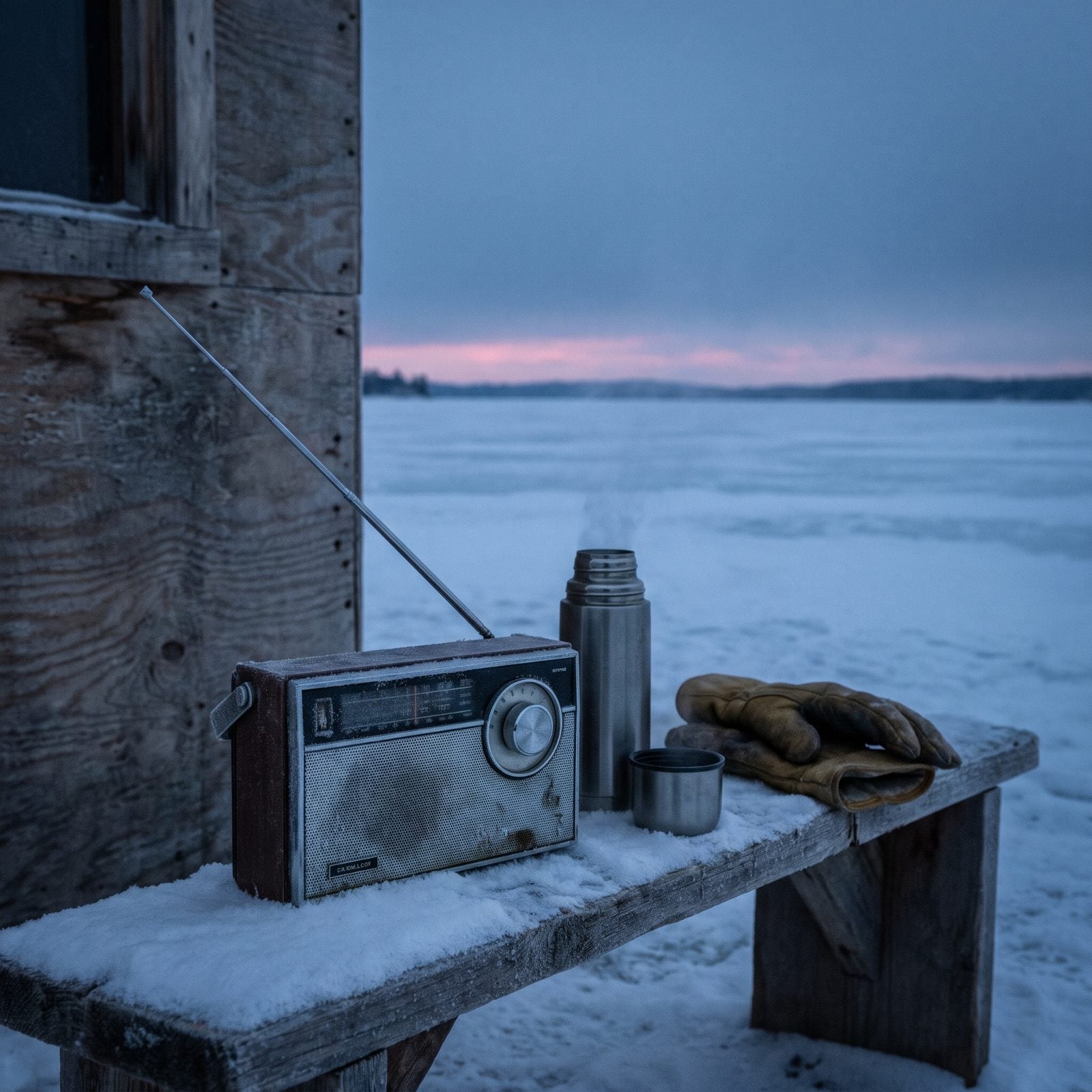
The decision got made at the kitchen table before dawn, radio crackling on the counter. Farm report, then the weather, read slow by a man who’d clearly done it a thousand times.
Cold holding? Wind laying down? Any warning about a front pushing in? That broadcast decided whether you headed out onto the lake or stayed home. A warming trend meant soft, rotten ice by afternoon, and the AM forecast was the only early heads-up you got. No app, no radar loop. Just a voice and your own read of the sky over the frozen lake.
34. The Local Bait Shop Was the Fishing Report
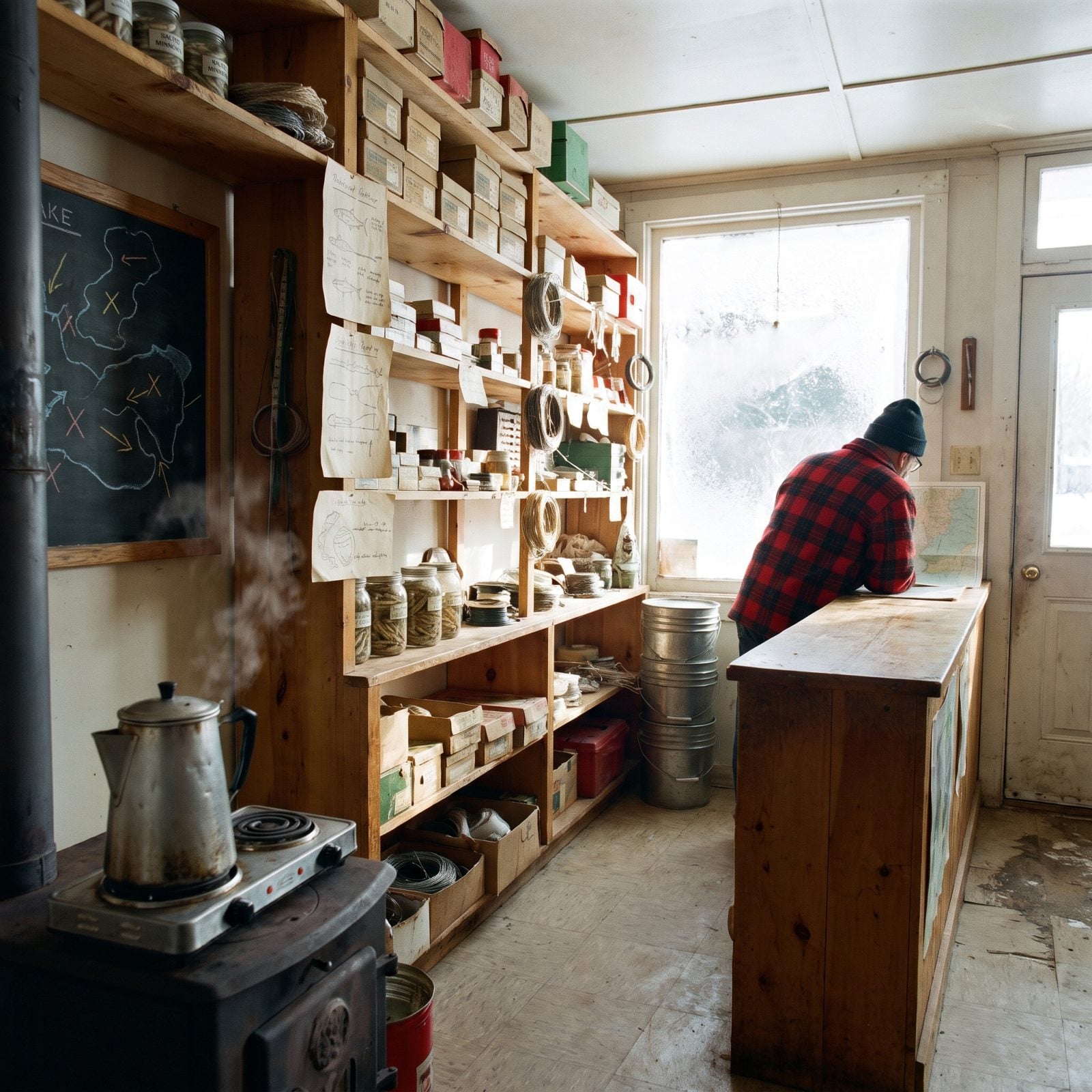
You didn’t check an app. You pushed open a door with a cowbell on it and asked the guy behind the counter where they were biting, and he’d tell you — mostly. The good ones kept a mental ledger of every regular’s catch and fed you just enough to sell a scoop of minnows.
The chalkboard above the shelves might carry hand-drawn outlines of the local lakes, with chalk arrows pointing to where the ice was safe. Half of it was gossip. The other half kept people alive. Steer customers wrong often enough and you didn’t stay in business long, so the information came with real stakes behind it.
33. Many Anglers Walked Miles While Pulling Their Gear
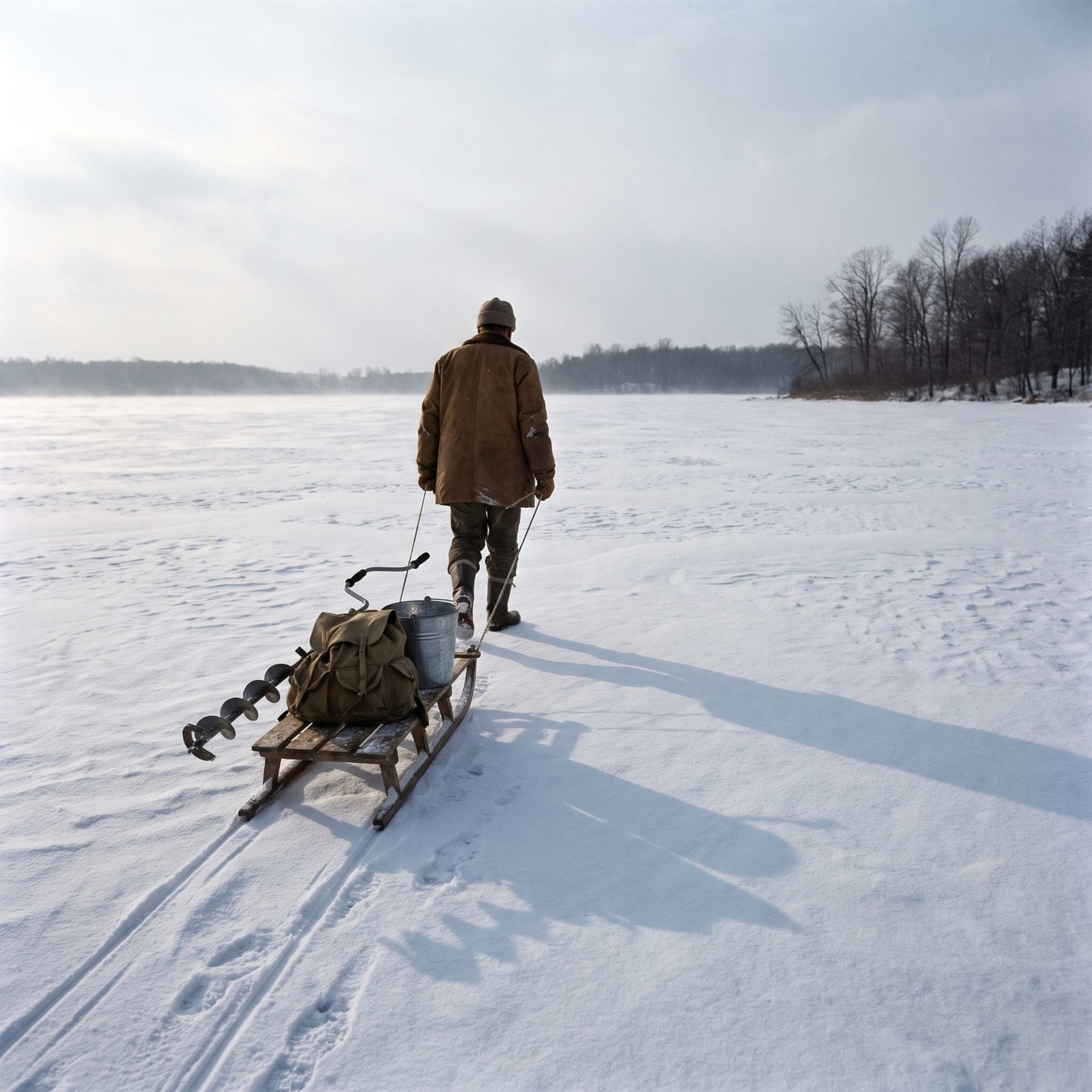
No snowmobile? You walked — a mile or two across open ice with the wind cutting straight through your coat, hauling everything behind you on a rope.
People forget how physical this was. By the time you reached the spot, you’d worked up a sweat under three layers of wool, and that sweat then froze while you sat still over a hole for four hours. Dressing for the walk and dressing for the sitting were two completely different problems, and nobody ever solved both at once.
32. Homemade Wooden Sleds Hauled the Entire Setup
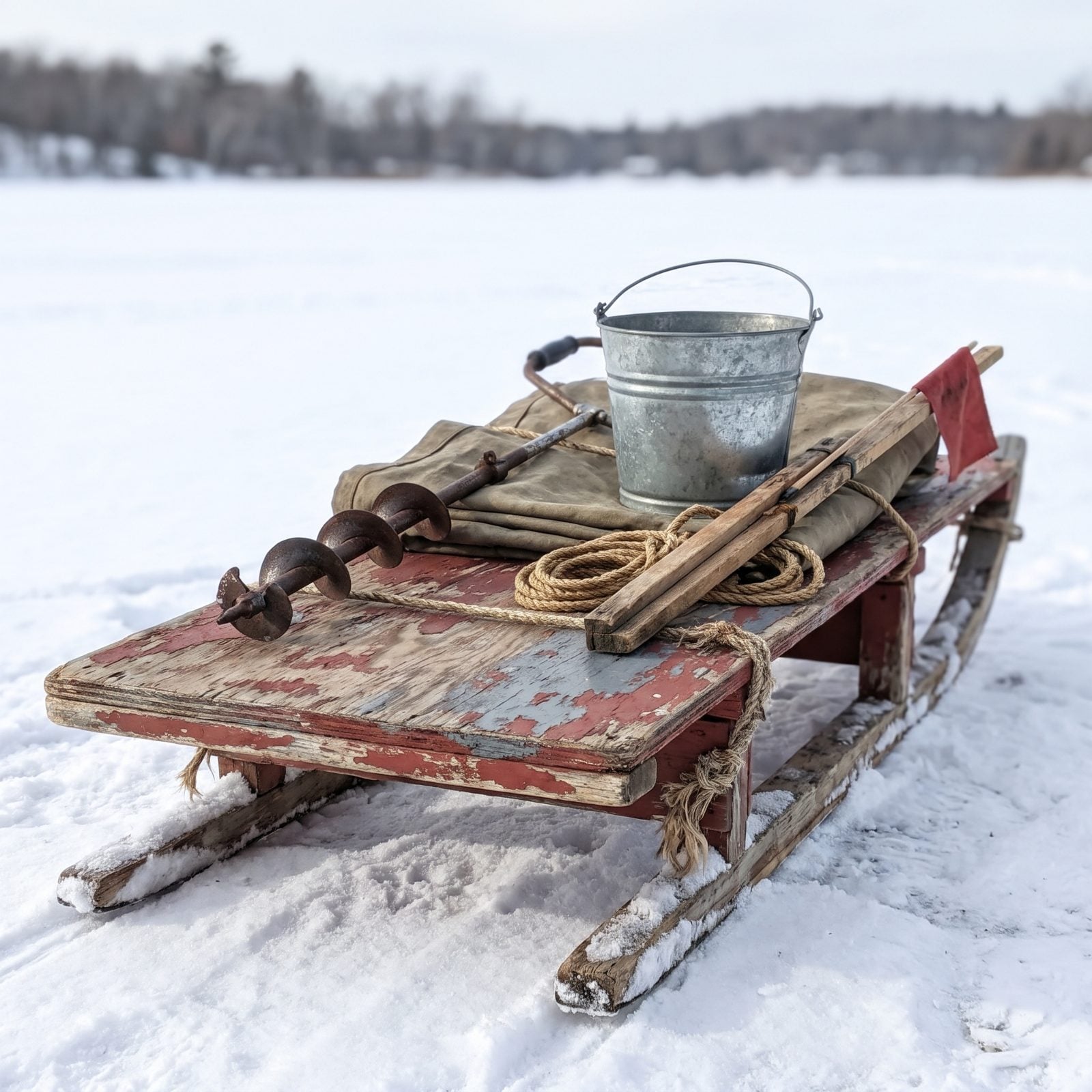
Somebody’s uncle built most of these in a garage over a weekend. Scrap plywood, two runners off an old toboggan, a length of clothesline for a pull rope. The design didn’t matter much as long as it slid and held your bucket.
The homemade sled was the workhorse of the hardwater crowd. It carried the auger, the bait, the tackle, the lunch, and on a good day the fish home too. Split a runner halfway across the lake and you were dragging the whole load by hand the rest of the way — which is exactly why the smart builders over-engineered the joints.
31. Snowmobiles Opened Vast New Areas of Frozen Water
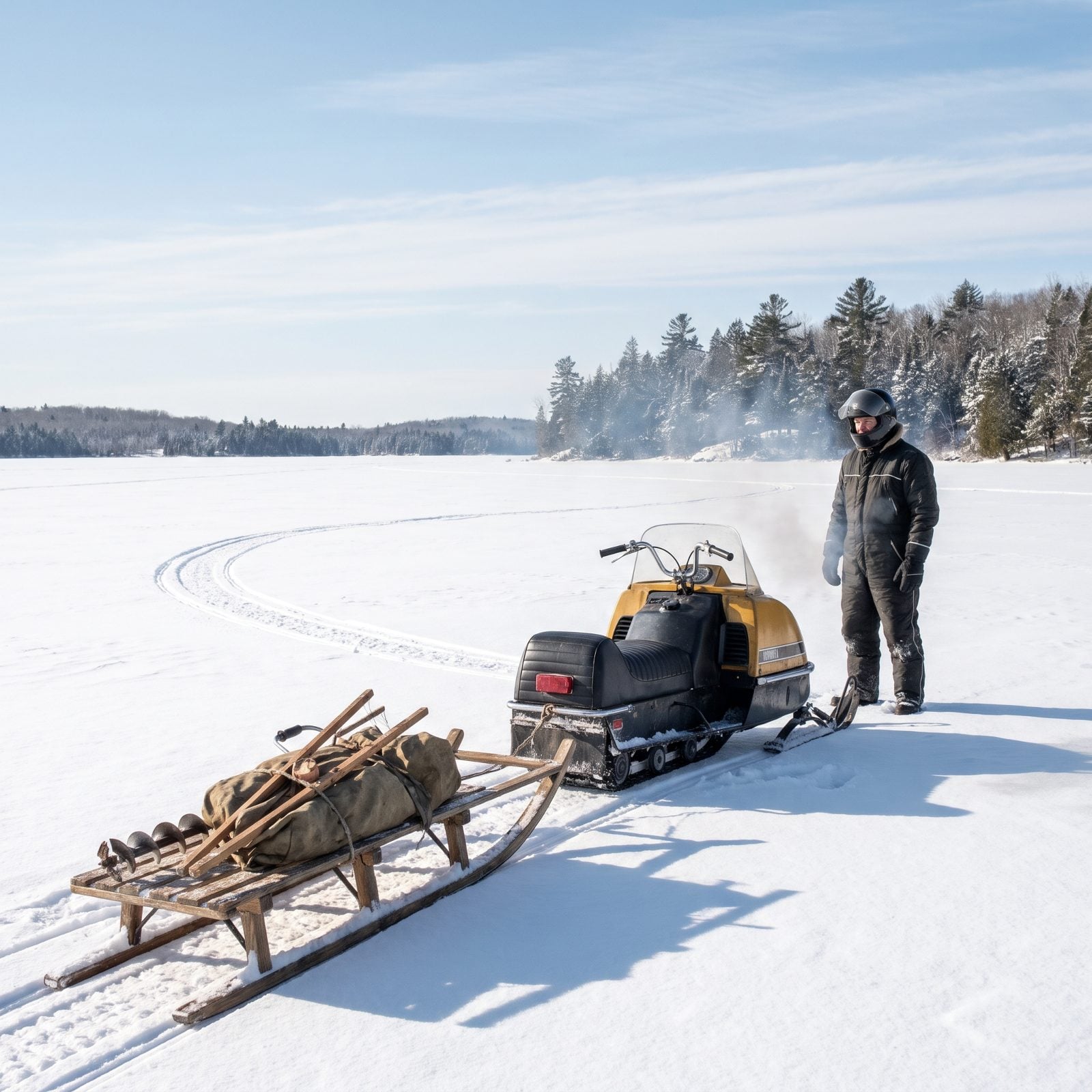
The snowmobile changed the whole game. Lakes that used to take an hour on foot were now ten minutes away, which meant anglers could reach fish nobody had bothered chasing before.
These early machines were loud, heavy and temperamental, and they broke down a lot. But the first time you crossed a mile of open ice in minutes instead of trudging it, you understood why people put up with them. A single sled hitched behind one could haul gear for three or four guys.
30. Breakdown Tools Traveled With Every Early Snowmobile
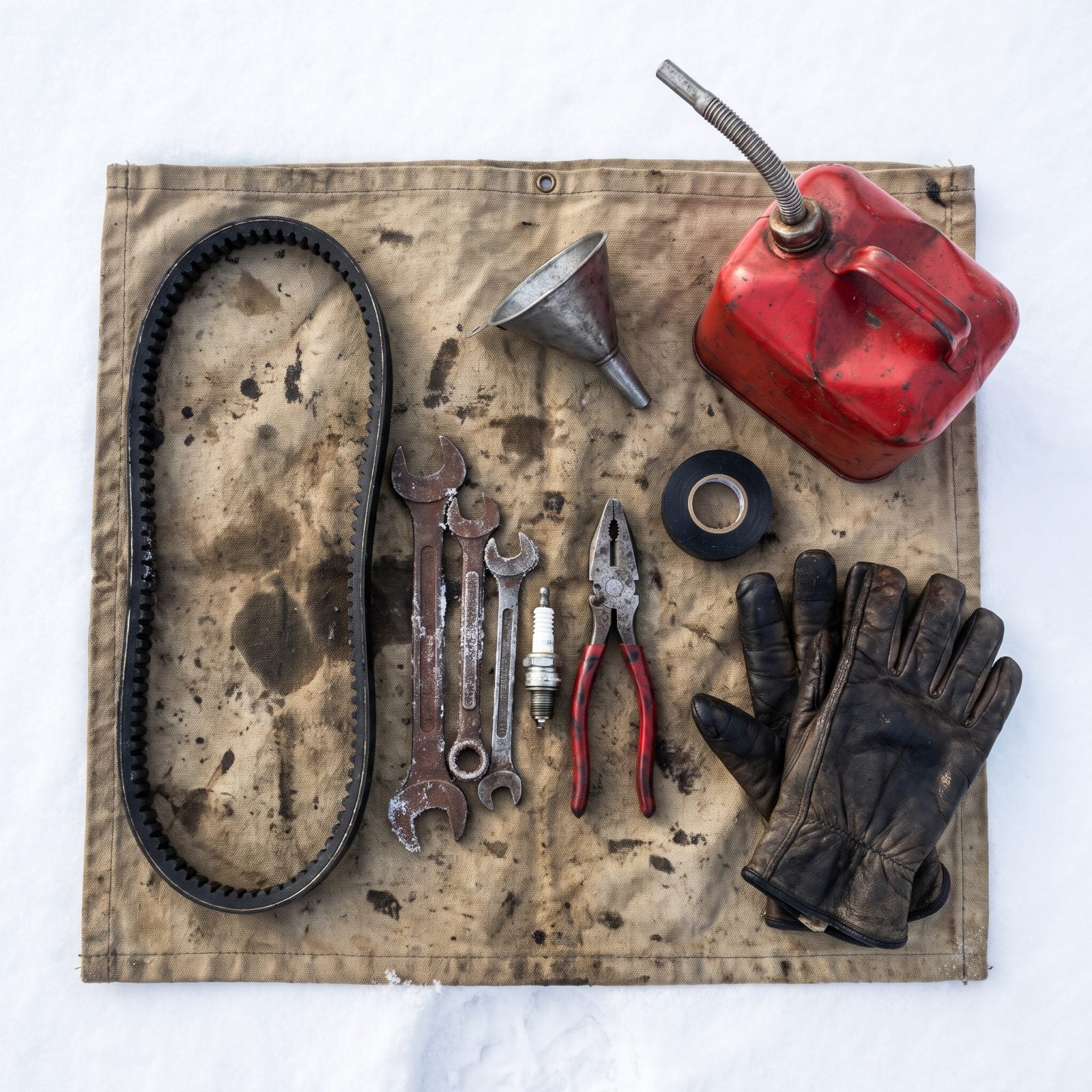
Run a snowmobile onto the ice and you brought a toolbox. Not out of caution — out of experience. These machines stalled, fouled plugs and threw belts with maddening regularity.
A spare drive belt lived under the seat of nearly every rig, along with a plug wrench and a few hand tools. Getting stranded a mile out with a dead engine and the temperature dropping was a genuine hazard, not an inconvenience. You learned to fix the thing yourself or you stopped going far from shore. Simple as that.
29. Cars and Pickup Trucks Regularly Became Ice-Fishing Transportation
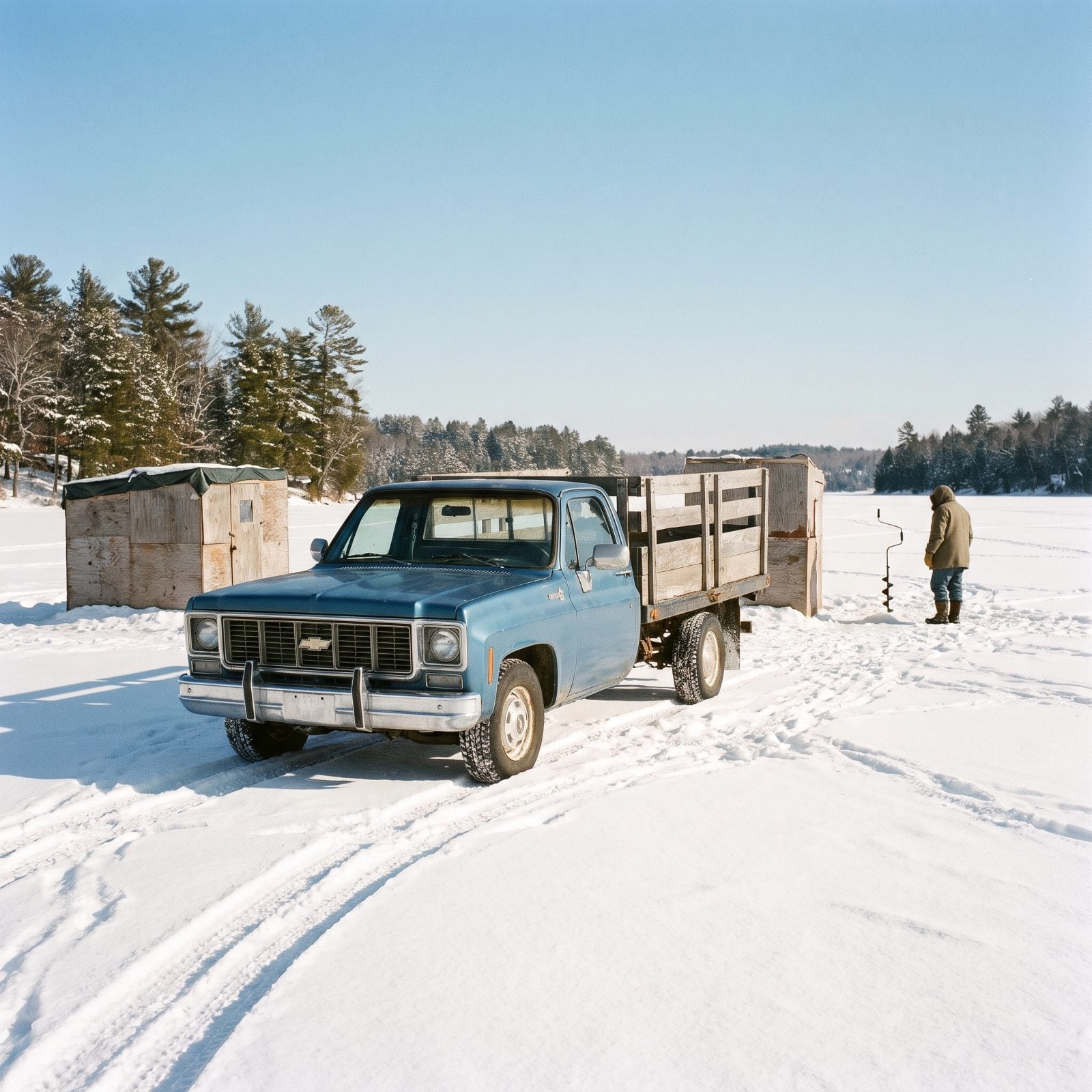
People drove out onto the lake. Full-size cars and pickups, right out on the ice, parked next to the shanties like a frozen parking lot.
On thick, well-established ice this was common and reasonably safe. On marginal ice it killed people. Every winter a few vehicles went through, usually near springs or pressure cracks or some spot a guy swore was solid last week. The confidence of driving out there was real, and so was the price when the judgment was off.
28. Local Knowledge Identified Springs, Current and Thin Ice
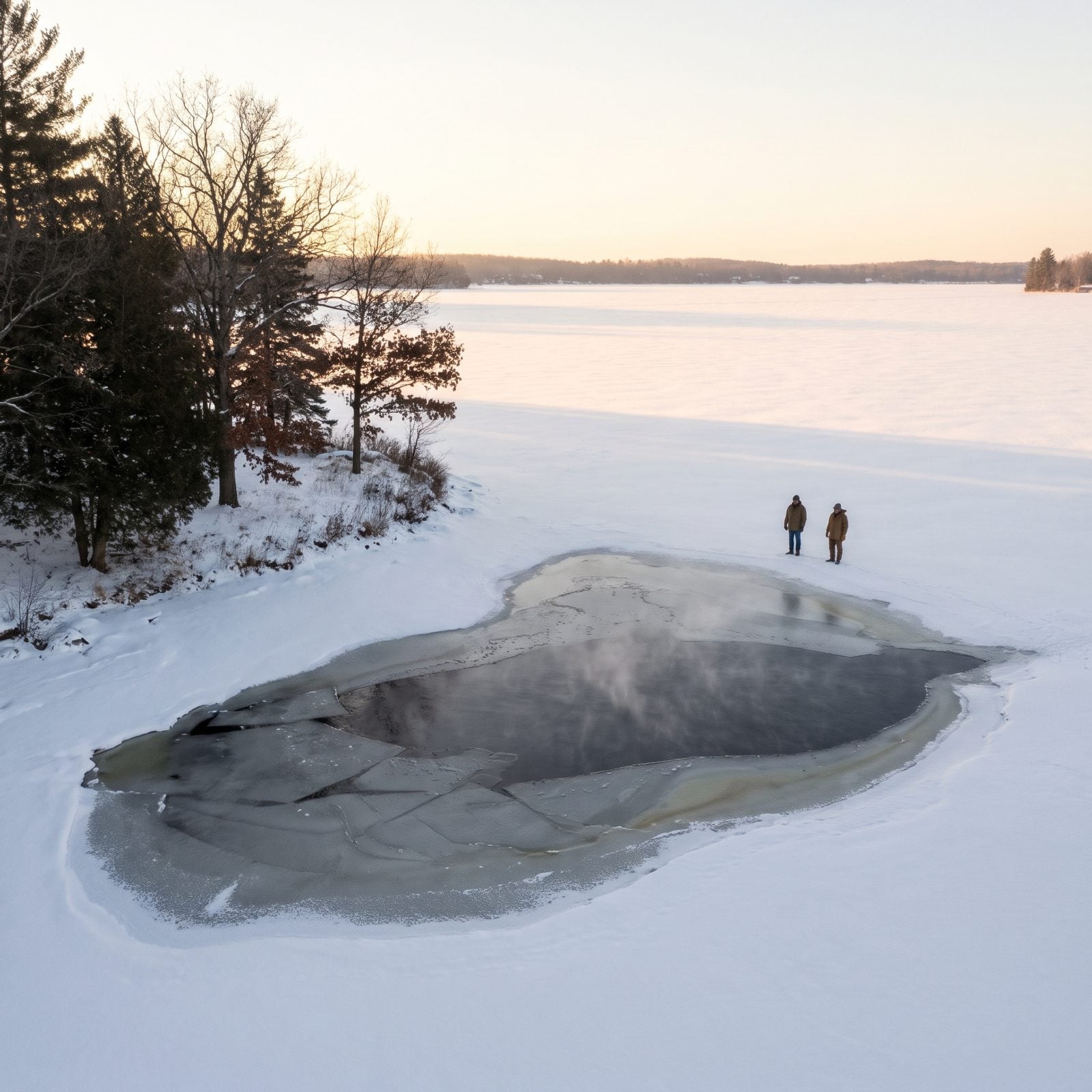
The old-timers knew where the springs came up. They knew which narrows kept a current running under the ice all winter, and which bay froze last and thawed first.
None of it was written down. It passed over coffee, father to son, neighbor to neighbor. A newcomer who ignored the local warnings and set up over a spring learned a hard lesson — if he was lucky enough to learn it at all. That knowledge was worth more than anything in the sled.
27. Ropes and Wooden Planks Served as Rescue Equipment
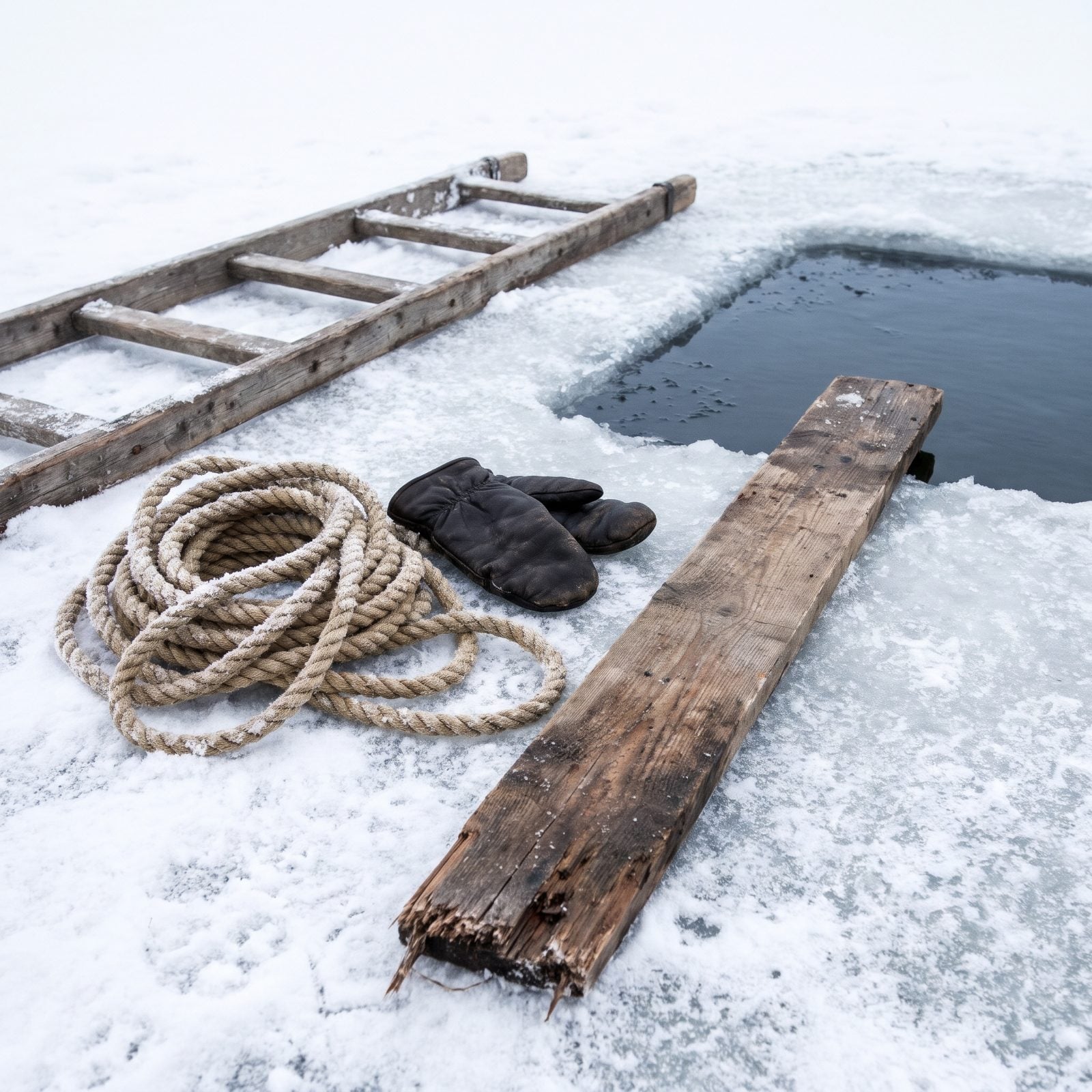
When someone went through, there was no throwable floating rescue device in a bright orange case. There was a rope, if you were smart enough to carry one, and whatever else you could reach out across the ice without going in yourself.
A plank or a wooden ladder spread your weight and let you crawl toward the hole without breaking through again. Everyone understood the rule: you don’t walk up to the edge of the broken ice. You spread your weight out and you keep something solid between you and the water.
26. Purpose-Built Flotation Suits Were Not Available
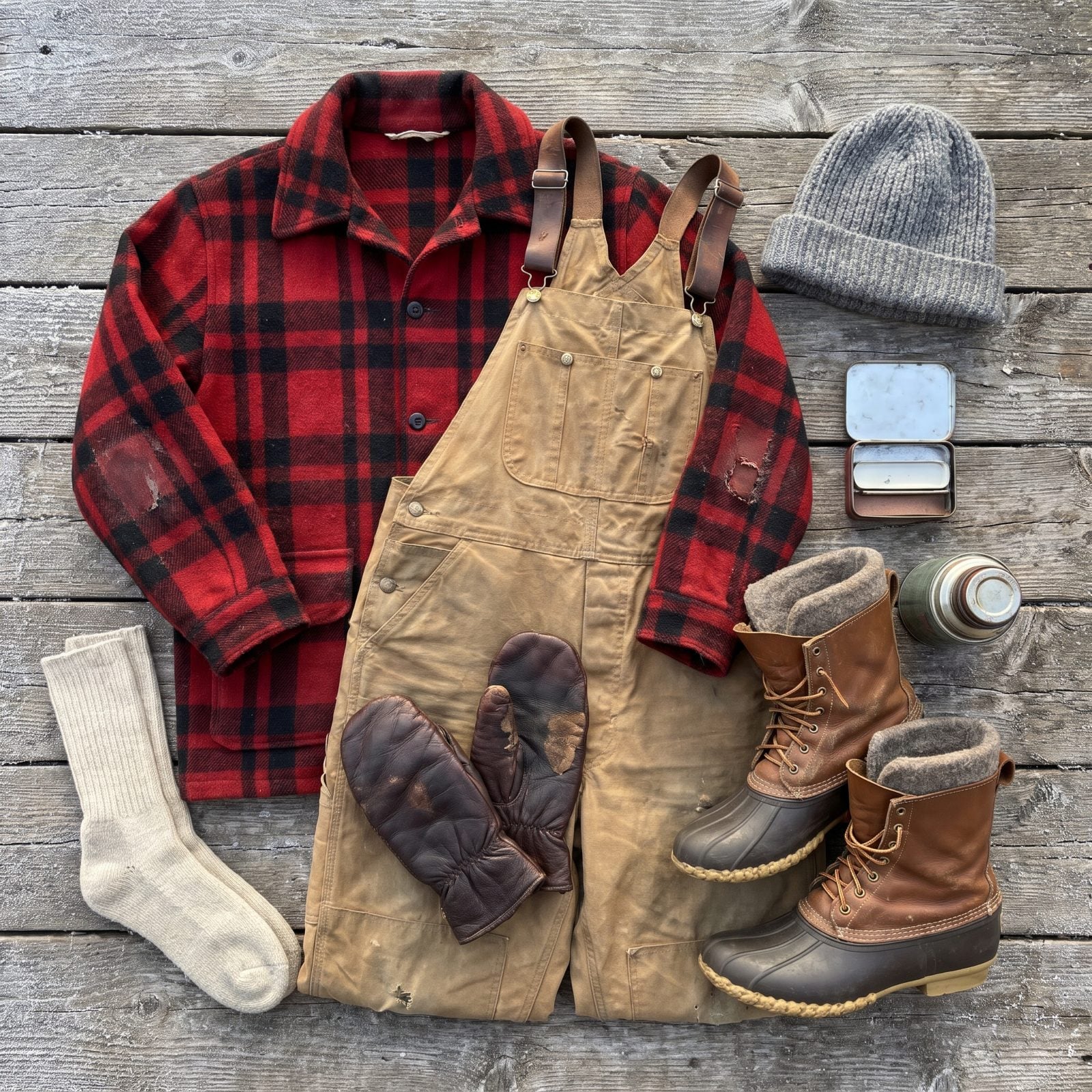
The flotation suit that keeps you alive and buoyant if you go through the ice? Didn’t exist for the average angler in the 1970s. You dressed in layers of wool and canvas, and if you broke through, all that soaked clothing pulled you straight down.
This is the single biggest safety gap between then and now. The clothing kept you warm and did absolutely nothing to keep you afloat. Survival in the water came down to cold reflexes, your companions, and whatever rope or plank happened to be within reach.
25. Heavy Plywood Fish Houses Rode on Wooden Skids
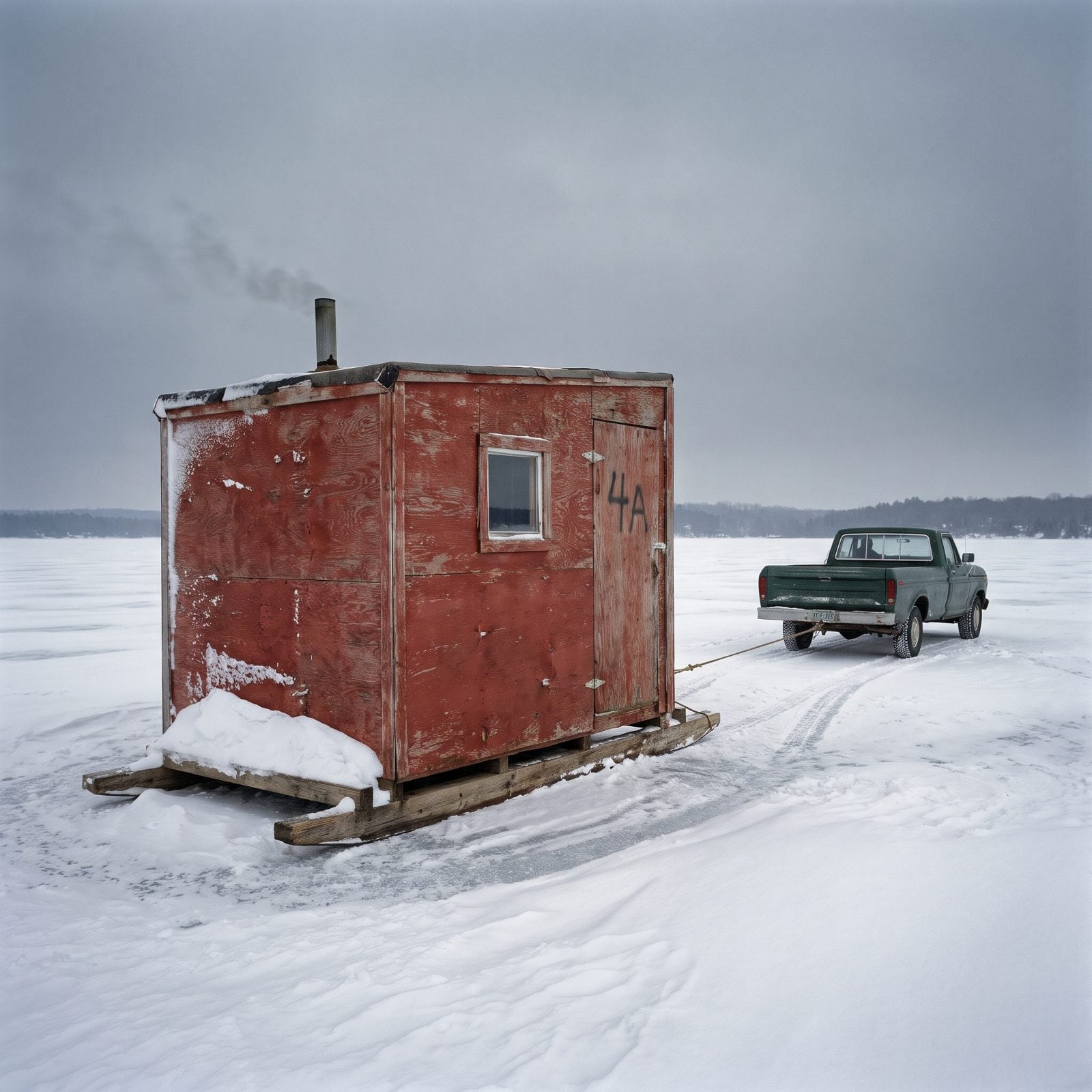
These things weighed a ton, and that was the point. A plywood fish house built on two wooden skids was never meant to be nimble. You dragged it out behind a truck once the ice was thick enough, parked it over a good spot, and left it until spring breakup made you nervous.
Skids beat wheels on snow. A wheeled trailer digs in and bogs down; a greased skid planes over the crust like a sled. Men would wax the runners or nail on strips of steel to help them glide.
The trade-off was obvious. Once that house froze down into slush and refroze overnight, moving it took a truck, a chain, and some colorful language.
24. Frozen Lakes Developed Entire Villages of Permanent Shacks
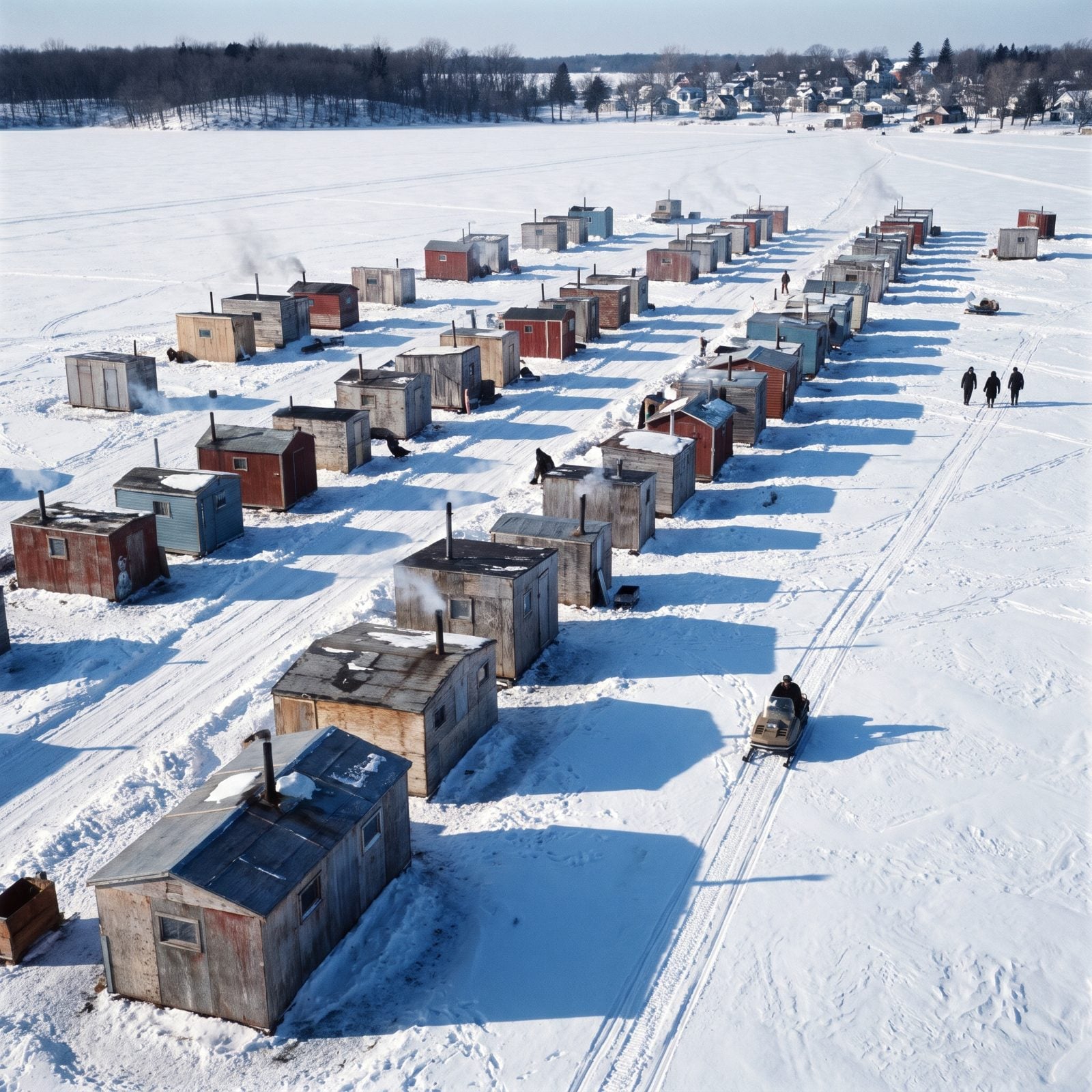
On the big lakes, winter grew a town. Hundreds of shacks laid out in rough rows, plowed lanes running between them like streets, smoke standing straight up on a still morning. Mille Lacs in Minnesota, Lake Simcoe up in Ontario, Saginaw Bay in Michigan. You could get mail delivered to some of them, which still strikes me as half miracle, half nonsense.
For a few months a sheet of ice carried a neighborhood that vanished without a trace by May.
There were rules, some written and most not. You didn’t drill next to another man’s house. You helped push a stuck truck. And everybody watched the ice together, because the whole village floated on the same uncertain thing.
23. Canvas Tents Provided Shelter Before Pop-Up Hubs
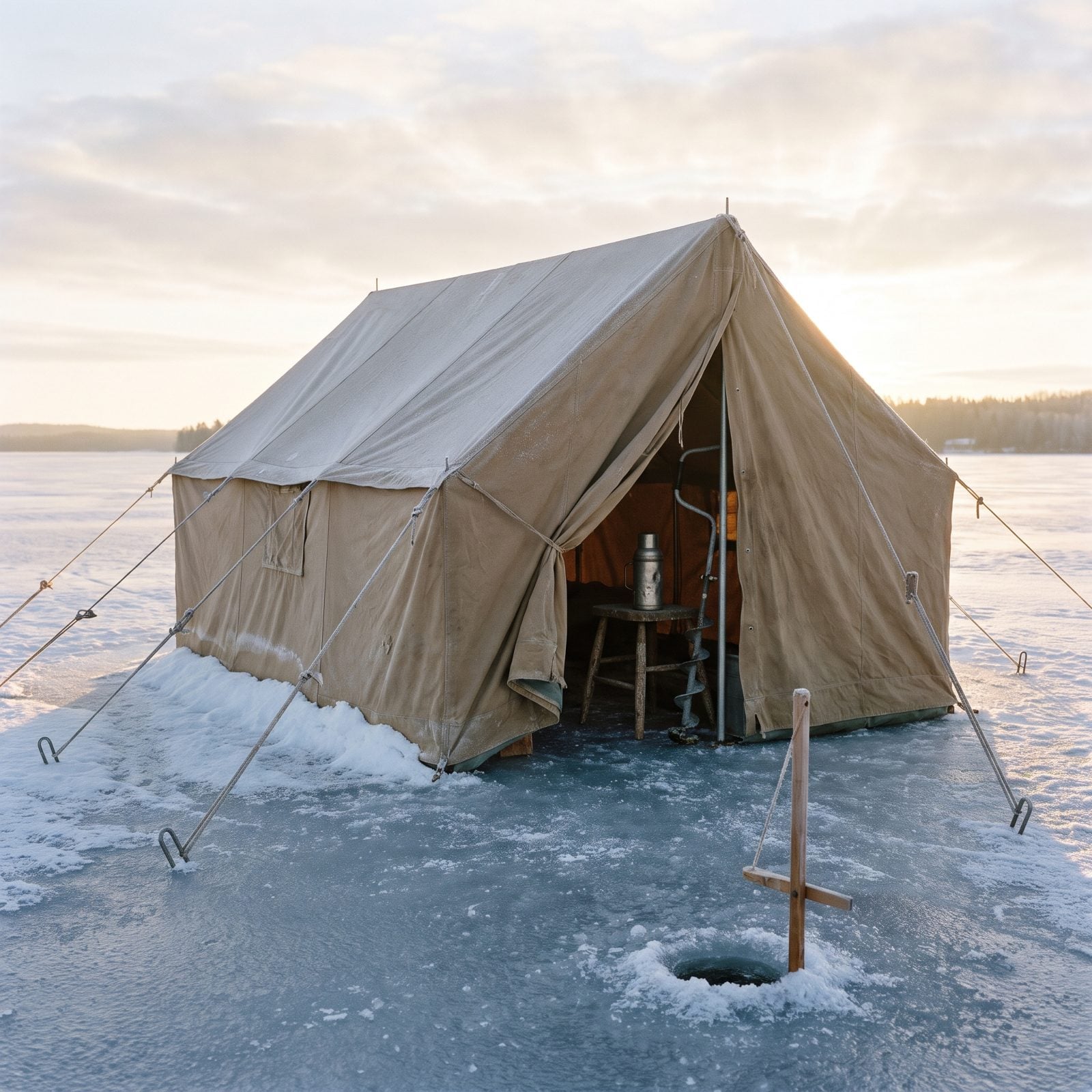
Before anything folded open in thirty seconds, shelter came in heavy canvas. You carried the poles and the fabric separately, staked the guy lines down into the ice, and hoped the wind held off until you got it standing.
Canvas had real virtues. It breathed, so you got less frost dripping off the ceiling than you do inside sealed nylon, and it held heat from a small stove reasonably well. It also smelled like every good trip you’d ever taken.
But it soaked up moisture, froze stiff as plywood, and weighed a small fortune when wet. Packing it out at dusk was a chore nobody volunteered for.
22. Scrap Lumber and Tarps Became Improvised Windbreaks
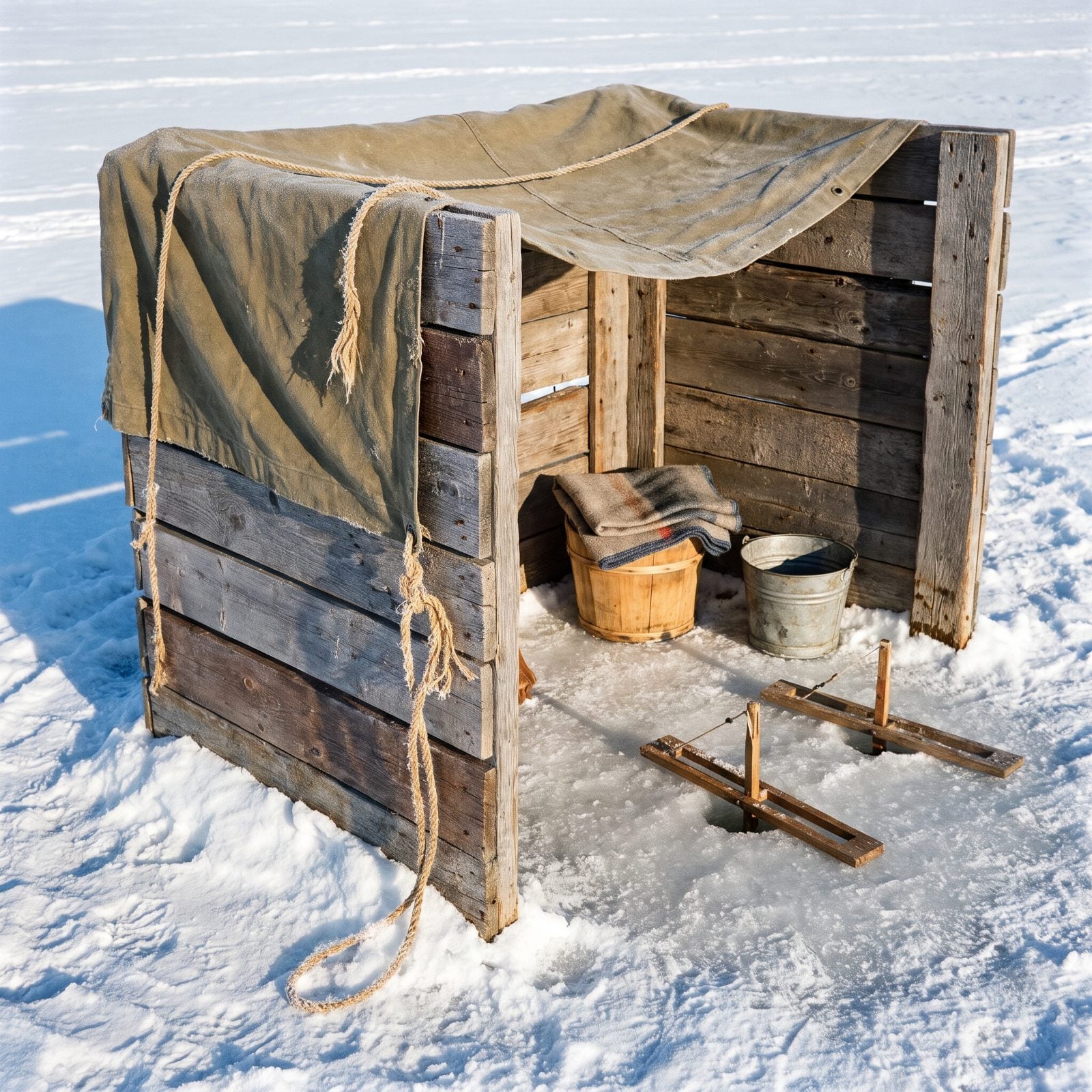
Not everyone wanted a shack. Plenty of men fished in the open, hunched over a hole, with nothing between them and the lake wind but whatever they’d thrown in the truck. Old barn boards. A tarp. A couple of fence posts.
You’d set the windbreak on the upwind side, wedge your bucket in the lee of it, and a brutal day turned tolerable. Doesn’t sound like much. On a flat lake with nothing to stop the wind for a mile, it’s the difference between staying and quitting.
21. Tiny Woodstoves Heated Many Permanent Fish Houses
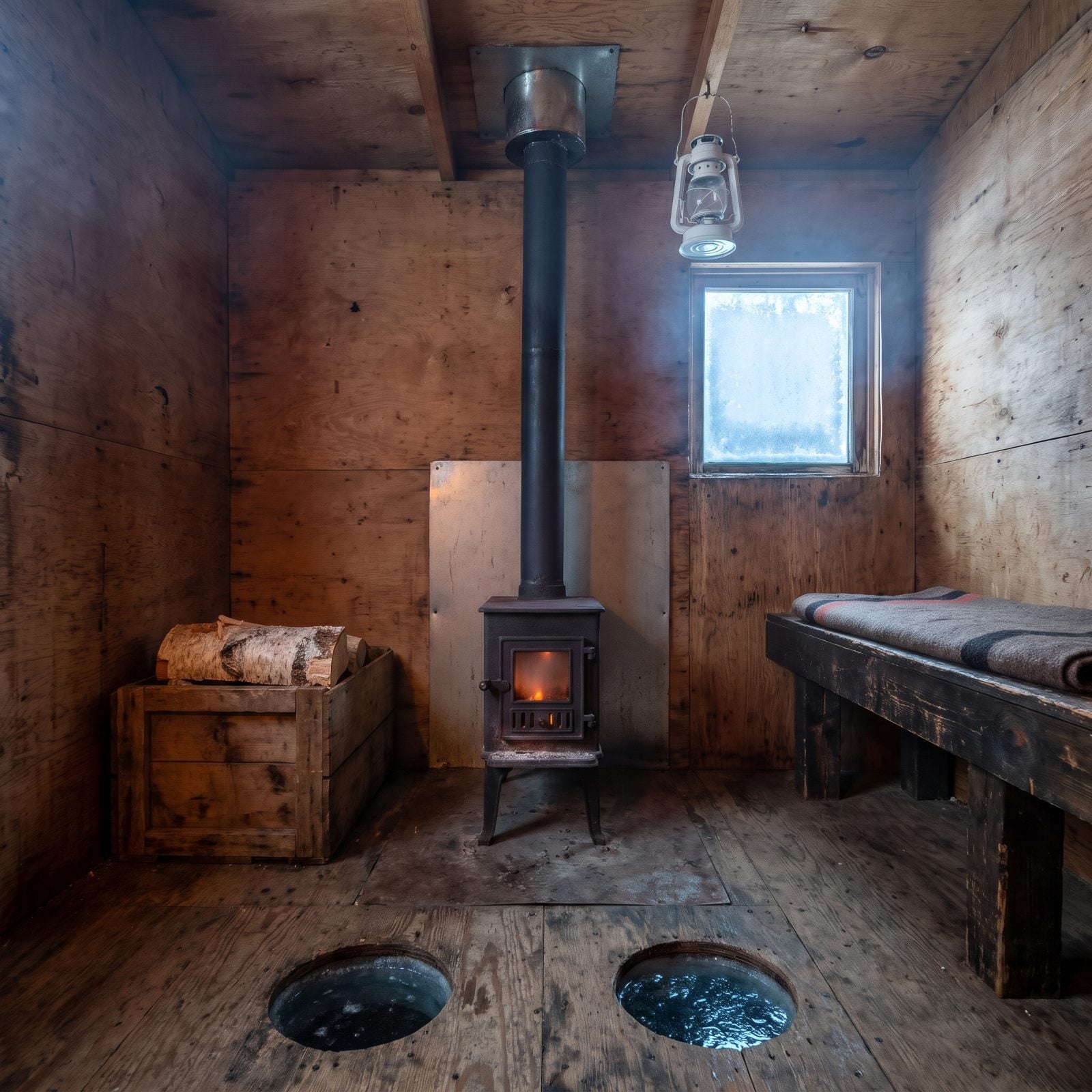
Step into a well-kept permanent house on a cold morning and the first thing that hit you was the warmth, coming off a woodstove the size of a bread box. Scrap birch, a few charred fingerprints on the loading door, a stovepipe punched through the roof.
A small woodstove does something a propane heater can’t quite manage: it dries the place out. The air inside a wood-heated shack felt different, warmer and less clammy, and your gloves actually got dry hanging over it.
The catch was feeding it. You couldn’t leave one burning unattended and you couldn’t sleep well next to one either. But for a day of fishing? Few things beat it.
20. White-Gas Lanterns Supplied Both Light and Warmth
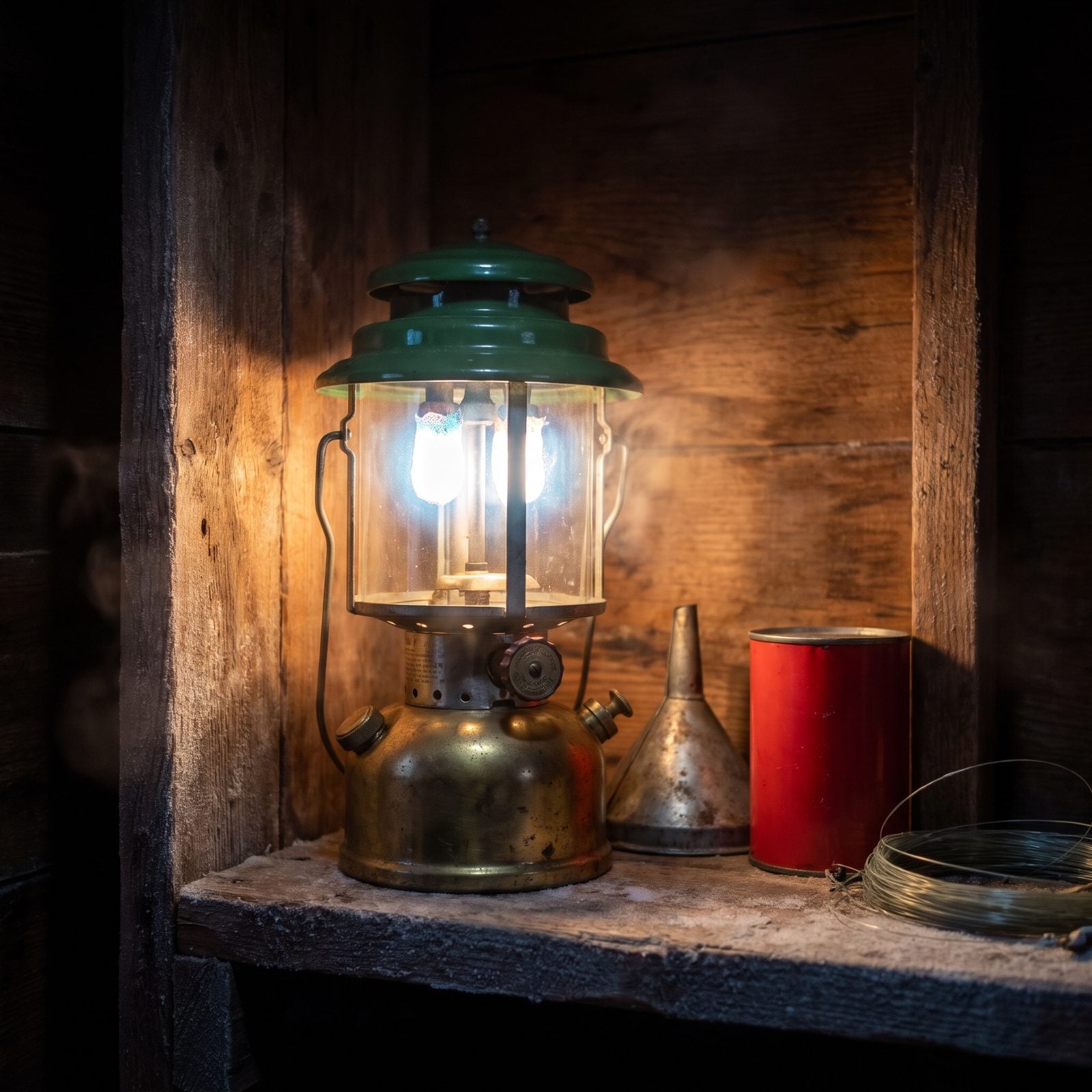
Dual purpose, and everybody knew it. A white-gas pressure lantern threw enough light to tie a jig in the dark, and it put off a surprising amount of heat doing it. In a small shelter, one roaring lantern took the edge right off.
You pumped the tank to build pressure, lit the mantles, and listened to that steady hiss all evening. The fragile mantles were the weak point. Bump one with a tackle box and it crumbled to ash, and then you were digging for a spare in the dark.
Here’s the part nobody mentions now. That heat and light came from burning fuel in a closed space, a theme that comes back more than once on this list, and not a happy one.
19. Carbon-Monoxide Alarms Were Rare or Entirely Absent
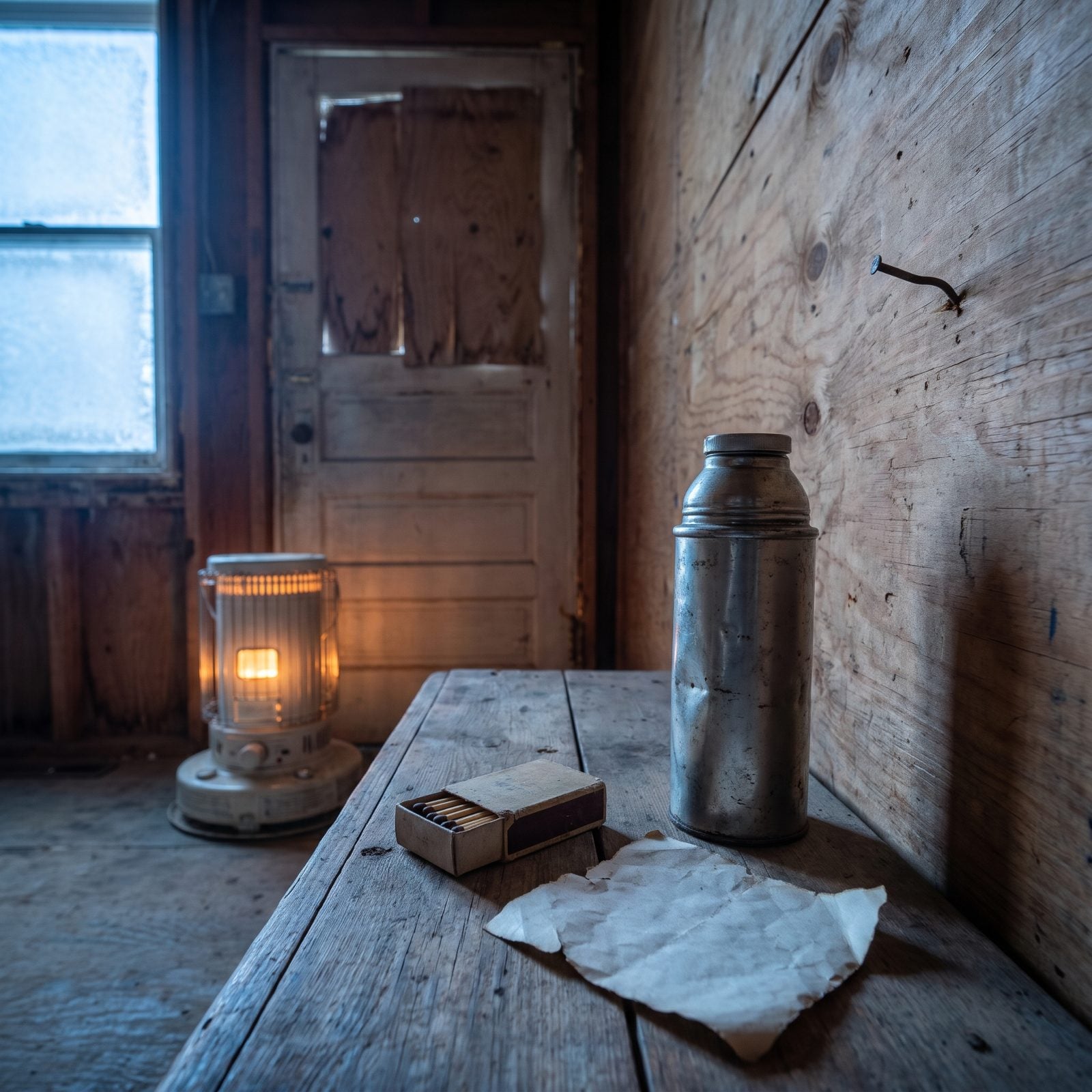
Here’s the sobering one. Through most of the 1970s, a carbon-monoxide detector in an ice-fishing shack was close to unheard of. The home units didn’t become common until the late 80s and 90s, and even in a dim, cramped wooden shack with a kerosene heater burning, a cheap, cautionary device simply wasn’t something people owned.
Carbon monoxide is colorless, odorless, and it doesn’t announce itself. It just makes you sleepy, gives you a headache, and in a closed-up shack with the door latched and the kerosene heater running it can do far worse. People got hurt. Some didn’t come home.
18. Wool, Cotton and Heavy Coveralls Were the Standard Layers
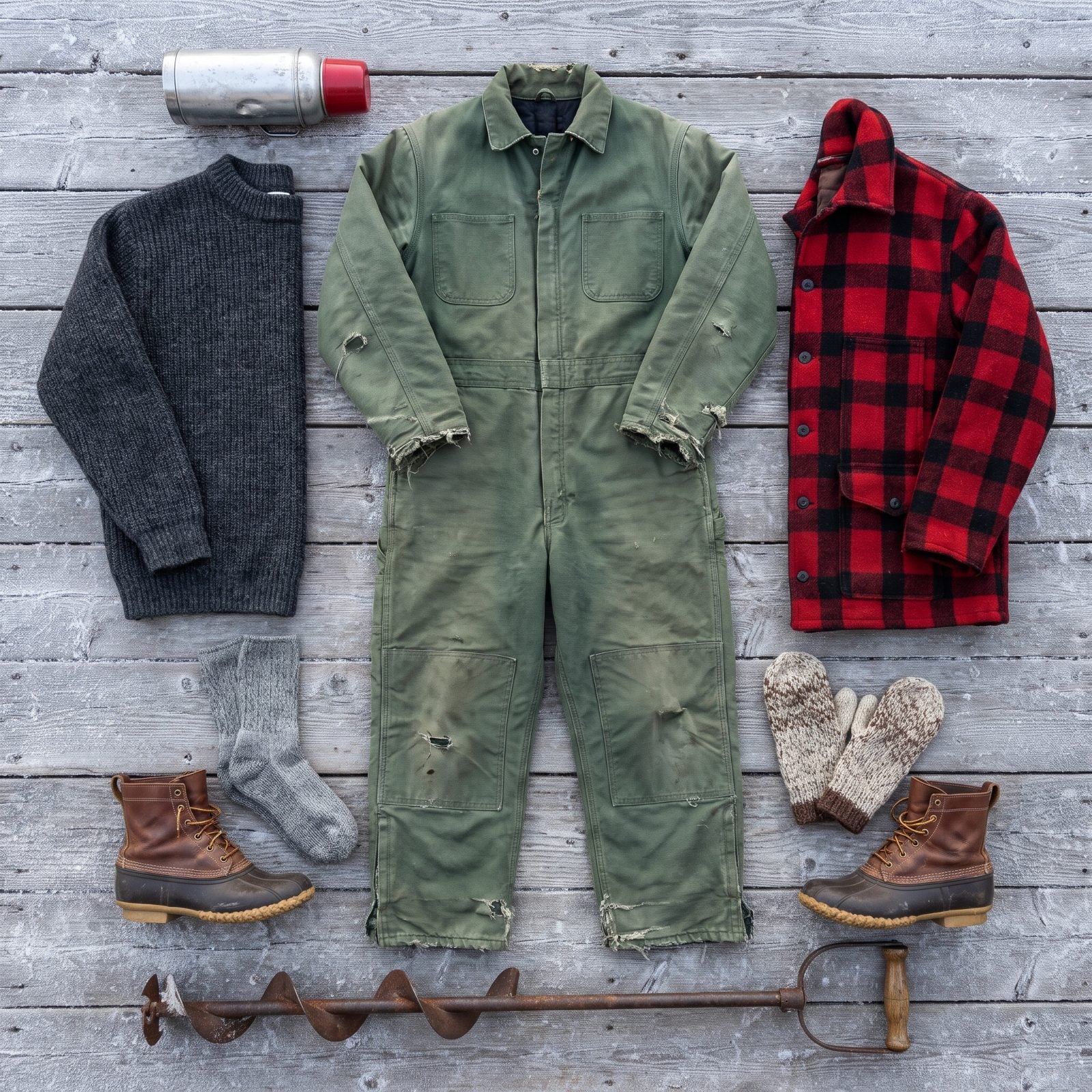
No microfiber, no laminated membranes, no heated anything. You layered wool over cotton, pulled on heavy canvas coveralls, and topped it with a buffalo-plaid wool jacket your father probably wore first.
Wool was the hero and the villain. It kept you warm even when damp, which on the ice happened constantly, between snow, slush, and your own sweat. That’s its real trick, and it’s why wool still earns its place today. The downside was weight. A full rig of soaked wool and canvas hung on you like a second body.
Cotton was the quiet danger nobody flagged back then. Soak a cotton undershirt with sweat and it holds that cold wet against your skin all day. The men who stayed warmest were the ones, often by pure luck, wearing wool next to the skin and saving the cotton for town.
17. Rubber Pac Boots and the Felt Liners That Lived by the Stove
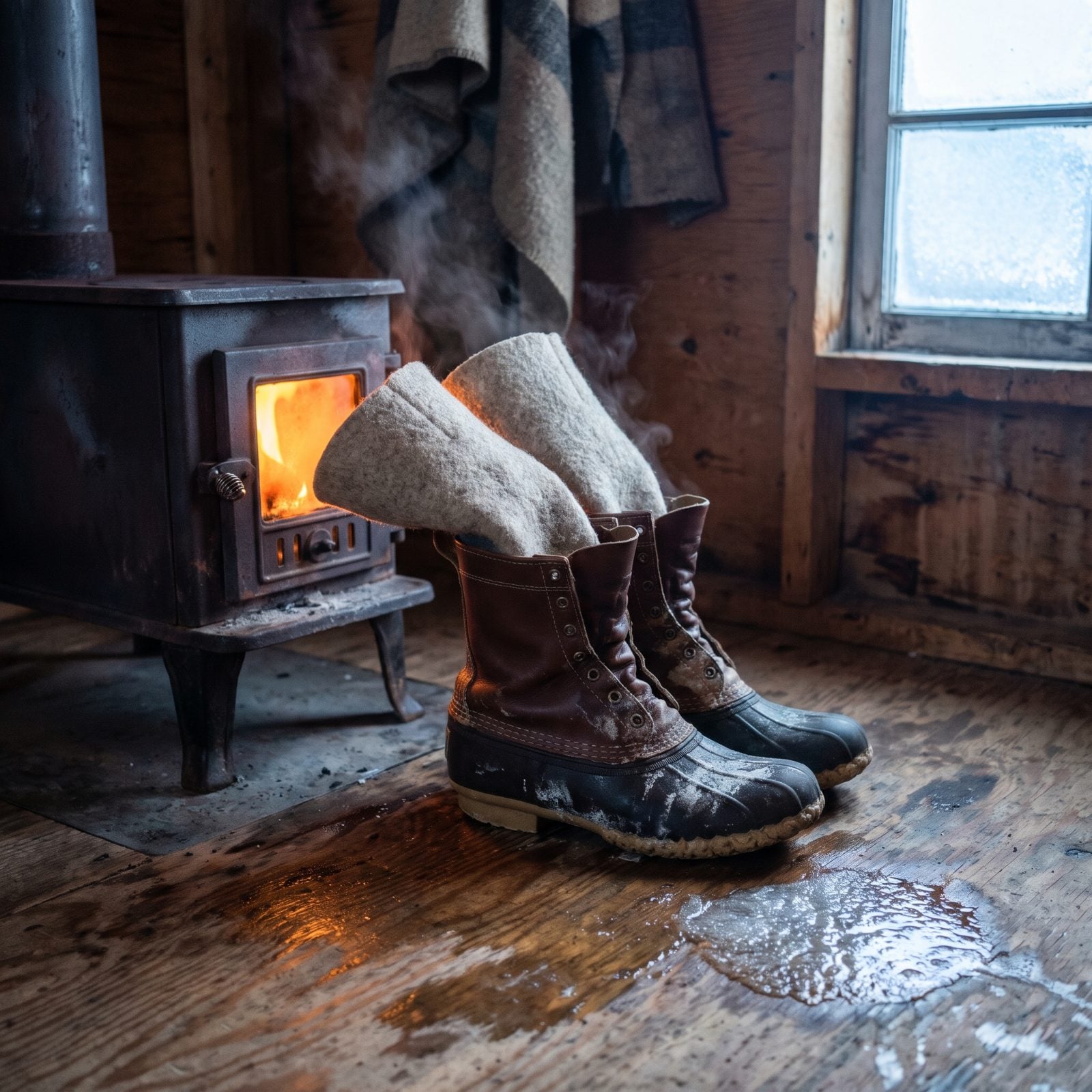
Everyone who fished hard water back then knew the ritual. You came in off the lake, pulled the boots, and the felt liners came out to dry by the stove or the furnace at home. Miss that step and the next morning started with cold, half-wet felt packed against your socks. Nothing drains the warmth from a day faster.
The liner was the whole system. The rubber shell kept slush out, but the felt did the insulating, and felt only works dry. Wet felt is just a cold sponge wrapped around your foot.
16. Charcoal Hand Warmers That Smoldered Inside a Metal Case
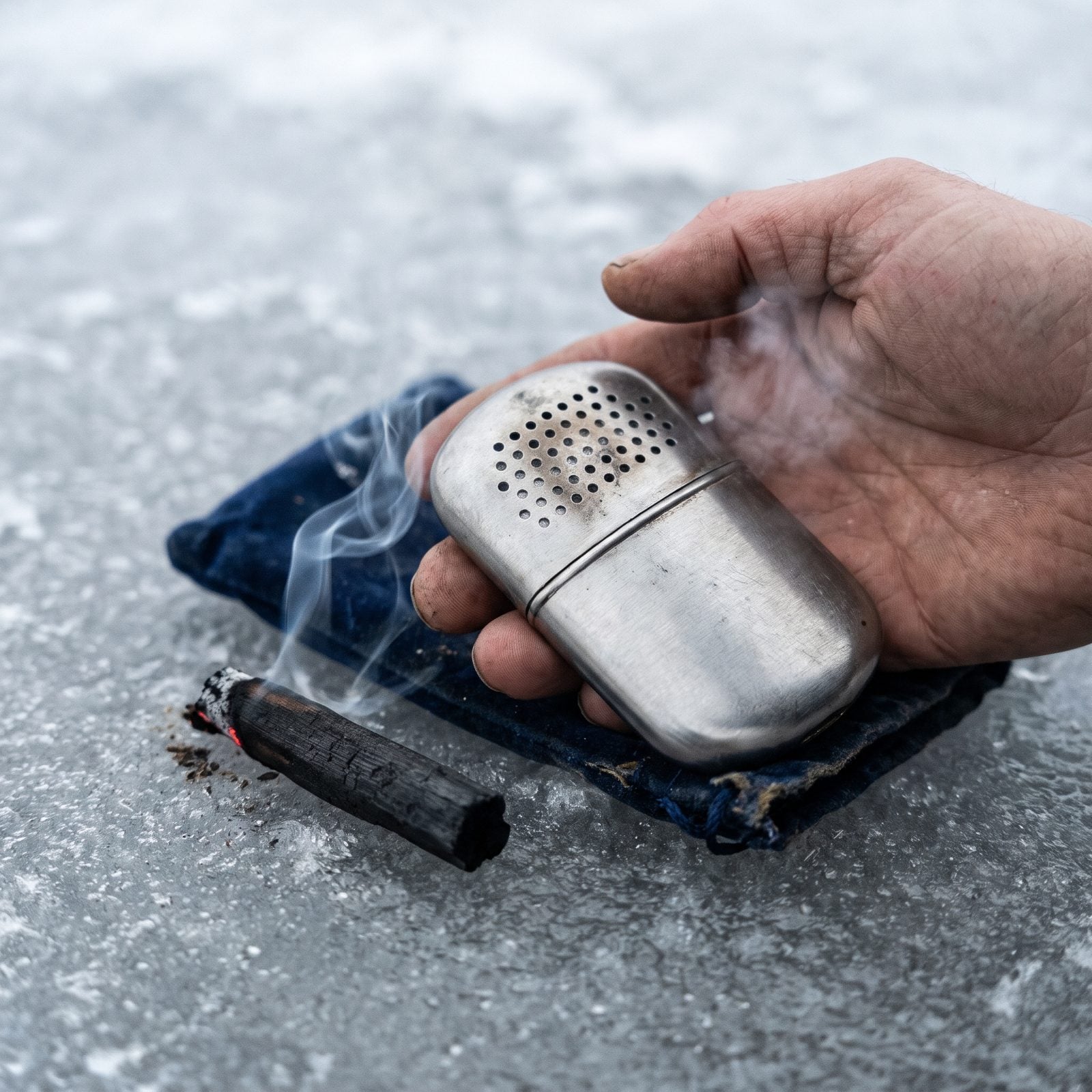
Before anybody carried throwaway air-activated packets, you lit a stick of compressed charcoal, dropped it into a metal case, and slid the whole thing into your pocket. It smoldered slow and low for hours, throwing just enough heat to keep your fingers from going numb.
The catch? Fumes, plus the faint worry about burning a hole in your coat. You learned to keep it in the velvet pouch and not crammed against bare skin. Done right, it was a small furnace you could cup in one hand.
15. Wet Wool Mittens That Froze Into Boards
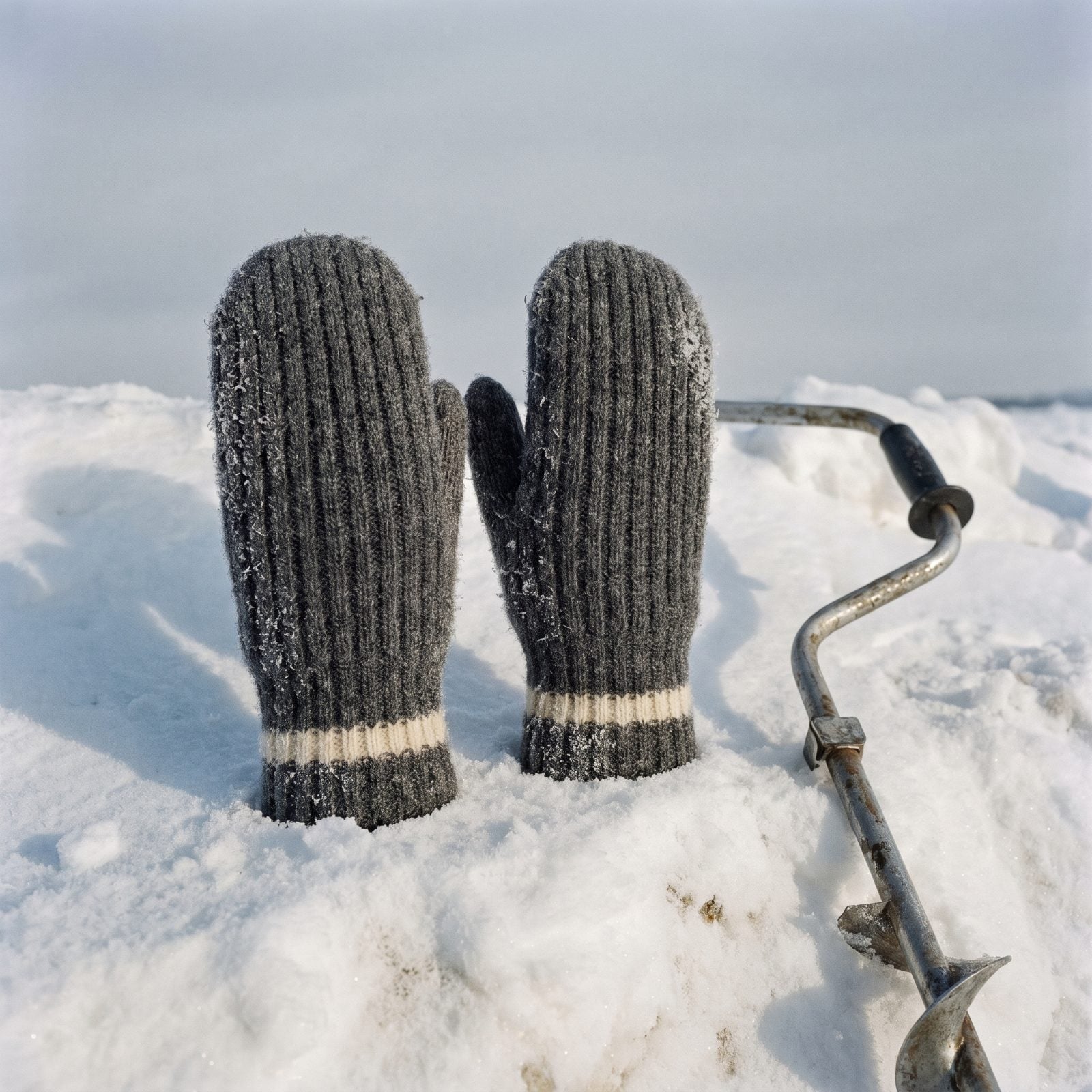
Wool was the standard, and wool had one bad habit. Get it soaked handling minnows or a wet line, step away from the heat, and the mitten would freeze solid. You could stand a frozen wool mitten up on the ice like a little sculpture.
It still beat the alternatives of the day. Wet wool holds some warmth where wet cotton holds none. But you carried a spare pair, always, because once a mitten froze stiff there was no wringing the ice out of it on the lake.
14. The Vacuum Thermos That Doubled as a Portable Kitchen
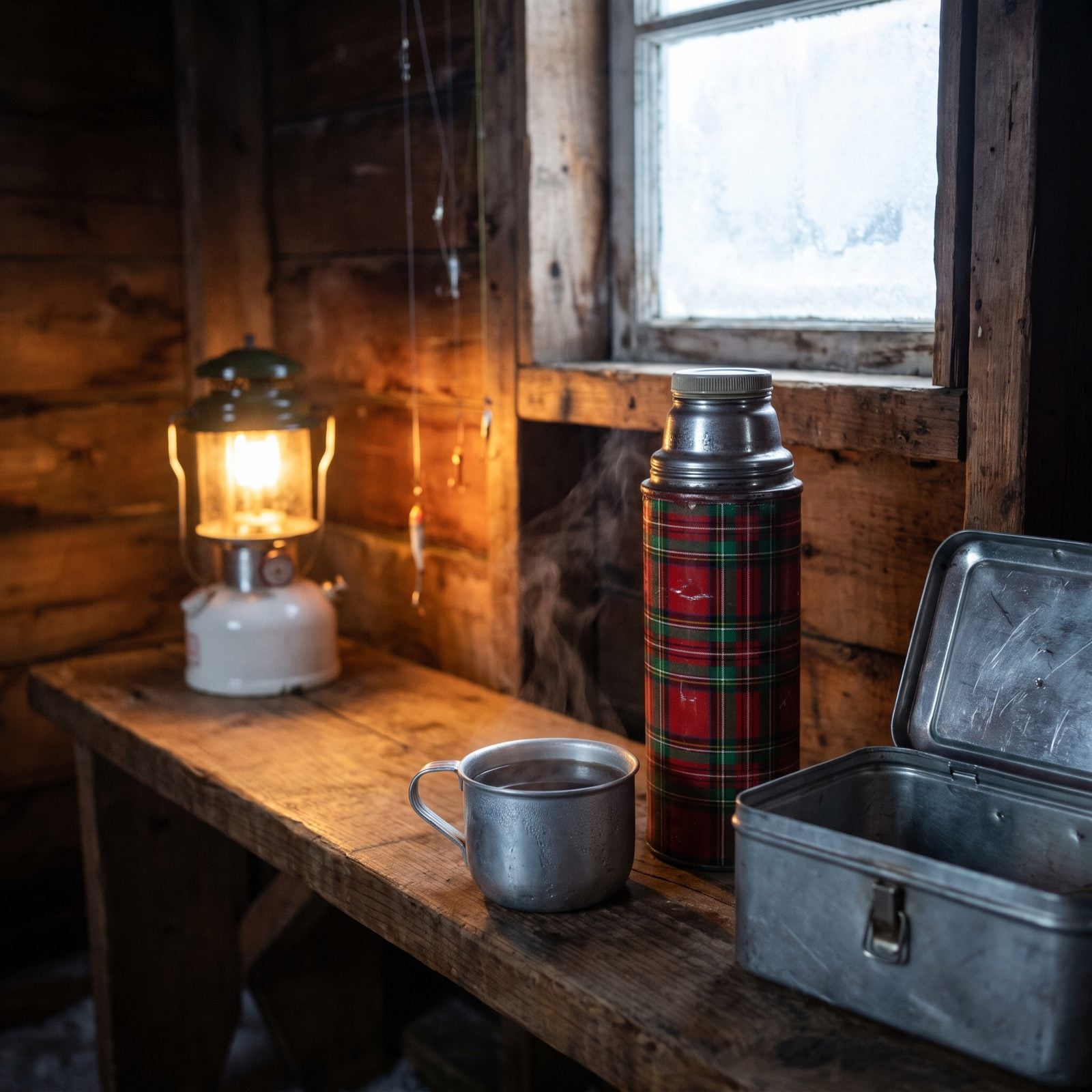
A steel vacuum thermos was the heart of the whole operation. Fill it with coffee or soup before dawn and it was still hot at noon, which on a lake in January feels like a small miracle. That screw-top cup was the warmest thing you’d hold all day.
Guys packed them in plaid and dented chrome, often tucked into a metal lunch pail. No stove to light, no fuss. You unscrewed the cap and the kitchen came to you.
13. Battery-Heated Jackets and Socks Belonged in Science Fiction
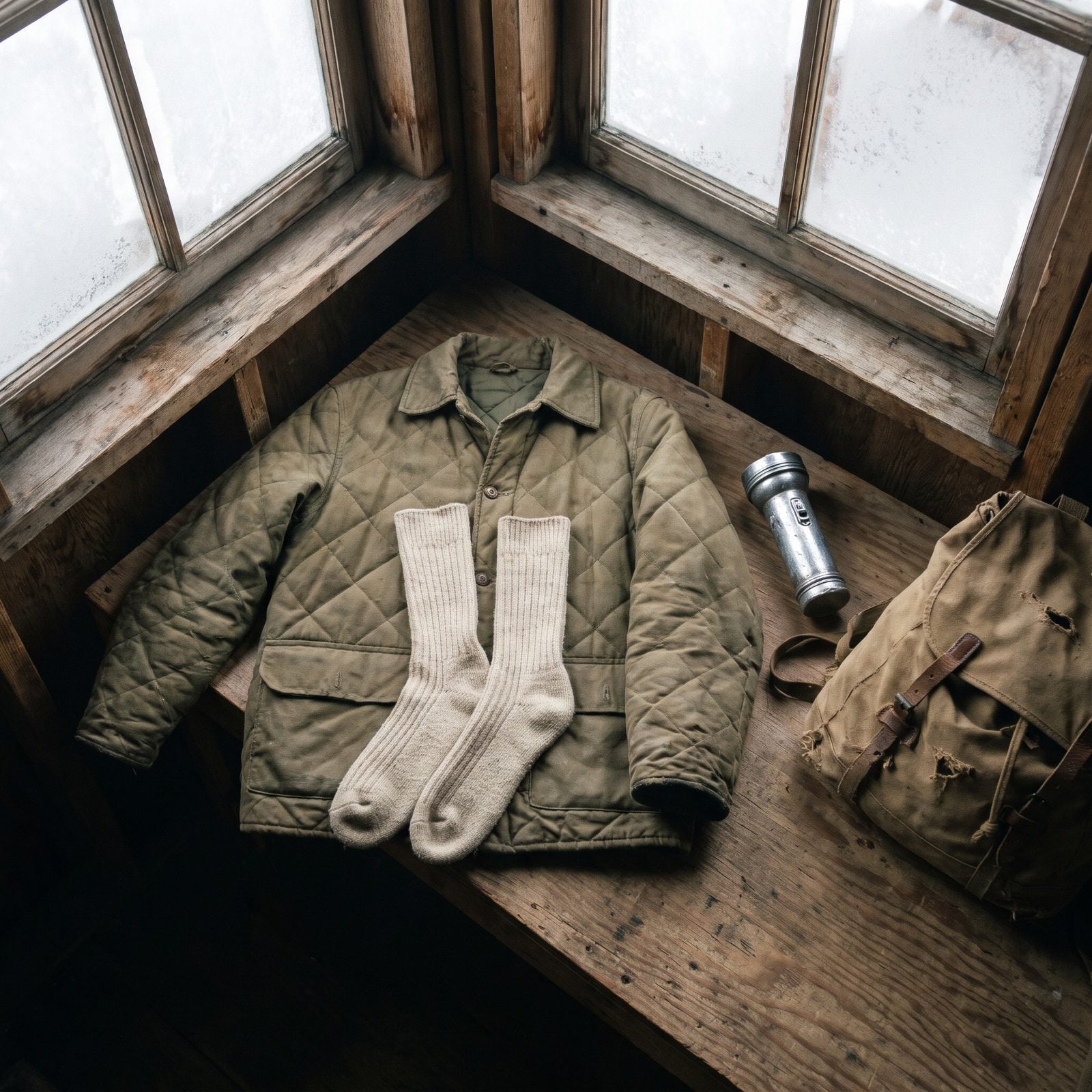
The idea of plugging your socks into a battery would’ve gotten a laugh at the bait shop. Staying warm meant layers, wool, and more layers. You dressed like you were going to sit still for six hours, because you were.
The technology simply wasn’t there. Batteries were heavy, dumb, and cold-shy, and the wiring to heat a whole jacket evenly was decades off. So you bulked up, tucked a smoldering hand warmer in a pocket, and accepted that warmth was something you packed, not something you switched on.
12. Short Jigging Sticks, Usually Whittled at Home
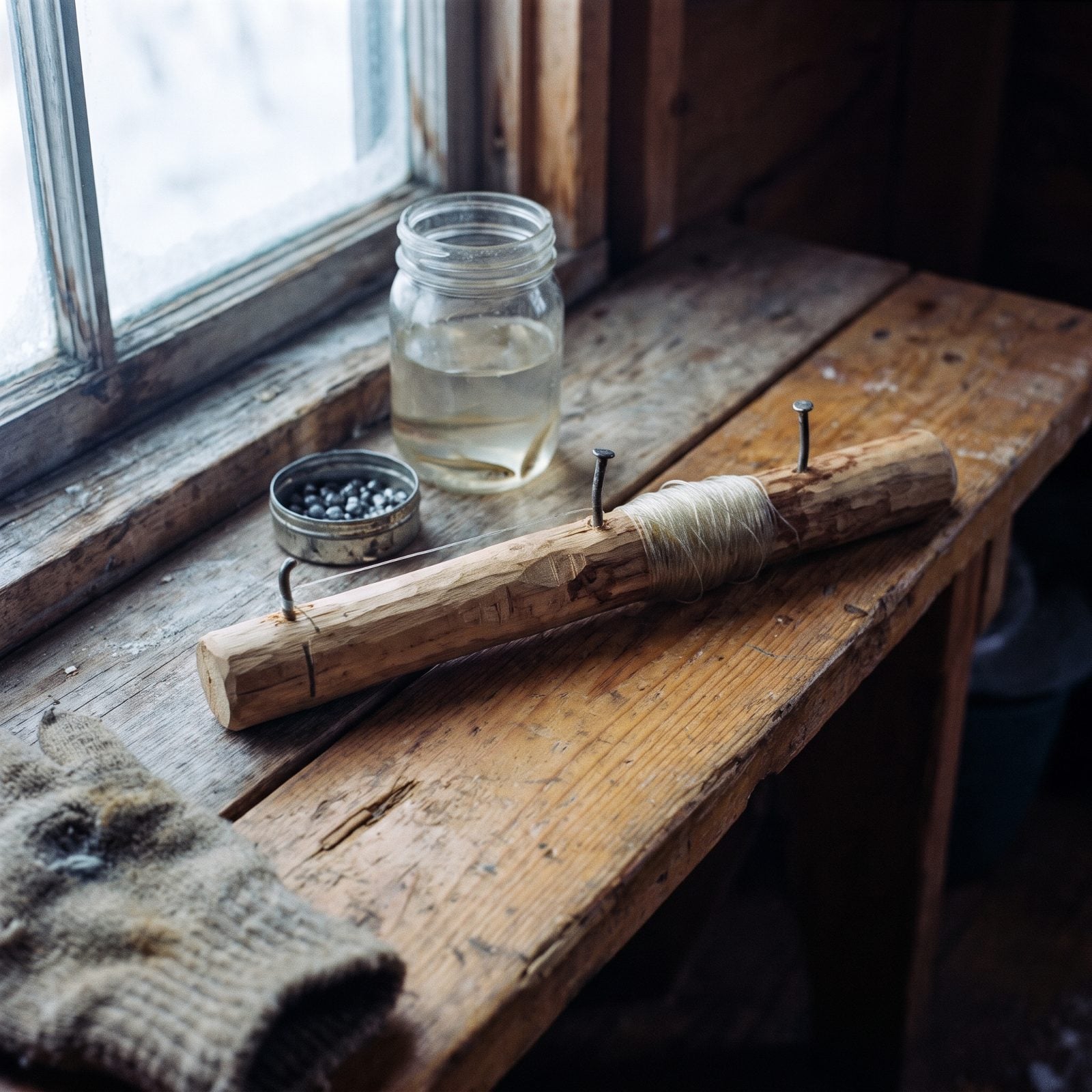
Most jigging sticks weren’t bought. They were whittled from a dowel or a broomstick on a winter night, fitted with a couple of bent nails for line guides and a peg to wind the line around. Cheap, short, and exactly as long as you needed in a cramped shanty.
I’ve got a soft spot for these, honestly. There’s a plainness to a tool somebody made with their own hands that no catalog rod ever had. It did one job and did it fine.
11. Spring Bobbers Bent by Hand from Spare Wire
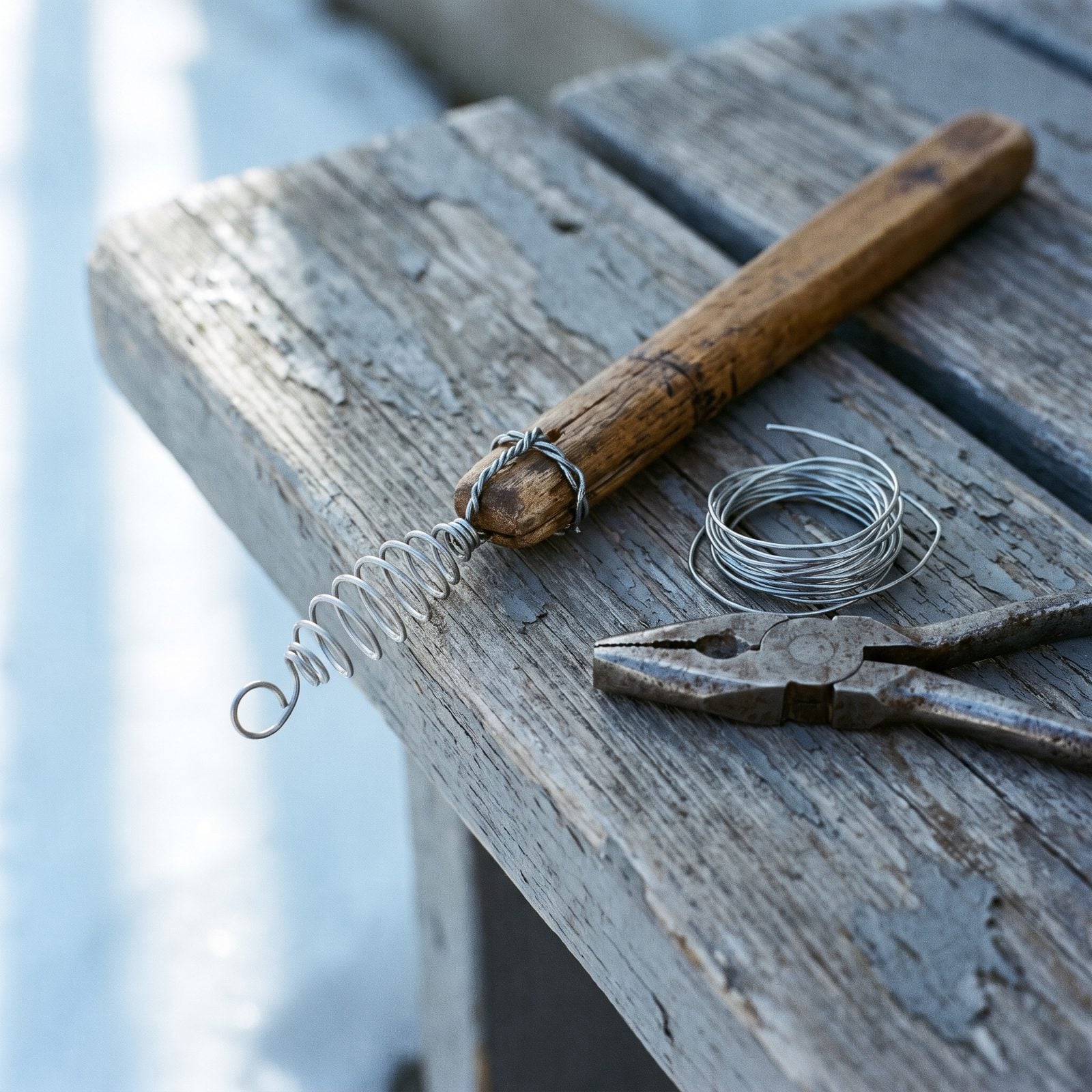
A spring bobber is a thin curl of wire at the tip of the rod that telegraphs the lightest bite — the kind a panfish gives when it just mouths the bait and sits there. Store-bought ones existed. But plenty of guys bent their own from spare wire or an old rod guide.
You tuned the sensitivity by how tight you coiled it. Too stiff and you missed the soft takes. Too limp and the wind read as a bite all day long. Finding that middle was its own small craft.
10. The Pocket Hook Stone That Brought a Dull Point Back
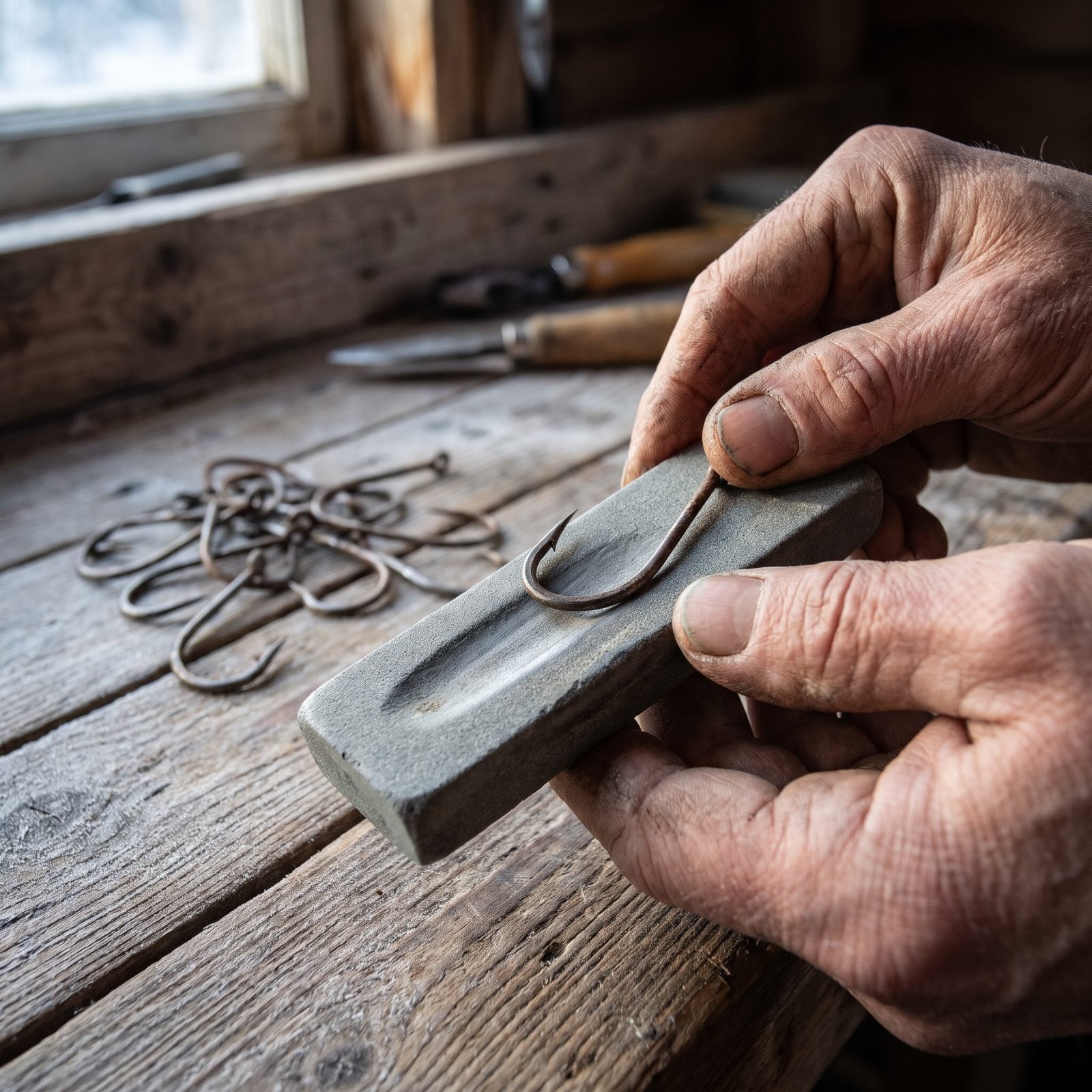
A hook point goes dull faster than you’d think — dragged across ice, nicked on gravel, worn soft from a season of use. The fix rode in your tackle kit: a hand-length bar of stone, worn into a smooth hollow in the middle from years of hooks.
Drag the point across it a few times, test it on a thumbnail, and a hook that slid off fish started biting into them again. Small habit, big difference. A sharp hook sets itself. A dull one just pokes.
9. Lowrance Green Boxes and Humminbird Super Sixties Arrived on the Ice
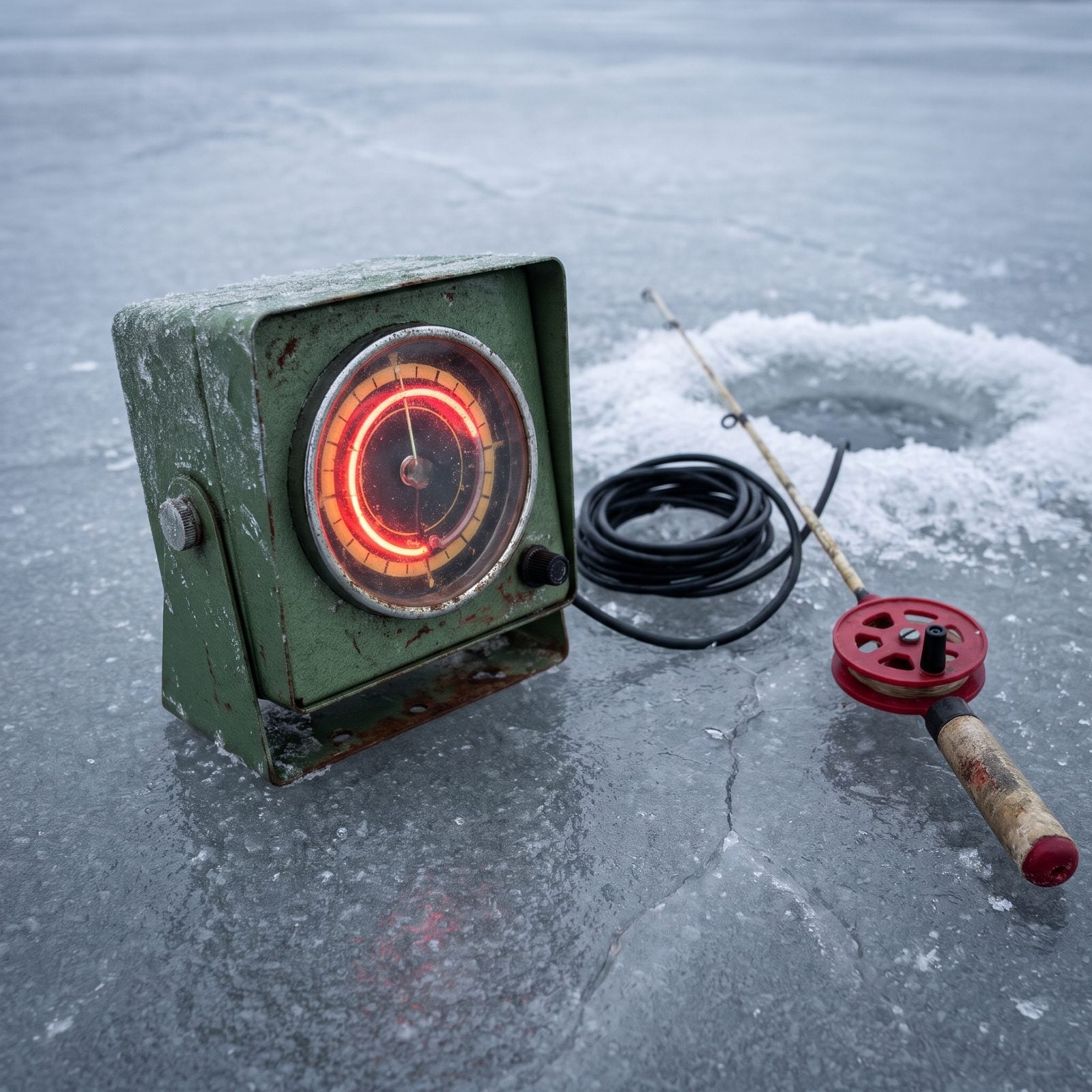
Those green Lowrance boxes changed everything, and anyone who fished before them will tell you that flat. The Fish Lo-K-Tor, the little round flasher folks just called the green box, turned a hole in the ice from a guess into a readout. A spinning light flashed red marks around the dial and told you depth, bottom hardness, and whether anything hung below your jig.
Humminbird’s Super Sixty ran the same idea with a different face. You learned to read that glowing ring like a second language — no screen, no menu, no settings, just a glowing dial and your own eyes doing the interpreting.
8. Full-Size Lead-Acid Batteries Lugged the Sonar Out
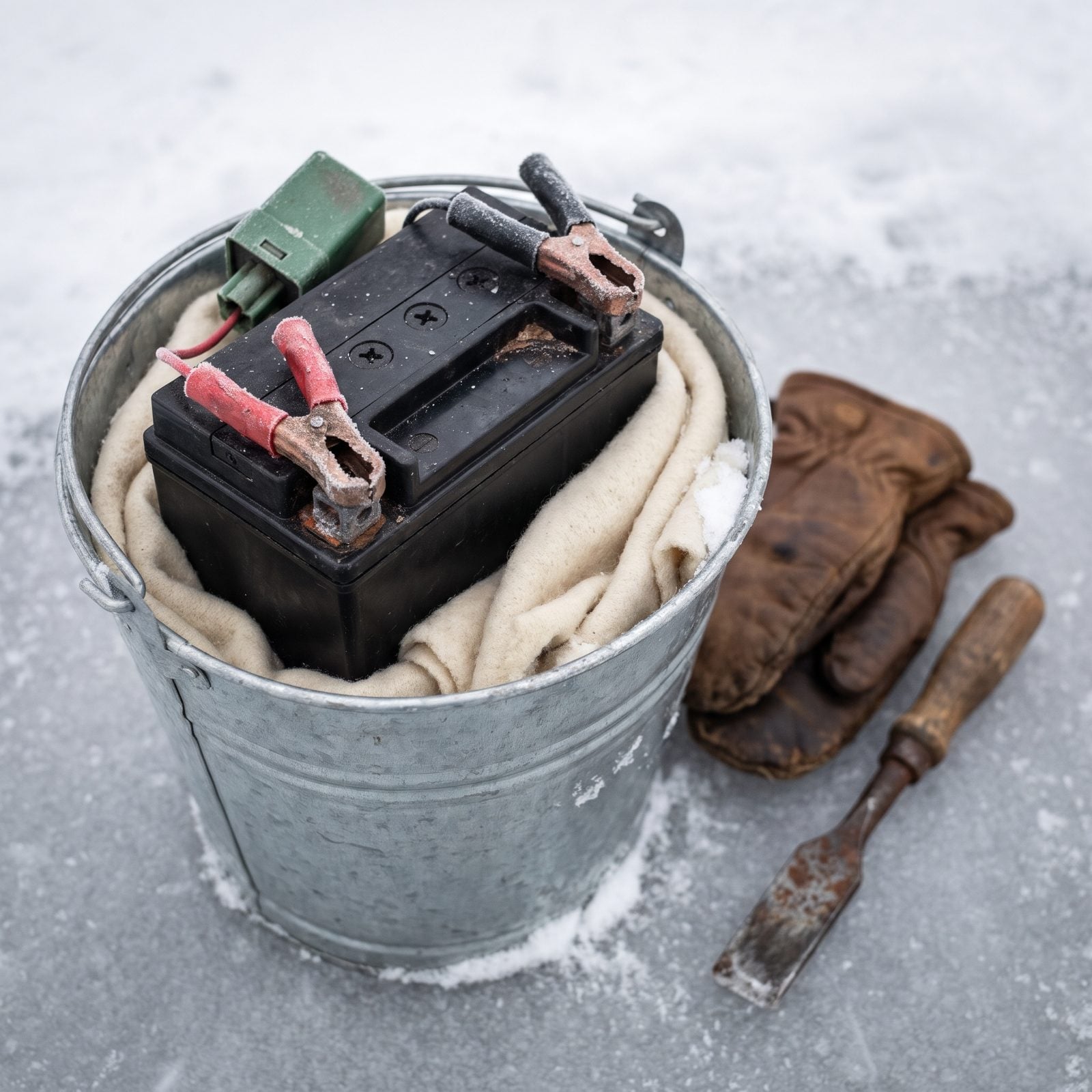
Portable sonar in those days meant portable in the loosest sense. The flasher sipped power from a lead-acid battery, often a car or motorcycle battery, and that slab of lead was the heaviest thing in the sled. You hauled it across the ice, set it in a bucket so the terminals wouldn’t short, and hoped the cold didn’t kill it by noon.
Lead-acid hates the cold. A battery that read full in your warm basement could sag badly once the air dropped to zero, and your bright red flash would dim to a ghost. So guys brought the battery inside overnight and wrapped it in a blanket out on the ice. Not elegant. It worked.
7. Underwater Fishing Cameras Simply Did Not Exist
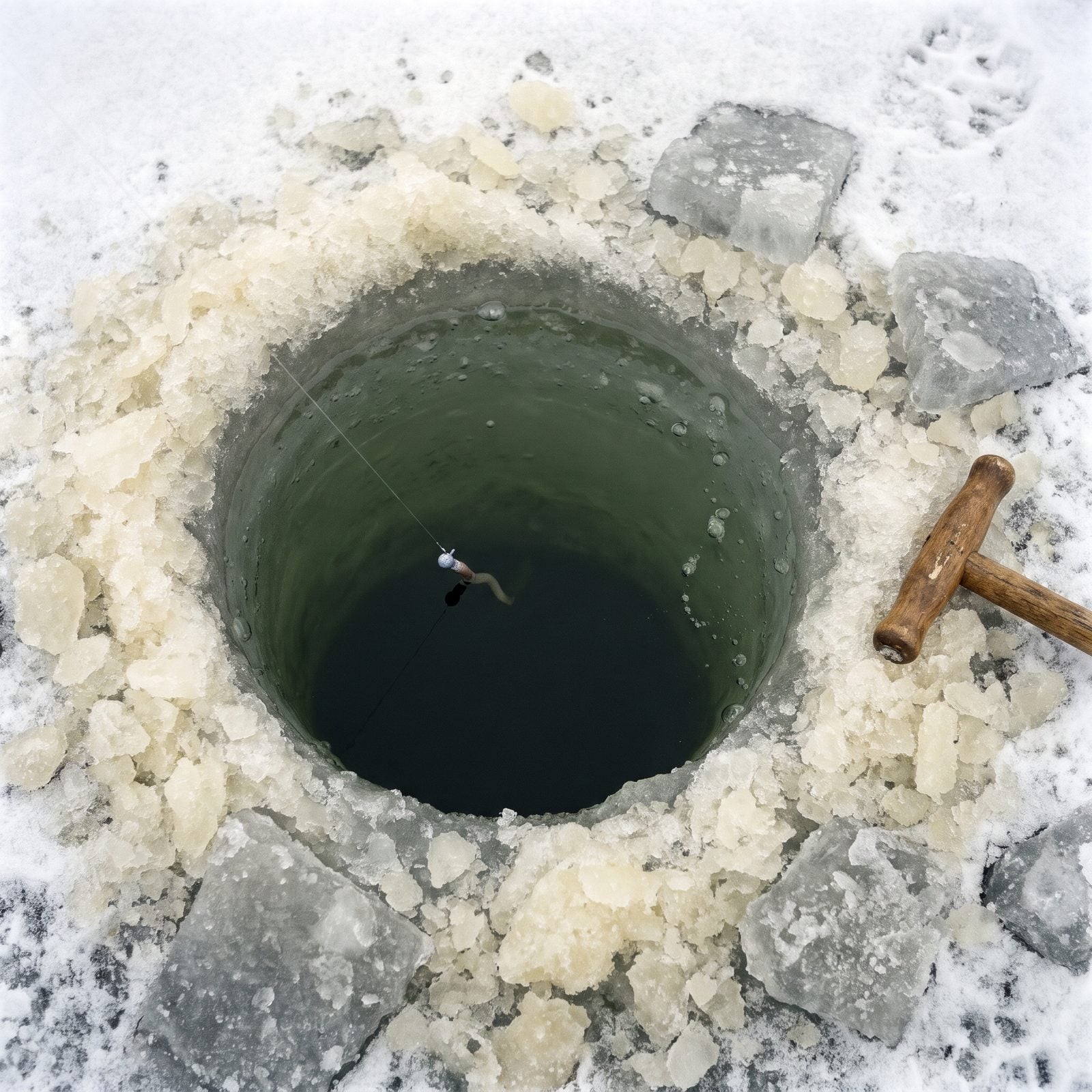
You fished blind, and you made your peace with it. No camera dropped down the hole to show you a crappie circling your bait or a walleye turning away at the last second. What happened six, twelve, twenty feet down stayed a rumor until something tugged.
That blindness bred a different kind of skill — reading the flasher, counting weight down to the right depth, feeling a soft bite through a stiff rod. A good ice angler built up an imagination for the dark water, a mental picture of structure and fish assembled from decades of what finally came up through the hole.
6. Coffee Cans and Bait Pails Carried Minnows Without a Motor
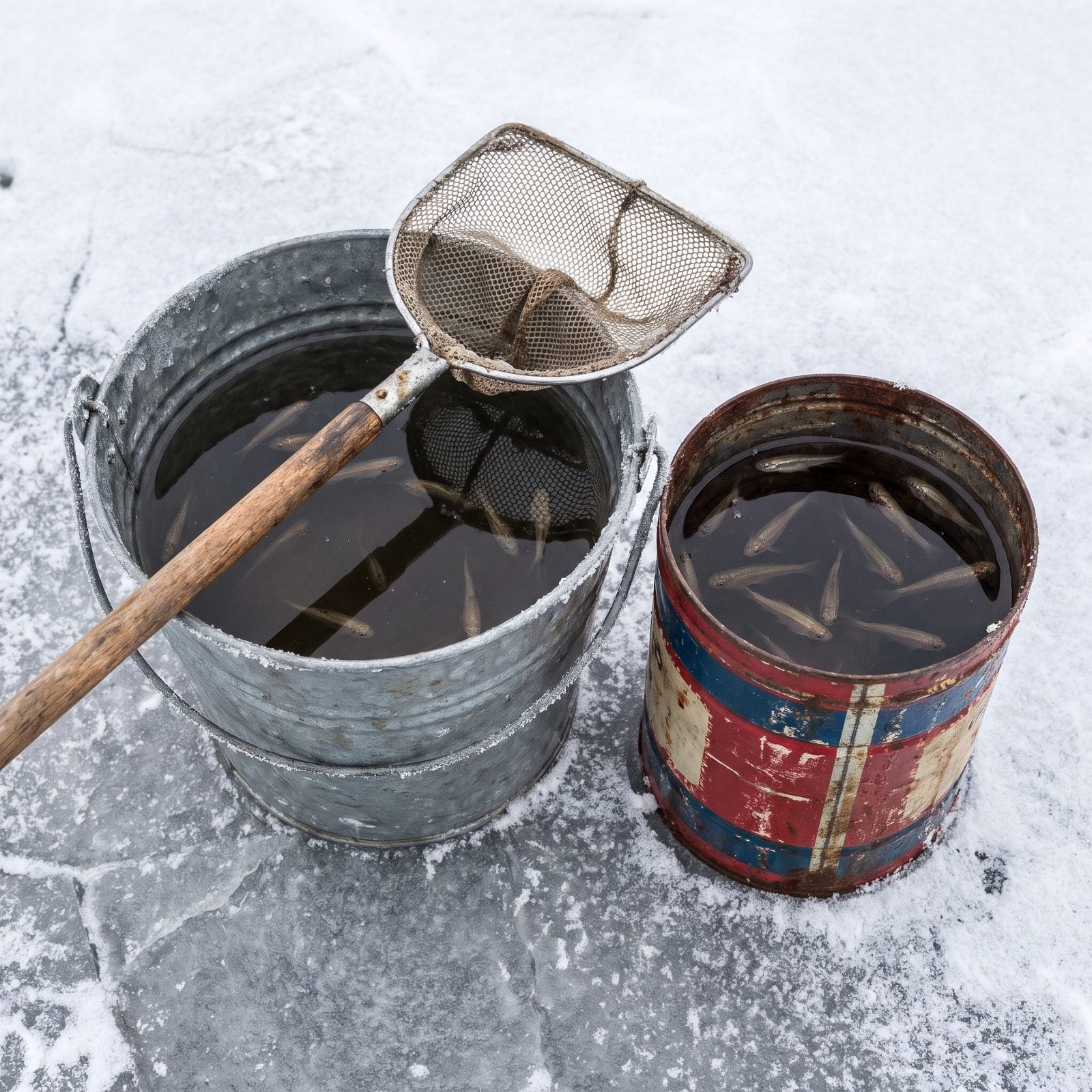
Keeping minnows alive was half the art. No battery aerator bubbling away in the sled — just a galvanized pail or a repurposed coffee can, cold lake water, and the knowledge that cold water holds oxygen better than warm.
The trick everybody knew: don’t crowd them, change the water now and then, and keep it cold without letting it freeze solid. A can of lively fatheads beat fancy tackle on a tough day. Crowd them, let the water warm in a heated shanty, and you’d pull out a can of dead bait and a lot of regret.
Explaining why bait water has to stay cool, a tackle shop employee says “Hot water won’t hold oxygen very well, so on hot days the water needs to be changed out frequently”
5. Hand-Carved Wooden Decoys Drove the Darkhouse Spearing Tradition
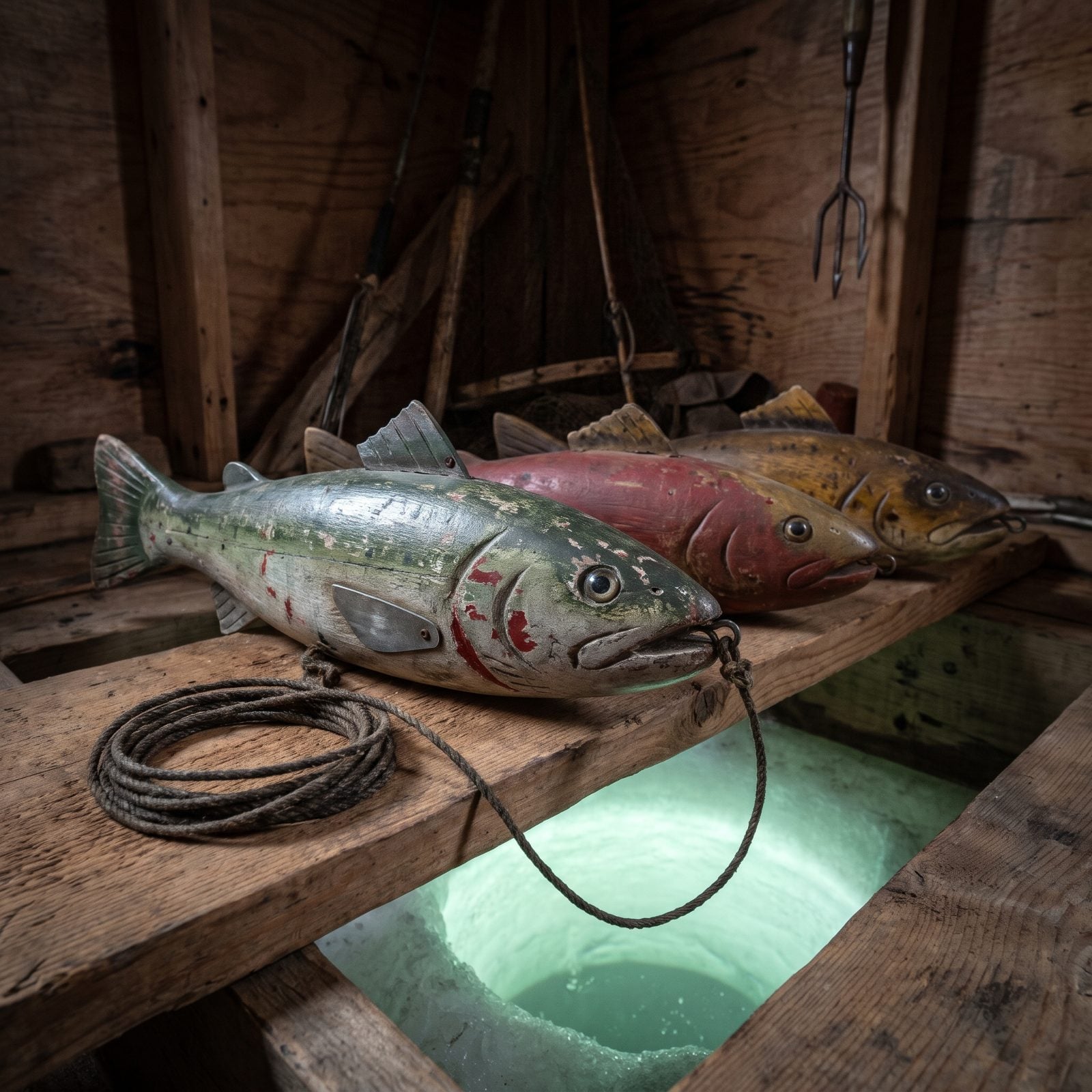
Spearing from a darkhouse is one of the oldest ways to take a fish in North America, and in the 1970s it still ran strong across the upper Midwest. Inside a blacked-out shanty, with a hole cut wide beneath you, a carved wooden decoy swam in slow circles on a jigging line to call in pike.
These decoys were folk art with a job. Lead-bellied for balance, metal-finned, painted by hand — each carver had his own style and his own secrets. A man’s decoys got passed down like a good knife. You spot the real old ones now in museums and auction houses, and they fetch serious money.
The decoy wasn’t bait. It was a lure for the eyes, a wooden lie told in the dark to a fish with a spear waiting above it.
Describing how he spears pike from a darkhouse, a fish decoy carver says “I like to get my ice hole dug in less than ten feet of water near a weed line, and run my decoy about half way up the water column, or higher.”
4. The Catch Went Straight Onto the Ice
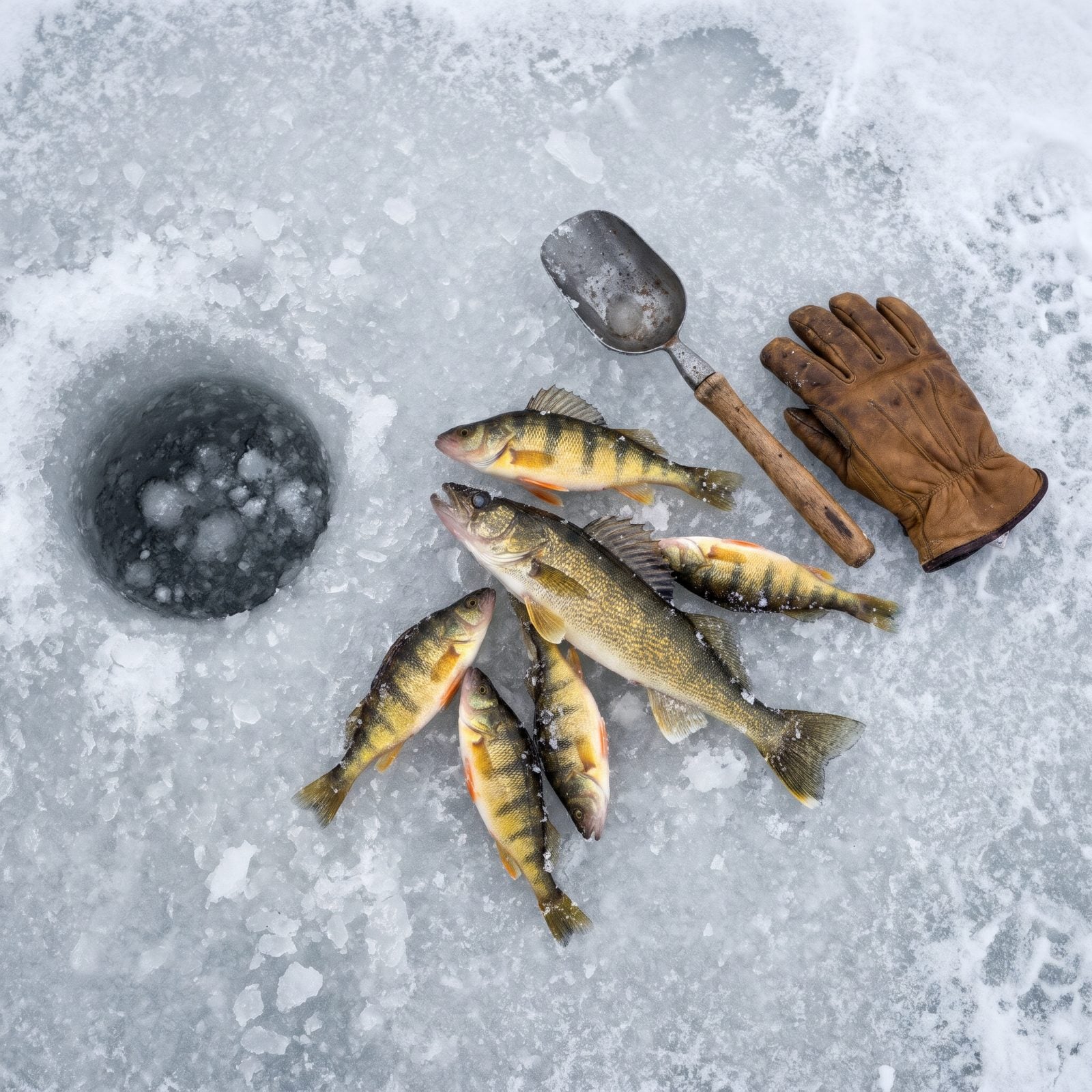
The lake was your cooler. Pull a perch up, unhook it, lay it on the ice, and the cold did the rest. Within minutes a fish would stiffen and frost over, held fresh by the same hard water you drilled through.
Simple, and it worked, though it had a cost nobody talked about. A fish frozen fast on the ice and then thawed could turn mushy, and a flash-frozen eye went cloudy quick. Still, there’s an honest picture of the whole sport in five perch and a walleye piled on the ice beside a fresh hole and an ice scoop. Limits and possession rules applied then same as now, so you kept count.
3. Every Fishing Photo Cost You a Frame of Film
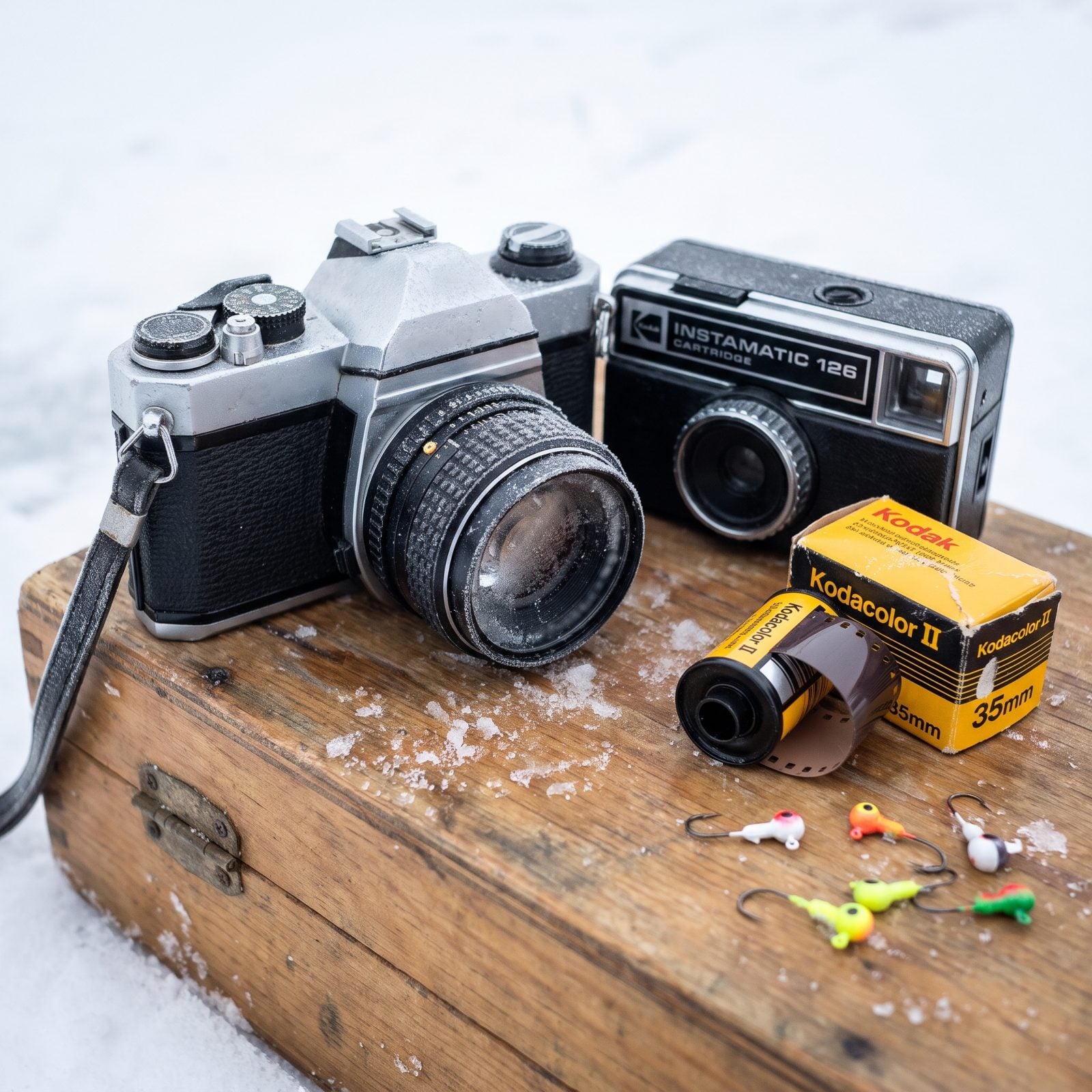
You didn’t take forty shots of a nice walleye and pick the best one. A roll of film held twenty-four or thirty-six frames, each one cost money to shoot and money to develop, and you wouldn’t see a single picture until the roll came back from the drugstore a week later.
So people picked their moments. One shot of the big fish, gloves off in the cold, held up fast before the fish froze and before you wasted film. There’s a leanness to old ice fishing photos because of it. Nobody was posing for a feed — they were marking a good day, once, and getting back to the hole.
2. No Instant Fishing Report From the Middle of the Lake
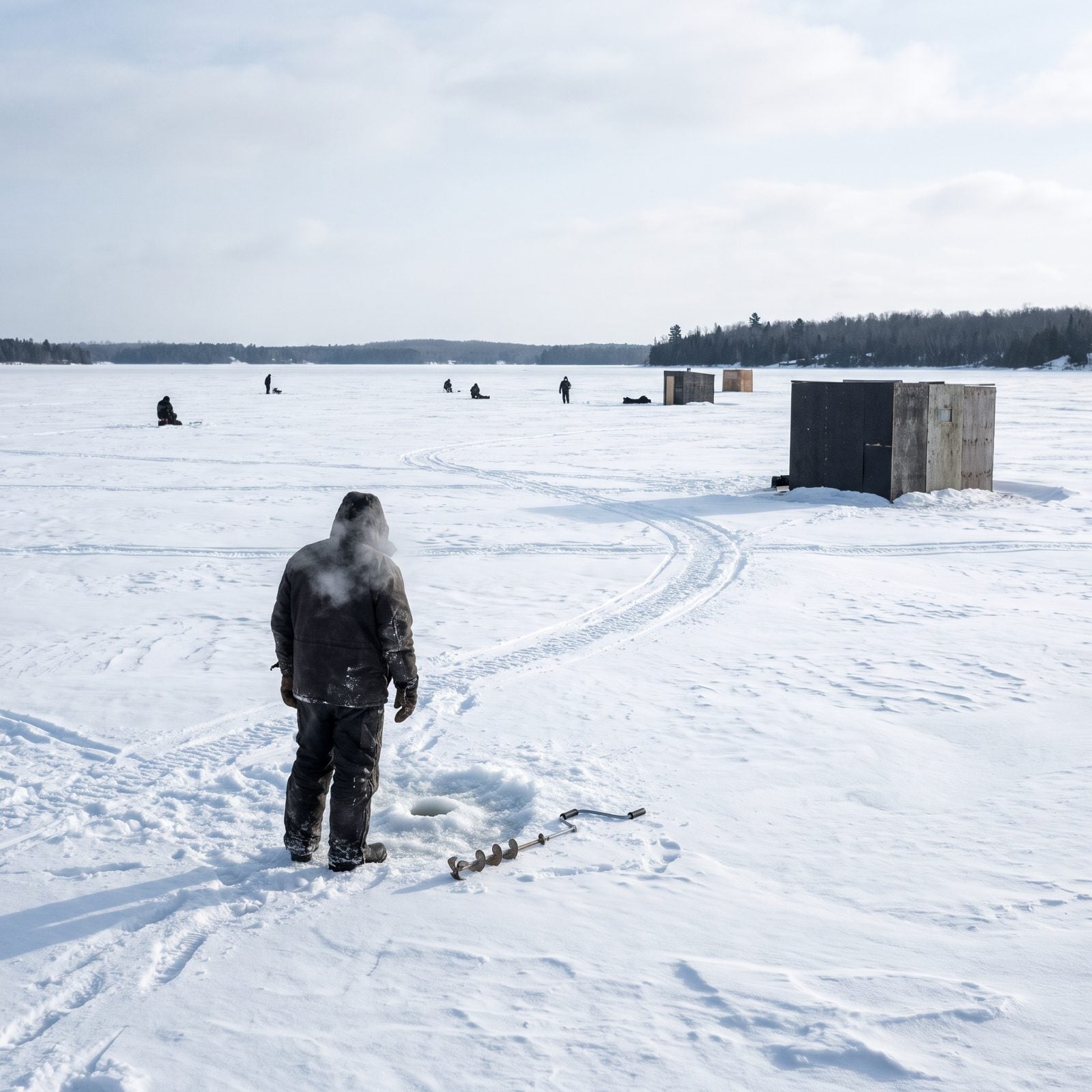
The lake kept its secrets until you drove home and knocked on a door. No posting a photo from the hole, no checking an app to see which bay was giving up crappies. If the fish were biting on the north end, that news traveled the old way, mouth to ear, hours or days later.
Which meant the guy who scouted, who drilled a lot of holes and paid attention, had a real edge. Information was scarce and local and earned. You couldn’t borrow somebody else’s hot bite with a tap — you went out and found your own.
1. Ice-Fishing Know-How Passed Hand to Hand, Face to Face
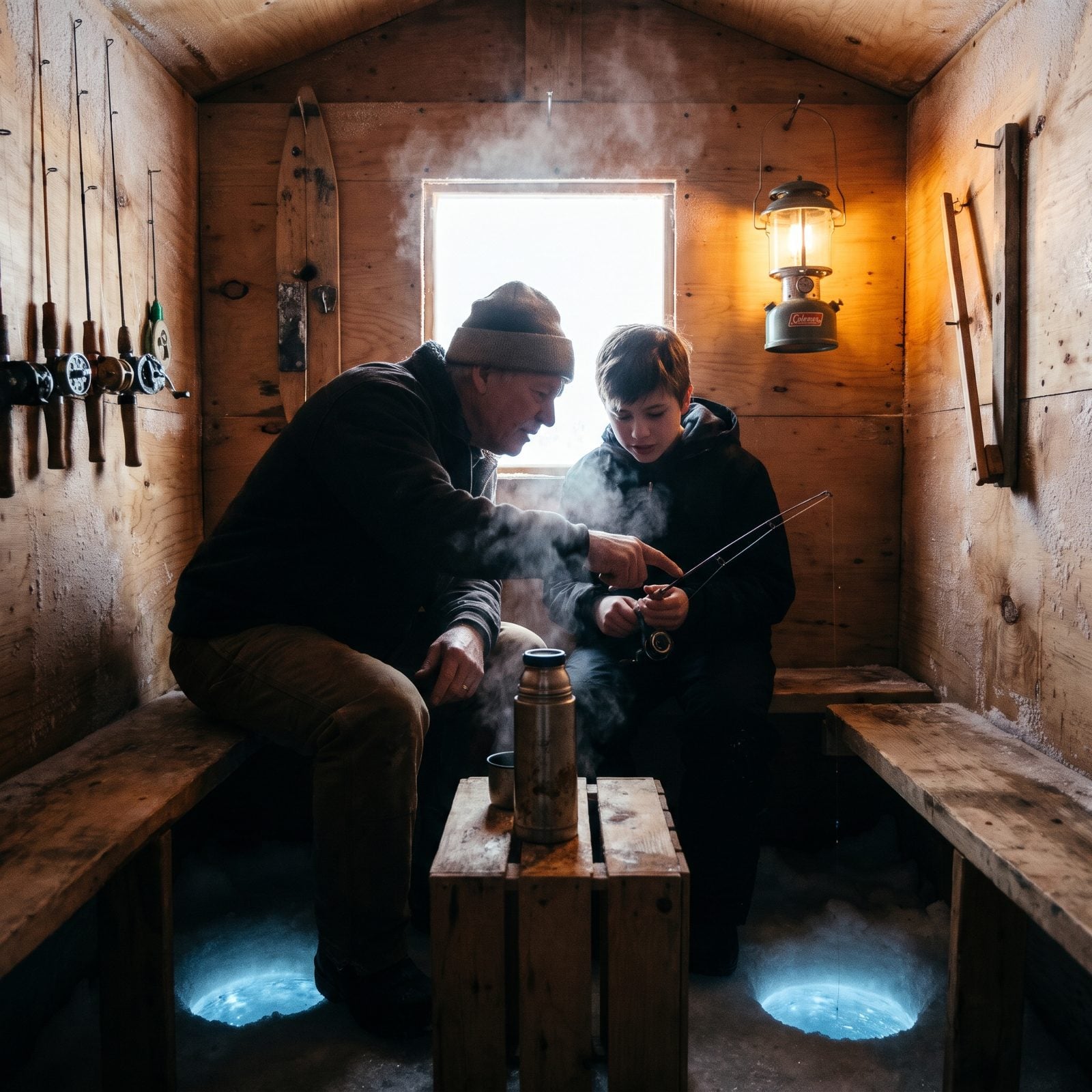
Nobody learned this on a screen. You learned it from your father or your uncle or the old man two shanties over who took pity and showed you how to set a tip-up right. How deep to fish. Where the weed edge dropped off. How to read the ice before you trusted your weight to it.
That knowledge moved through families and small towns, carried in a warm shanty over a thermos of coffee, corrected on the spot when you did it wrong. Slow, personal, and sticky. A lesson you got burned on in person stayed learned. There was no comment section — just a quiet nod when you finally got it right.