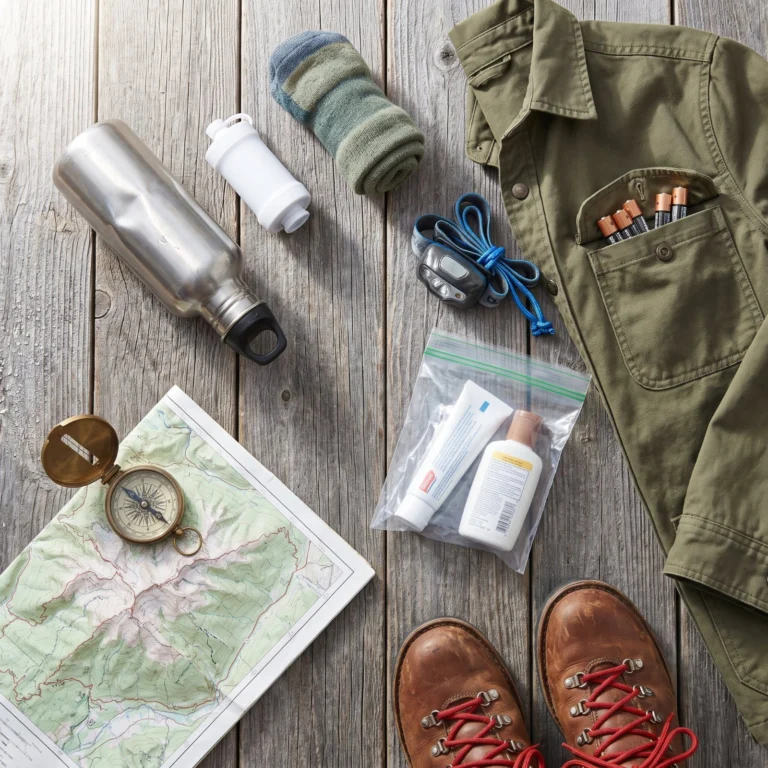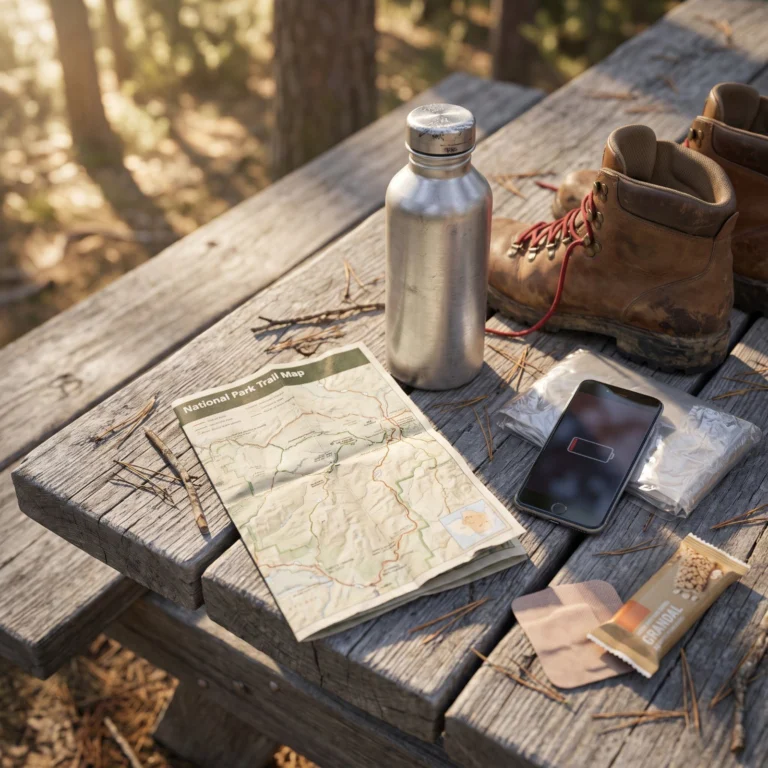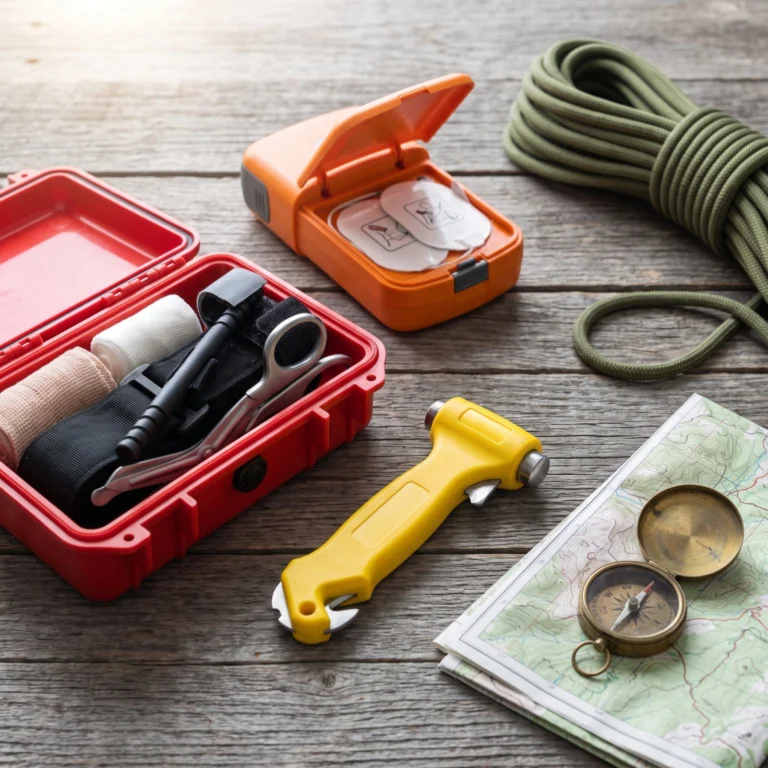
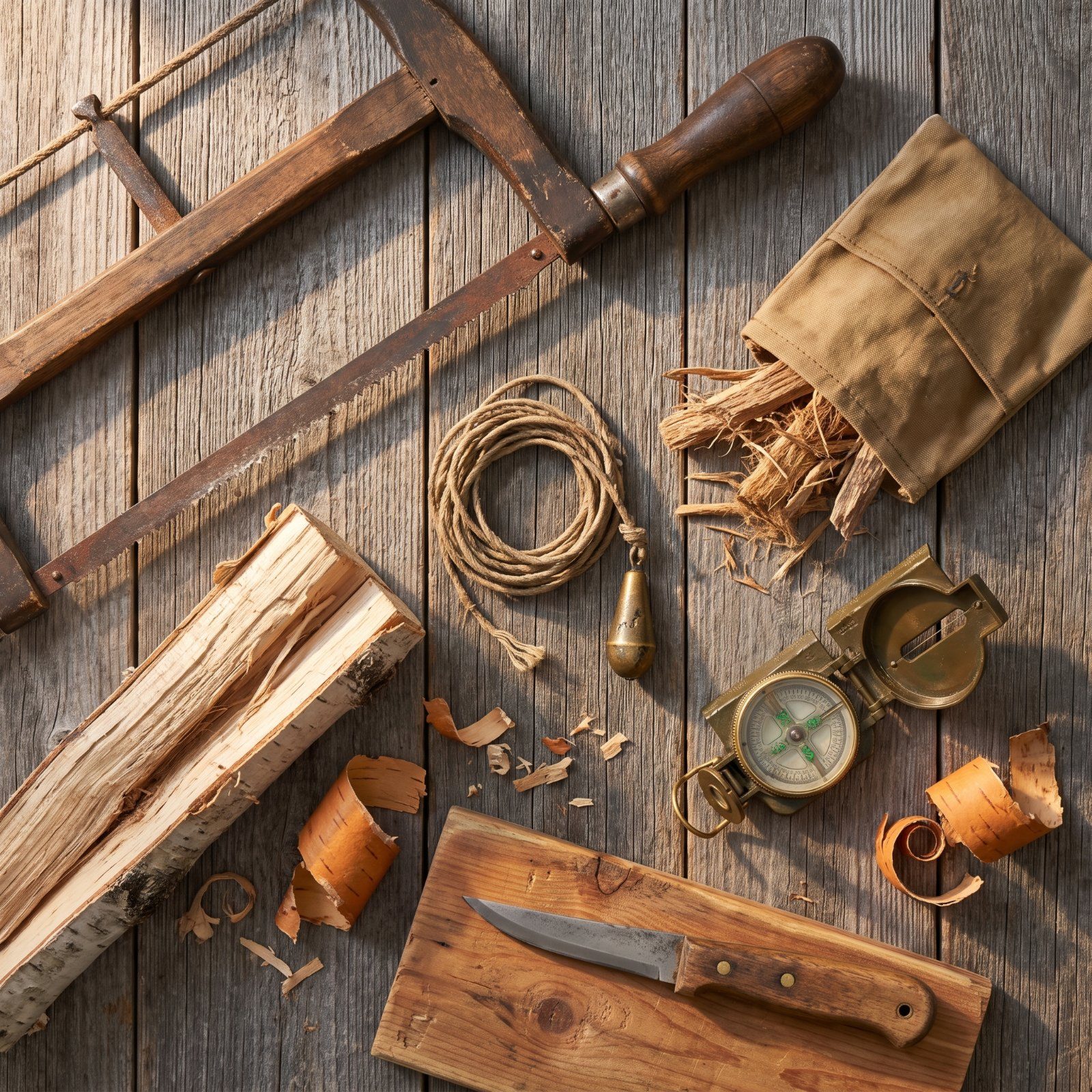
Somewhere in a shed there’s a bucksaw with the tension left too loose, and the man who knew better is gone. Happens a lot now. The woodsmen who could read a split log, cross a river sideways, or carry fire from one camp to the next passed those tricks across a fire, not a screen, and plenty of them went in the ground with nobody writing a word down. These are working skills, learned with cold hands and a few mistakes. Still useful. Still earned the same hard way they always were. Here are the ones most worth saving before the last person who does them by feel forgets.
Please note that some of the images in this article were created with the assistance of AI.
49. Reading a Split Log to Find Its Driest Burning Face
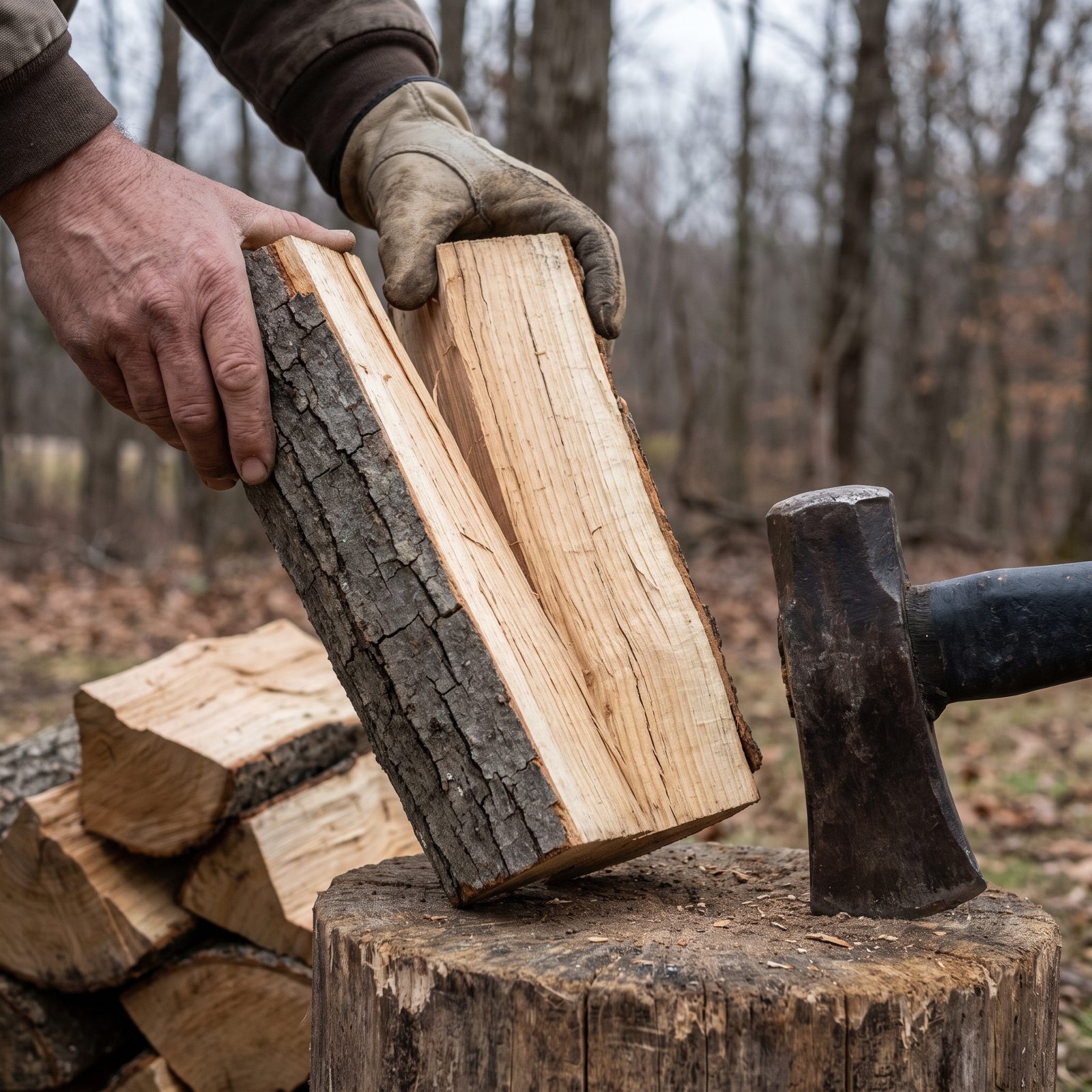
Not every face of a split log burns the same. The checking cracks that fan out from the center tell you which piece is actually seasoned, because the lighter, drier wood near the heart catches faster than the damp sapwood along the bark. Old hands turned the split before laying it on the coals, putting that cracked pale face down into the flame where it would take.
Tap two pieces together. Dry wood rings; wet wood thuds, and that dull sound is the reason your fire smoked all night and never threw real heat.
48. Judging Water Depth and Bottom Type With a Weighted Line
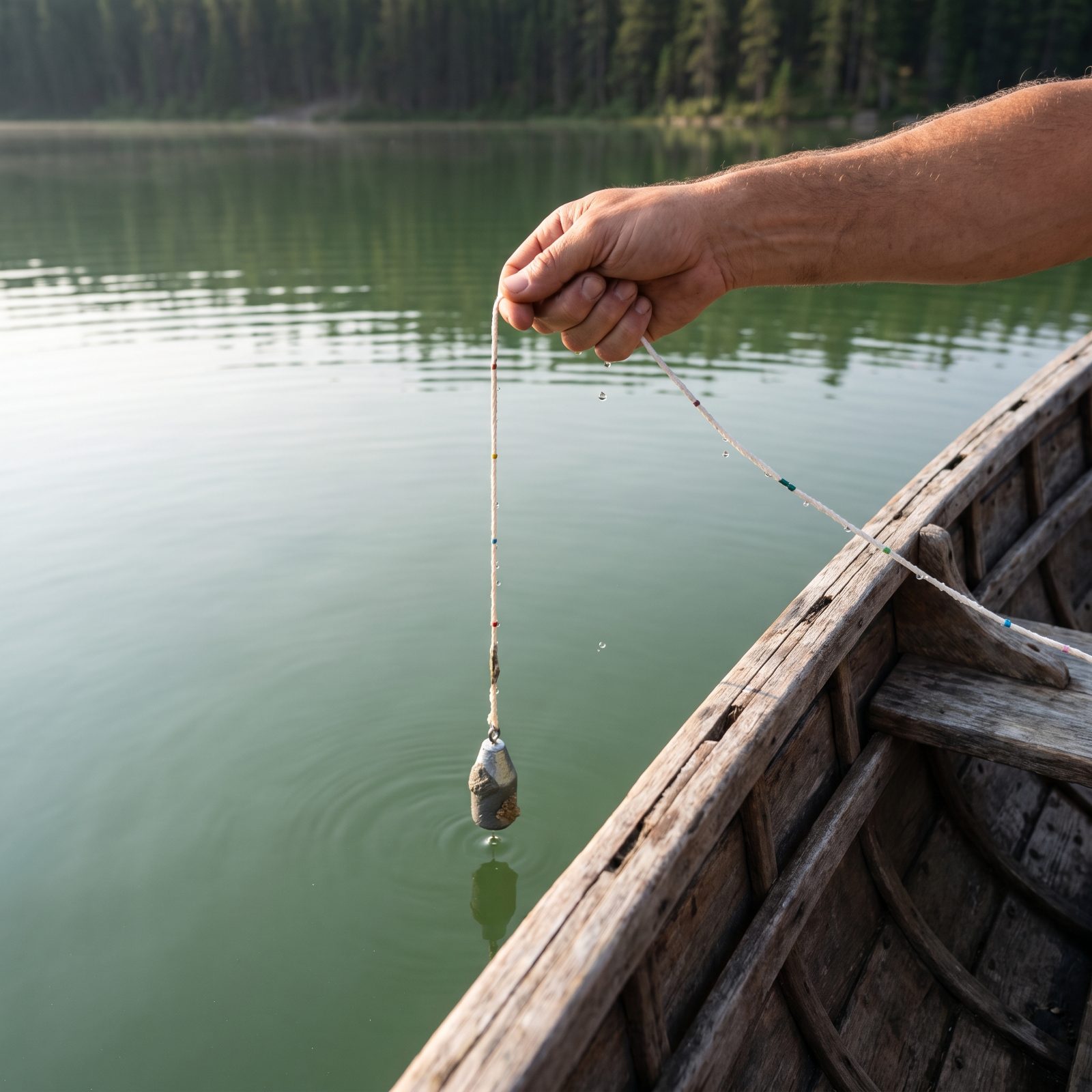
Before sonar lived on everybody’s dash, a man found the bottom with a weighted line and a dab of tallow smeared on the base of the lead. Drop it, feel it hit, read the depth off the marks on your cord. Then haul it back up and see what stuck to the grease: sand, soft mud, gravel, or nothing at all off hard clean rock.
That bottom read matters more than the depth sometimes. Walleye want one thing, bass want another, and a soft mucky bottom tells you plenty about where the fish won’t be sitting. Costs you a sinker, some cord, and ten minutes. Teaches you a lake faster than you’d think.
47. Carrying an Emergency Ember in Dry Tinder
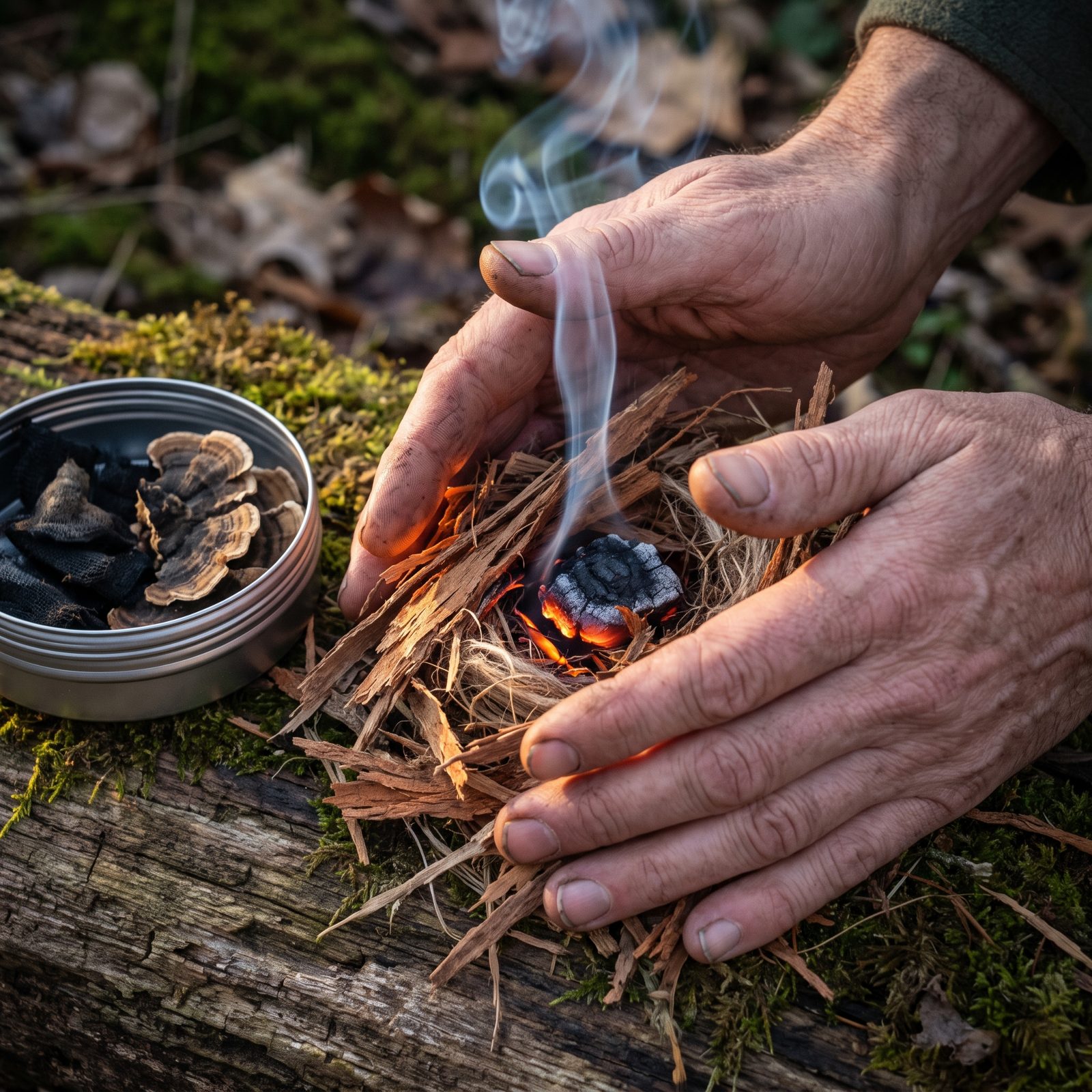
Fire used to be too valuable to let die. When matches were scarce and a lighter was a luxury, people moved a live coal from one camp to the next wrapped in dry punky wood or shelf fungus packed inside a tin. A good ember cradled in the right dry material holds heat for hours, waiting to be coaxed back into flame with nothing but breath and fresh tinder.
The trick is starving it just enough. Too much air and it burns out. Too little and it smothers. Most people learn that one the hard way before it sticks.
46. Setting Camp Above the Cold-Air Drainage
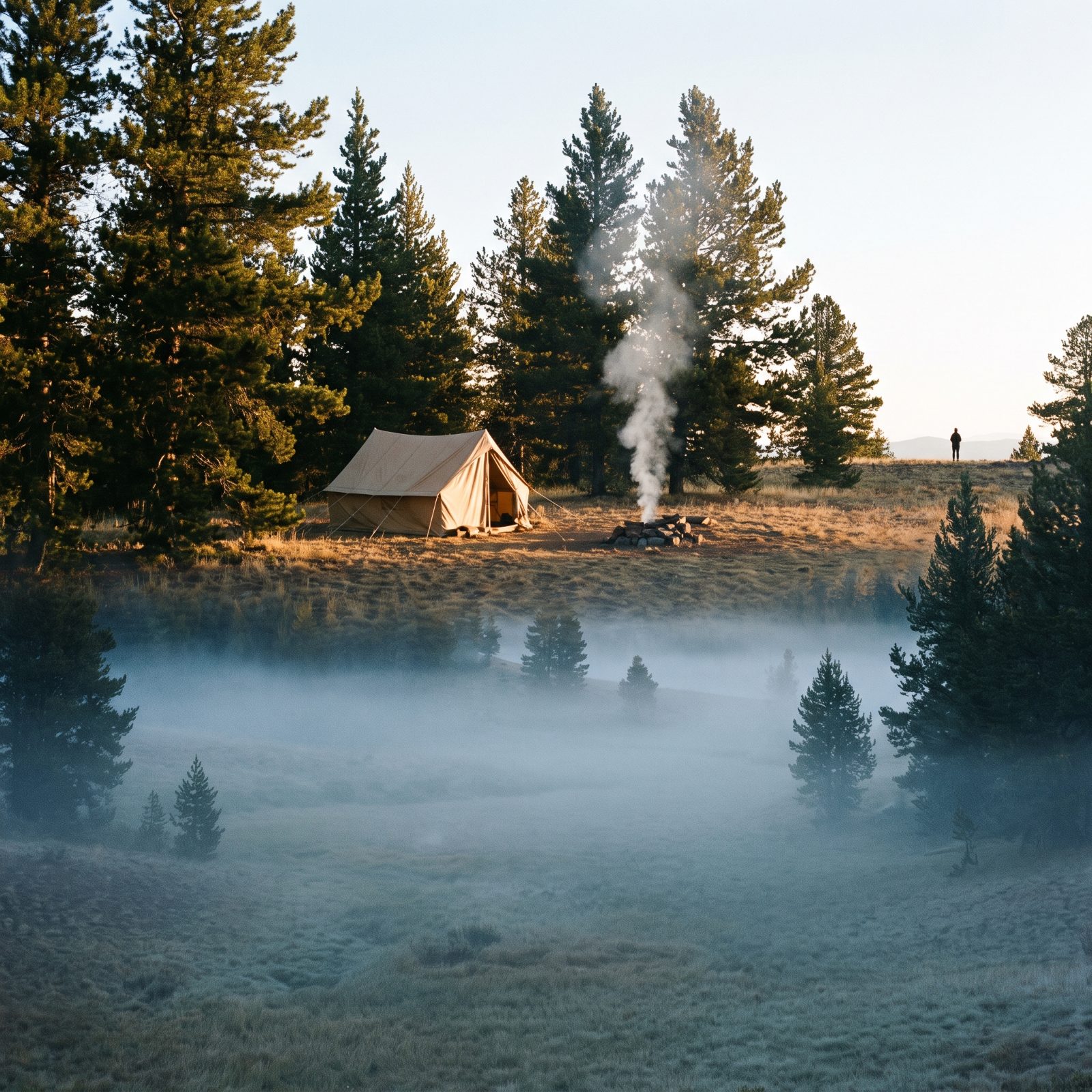
Cold air behaves like water, sliding downhill and pooling in the low spots, which is exactly why the prettiest meadow by the creek is often the coldest, dampest place you could put a tent. The folks who slept well climbed a little, setting camp on a bench or a low rise where the chilled air runs past instead of settling around you.
You can feel it on an evening walk. Step into a hollow and the temperature drops a few degrees, plain as that. Camp up out of that drainage and you’ll sleep warmer, wake to less condensation on your gear, and fight less valley fog soaking everything you own.
45. Using a Ferry Angle to Cross a River by Canoe
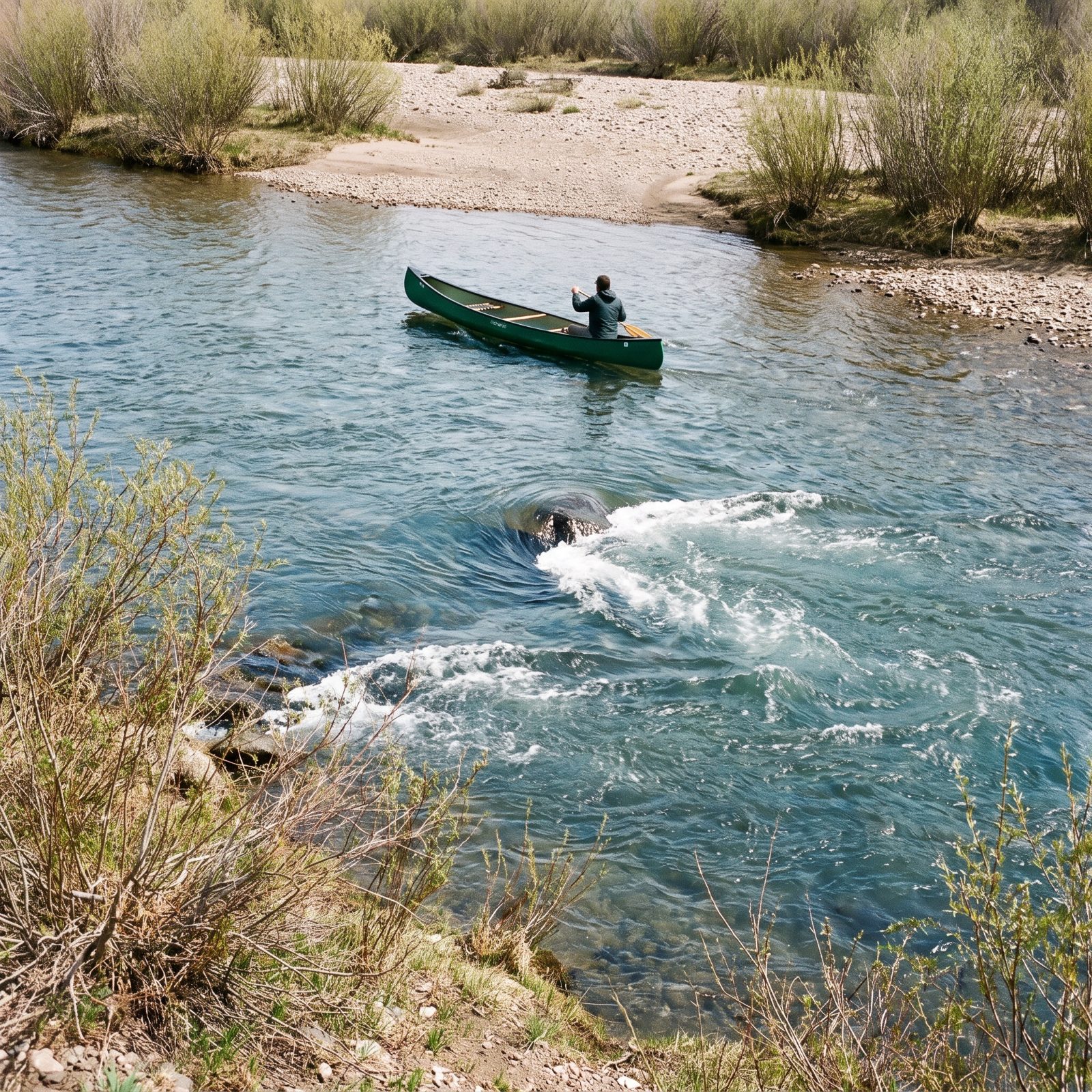
Point straight across a moving river and the current wins, carrying you downstream into whatever’s waiting below. The old canoe men crossed by angling the boat upstream and letting the river itself push them sideways to the far bank, a move called ferrying. You hold the angle, keep paddling, and the water does the heavy work of moving you across.
It looks backward the first time you see it. The bow points nowhere near where you’re going. But that angle is the whole game, and getting it wrong on fast water is how canoes end up wrapped around rocks.
44. Finding Dry Punkwood Inside a Rain-Soaked Stump
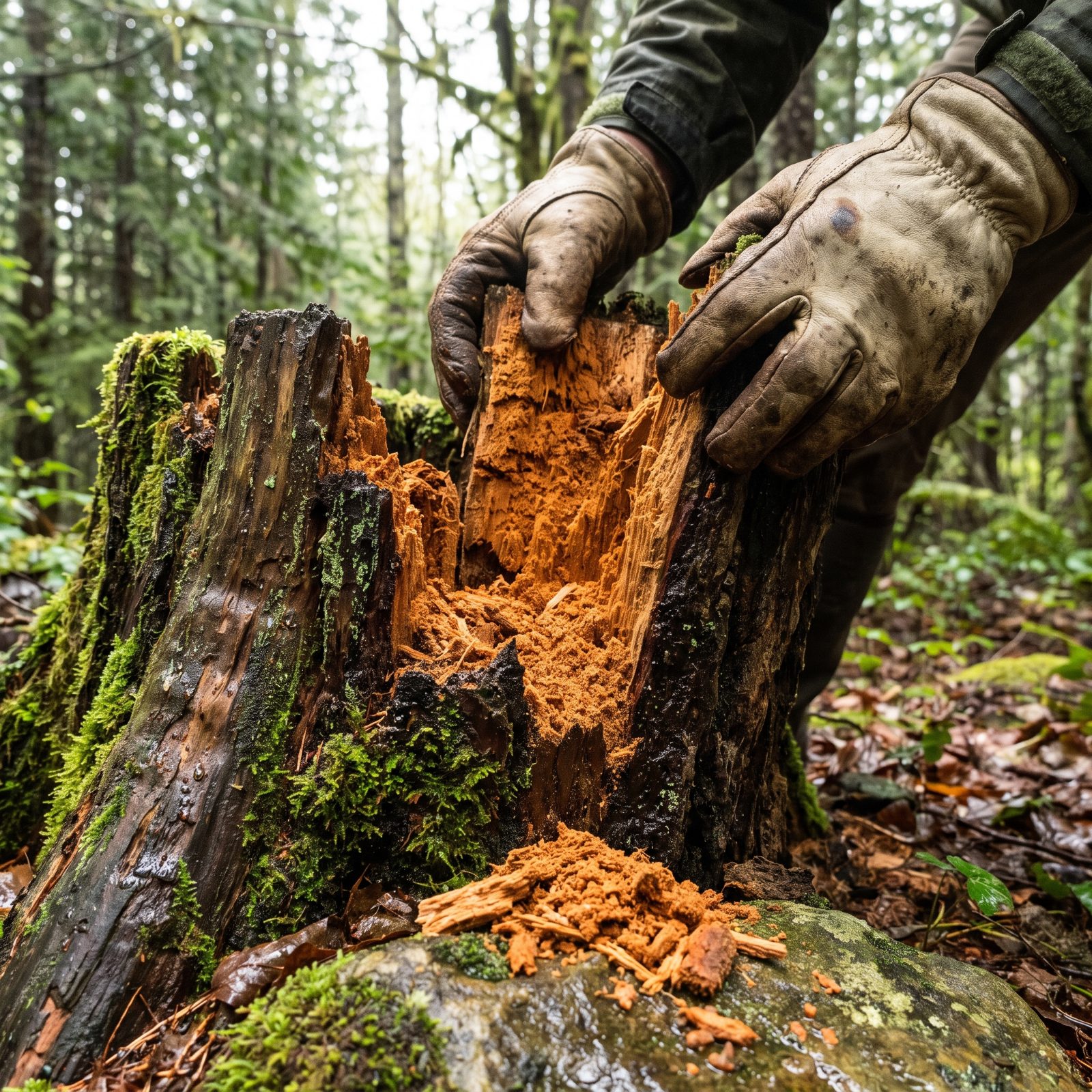
Pouring rain and everything soaked? There’s still dry tinder in the woods if you know where it hides. The punky, rotted heartwood deep inside an old standing stump stays dry when the whole forest is dripping, protected by the wet shell around it. Break the stump open, dig past the soggy outer layer, and the crumbly orange-brown wood inside will take a spark when nothing else will.
Same goes for the underside of blown-down logs and those dead lower branches still clinging to a conifer, the ones that never touch the wet ground. Rain is only a fire problem for people who look in the obvious places.
43. Taking a Back Bearing Before You Leave the Trail
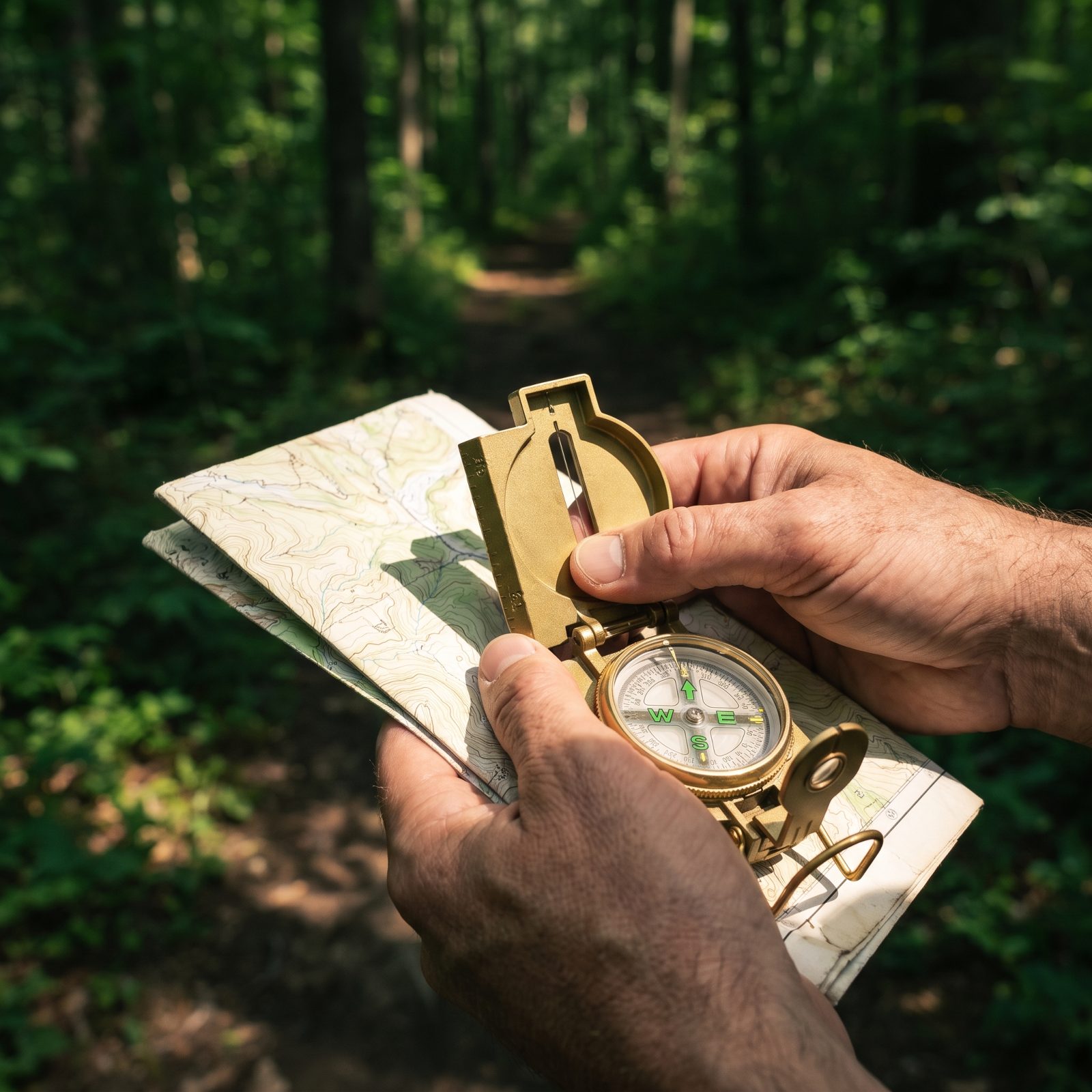
Before stepping off the trail to check a game trail, a fishing hole, or a berry patch, the careful ones took a back bearing: the compass direction back to the path they just left. Dense timber and gentle terrain erase your tracks fast, and that one number is how you find your way home instead of wandering in a circle until dark.
Ten seconds, that’s all. Shoot the bearing to the trail, note it, then walk off with the figure in your head. GPS is great right up until the battery dies or the canopy eats the signal, and a compass asks nothing of a battery.
42. Removing the Y-Bones From a Northern Pike Fillet
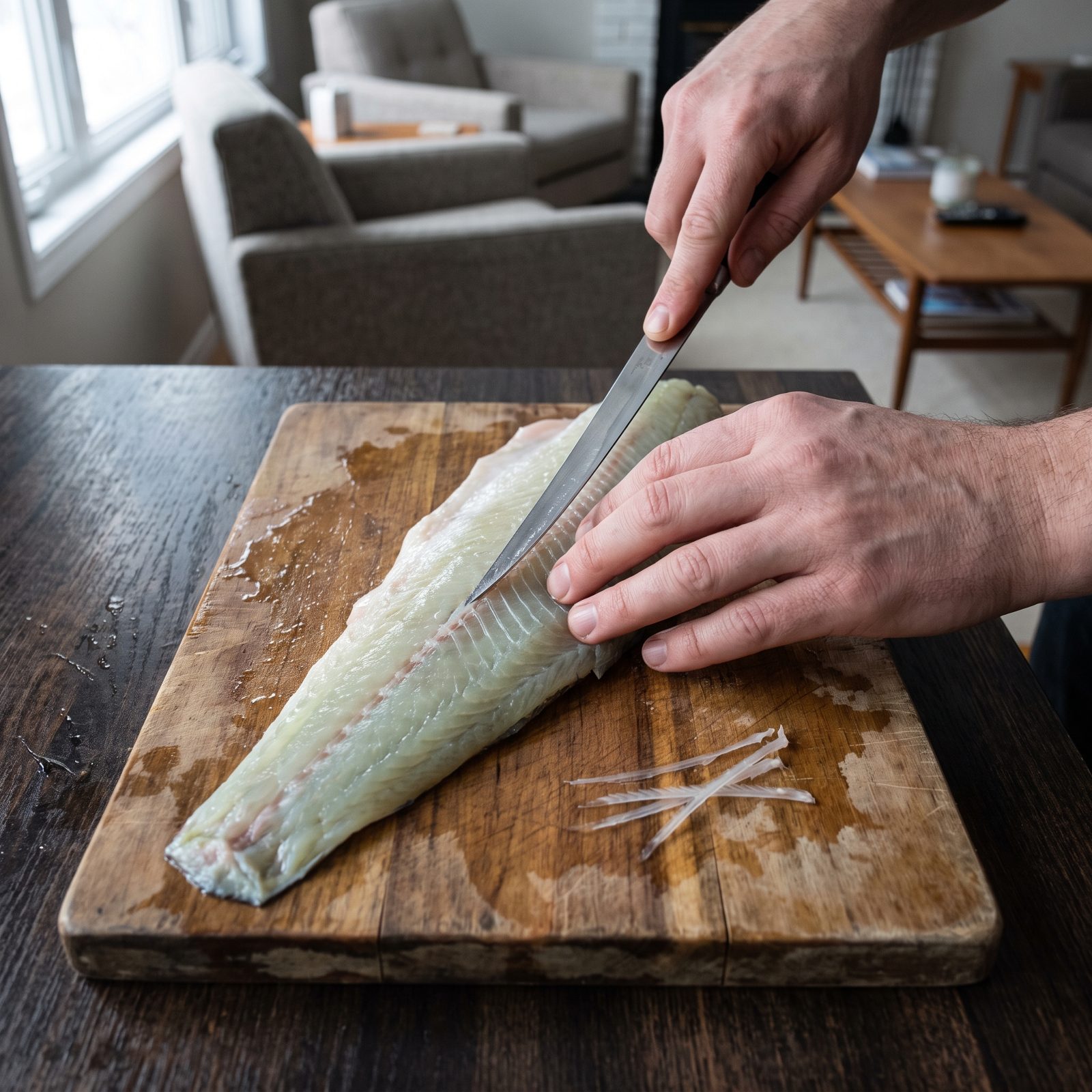
People call pike a bony trash fish and throw perfectly good fillets back because of a row of floating Y-bones that no amount of regular filleting removes. That reputation is a shame. Those bones sit in a predictable line along the top of the fillet, and once you learn to feel for them and cut above and then under, you lift out a clean bone-free strip of some of the best-eating white meat in fresh water.
The first few you’ll mangle. Everybody does. But a properly boned-out pike shuts up anyone at the table who claimed they couldn’t stand the things.
41. Setting the Right Tension on a Frame Bucksaw
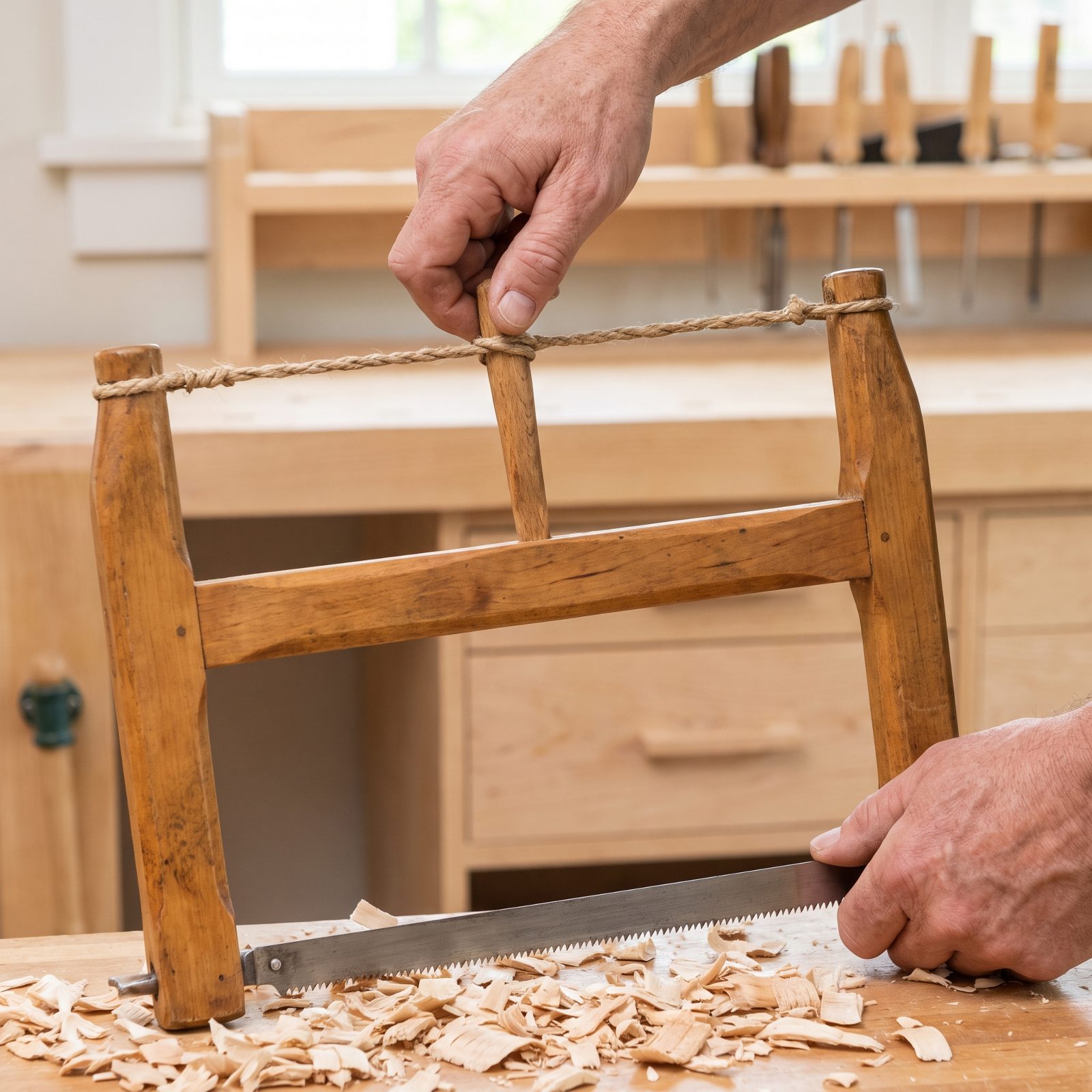
A bucksaw cuts on its tension, not its muscle. The thin blade has to be pinned at both uprights and pulled bowstring-tight by a doubled, twisted cord windlass at the top of the frame. A loose blade wanders, binds, and buckles the moment it meets the wood. Crank it too far and you risk cracking the frame or snapping the blade on a cold morning.
Right tension gives a clear musical note when you flick the blade. That hum means the saw will track straight and do the work with you. A floppy, tuneless blade means a long, frustrating afternoon and a lot of cussing at a tool that isn’t the problem.
40. Reading Smoke Movement for Sudden Wind Changes
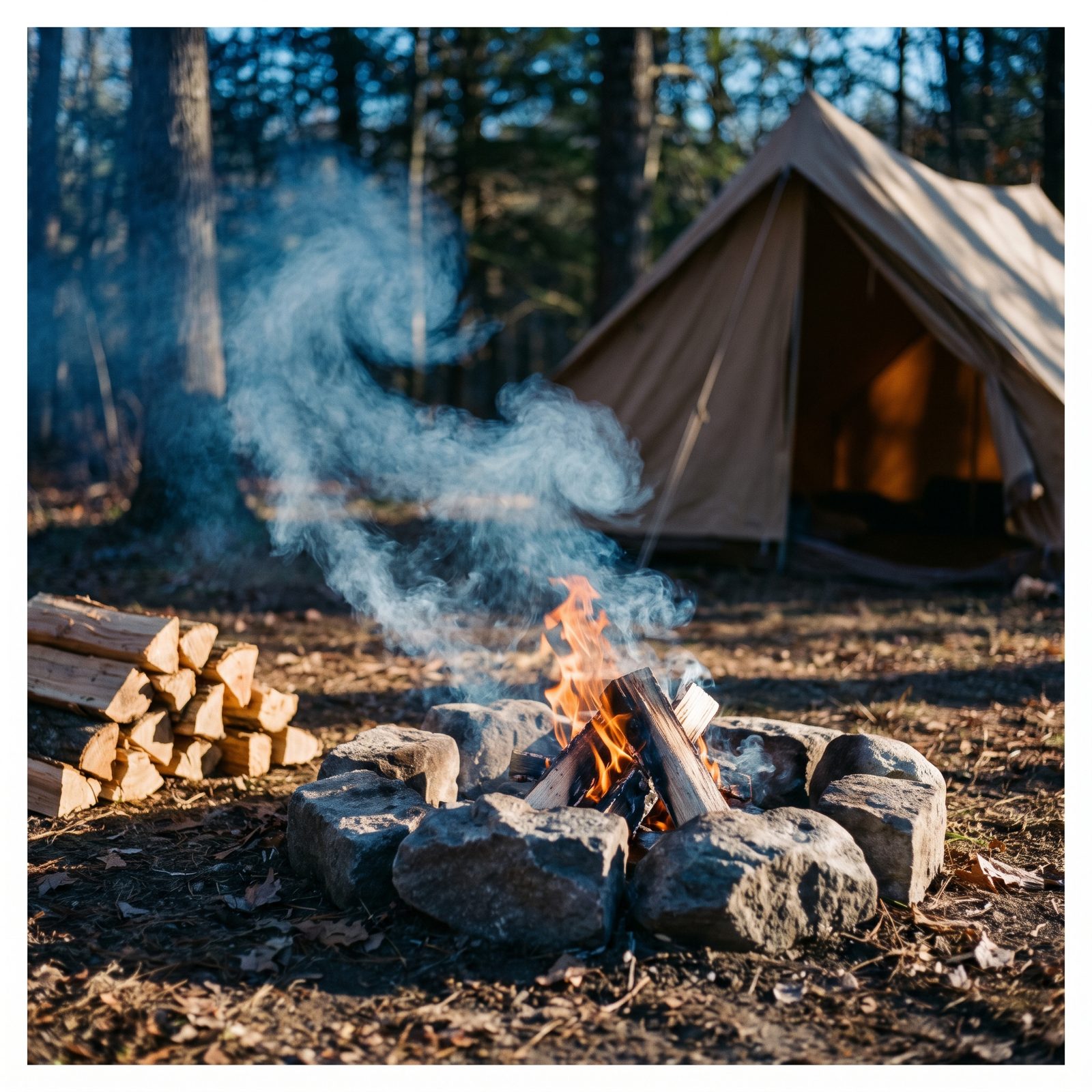
Watch the smoke and the weather tells on itself. Smoke that rises straight and clean means settled air. Smoke that suddenly flattens, swirls, or gets pushed back down toward the ground is a wind shift coming, sometimes ahead of a change you can’t yet feel on your face.
That early read mattered to anyone running a fire near a dry camp or tending a controlled burn. A shifting wind throws sparks in a new direction and can turn a tame fire mean in a hurry. It also hints at falling pressure and weather on the way, which is worth knowing before you’ve got the tarp up. Pay attention to your fire and it’ll warn you before the sky does.
39. Securing a Load With a Diamond Hitch
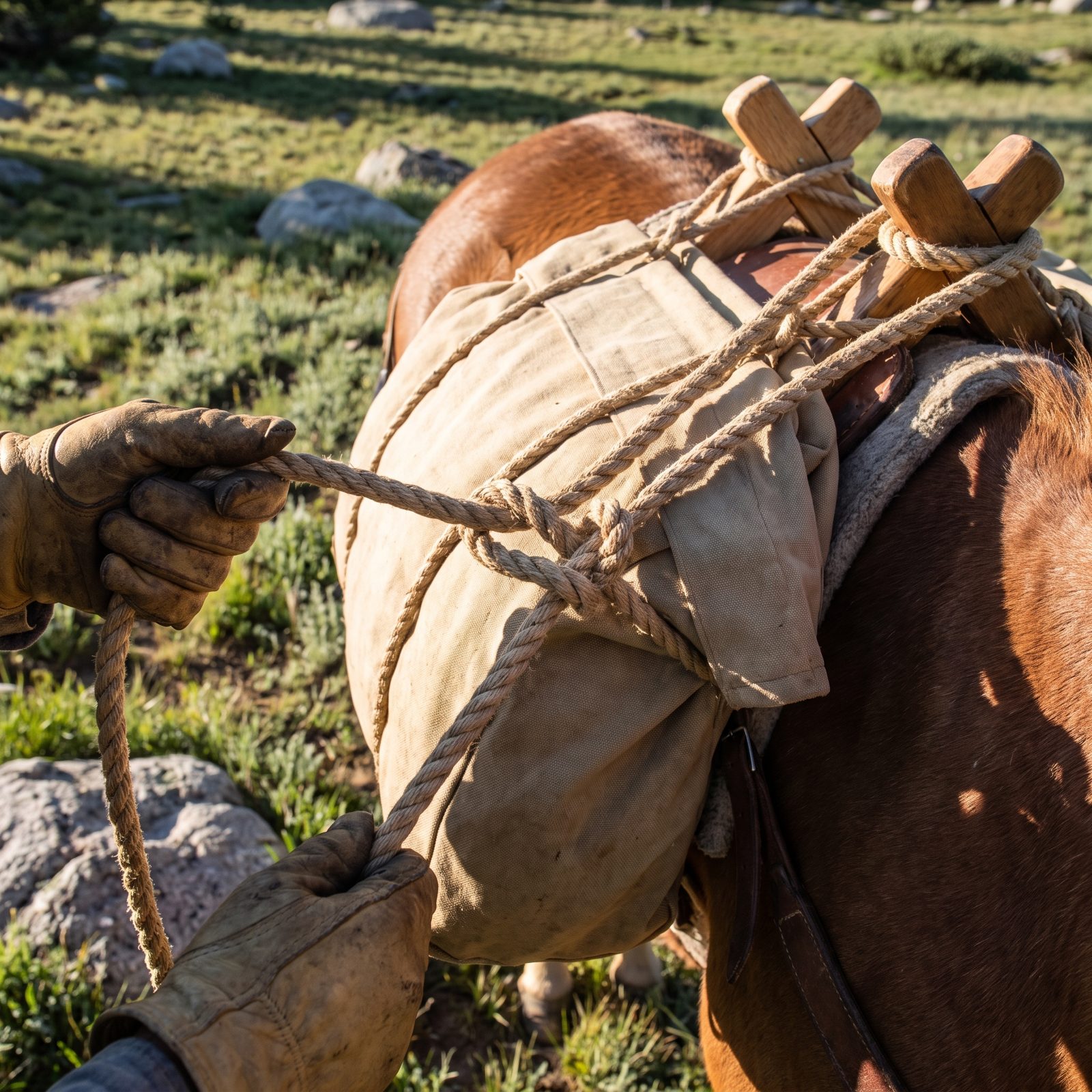
Watch an old packer throw a diamond hitch and you’ll swear the rope ties itself. Thirty seconds, no fumbling, and the load rides fifteen miles of switchbacks without budging. The magic isn’t the knot — it’s that the hitch spreads tension evenly down both flanks of the animal, so nothing shifts and nothing galls.
Most people now bungee-cord a cooler to a kayak and call it secured. That works until it doesn’t. Mule packers trusted the diamond with everything they owned, on trails where a slipped load meant the whole trip was ruined.
38. Reading Current Seams and Eddies From the Bank
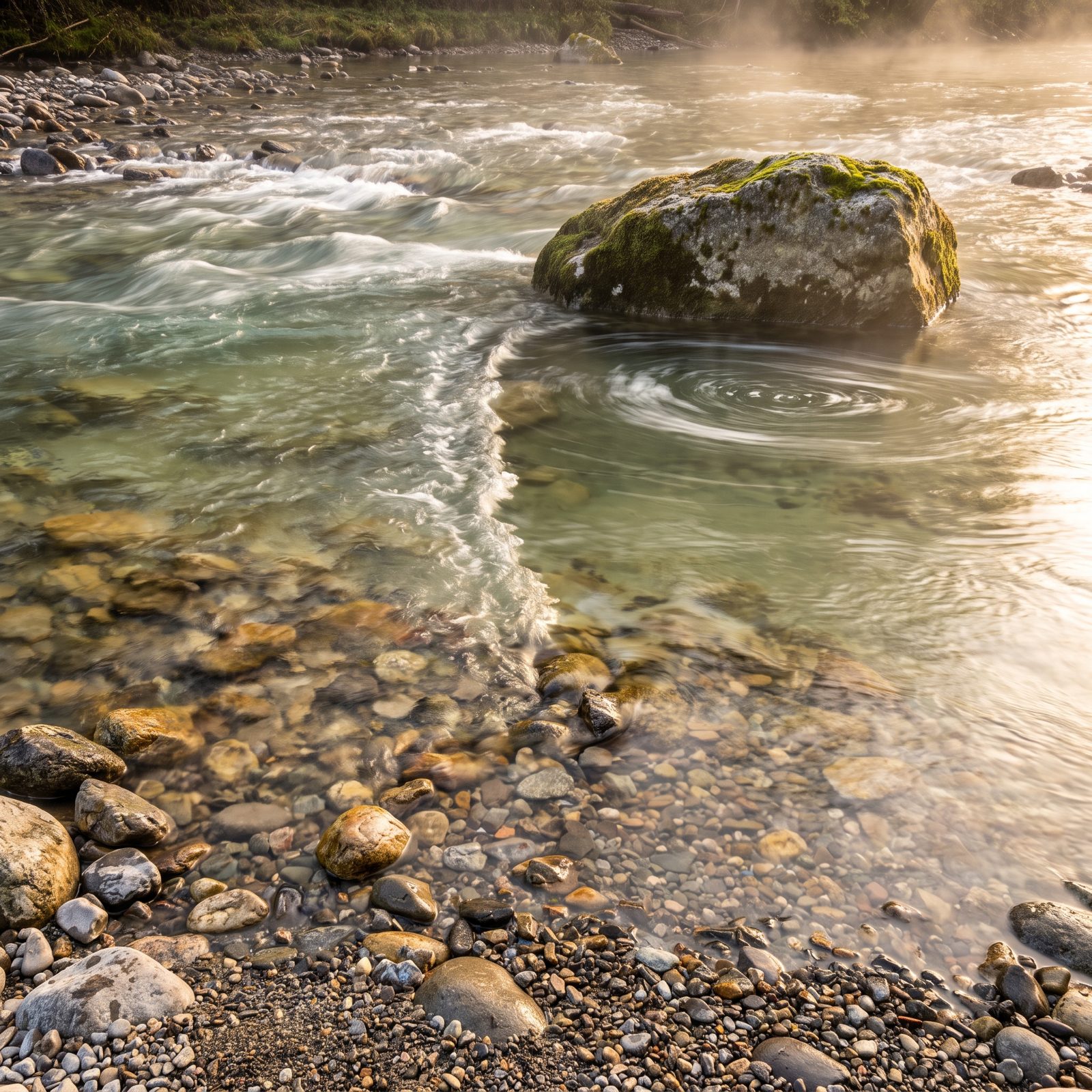
A river tells you where the fish are, if you know how to read its surface. The seam — that line where fast water slides against slow — is where trout hold. They sit in the slack and let the current carry food to them. Why work harder than you have to?
Now the eddy behind a boulder. It spins upstream, which trips up every beginner who casts in and then watches, baffled, as the fly drags the wrong way. Learn to spot the foam line and you stop wasting casts on dead water. Honestly, this one skill separates the people who catch fish from the people who just enjoy the scenery. Both are fine. Only one of them eats.
37. Banking a Fire So Embers Survive Until Morning
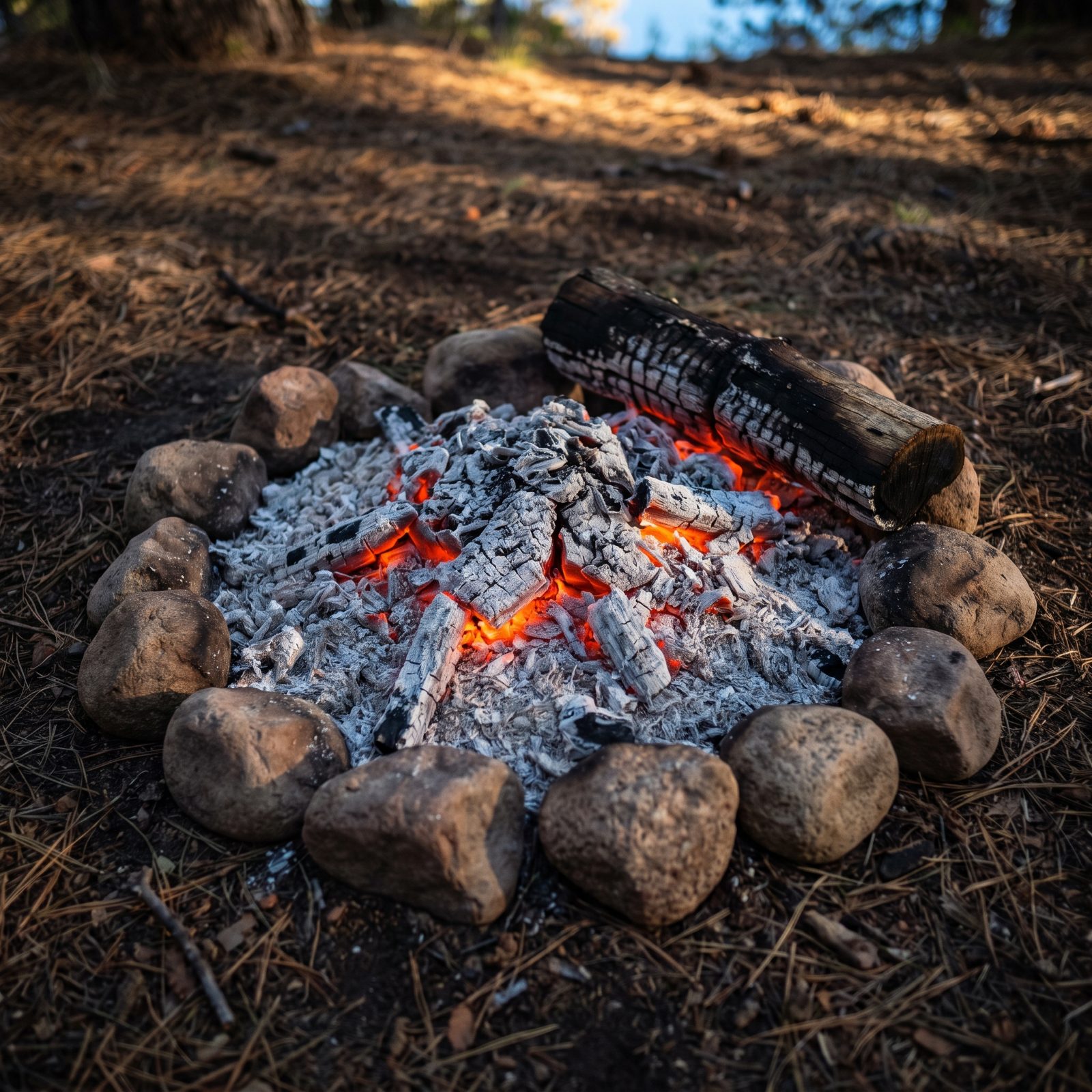
Building a fire from scratch every cold dawn is a rookie tax nobody has to pay. Bank the coals right and you wake to a bed of live embers that’ll take a fresh twig and flame up in under a minute.
It comes down to a blanket of ash. Rake the glowing coals into a tight pile and cover them, choking off most of the oxygen so they smolder instead of burning themselves out. One thick log laid across the top holds heat clear through the night.
36. Hanging a New Wooden Handle on an Axe Head
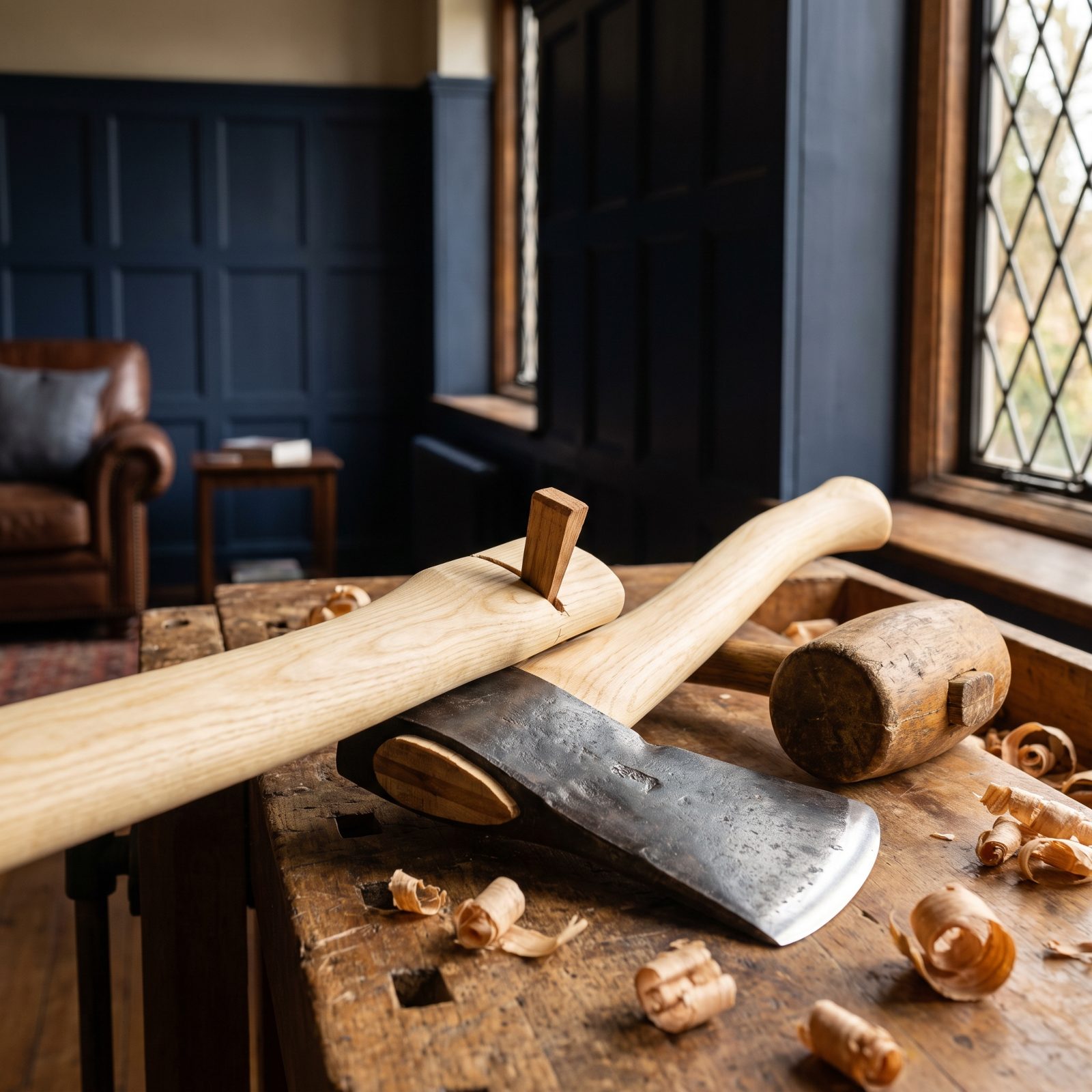
A good axe head will outlive three or four handles. Re-hanging one used to be a Saturday chore, not a reason to pitch the whole tool in the trash.
The fit is everything. You rasp the handle down until the head slides most of the way on, and only then drive the wedge into the kerf so the wood swells tight against the steel. People rush this part, slap it together, and then wonder why the head sails off mid-swing and buries itself in the dirt — or worse.
Grain orientation matters too. The handle’s grain should run parallel to the blade. Crossgrain, and it snaps at the worst possible moment, usually with a heavy swing already committed.
35. Reading a Halo Around the Moon as a Sign of an Approaching Front

That pale ring around the moon isn’t decoration. It’s a forecast written across the sky, and campers used to read it the way we read a phone screen now.
The halo comes from ice crystals in high cirrus clouds — the thin advance guard that rides in ahead of a warm front. See one, and a change in weather tends to follow within a day or two. The old rhyme said it plain: ring around the moon, rain or snow soon.
34. Measuring Trail Distance by Counting Paces
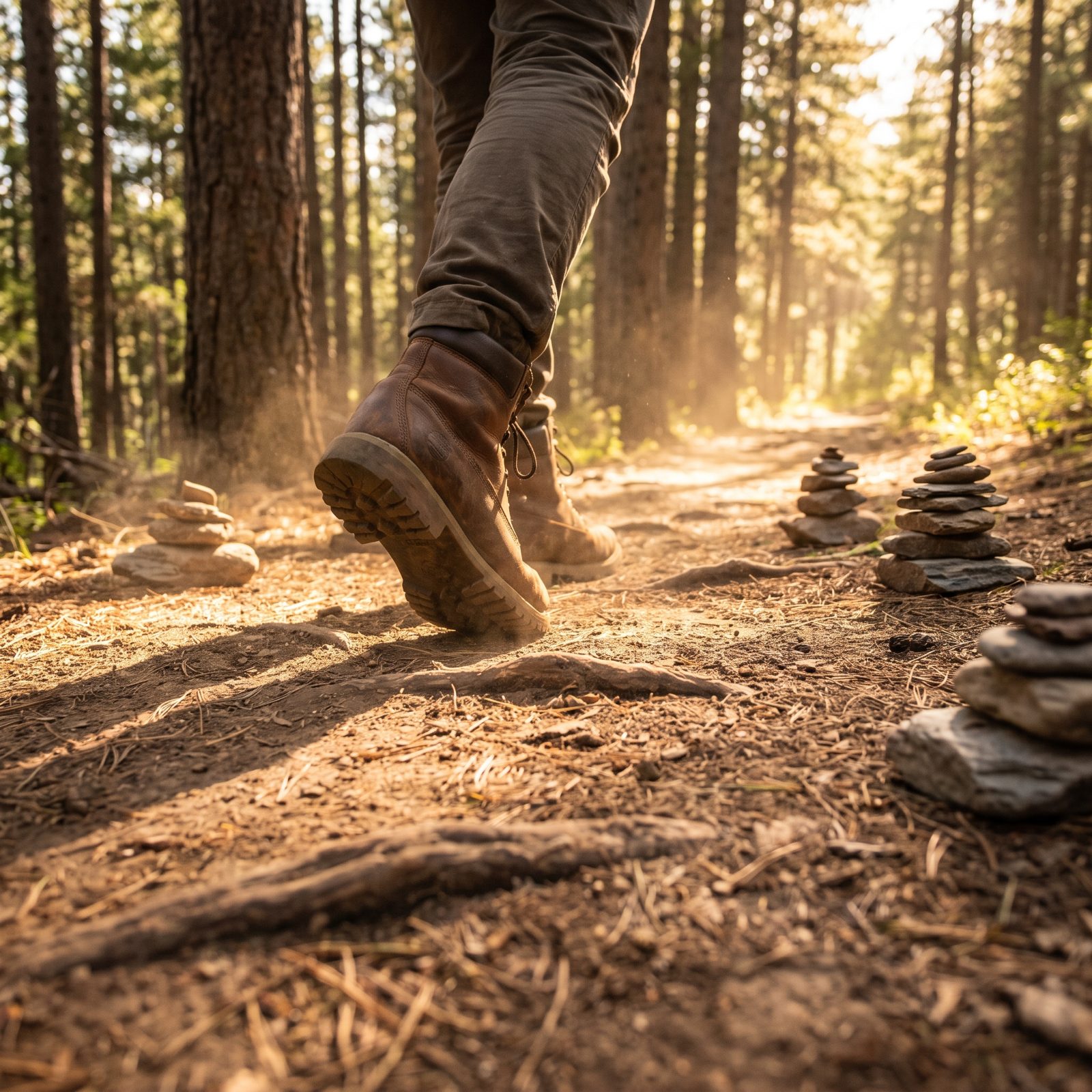
Before GPS lived in every pocket, people knew exactly how far they’d walked by counting. A pace — every time the same foot hits the ground — covers a known distance once you’ve calibrated your stride against a measured stretch.
Surveyors and soldiers mapped whole territories this way. A walker will average somewhere around sixty-odd paces per hundred yards on flat ground, though loose rock and steep grades stretch that count. It’s a skill worth keeping for the day your batteries die, the fog rolls in, and the little blue dot goes dark.
33. Recognizing Standing Deadwood That Is Sound, Not Rotten
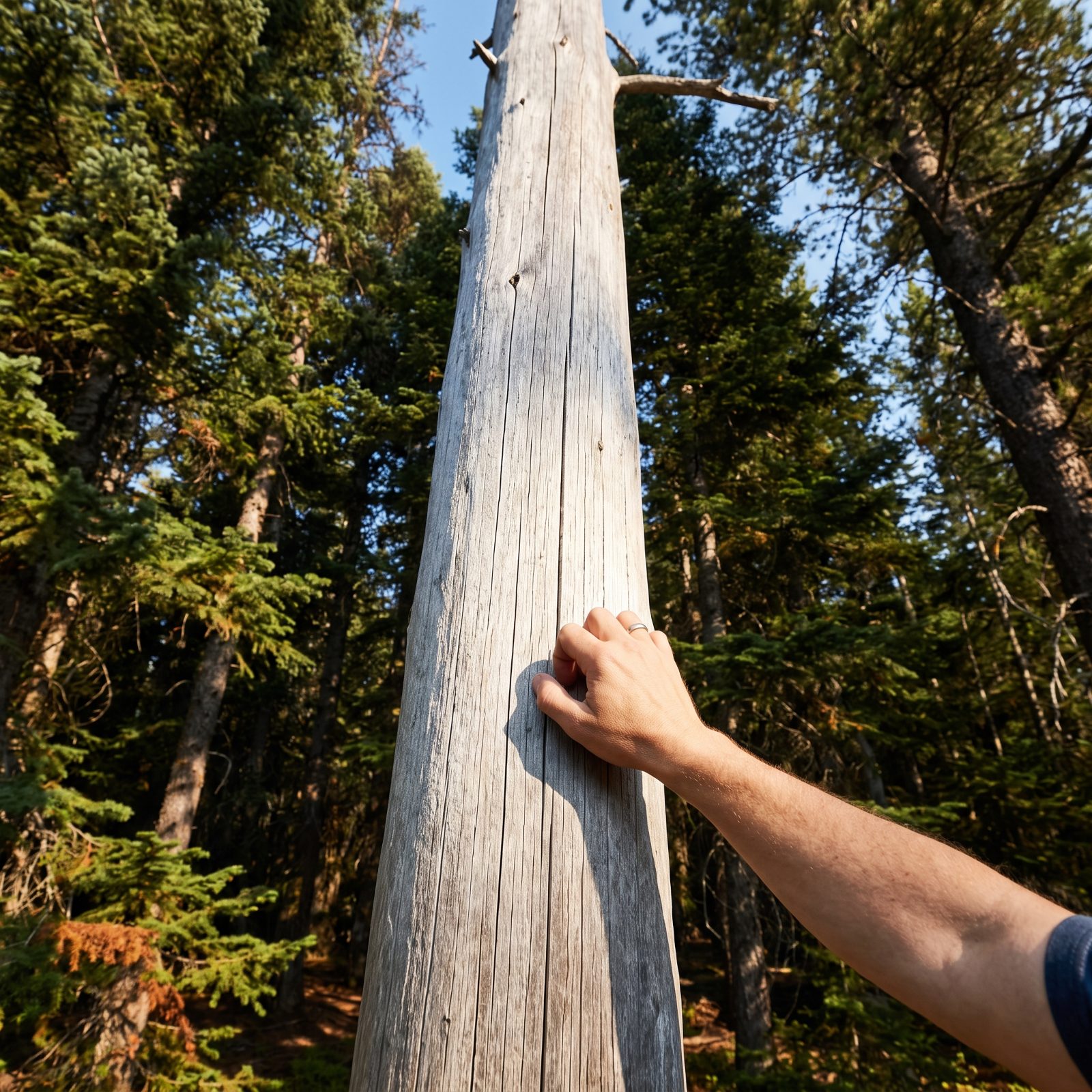
Standing dead wood is the best firewood in the forest. It’s already seasoned, it’s up off the damp ground, and it burns clean. But not all of it is sound — the rotten stuff wastes your saw and hangs overhead like a threat.
You test it by knocking. A solid dead tree rings back with a sharp crack. Rotten wood thuds dull and soft, the sound of punk ready to crumble in your hand. Sound deadwood keeps its bark tight, or sheds it cleanly to show hard, pale wood underneath.
32. Moving Hot Coals to Control a Dutch Oven’s Heat
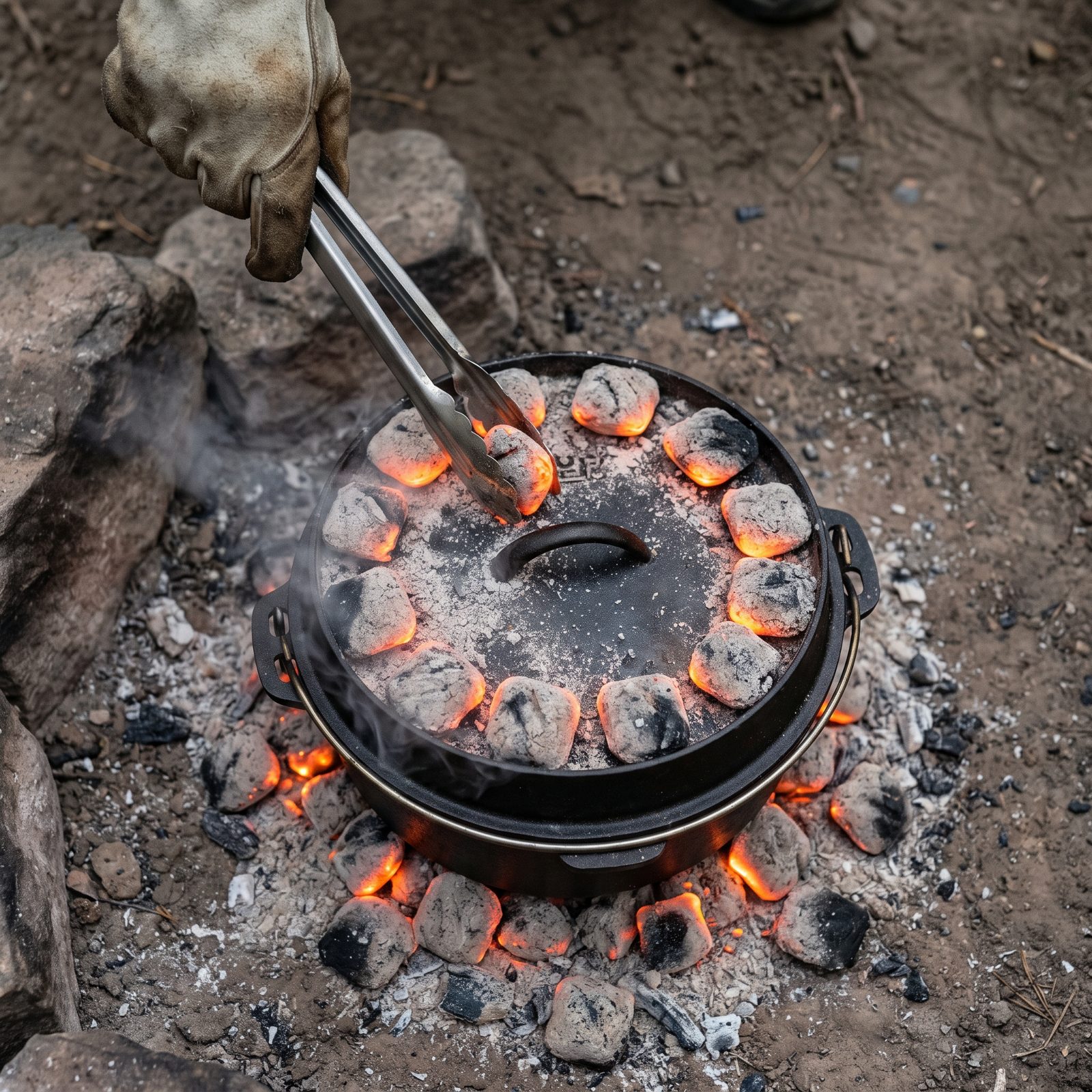
A Dutch oven isn’t a kettle you hang over the flames. It’s an oven, and the whole trick is coals on the lid as well as underneath. Heat from above browns and bakes; heat from below simmers and fries.
Move the coals, move the temperature. Pile more on top for a biscuit crust, shift them beneath for a stew. Old camp cooks counted briquettes — roughly twice as many on the lid as below for even baking — and rotated the pot a quarter turn now and then so no hot spot scorched one side.
There’s nothing quite like pulling a cobbler out of cast iron in the middle of nowhere. The folks who never learned this are missing out, and that’s all there is to it.
31. Distinguishing Fresh Tracks From Weathered Ones
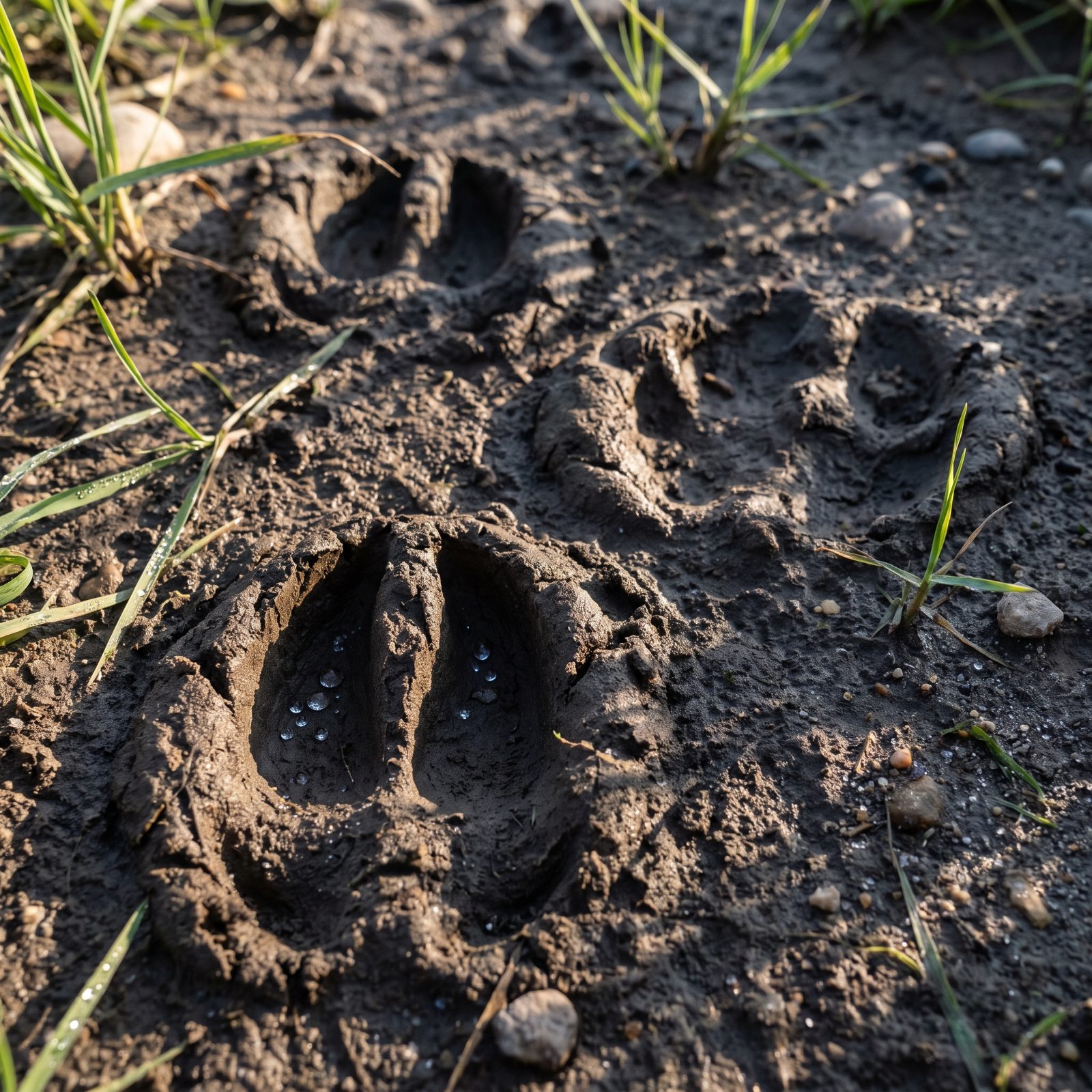
Anyone can spot a track. Reading its age is the real skill — the difference between trailing an animal that’s long gone and one browsing just over the next ridge.
A fresh track has sharp, crisp edges, the walls of the print standing clean and vertical. Give it a few hours of sun and wind and those edges round off, dry out, and crumble. Dew settled inside means it was made before dawn; a print still filling with seeping water was made minutes ago.
30. Packing a Canvas Bedroll That Sheds Rain
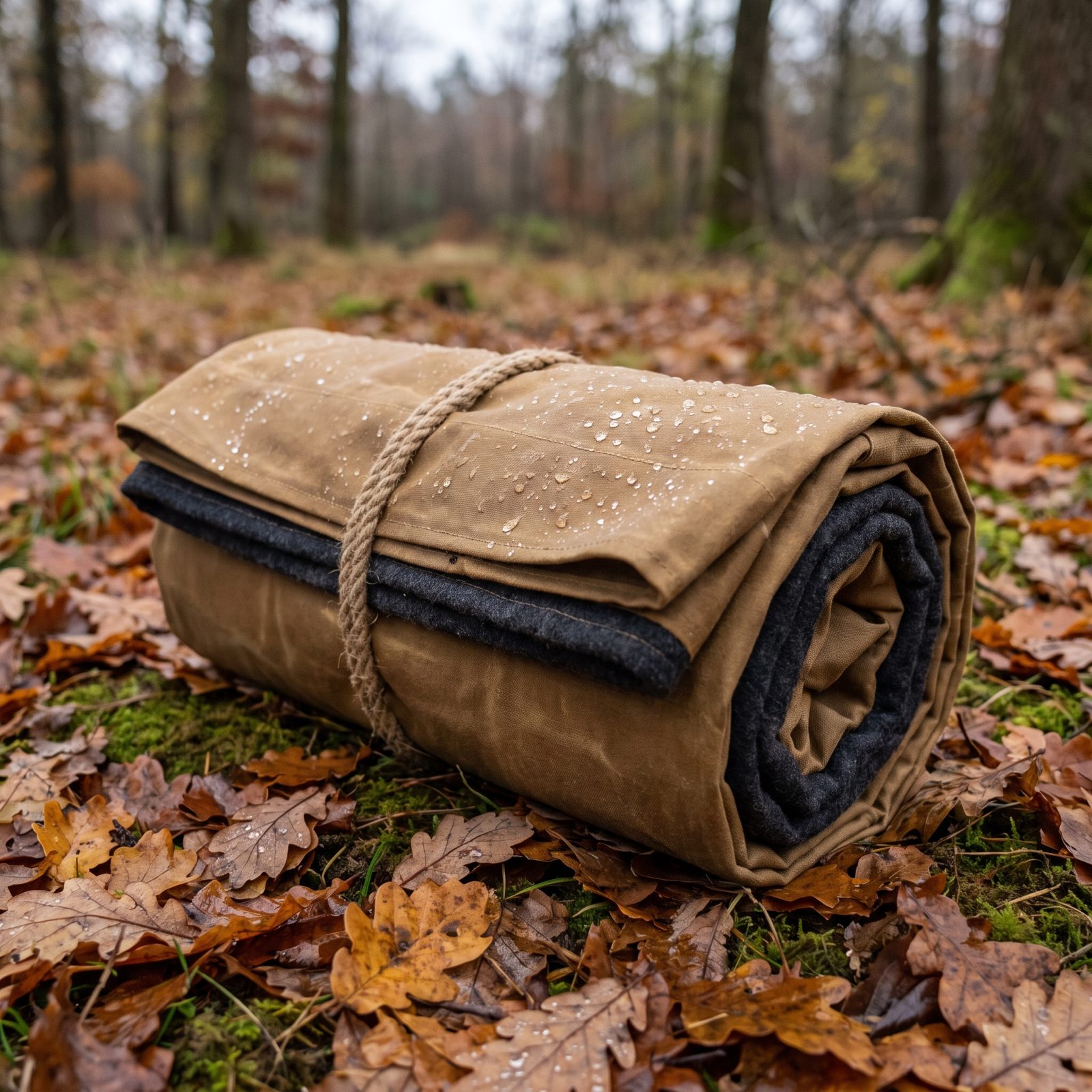
Long before nylon and zippers, a canvas bedroll kept drovers and hunters dry in weather that would soak a modern sleeping bag straight through. The whole secret is in the fold.
Heavy waxed cotton wraps the wool blankets, and you roll the outer flap so every seam points down. Rain hits it and runs off instead of wicking in. Tucked and cinched right, it works like shingles on a roof — each layer overlapping the one below.
It weighs a ton and takes real practice to roll tight. Fair enough. But there’s a reason the design survived a century of hard use before lightweight gear shoved it to the back of the shed. Sleep dry through one downpour and you stop laughing at the old ways.
29. Suspending a Pot From a Carved Adjustable Pot Hook
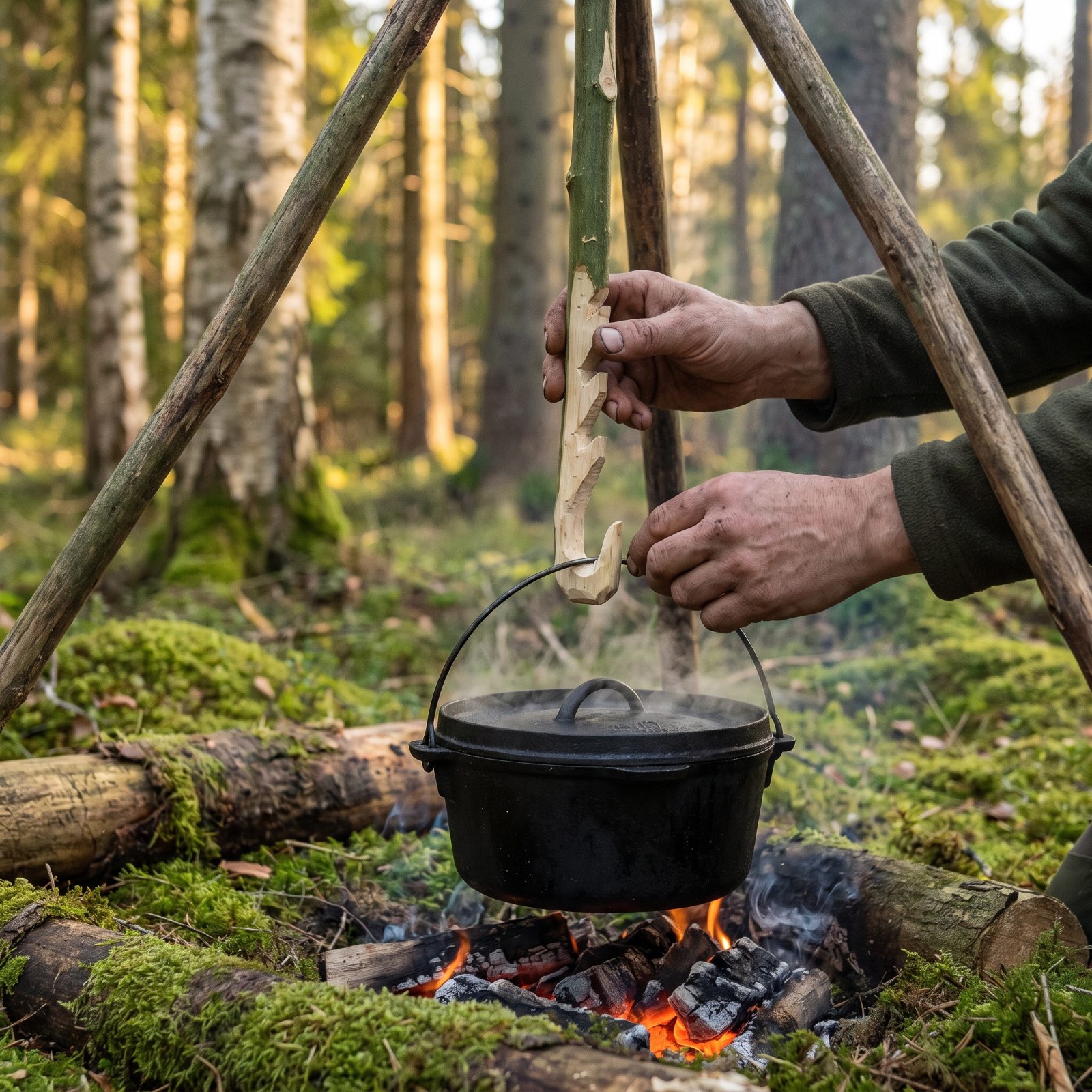
Heat control over a fire has nothing to do with the fire. It has to do with distance. The old carved pot hook is just a notched green stick hung from the top of a three-legged tripod, and it lets you drop the kettle closer to boil or ratchet it up a few notches to simmer, all without balancing the pot on shifting coals or a hot rock to burn your knuckles on.
Most people cook straight on the coals now and then wonder why the beans scorch on the bottom and stay cold in the middle. The hook solves that. You carve the sawtooth notches with the same knife you’d use for anything else, and it takes maybe fifteen minutes.
28. Reading Cloud Layers Before an Approaching Front
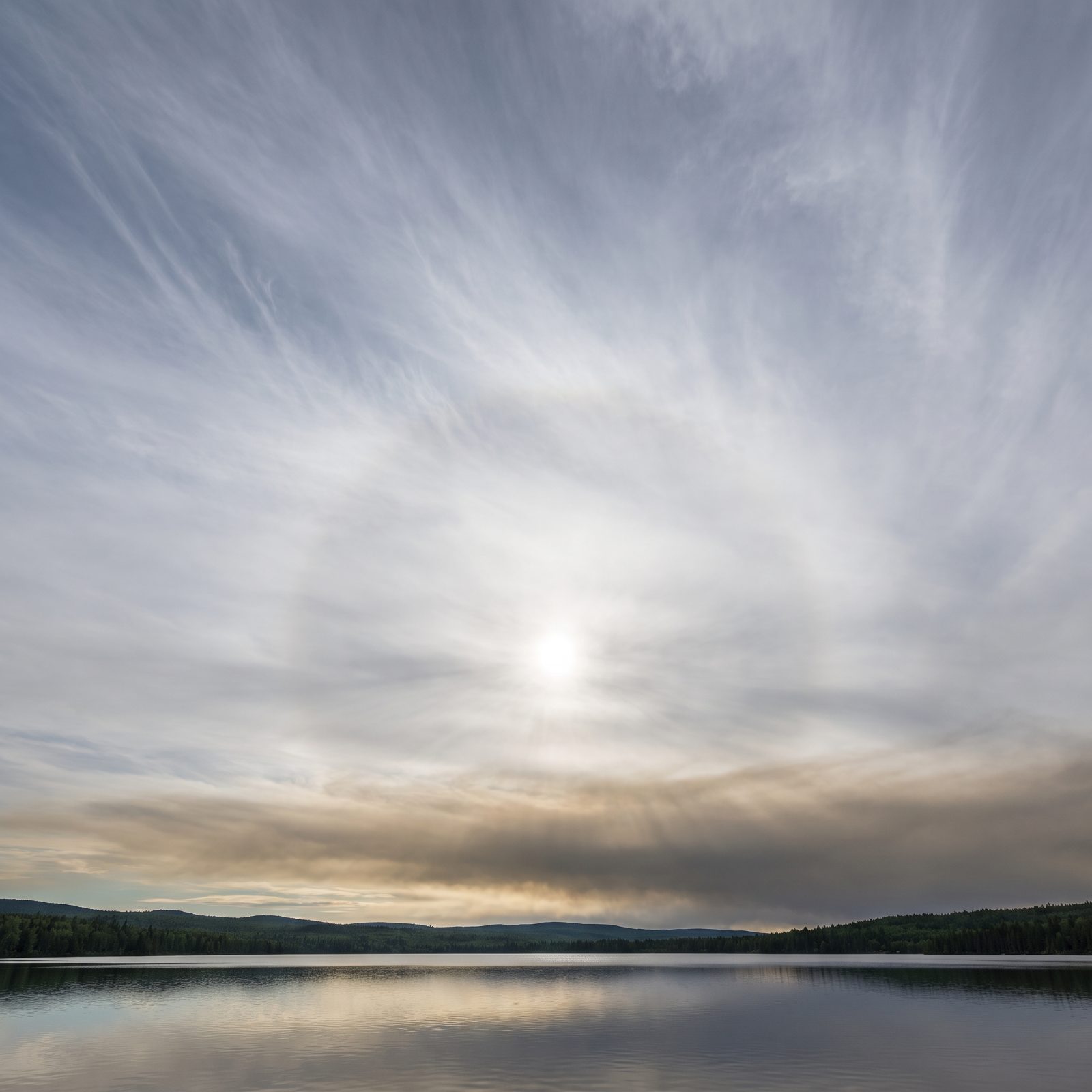
Cirrus first. Those thin, feathery streaks way up high, the ones people call mare’s tails. When they show up and the sky then hazes over slowly with a milky veil, something is coming, usually inside a day. The clouds are dropping and thickening in order, like a staircase of weather walking toward you.
A phone forecast is fine right up until the signal dies. Then it’s just you and the sky, and the sky has been honest about this business for a very long time. Watch the sequence, not any single cloud. Cirrus to altostratus to a flat grey ceiling means rain is on the way, and you’ve still got time to make camp before it hits.
27. Building a Stable Cooking Tripod With Three-Pole Lashing
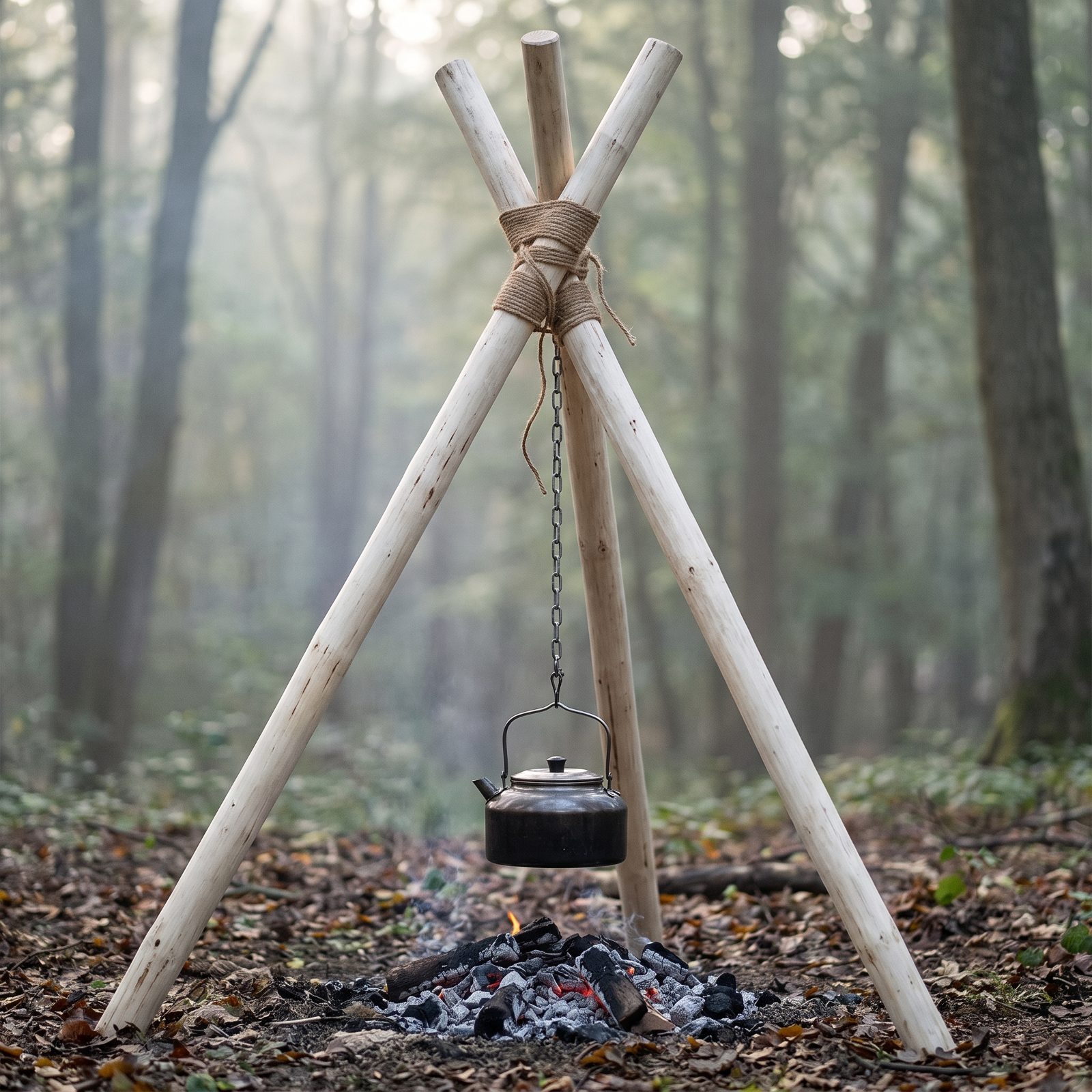
A tripod that racks and folds under a full kettle isn’t a tripod. It’s a trap for your dinner. The part nobody teaches anymore is the frapping turns, the wraps you make between the poles after you’ve lashed them together, which pull the whole thing into one rigid unit instead of a floppy hinge.
Lay the three poles side by side, lash near one end, then stand it up and walk the legs out until it bites the ground. The wider the stance, the harder it is to knock over. Honestly? Most store-bought folding grills are shakier than a properly lashed tripod made from three sticks you found lying around.
26. Making Feather Sticks From the Dry Core of Wet Wood
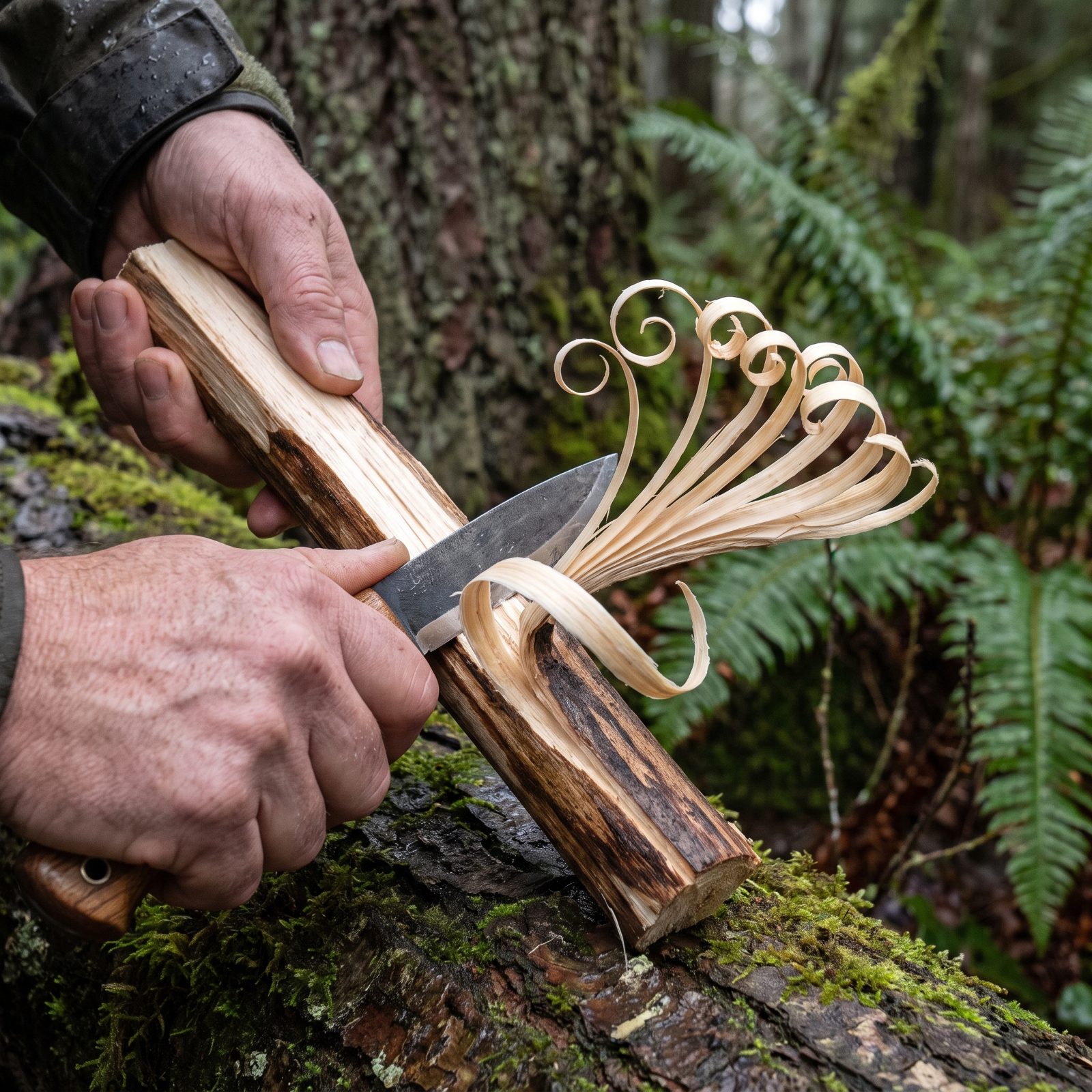
Everything’s soaked and you need fire. Here’s the part that saves you: the wet is only skin deep. Split a dead standing branch and the core is bone dry. Carve long curls off that dry face, leave them attached in a feathered bunch, and you’ve just built your own tinder out of what looked like useless wet wood.
The curls catch a spark because they’re thin enough to heat fast. Beginners carve them too thick and too few, like the wide, chunky ribbons in this photo. Go thinner than that: fine as paper, and plenty of them.
25. Recognizing Flash-Flood Terrain Before Pitching Camp
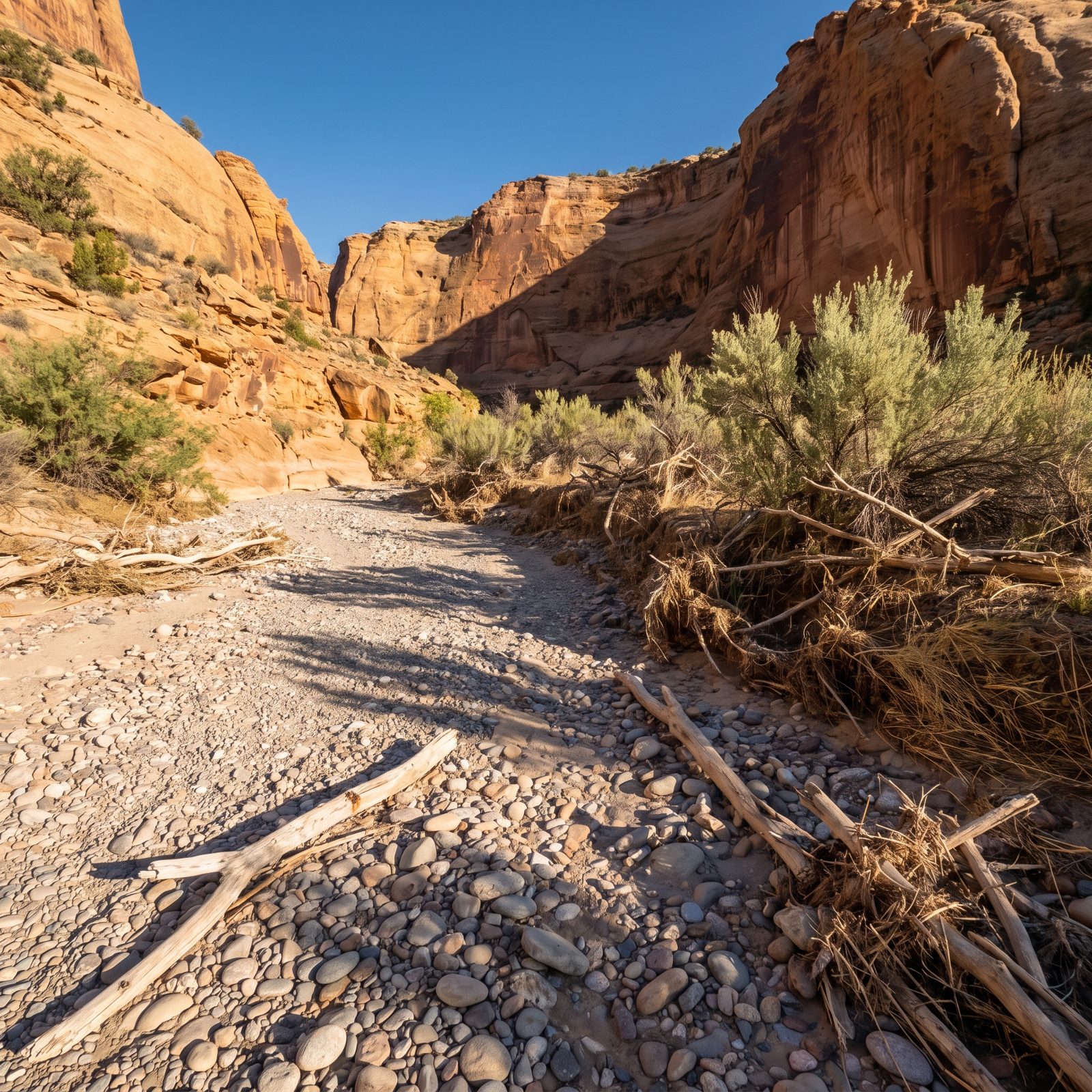
A flat, sandy spot in a canyon looks like a gift after a long day. Usually it’s a drain. Water falling miles away, on ground you can’t even see, funnels down these channels with no warning and no mercy, and people have drowned in washes under a perfectly clear sky.
Read the ground for the story it’s already told you. A high-water line of tangled grass and driftwood caught up in the brush shows you exactly how deep it ran last time. Rounded, sorted gravel means moving water lives here. Camp up on a bench or terrace, never down in the bottom, and never where the walls pinch tight.
24. Following Contour Lines to Avoid Exhausting Climbs
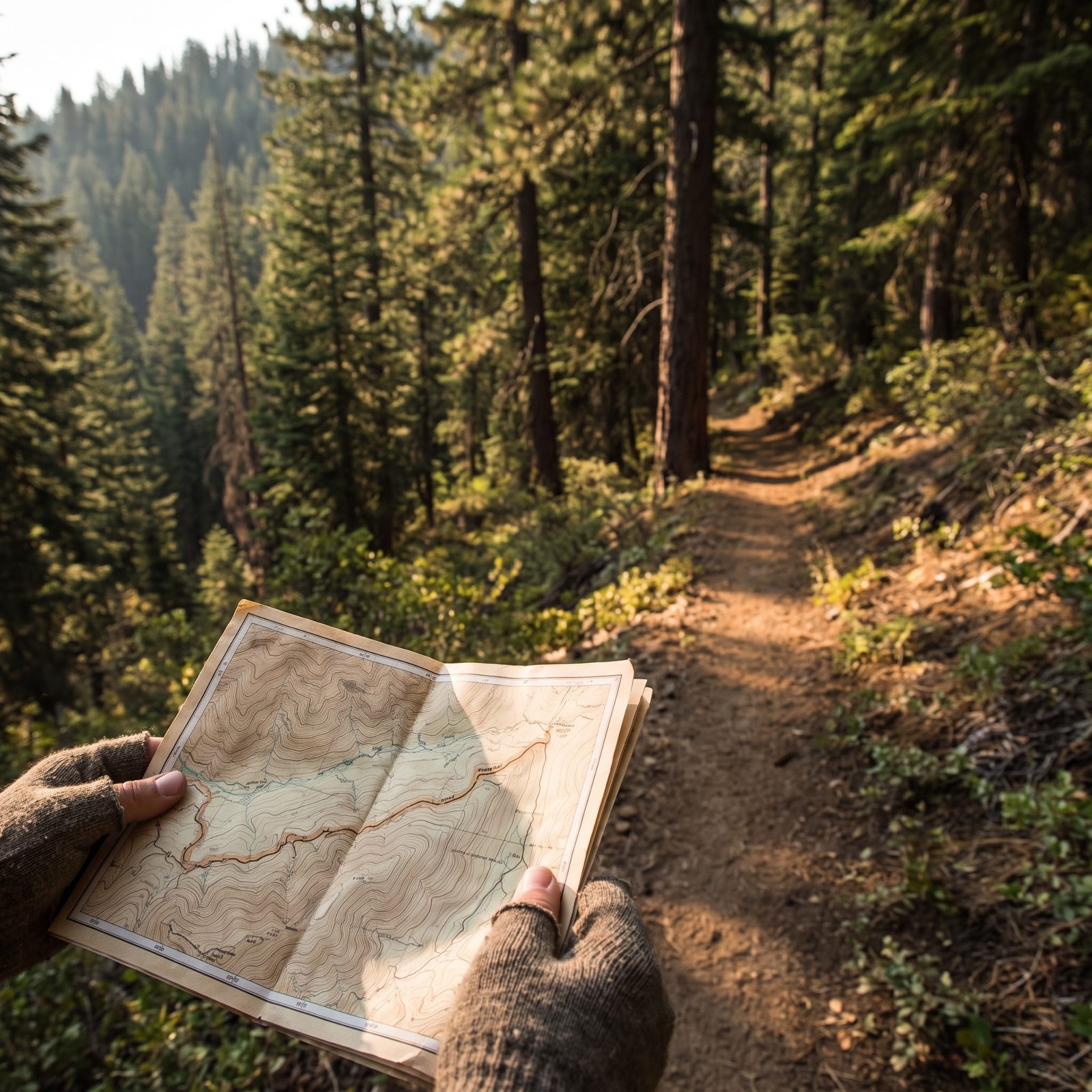
The shortest line up a hill is also the one that wrecks your legs by noon. Old hands and old game trails both figured this out long ago. They traverse, cutting sideways across the slope and gaining height a little at a time instead of charging straight at the fall line.
On a topo map it’s written right there in the brown contour lines. Packed tight means steep. Spread apart means gentle. Plan a route that keeps those lines spread as much as the terrain allows, and your knees will thank you three ridges later.
23. Collecting Birch Bark Without Injuring a Living Tree
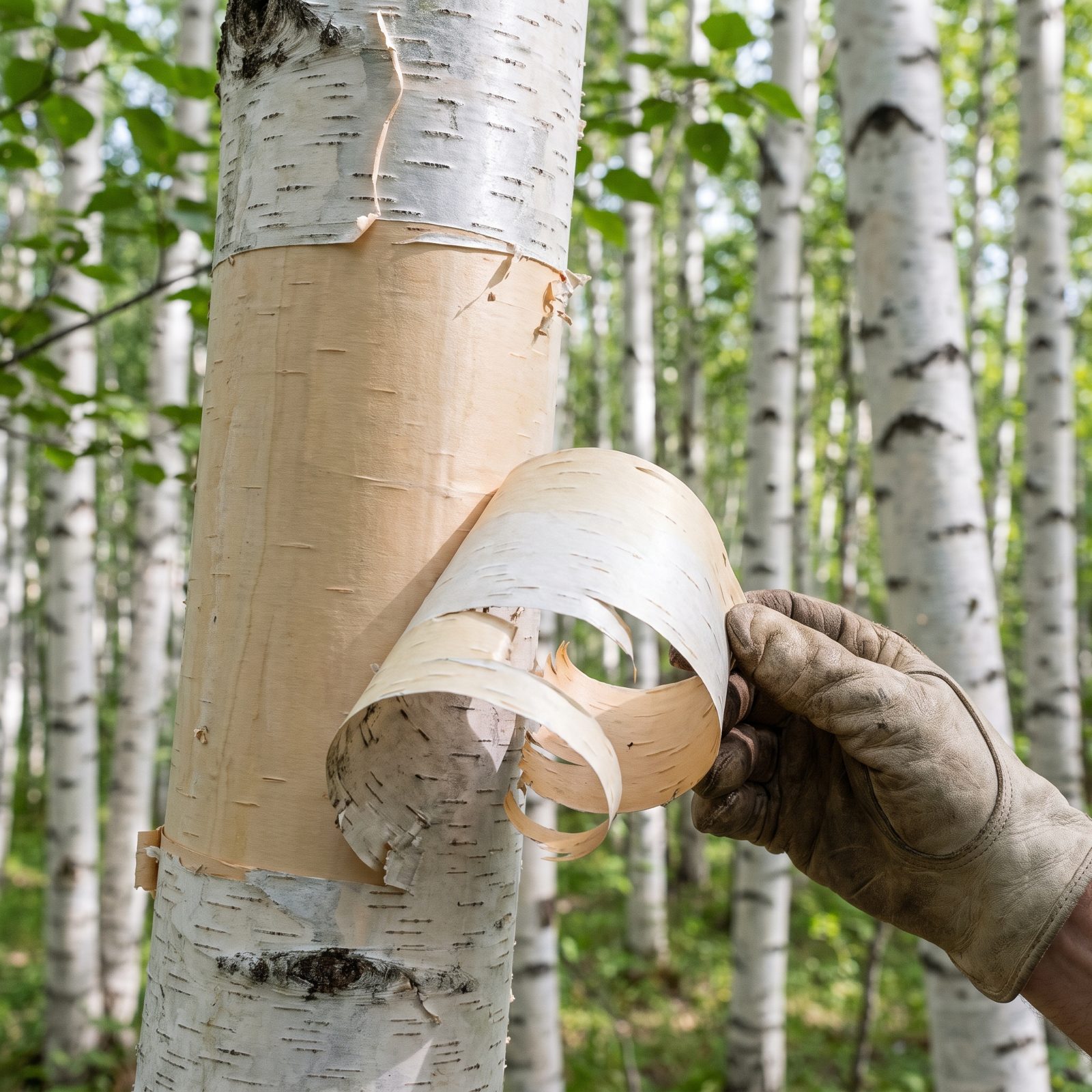
Birch bark is one of the best natural firestarters going. The oils in it mean it burns even when it’s wet. But people strip big sheets off living trees to get it, like the wide, clean-edged patch peeled from this trunk, leaving the orange layer underneath bare, and damage that runs clean through the bark can kill a birch the same way it would any other tree.
Don’t do what’s shown here. Take only the thin, loose outer layer that’s already peeling and curling on its own. Never cut into the trunk. Never strip all the way around. Downed birch is better still, since nothing gets hurt at all, and a dead birch log holds dry, flammable bark long after the wood inside has rotted to mush.
22. Signaling With a Mirror Using the Two-Finger Aiming Method

A signal mirror’s flash can be seen for miles, farther than you’d ever shout or wave. Aiming it is the hard part, because that bright flash does you no good if it never lands on the plane or the search party you’re trying to reach.
Hold two fingers out at arm’s length in a V and set your target in the gap. Angle the mirror to catch the sun and flash its reflection across your own fingers. When the light sweeps over them, it’s pointed right where you’re looking. Sweep it slowly back and forth so a searcher catches the glint.
A cheap signal mirror in a pack has saved more lives than most expensive gear ever will.
21. Making a Functional Snowshoe Repair With Cord and Wood
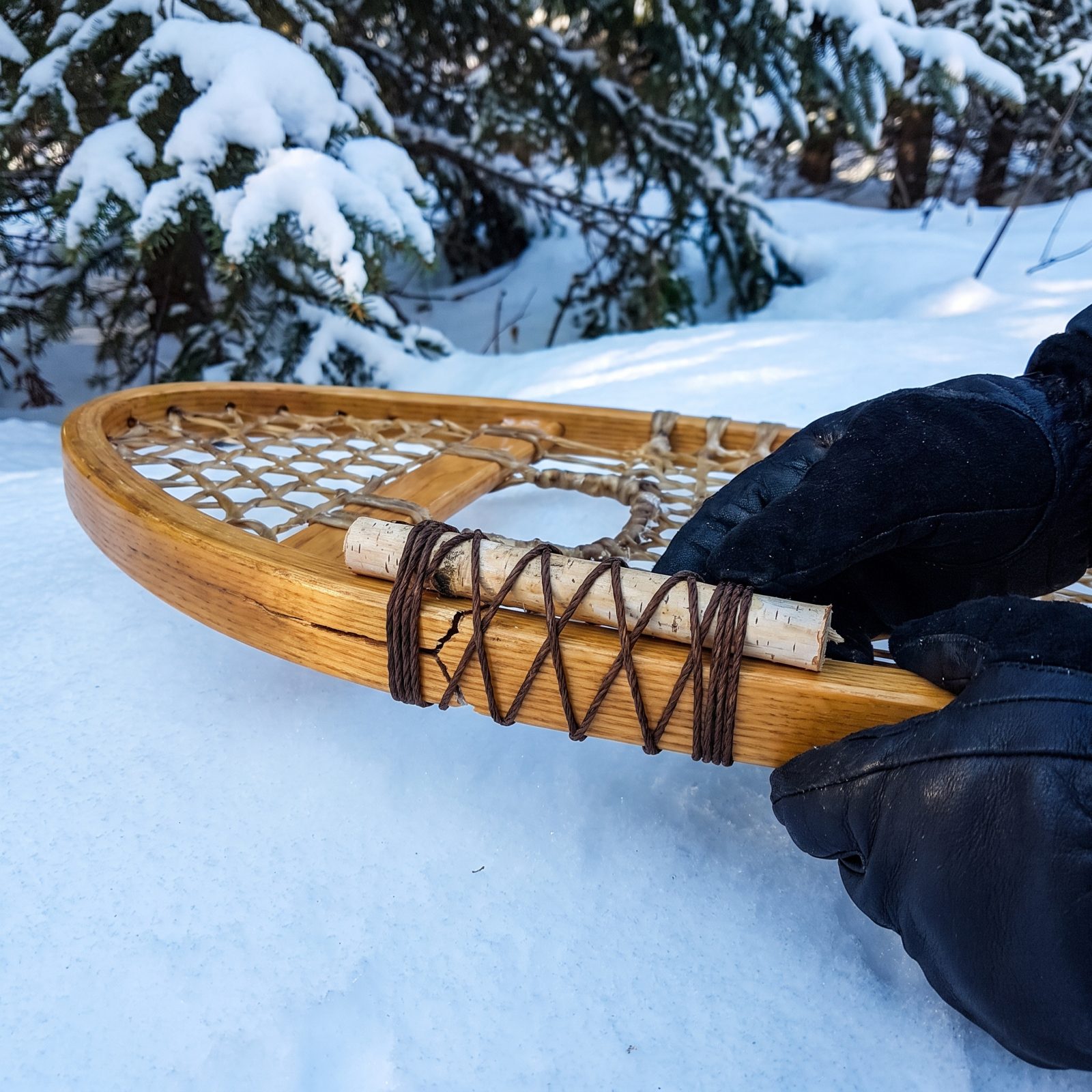
A snapped snowshoe frame miles from the truck used to be a real problem, and the people who traveled on snow for a living knew how to deal with it right where they stood. The fix is a splint: a straight stick laid lengthwise along the cracked frame rail and lashed hard with cord, wrapped tight at each end and criss-crossed over the break.
You carry the cord anyway. The stick you find anywhere. It won’t be pretty and it won’t last the season, but it’ll get you home walking on top of the snow instead of floundering waist-deep in it.
20. Splitting Straight Kindling With a Froe and Wooden Mallet
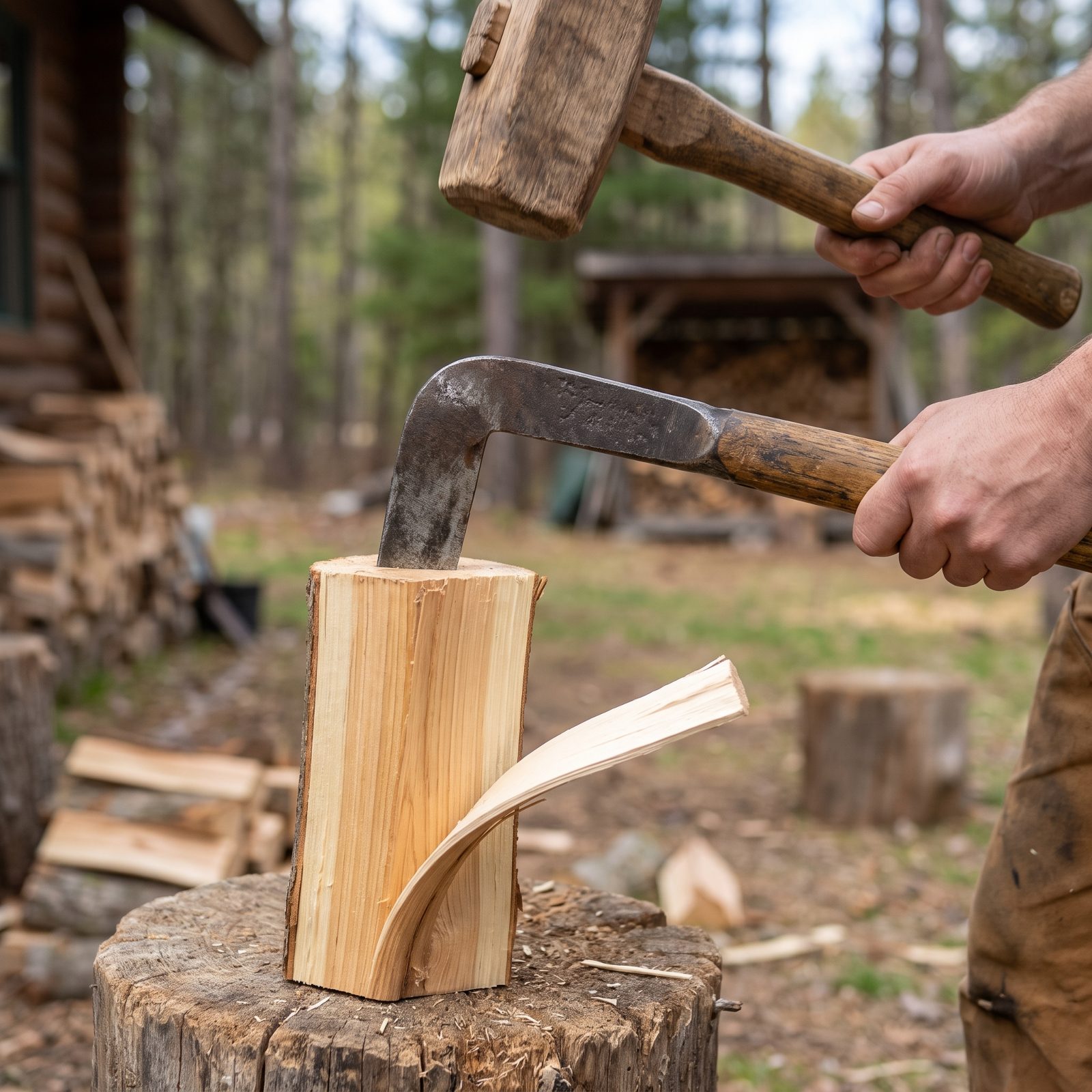
A froe splits wood with the grain instead of across it, and that’s how you’re meant to end up with long, straight, uniform kindling and shakes. Set the blade on the end of a log, whack the top with a wooden mallet to start the split, then lever the handle to run it on down.
Hardly anyone owns one now. A shame, really, because it’s a lot safer than swinging a hatchet at small stuff. Your hand stays nowhere near the blade. The wood tells you where it wants to go, and a froe lets you follow the line it gives you. Go find an old one at a farm sale.
19. Building a Reflector Fire to Push Heat Back Toward Camp
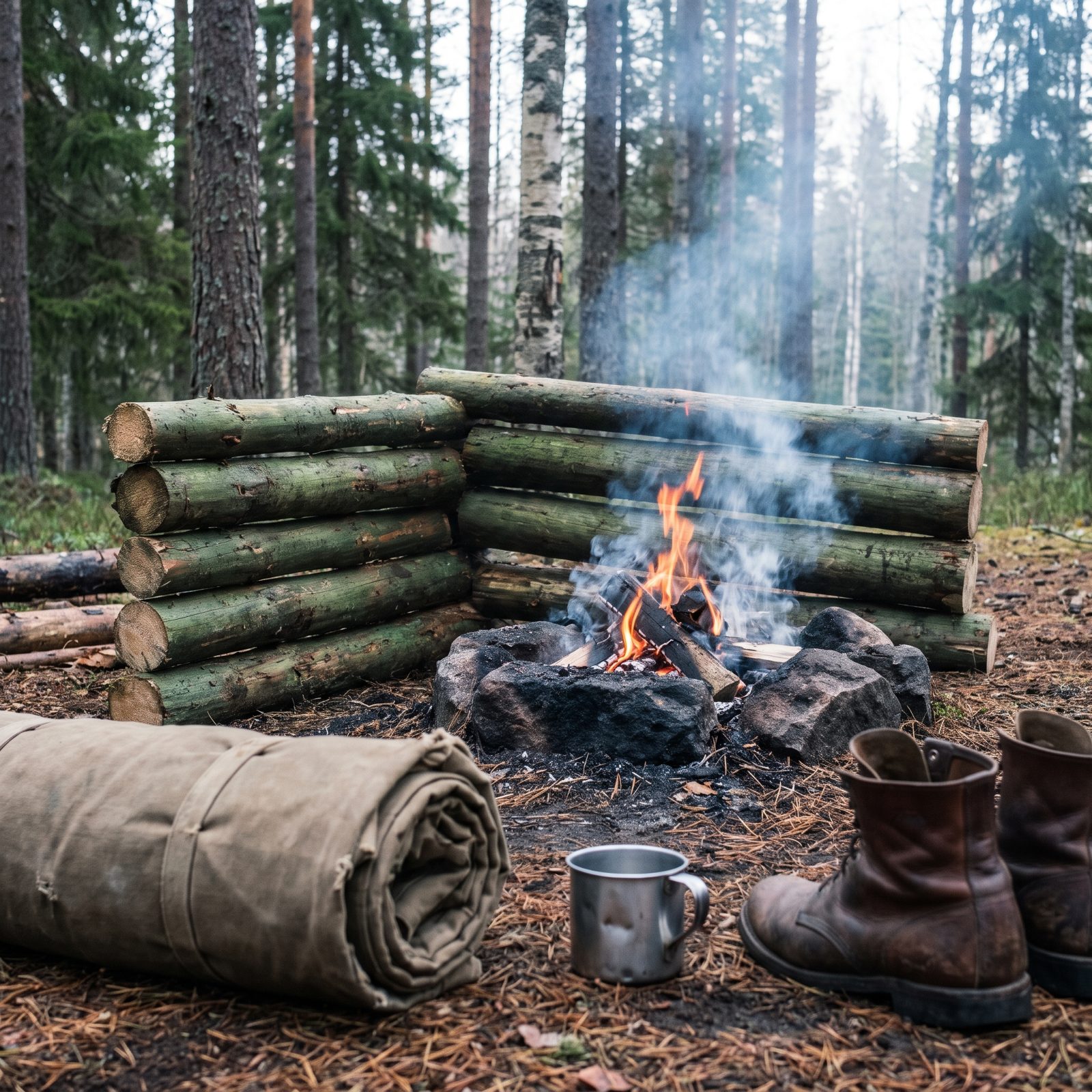
A fire left open to the night throws half its warmth into the dark where nobody is sitting. A reflector fixes that. Stack a low wall of green logs or stones on the far side, angled slightly back, and the heat that would have escaped gets bounced toward your bedroll instead.
Green wood matters here, because dry logs just become more fire. The old trick was to build that wall on the far side of the fire, facing your sleeping spot, so warmth rolled over you all night on a long, slow burn.
18. Finding Your Way With a Paper Topo Map and a Baseplate Compass
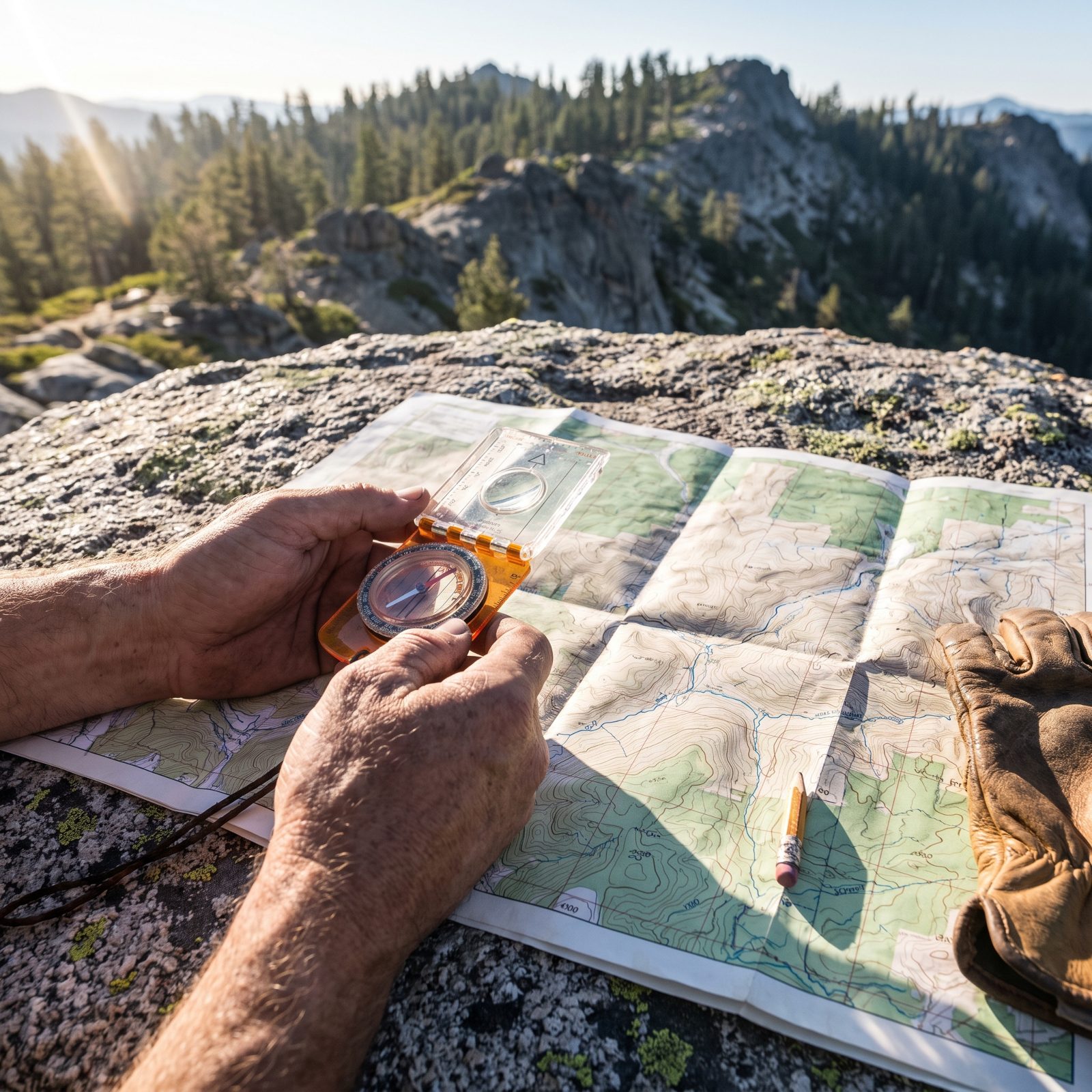
Phones die. Signal drops in the bottom of a valley exactly when you need it, and that’s the moment a paper topo map and a baseplate compass keep right on working — cold morning, cracked knuckles, gloves and all. They fold into a pocket, too.
Most people never bother learning to read the brown squiggles. Pity. Those contour lines tell you where the land climbs, where it falls off steep, where a saddle lets you slip over a ridge without a brutal pull. Match the lines to the ground in front of you and the terrain starts narrating itself, which is a quieter kind of magic than it sounds.
Honestly? It takes most people years to trust a map over a gut feeling. The map wins almost every time.
17. Using Ridges and Streams as Navigation Handrails
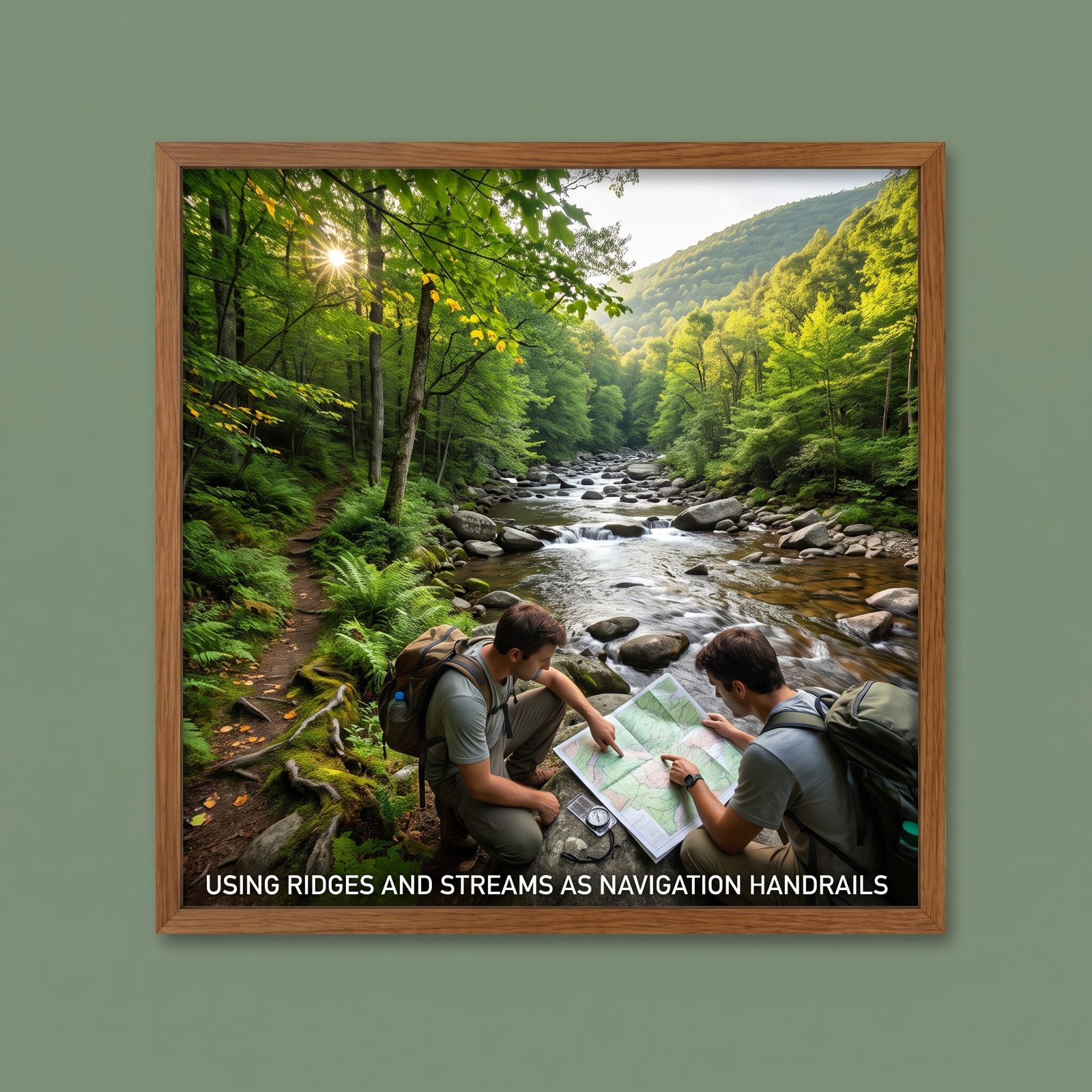
A handrail is any long feature running roughly the direction you want to travel — a ridgeline, a river, the edge where field meets forest. Keep it on one shoulder, follow it, and you almost cannot get lost, because the feature catches you.
People moved through big country this way long before GPS. You don’t aim at a pinpoint. You aim at a line that’s miles long and impossible to miss, then walk it until you hit the thing you actually came for.
16. Settling Cloudy Water Before You Filter and Boil It
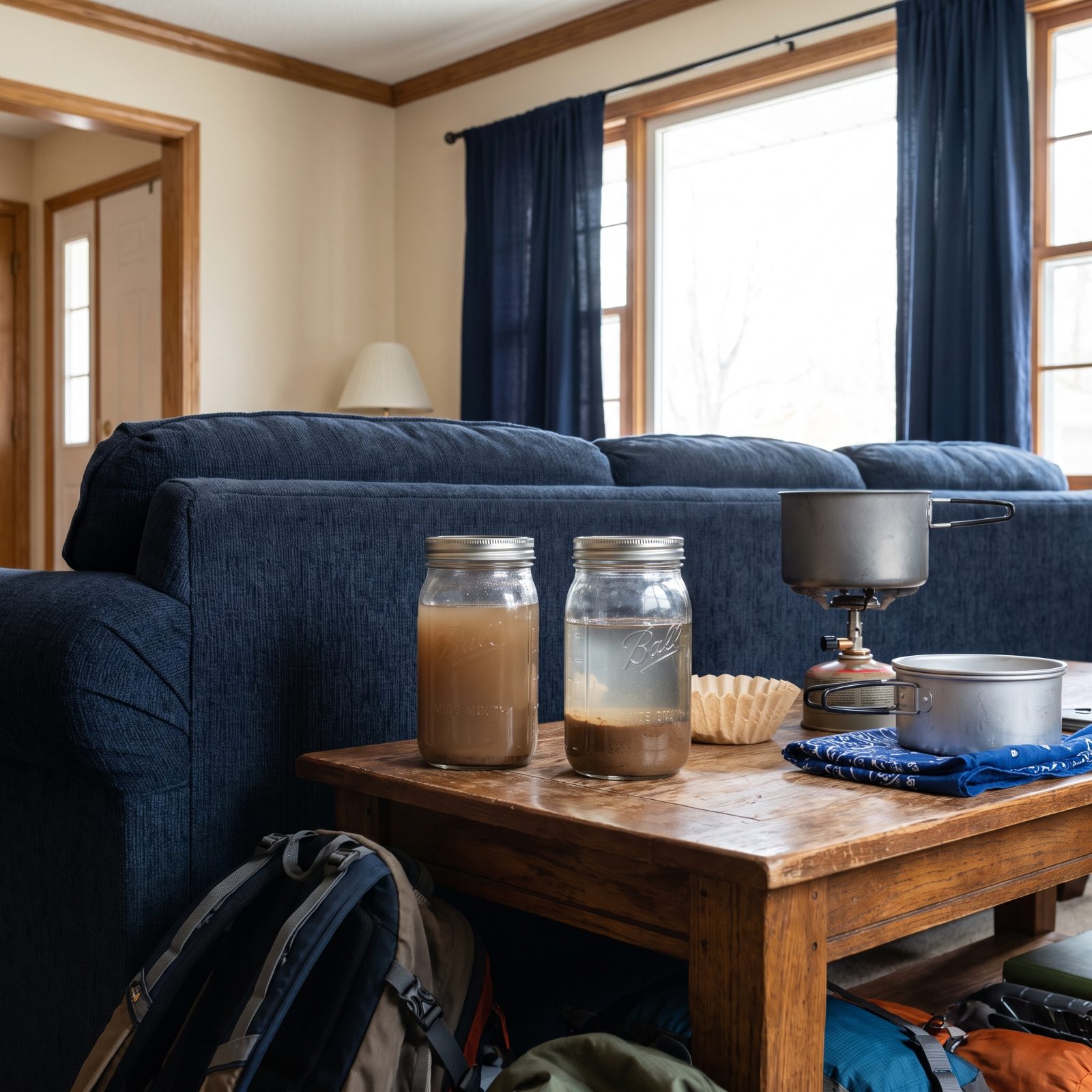
Scoop water from a churned-up creek and you get silt, and silt clogs a filter fast while hiding whatever you’re trying to kill. The old move was patience: fill a container, let it sit, and watch the heavy stuff drop to the bottom.
Give it an hour, pour the clear water off the top through a cloth, and only then run it through a filter or bring it to a boil. You’ve done your filter a favor and made the boil more reliable. Settling is not purifying, though. It just gets you clear water to treat properly — and treat it you must.
15. Picking a Safer Place to Ford a Moving Stream
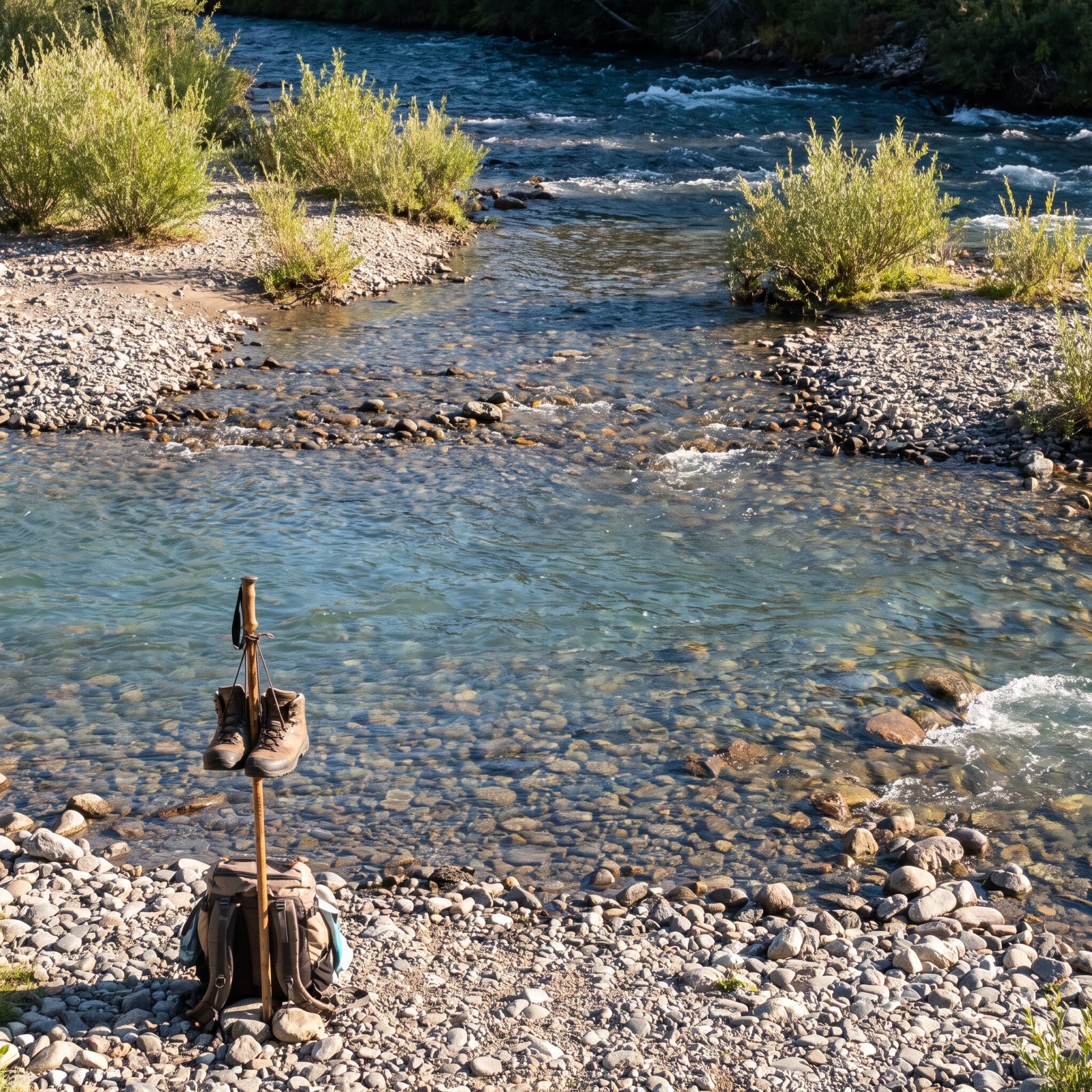
The spot that looks easiest to cross is often the worst. Narrow means deep and fast. What you want is wide and braided, where the current spreads thin over gravel and the water barely reaches your shins.
Read the surface. Smooth, glassy water is deep and moving hard, while riffled, broken water running over stones is usually shallow enough to wade. Scout upstream and down before you commit — the first spot you reach is rarely the best one.
14. Crossing Current With a Sturdy Wading Staff
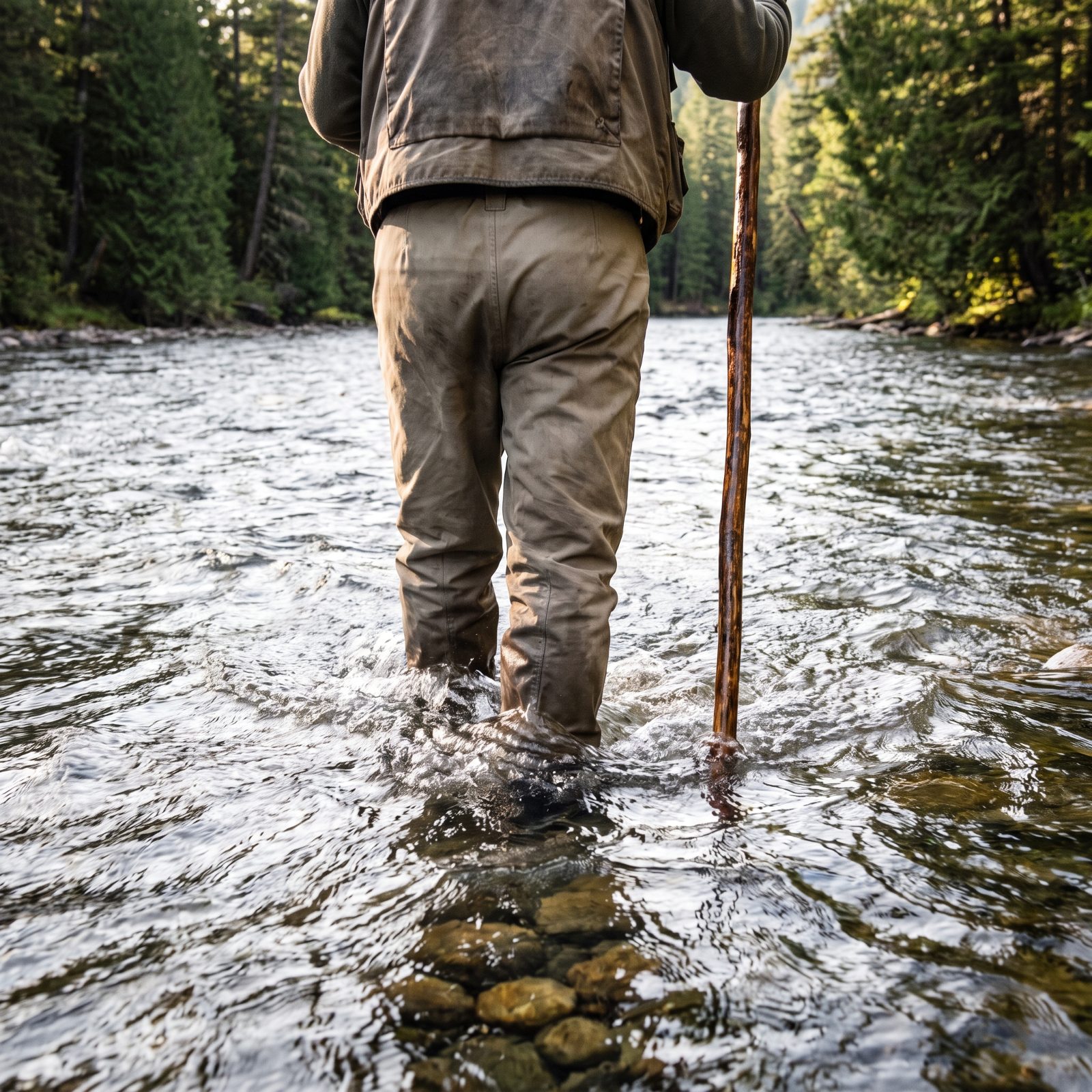
Two legs in current give you a point that wants to pivot. Add a staff and you’ve got a tripod, and a tripod doesn’t tip. One rule covers it: always keep two of your three points planted before moving the third.
Plant the staff upstream, where the current presses it into the bed and locks it, then shuffle sideways with your feet never crossing, leaning slightly into the flow. A broomstick-thick length of hardwood does the job for nothing.
Anglers who’ve gone in cold once rarely wade without a staff again. Learn that lesson the cheap way.
13. Recovering a Swamped Canoe in Deep Water
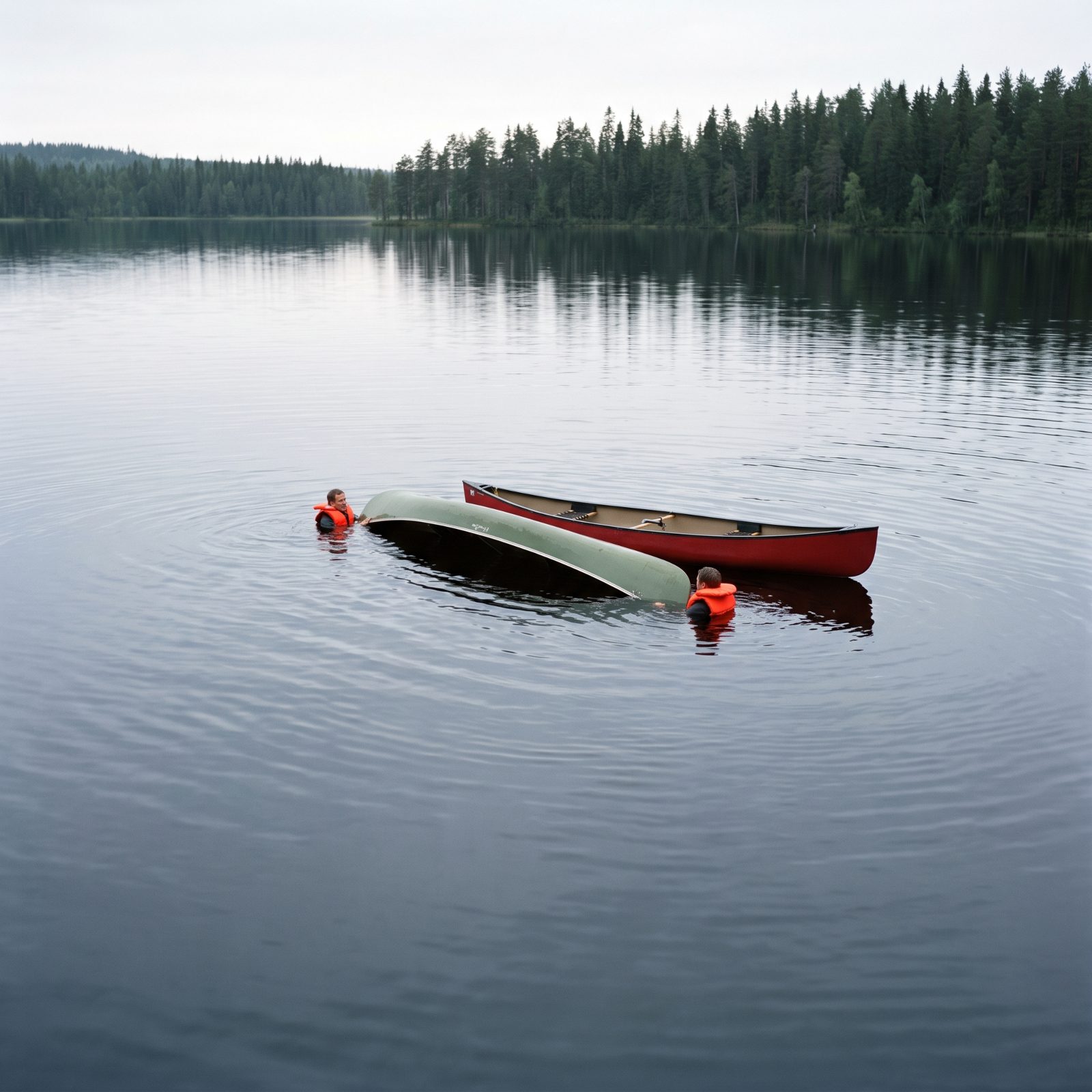
A canoe goes over, and panic is the real danger — not the water. Stay with the boat. It floats even full, and it’s far easier to spot than a head bobbing in the chop.
The classic recovery uses a second canoe as a platform. Here, two swimmers in the water steady the swamped green hull beside an empty wooden canoe. Next comes sliding it up across that boat’s gunwales, rocking it to drain, then flipping and lowering it back into the water. Out in solo country, you kick it to shore and bail there.
12. Reading Broken Twigs and Flattened Grass as Animal Sign
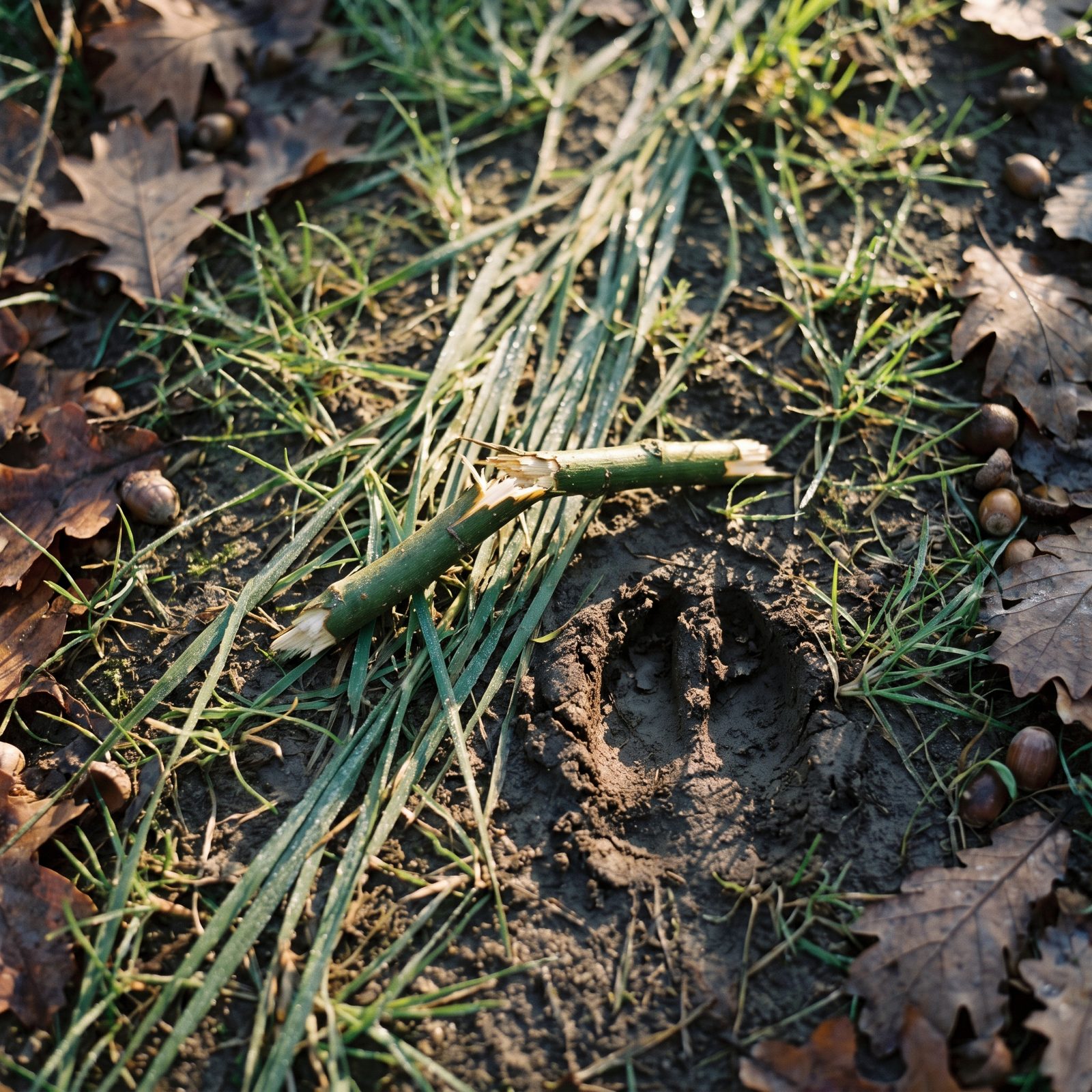
Tracks get all the attention, but the ground tells more than footprints. A twig snapped at knee height, the break still green and wet. Grass pressed flat and pointing the way something walked. Dew wiped off a leaf where nothing wild should have touched it.
Hunters and trappers read a place this way long before anyone bolted a camera to a tree. You slow down, you look low, and you start noticing where the land has been disturbed and which direction the disturbance points.
11. Smoking Fish Over Low Heat So It Keeps
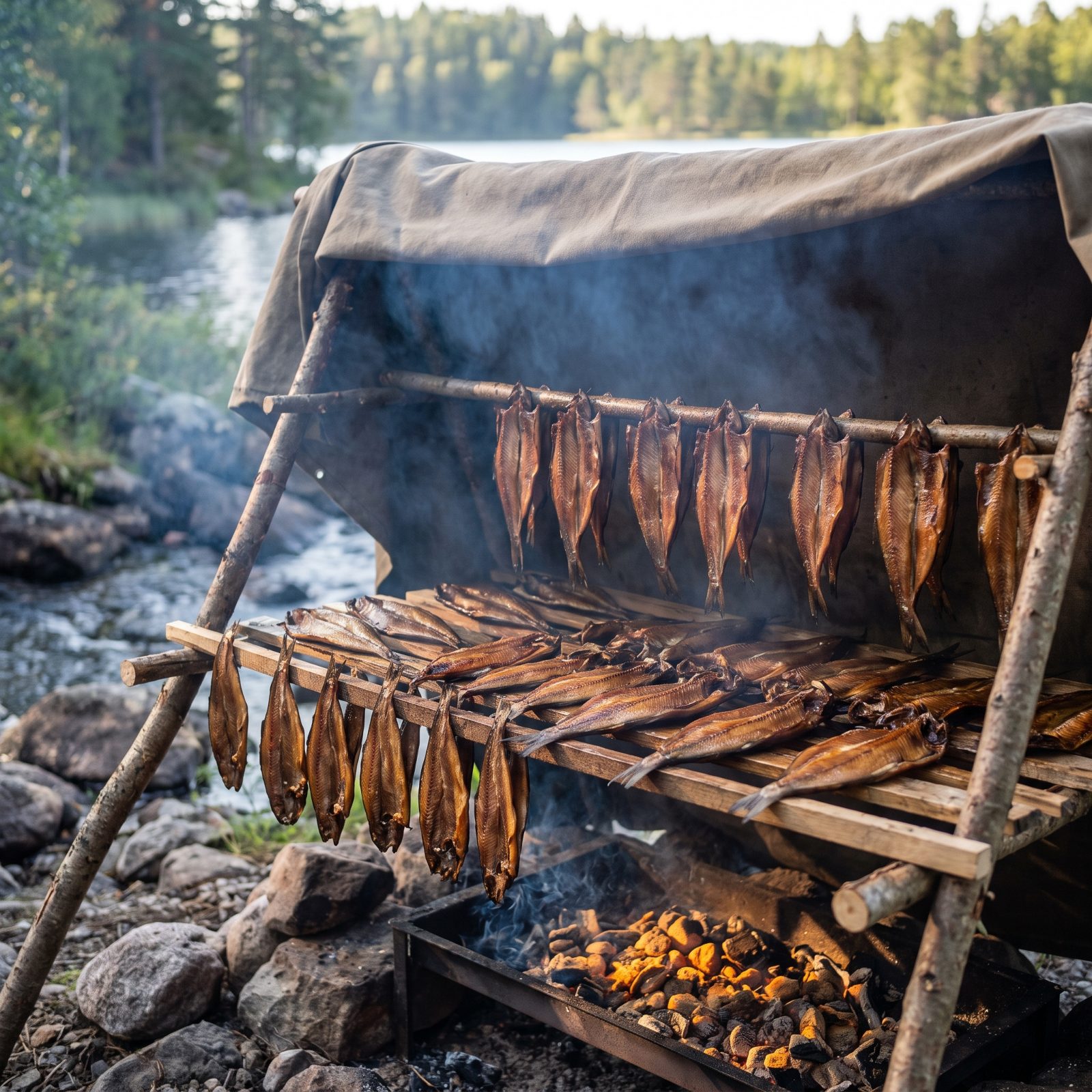
Before refrigeration followed people into the backcountry, smoke was how a good catch survived more than a day. Low heat and steady smoke slowly dry the flesh and lay down a surface that holds spoilage off.
The mistake is treating it like a grill. This is patient work — a tray of glowing charcoal kept low and steady beneath the rack, a tarp overhead to hold the smoke, fillets split thin, hours rather than minutes. Run it too hot and you just cook the fish, and cooked fish spoils like any other.
Done right, it comes off bronze and firm, keeps for days in cool weather, and tastes like the lake it came from.
10. Tying a Snell Knot Around a Hook Shank
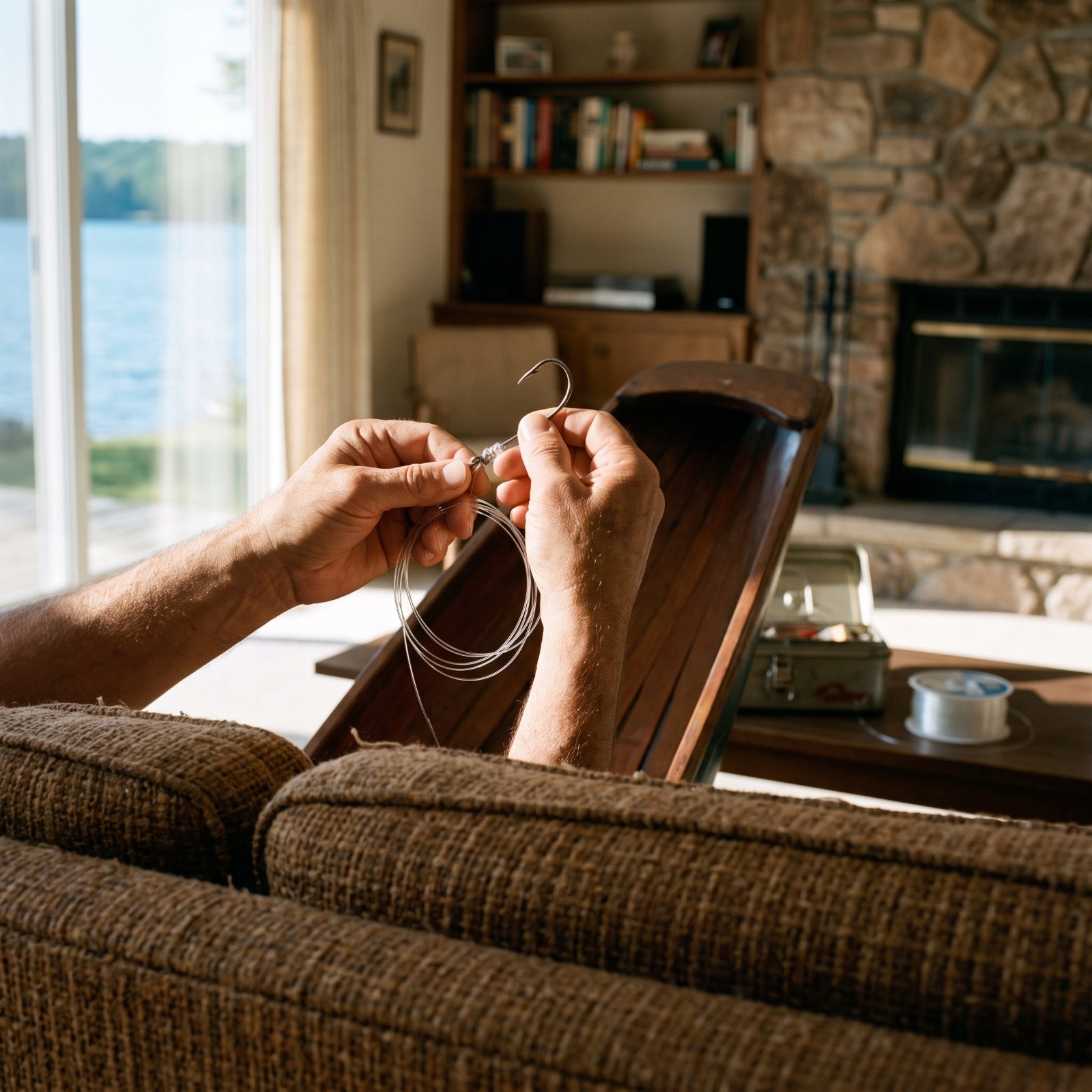
A snell doesn’t tie to the eye of the hook. It wraps around the shank itself, which lines the pull up straight behind the point and sets the hook harder on the take. Bait anglers have sworn by it for generations.
Most people now clinch-knot everything to the eye and never learn the snell. Worth knowing anyway, because for live bait and circle hooks it plants fish in the corner of the mouth more reliably.
9. Repairing Torn Canvas With a Sailmaker’s Stitch
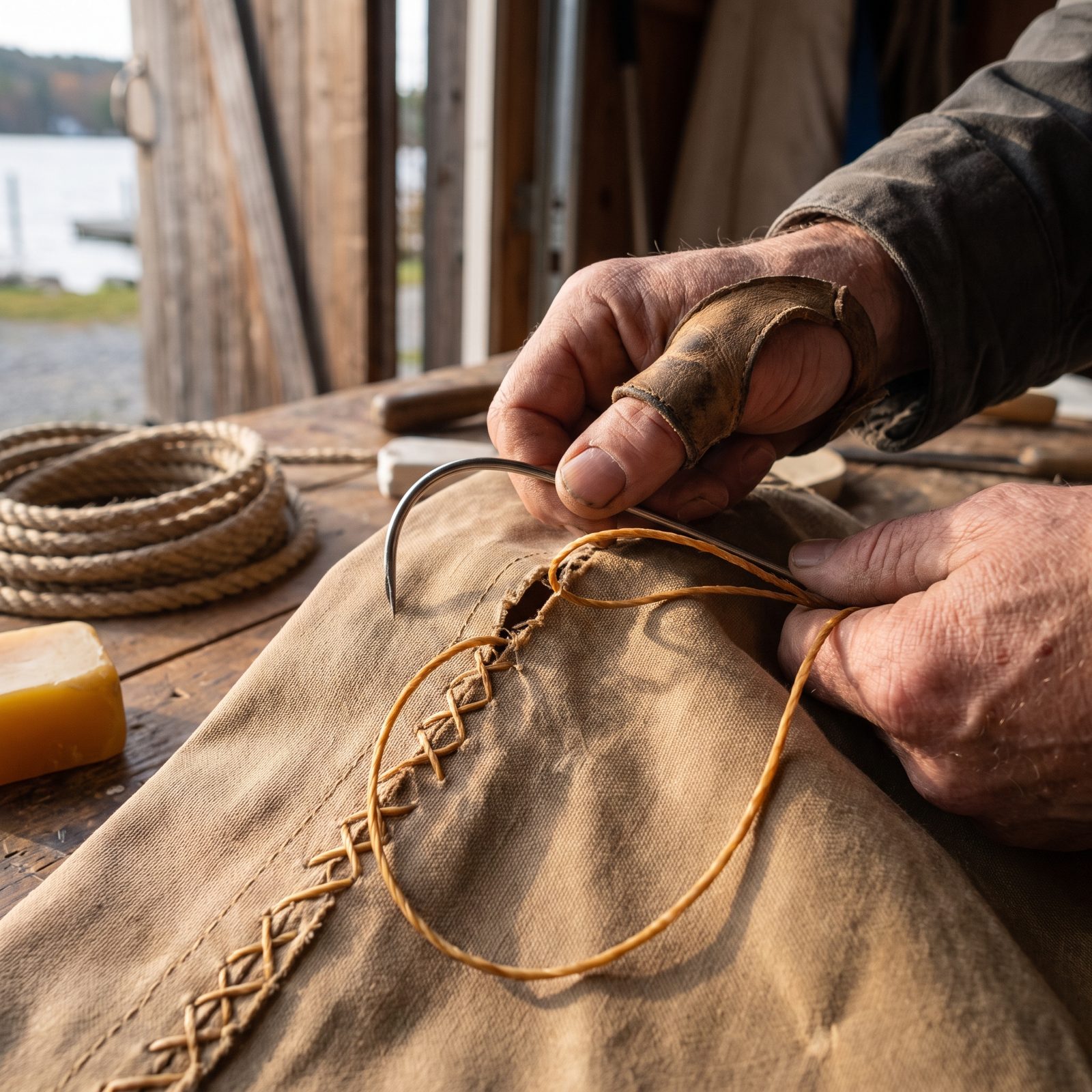
A two-dollar roll of waxed sail twine will outlast a fifty-dollar canvas tent, and most people never learn to use it. The sailmaker’s stitch works because each pass laps the last, so a single thread never carries the whole load. Pull one stitch and the tear doesn’t unzip.
Here’s the detail nobody mentions. It’s the leather stall — that worn sleeve wrapped around your finger. Try pushing a needle through doubled canvas with bare fingers and you’ll quit by the third stitch, I promise you. The stall lets you push hard without the needle eye biting into your skin.
8. Splicing the End of a Three-Strand Rope
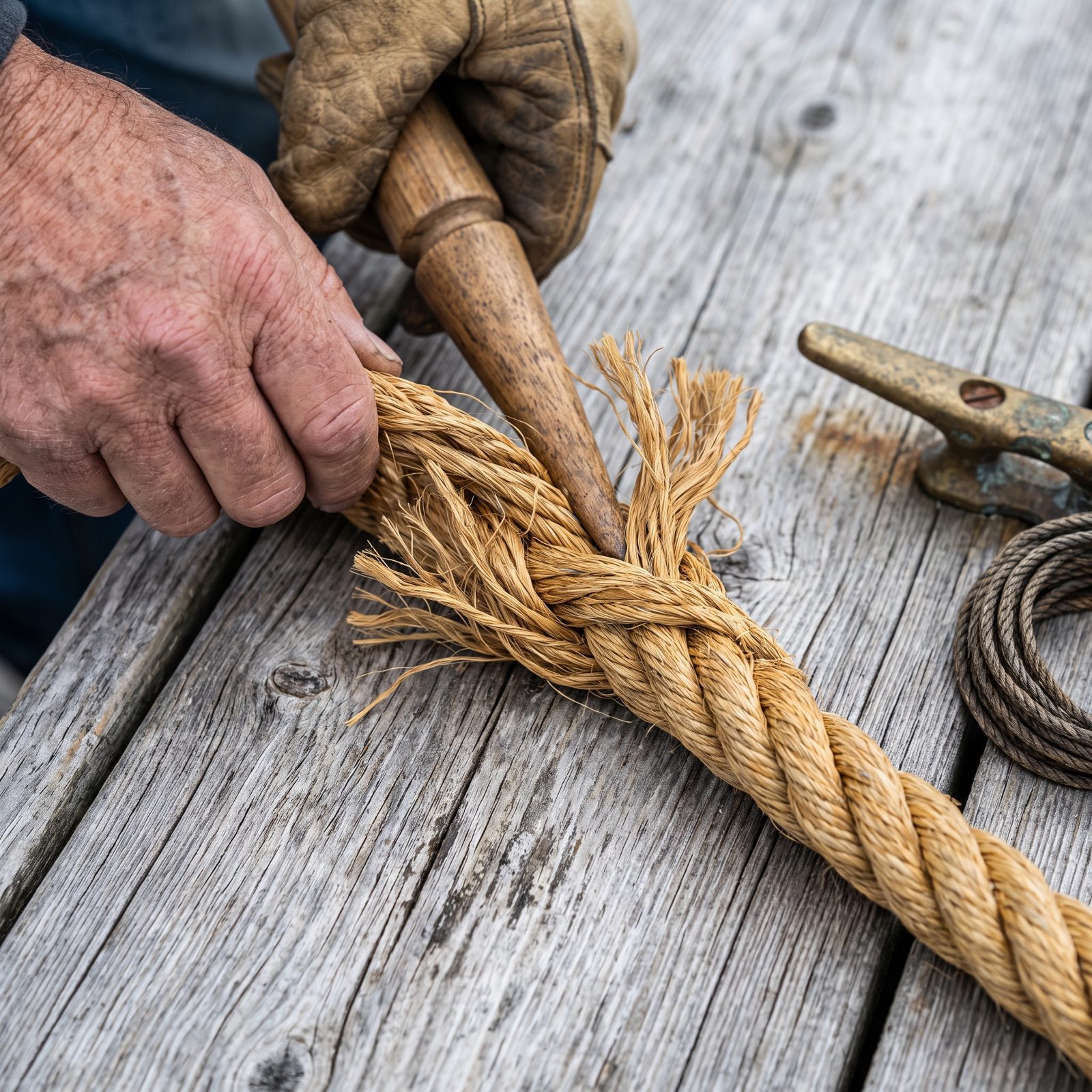
Tie a knot in the end of a rope and you lose roughly half its strength at the bend. Splice it and you keep almost all of it. That’s why the splice exists, and it’s why riggers trusted their lives to it.
The rhythm is simple once it clicks: over one strand, under the next, against the lay of the rope. Three tucks hold on natural fiber. Slippery modern line wants four or five. Where people go wrong is tucking with the twist instead of against it — and then the whole thing loosens the first time the load comes on.
7. Building a Debris Shelter With a Thick Insulating Roof
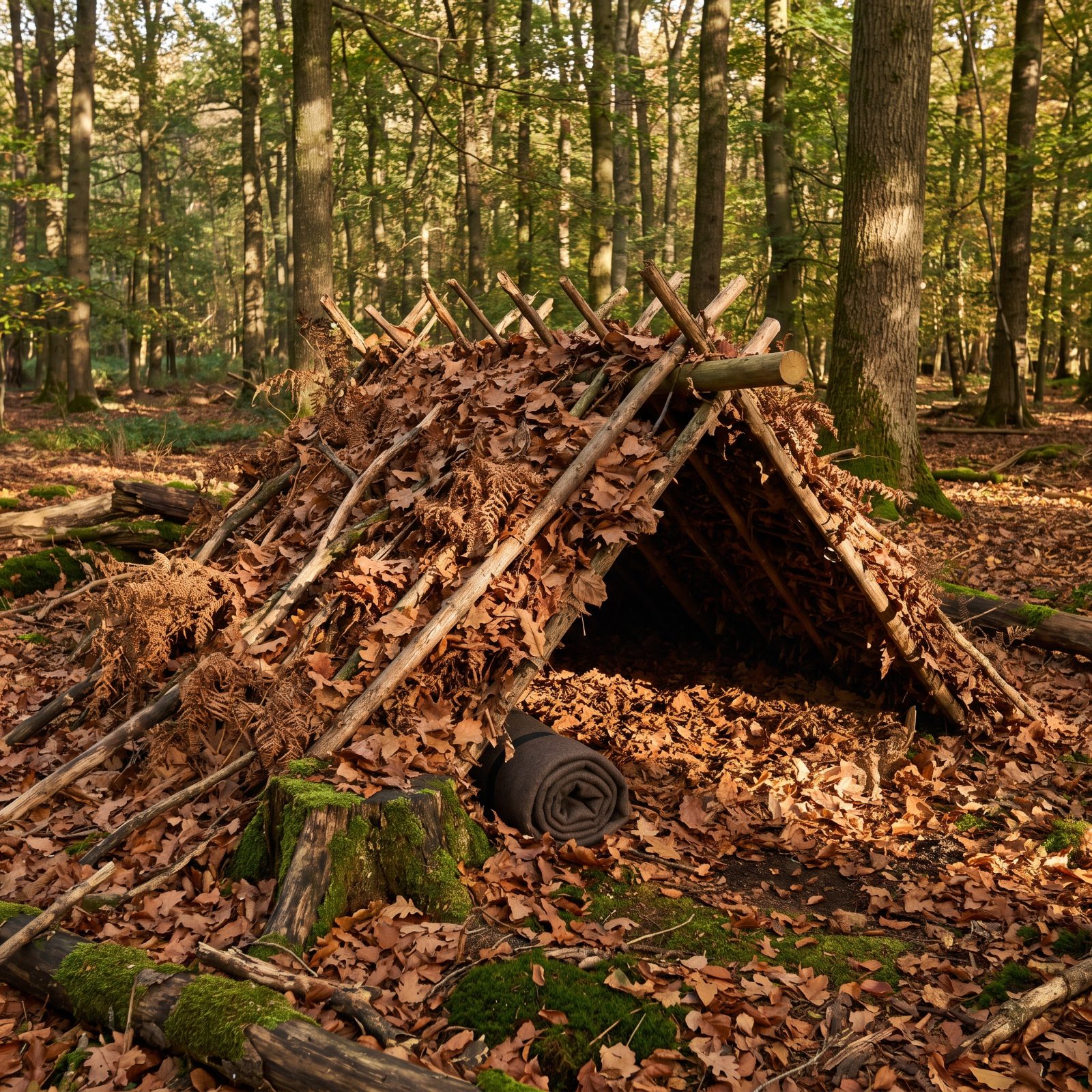
The cold that kills you comes from the ground, not the air. A debris shelter is really two things: a heap of leaves over you, and a thicker heap of leaves under you. People build the roof and forget the mattress, then lie awake shivering into bare dirt all night.
How thick is thick enough? If you can see through the pile or compress it flat with one hand, it’s too thin. The shelter shown here has only a thin layer of leaves draped over the sticks, with framework poles still visible along the ridge and the right side, so it’s a starting point, not a finished roof. Keep piling until the poles disappear. Dead air trapped in dry leaves does the insulating. The leaves themselves do nothing.
6. Drying Wet Boots Without Cracking the Leather
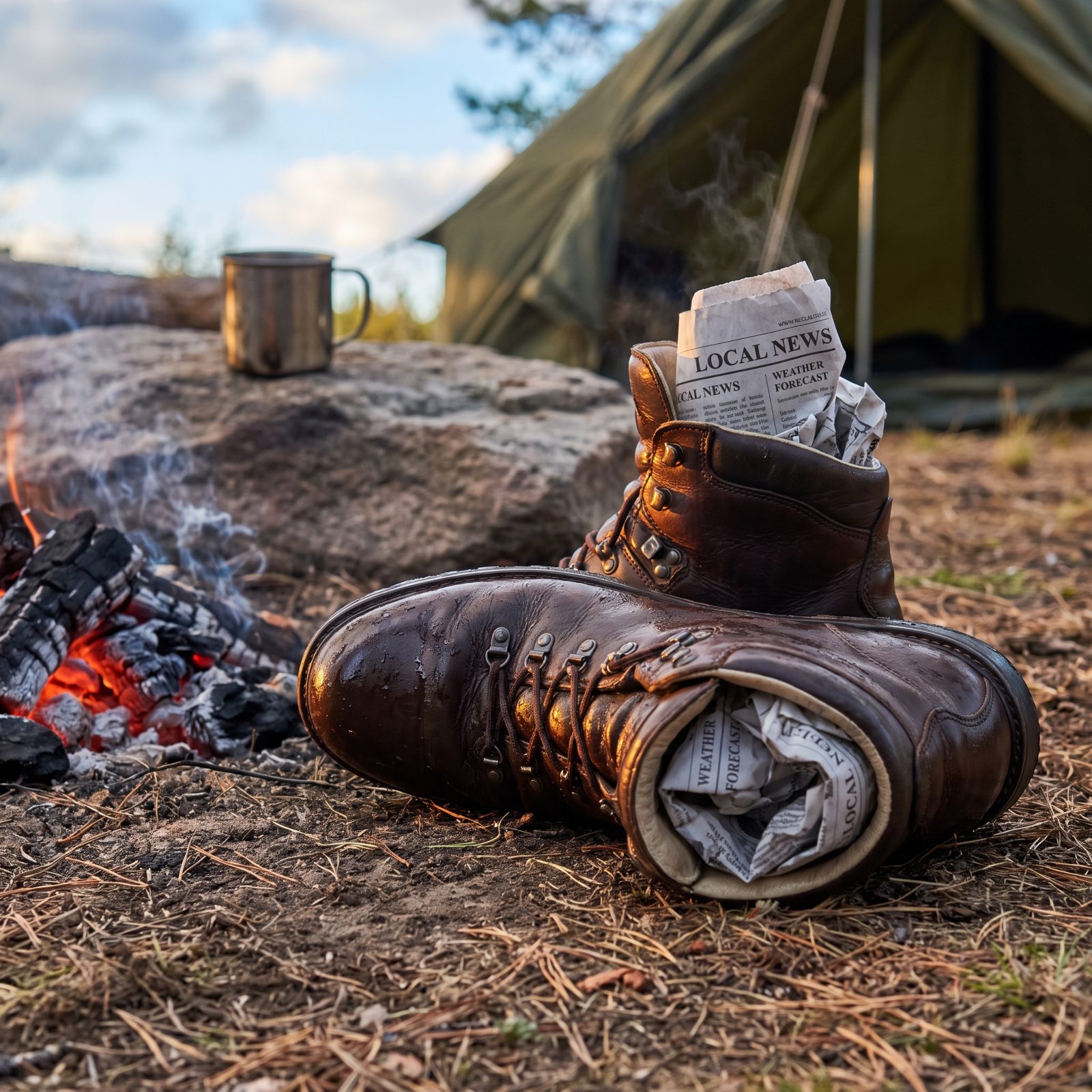
Set wet, empty boots by the fire and forget them, and you’ll ruin them by morning. Leather is a hide, and hide dried fast and hot does exactly what jerky does: it shrinks, stiffens and splits along the flex creases. One careless night of hard heat can age a good boot years.
The old trick is newspaper, swapped out as it soaks through, pulling water from the inside while the warmth from the coals beside them does the rest. Slow is the word. Warm, never hot. And once they’re dry, work a palmful of mink oil or dubbin into the seams — it puts back the fat that drying pulls out.
5. Sharpening a Pocketknife on a Whetstone
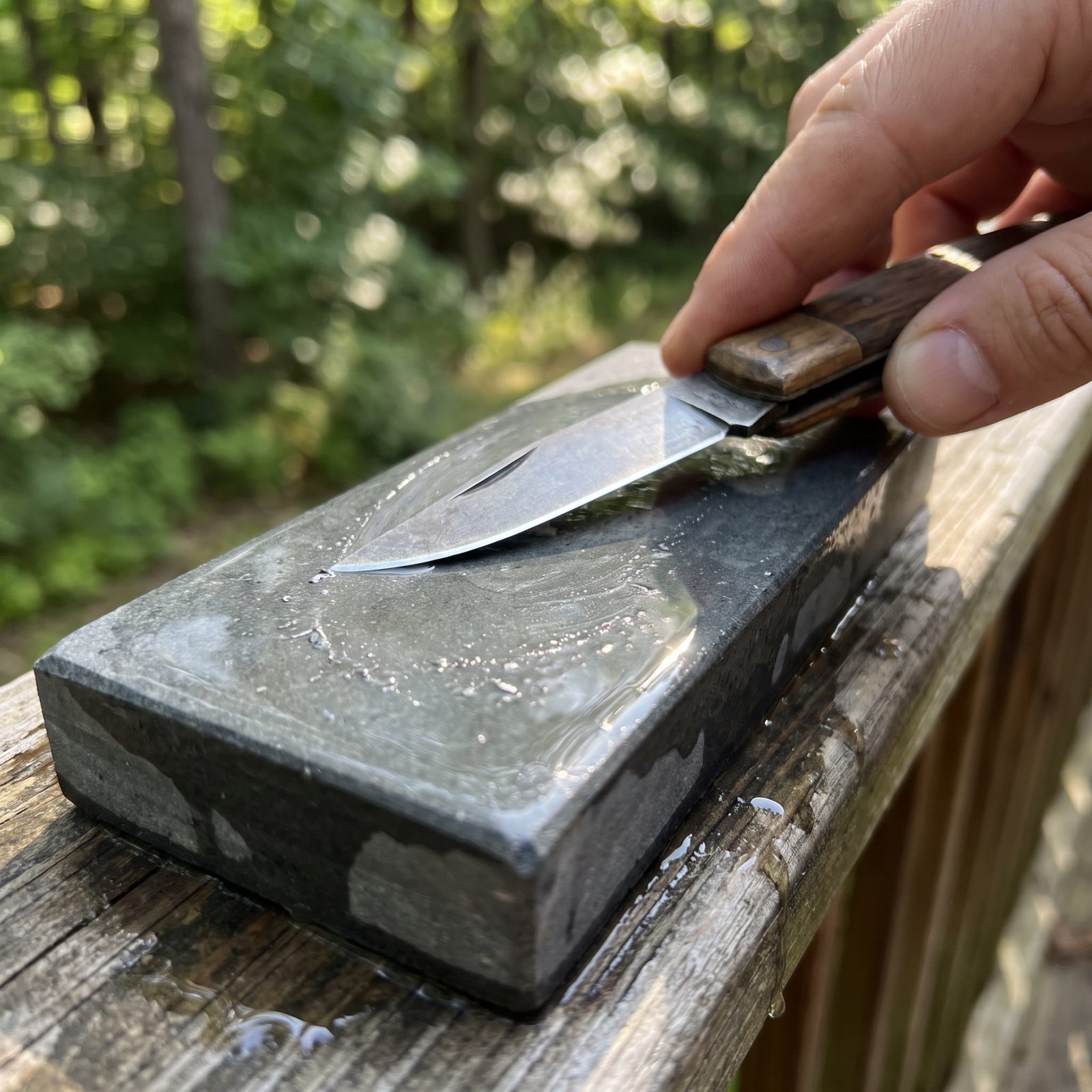
Most dull knives aren’t dull. They’re rounded over from years of sharpening at the wrong angle, a little steeper each time, until there’s no edge left to find. A whetstone fixes that because you set the angle and hold it, stroke after stroke.
Fifteen or twenty degrees per side suits a pocketknife, which is about two stacked matchbooks’ worth of gap under the spine. The burr tells you when to stop. Run a fingertip gently off the edge and feel the tiny wire of turned-up steel, then flip and work the other side until it forms there too. No burr, no edge. Folks skip the burr check and then wonder why the thing still won’t bite.
4. Finding Resin-Rich Fatwood in an Old Pine Stump
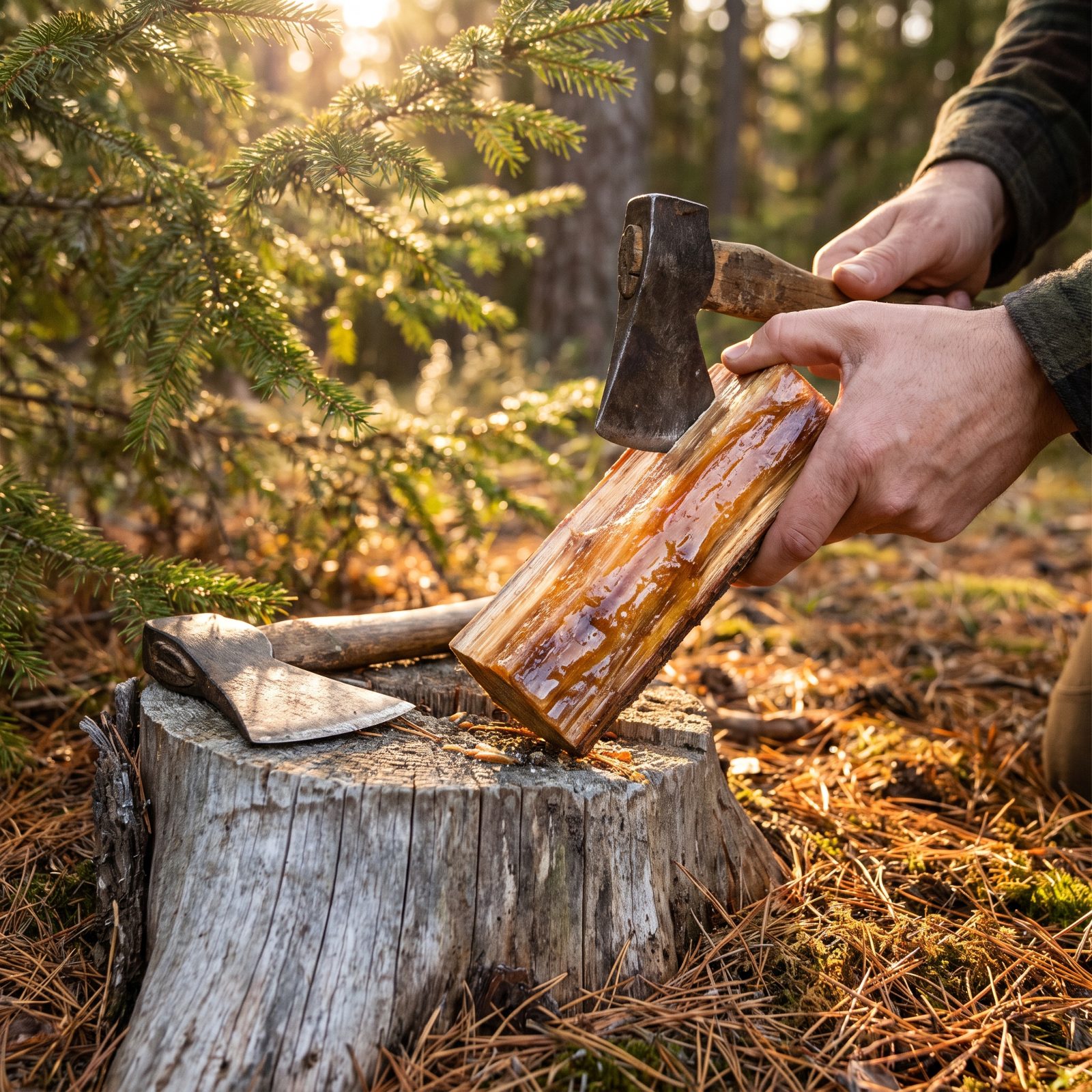
Fatwood is nature’s lighter fluid, sitting in nearly every old pine stump in the country for free. When a pine dies or gets cut, resin drains down and pools in the stump and the base of the roots, soaking the wood until it’s heavy, amber and sticky. That saturated heartwood lights with a single match in the rain.
Dig into the stump heart or the root collar to find it — the wood there smells sharply of turpentine and feels greasy under your thumb. Shave off a few curls. They’ll catch and burn hot enough to dry and light damp kindling piled around them.
3. Estimating Remaining Daylight With Fingers Above the Horizon

No watch, no phone, and the sun dropping fast toward the treeline. Hunters and hikers have leaned on this one forever: hold your hand out at arm’s length, pinch the sun between your thumb and fingers to frame it, then gauge the gap down to the horizon in finger-widths, counting each finger as roughly fifteen minutes of daylight left.
Four fingers is about an hour. A full hand, a bit more. It’s no surveyor’s measurement and it drifts with your latitude, but it’s close enough to tell you whether to push for camp or start gathering firewood right where you stand. That single piece of knowledge has turned a lot of risky night hikes into easy evenings by a fire.
2. Finding North From Polaris and the Big Dipper
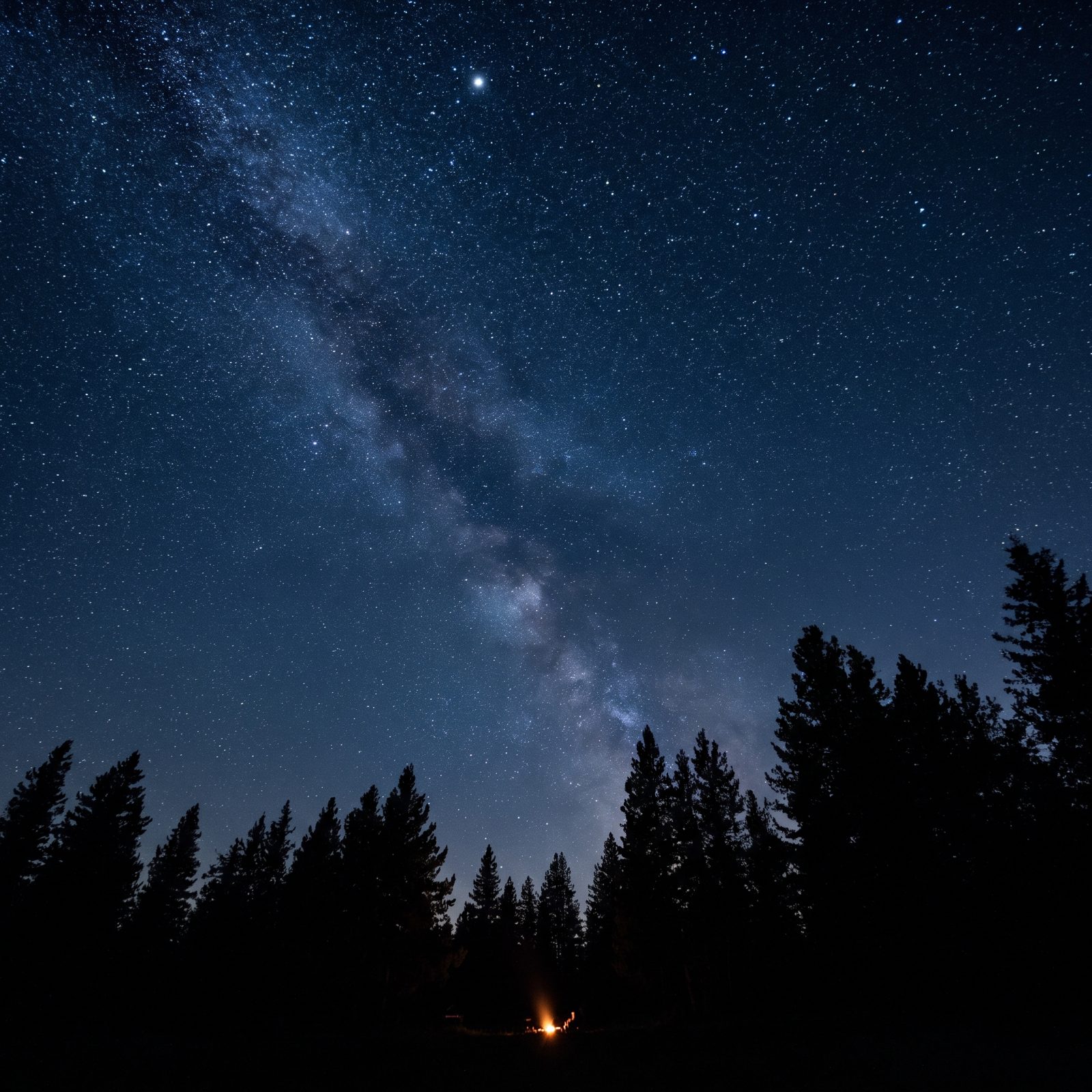
Polaris doesn’t move. The whole night sky wheels around it, which makes it the one fixed point you can navigate by once the sun’s gone. Find it and you’ve found true north — not the magnetic north a compass hands you.
The Big Dipper points the way. Those two stars at the lip of its bowl, the ones called the Pointers, line straight up to Polaris about five times their own spacing away. But the Dipper spins through the night and swings low in some seasons, which is why the cross-check matters. Cassiopeia, that lazy W, sits on the opposite side of Polaris and rides high when the Dipper dips down.
1. Darning a Wool Sock Before the Hole Spreads
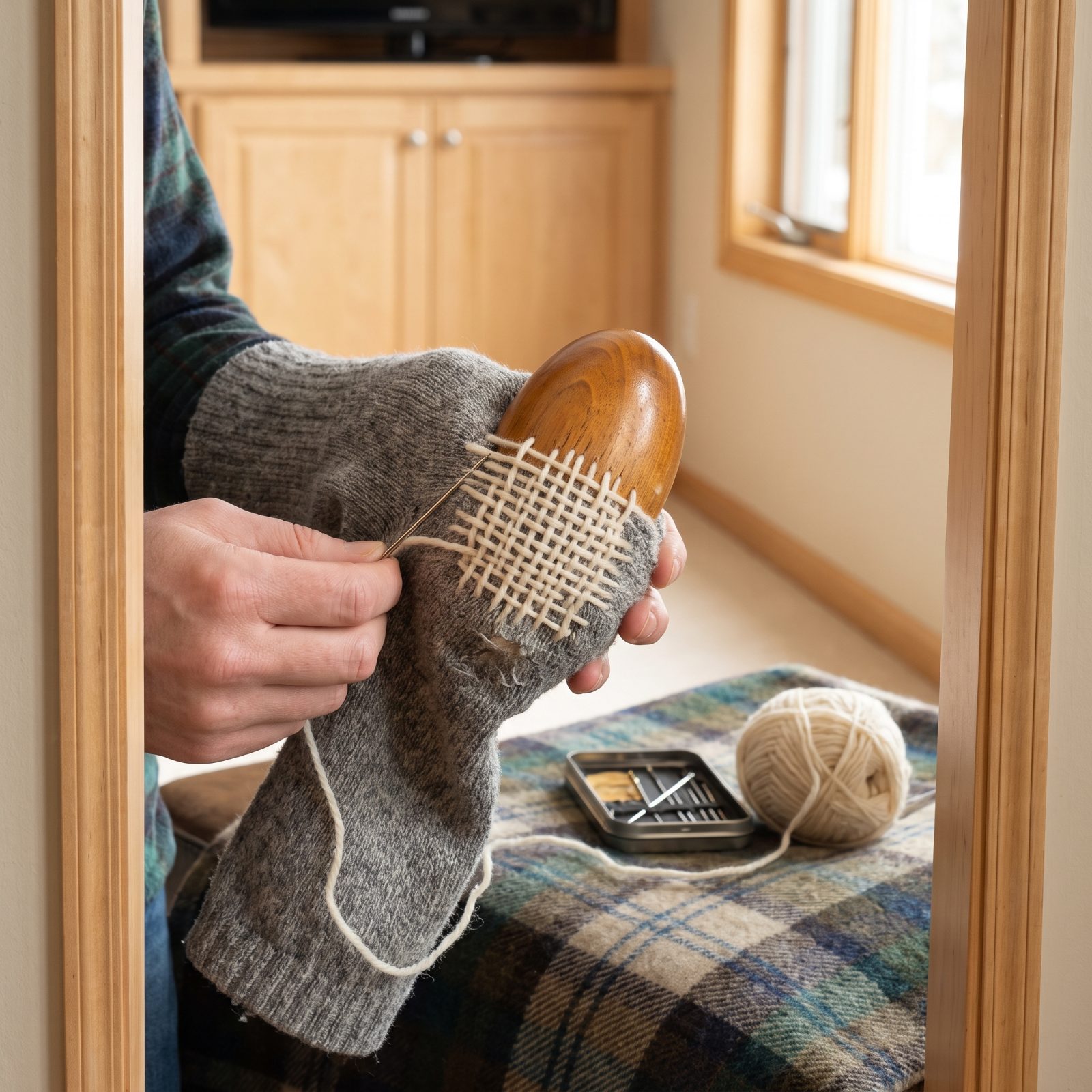
A wool sock gives you fair warning. First the heel goes thin and shiny, then a pinhole, then a gaping hole that swallows your toe. Catch it at the thin stage and a few minutes with a needle saves a sock that cost real money.
Darning isn’t sewing the hole shut — do that and you just pucker it into a blister machine. You weave a little patch of fabric right over the thinning wool, before it opens into a gap. Lay down a ladder of parallel threads, then weave more over and under them crosswise, building new cloth where the old is wearing thin. That frayed spot just below the patch is next in line. A smooth wooden egg underneath keeps it from bunching. Looks fussy. Isn’t. One good wool hiking sock outlasts three cheap pairs, and darning is how the old-timers stretched a single pair across a decade.