
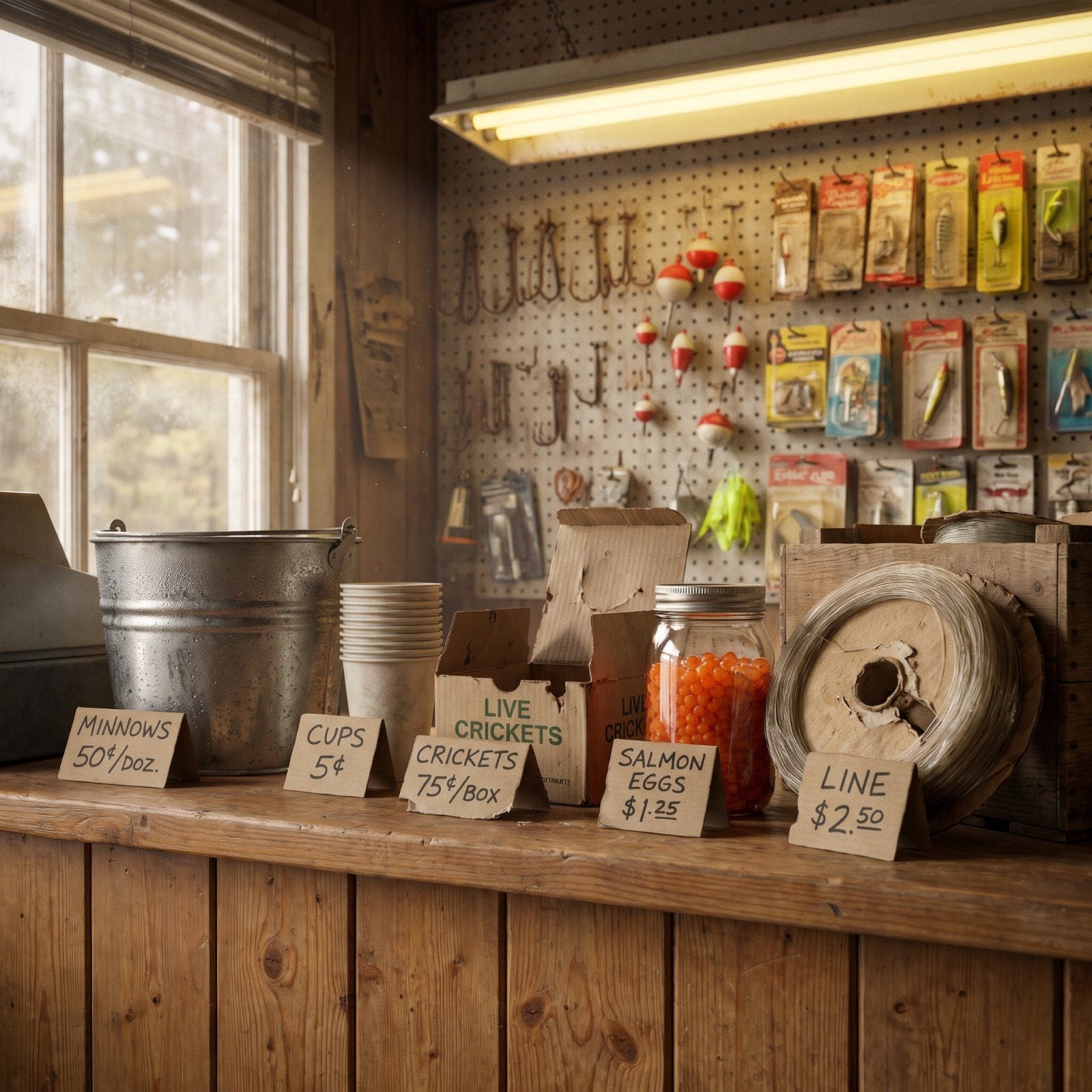
The screen door snapped shut behind you and the first thing you noticed was the hum: a cold fluorescent tube overhead, a tank pump chugging in the corner, and underneath it all that smell of damp sawdust, pond water, and whatever was dripping out of the dip-bait bucket by the register. These places ran on handwritten prices and trust. You grabbed a soda from the cooler, counted out worms into a paper cup, and the man behind the counter already knew where the crappie were biting. What follows is the stuff that filled those shelves, back when a certain kind of American morning started with a screen door and a scoop net.
Please note that some of the images in this article were created with the assistance of AI.
44. The Bubbling Galvanized Minnow Tank
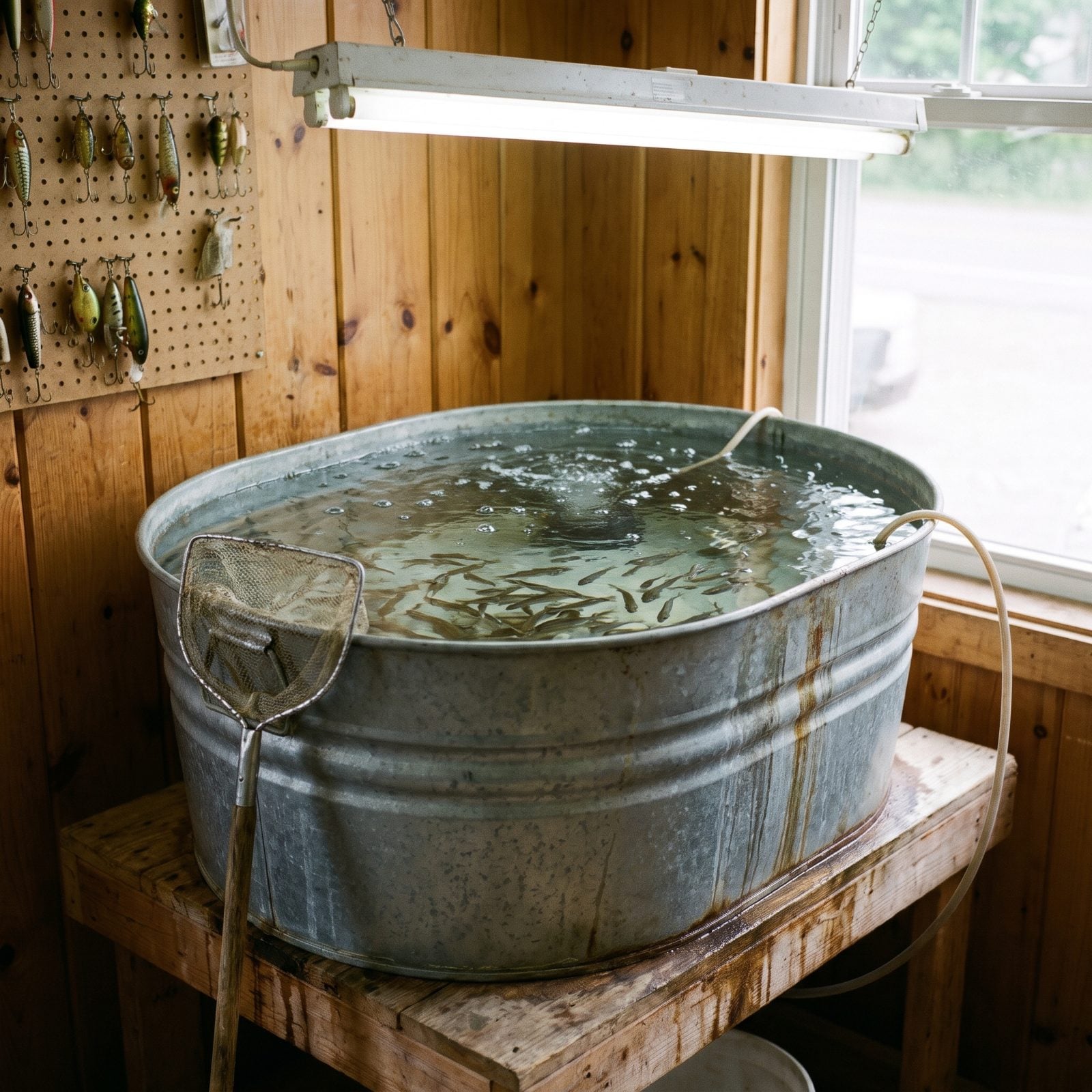
You heard it before you saw it. That steady gurgle of the aerator was the heartbeat of the whole shop, and the tank was where every morning started.
Shiners, fatheads, golden roseys, all schooling in a tin cylinder that sweated through the summer heat. The guy behind the counter would reach in with a battered dip net and count a dozen into your bucket by eye, almost never missing. Minnows ran cheap back then, sold by the dozen or the scoop, and the water smelled exactly like the lake you were about to drive to.
43. Waxed Paper Cups of Nightcrawlers
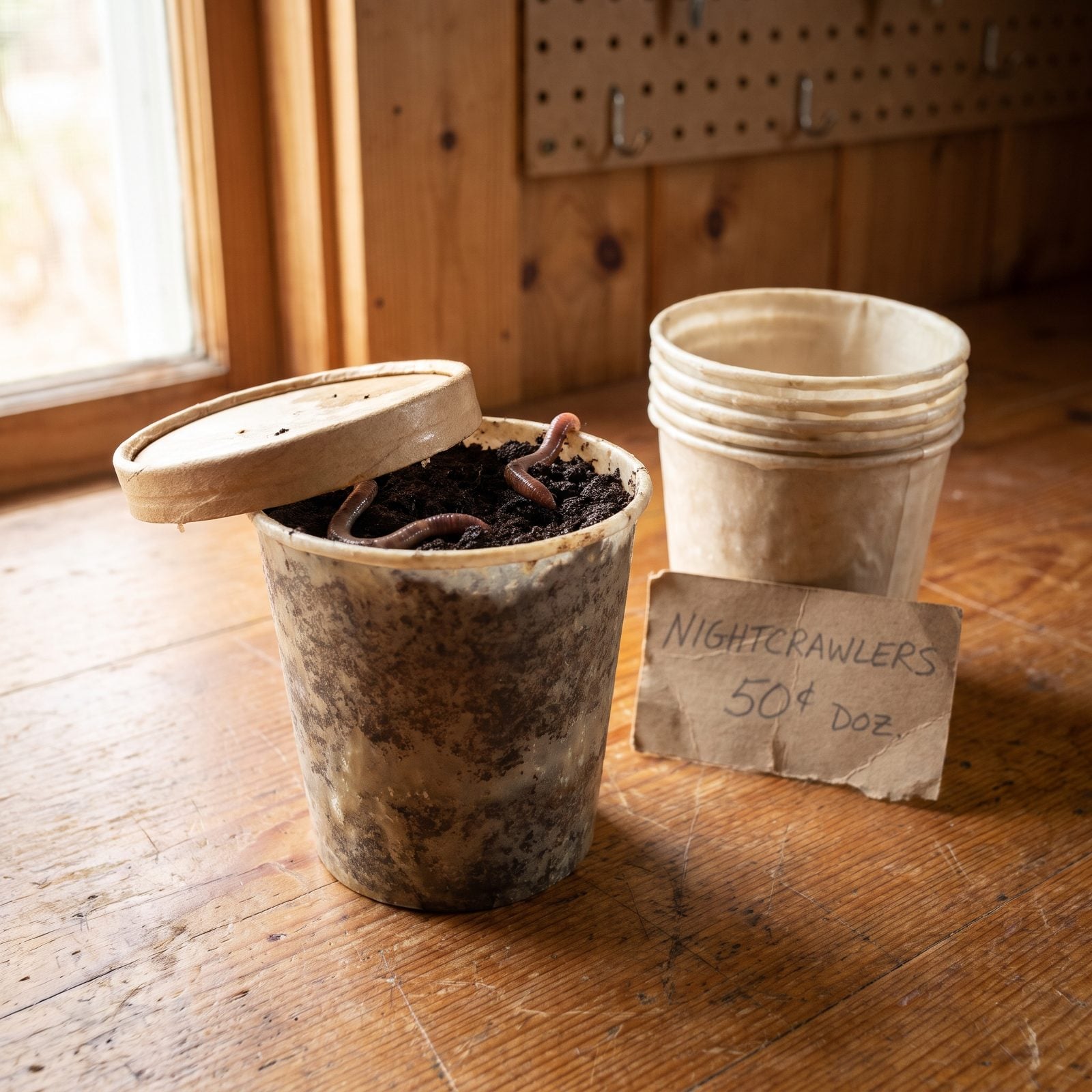
Nothing fancy here. A wax cup, a scoop of black dirt, and a tangle of crawlers that would outlast you if you forgot them in the cooler.
These were the bait of the people. A kid with a dollar could buy a cup and catch bluegill all afternoon, and that was the whole appeal. The wax kept the moisture in so the worms stayed fat and lively. And you learned fast that one escaped crawler in the car on a July day would announce itself for a week.
42. Cardboard Cartons Full of Crickets
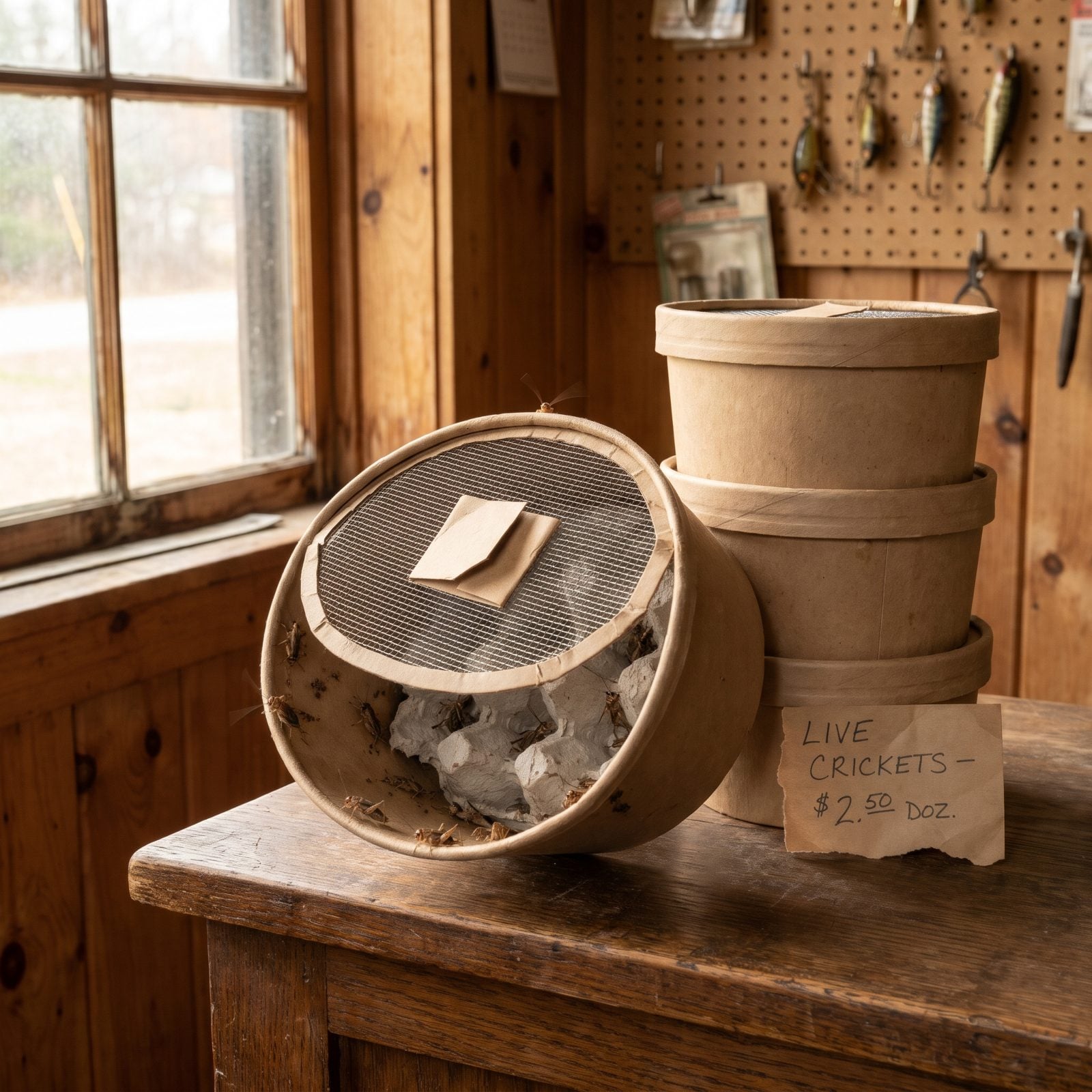
You could hear them chirping from the doorway. A rack of cardboard tubes, screen-topped, each one alive with the dry rustle of crickets climbing over a wad of egg-carton paper.
Perfect for bream and shellcracker, and a nightmare to transport if the lid popped. Every bait shop had one carton that had gotten loose at some point, and you’d still hear a lone survivor singing somewhere behind the snack rack.
41. Glass Jars of Live Leeches
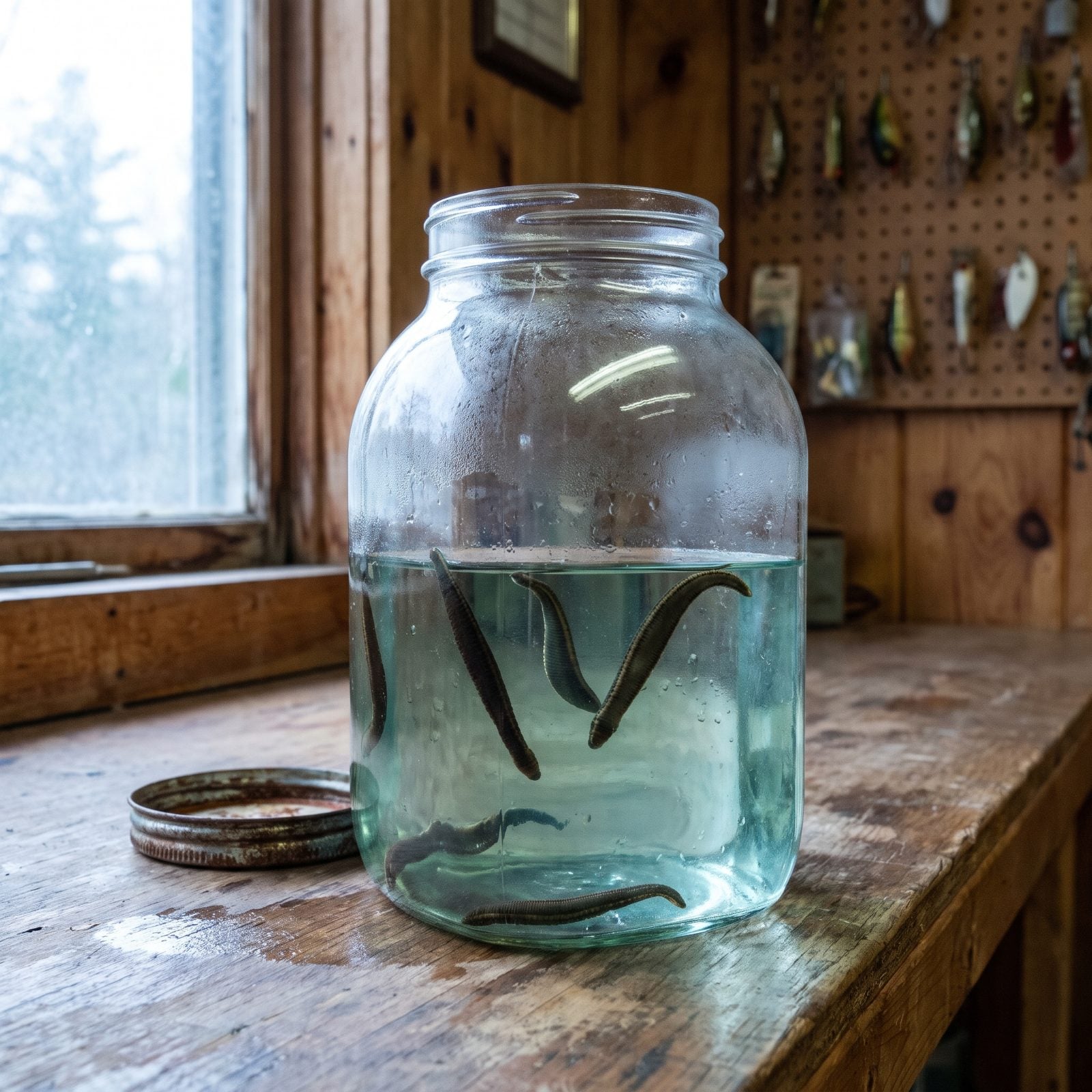
This was the bait that made squeamish customers hesitate at the counter. Ribbon leeches, kept cool in glass, swimming in that unmistakable rippling motion against the side of the jar.
Walleye anglers swore by them, and still do up north. They kept best cold, so shops stored the jars low, near the floor or in the cooler, and sold them by the dozen scooped out with a little net. Hardy, long-lived, and one of the best baits ever hung on a hook, even if your fishing buddy flat refused to touch them.
40. Jars of Preserved Salmon Eggs
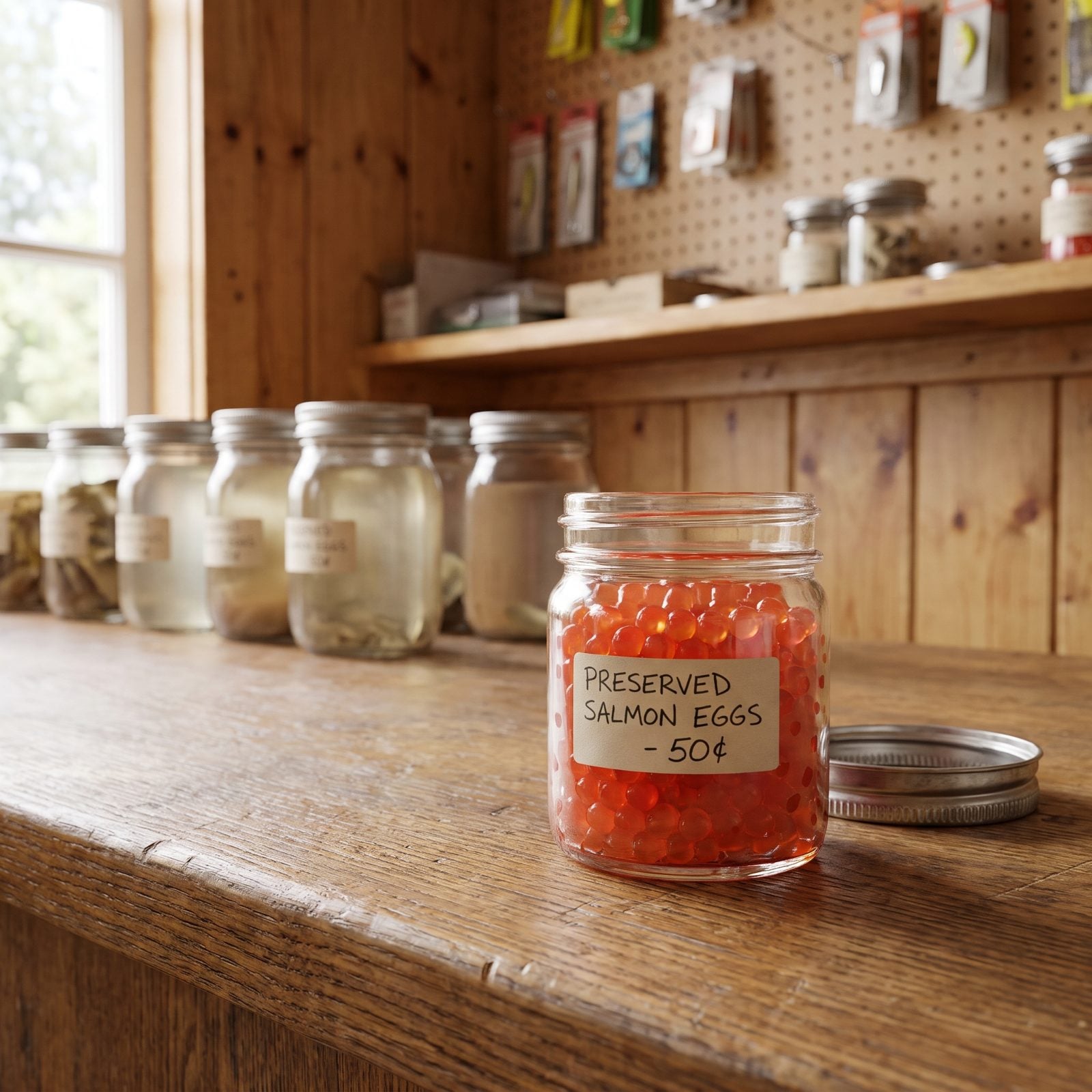
Little jars of trout candy. The eggs glowed almost unnaturally orange, cured and jarred so they’d keep on a shelf for a season or two.
Drift one under a bobber in a cold stream and you had a shot at any rainbow in the hole. They came in bright red, fluorescent orange, even a chartreuse that no fish egg ever actually was, and that was deliberate. You fished color as much as scent, and everybody had a jar rattling around in the tackle box with the lid crusted shut.
39. Buckets of Catfish Dip Bait
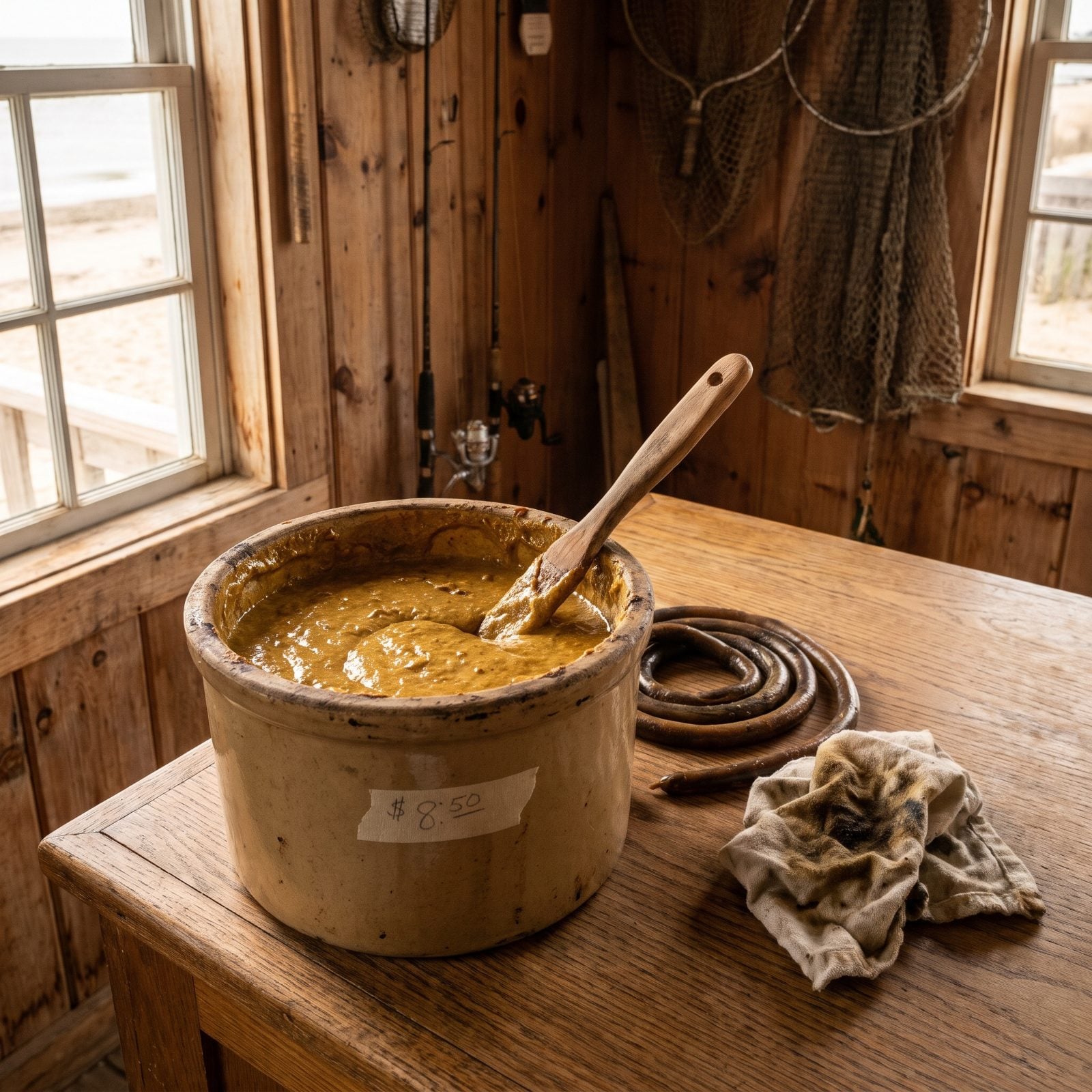
You smelled this one coming. Dip bait was the most honest product in the whole store, a tub of fermented stink built to drive a channel cat clean out of its mind.
Cheese-based, blood-based, who knows what else, mixed to the consistency of wet concrete and smeared onto a ribbed plastic worm or a sponge hook. Nobody enjoyed opening the lid. Everybody kept a jar anyway, because the stuff flat worked, and the worse it smelled the better your stringer looked at the end of the night. Keep it off your hands. Actually, keep it off everything.
38. Simple Cane Fishing Poles
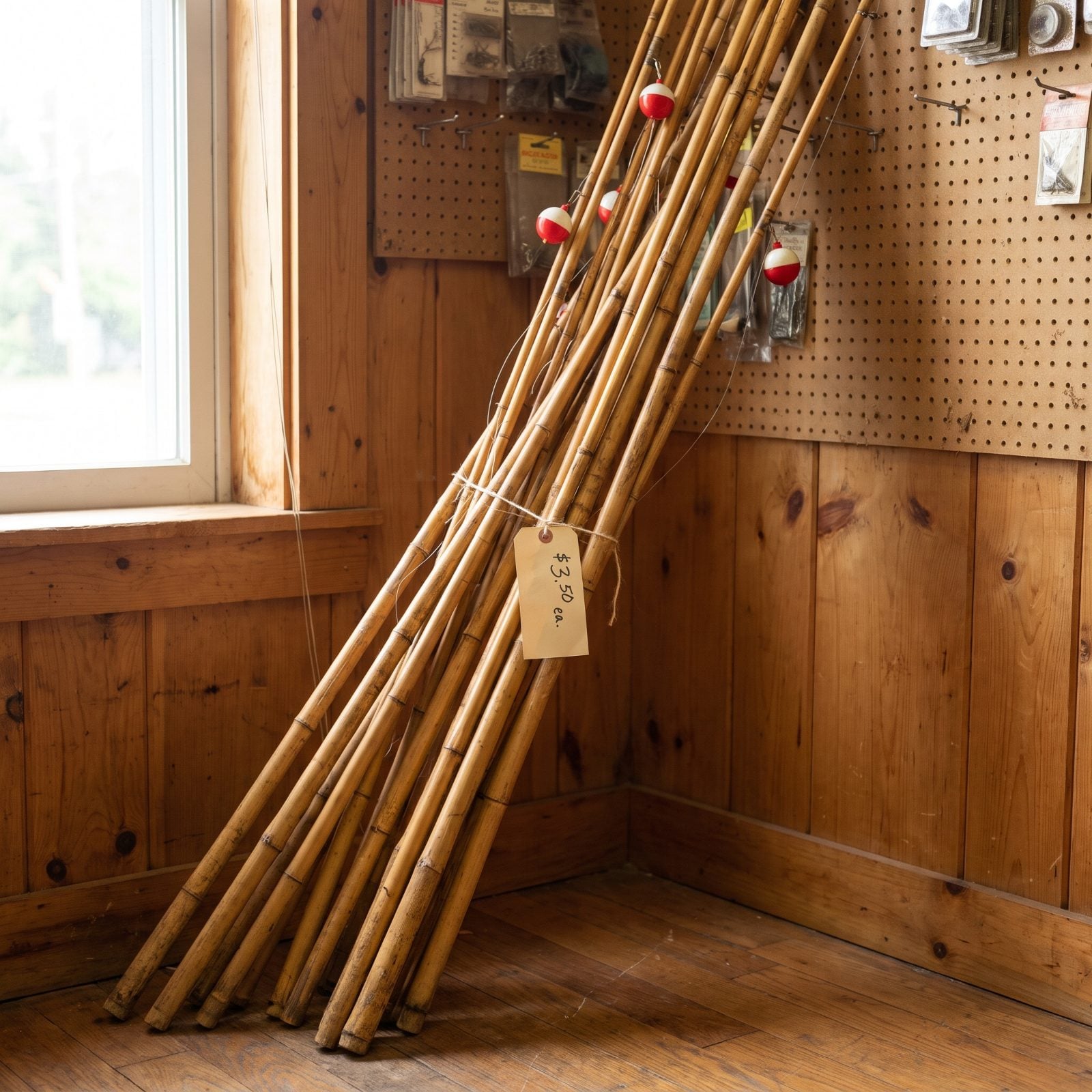
Before anybody owned a reel, they owned one of these. A length of cane, a line tied to the tip, a hook, a bobber, done.
Shops kept them in a barrel or leaned in the corner, sorted by length and sold for pocket change. A cane pole taught more kids to fish than every fancy outfit put together. You swung the bait out, watched the bobber, and when it went under you just lifted — no casting, no backlash, no instructions. Simple as it gets, and still one of the best ways to park a worm in front of a panfish.
37. Two-Piece Fiberglass Fishing Rods
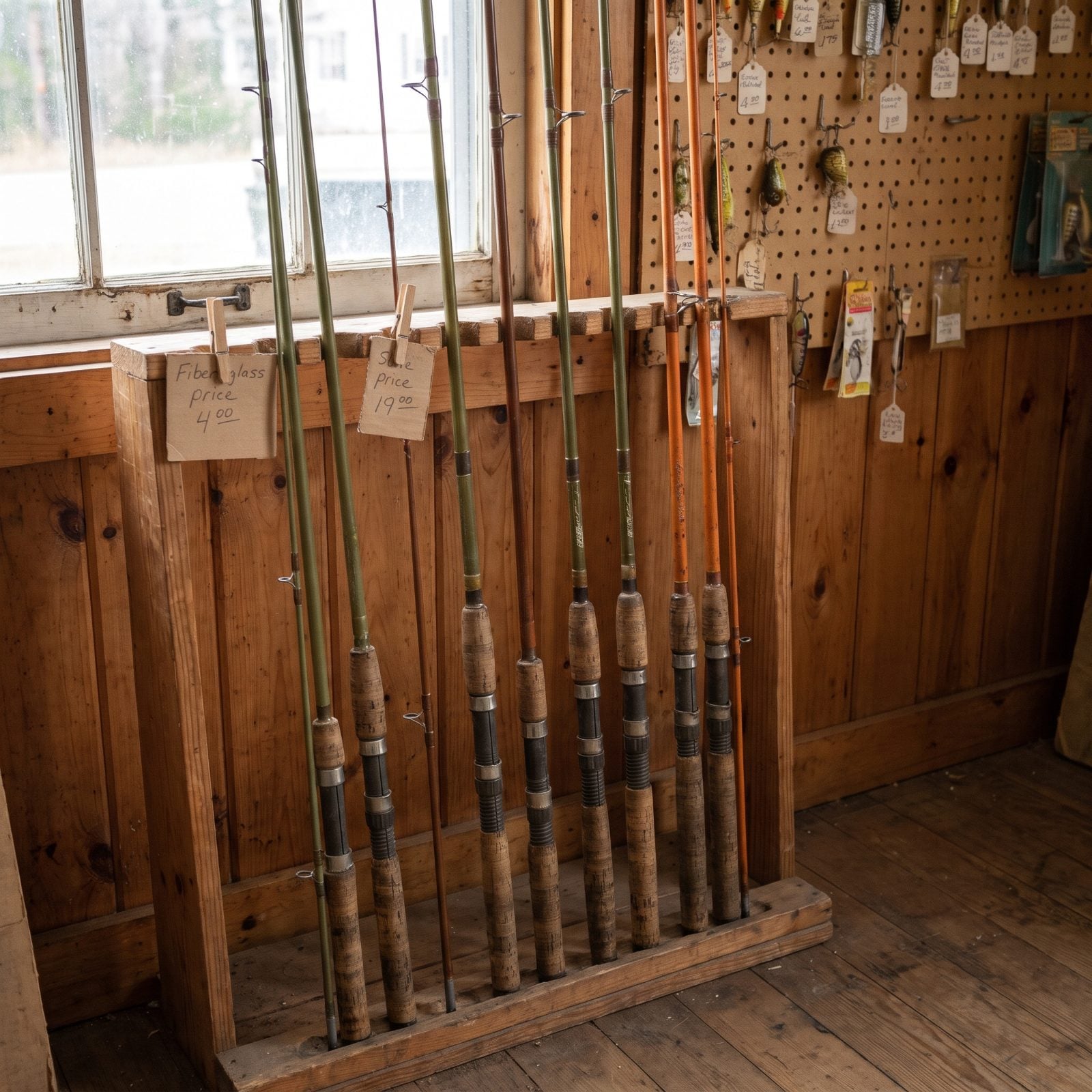
Heavy, slow, and nearly indestructible. The fiberglass rod was the workhorse of the era, built before graphite made everything feather-light.
They came in two pieces so they’d fit in a car trunk, joined by a metal ferrule that you learned to twist apart carefully or risk snapping. The action was soft by today’s standards, more of a lazy bend than a crisp snap, but you could run one over with a truck and it’d still catch fish. Cork grips, chrome guides, and a finish usually in some shade of olive or orange that screamed exactly which decade it came from.
36. Closed-Face Spincast Combos
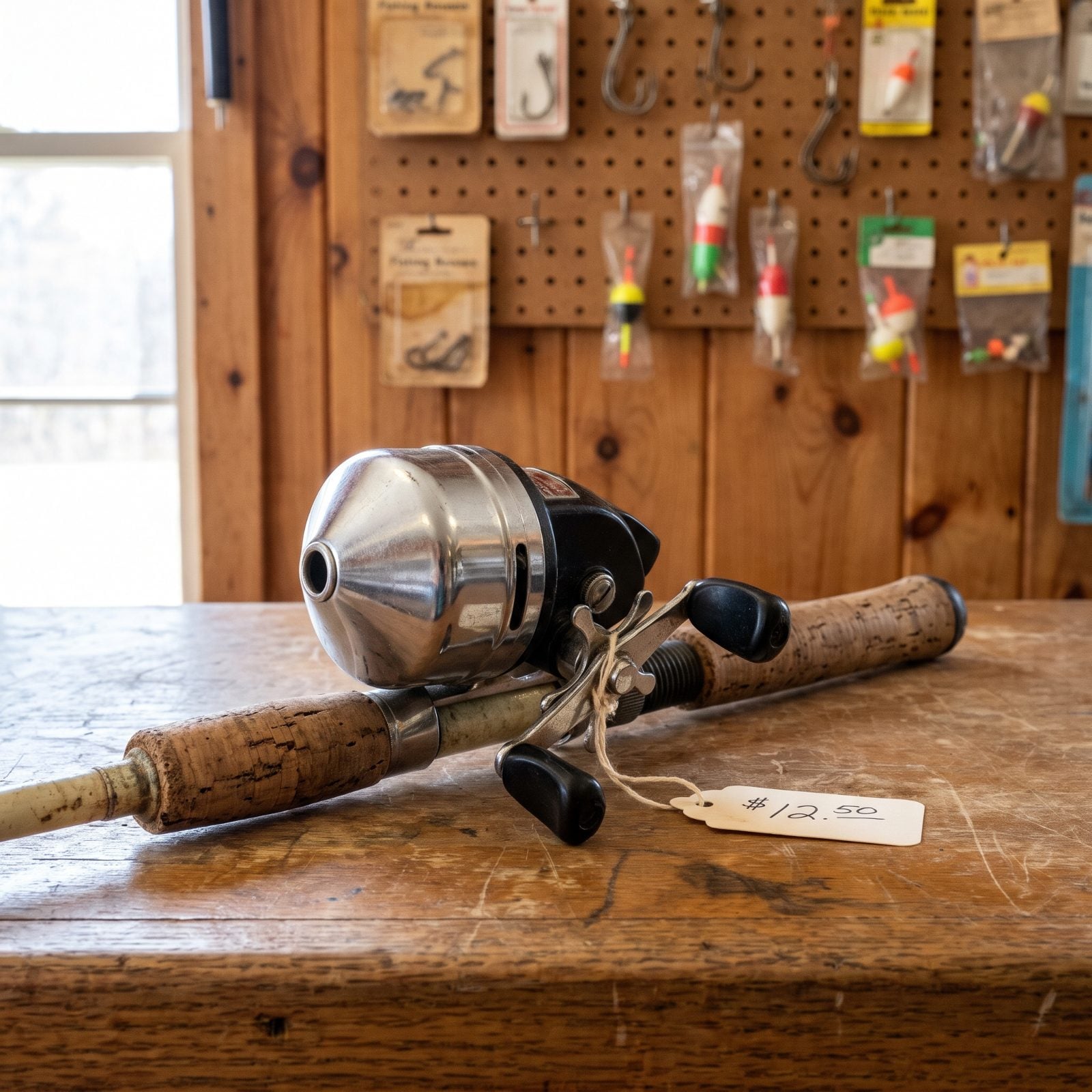
The push-button reel. Thumb the button, swing forward, let go, and your bait sailed out there with no tangle and no mystery.
This was how a generation learned to cast without the frustration of a baitcaster backlash or the loops of an open-faced spinner. The whole mechanism hid under a metal nose cone that protected the line and jammed with sand at the worst possible moment. Sold as a complete rod-and-reel combo on a hook display, cheap enough to be a birthday gift and tough enough to survive one. Plenty of them are sitting in garages right now, line long since rotted, button still clicking.
35. Clear Monofilament Fishing Line
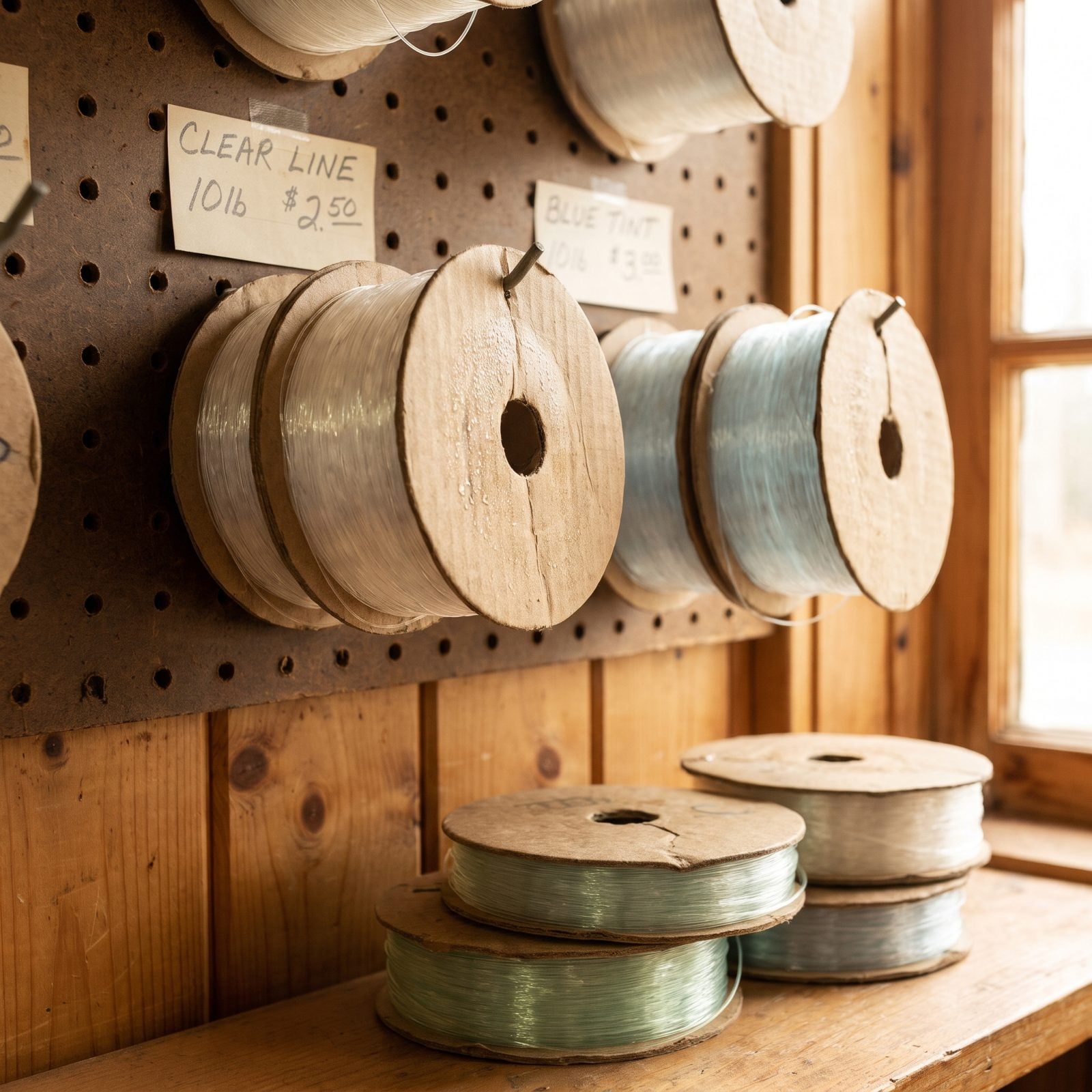
The quiet backbone of everything else here. A line is only as good as the knot you tie in it, and mono was what everybody tied.
Spools sat on the pegboard sorted by pound test, the clear stuff for spooky water, the blue tint so you could pick out your line against the sky. It had memory, meaning it held the coils of the spool and sprang off in loops if you weren’t careful, and a season in the sun left it weak. So you respooled every spring whether you needed to or not. Call it ritual.
34. Cards of Pre-Snelled Hooks
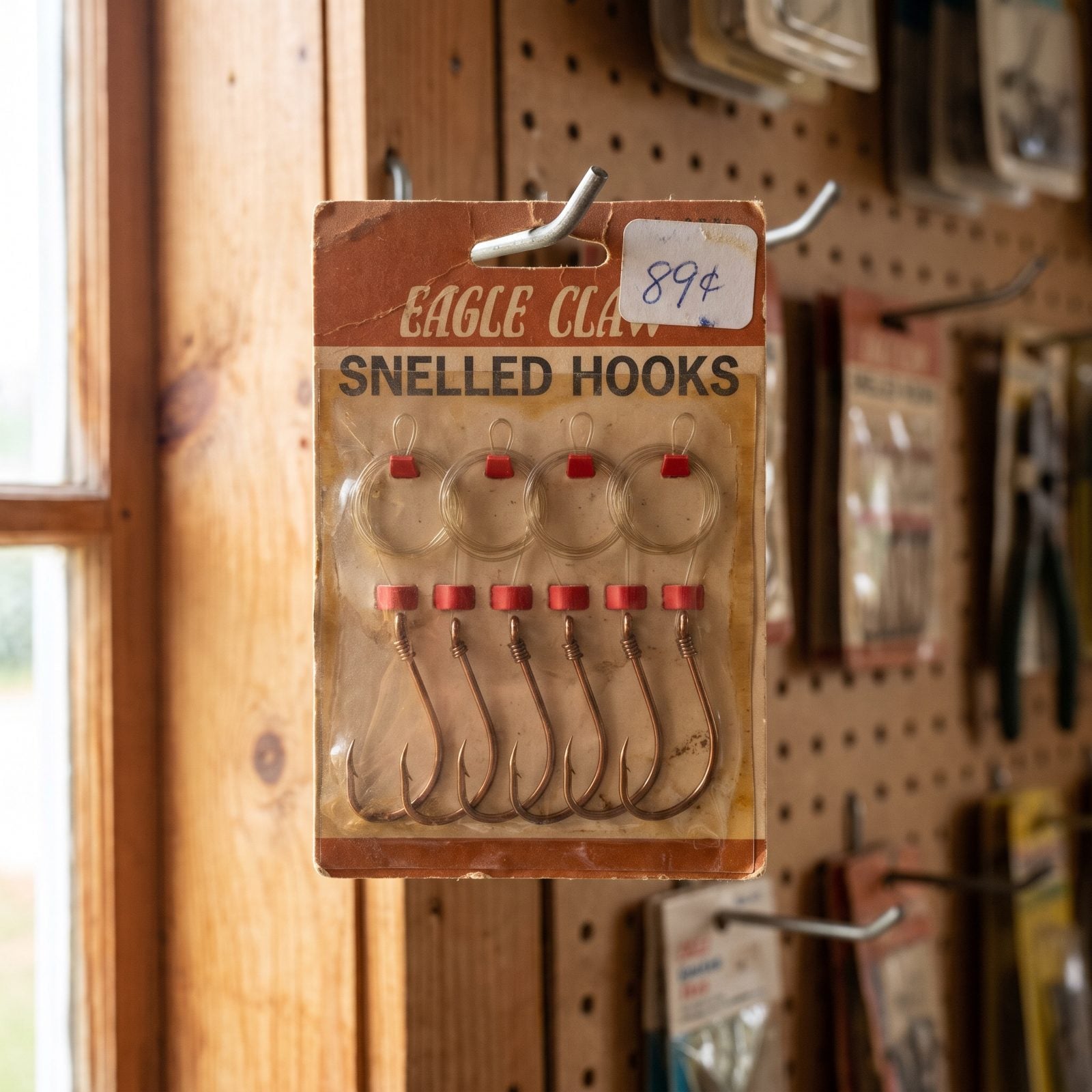
Convenience you could buy for pocket change. A card of pre-snelled hooks meant you didn’t have to tie a clinch knot with cold fingers on a dock at dawn, because the leader came already attached, looped and ready to tie onto your line.
Purists sneered at them, and they weren’t entirely wrong. The mono was often stiff, the knots factory-rough. But for a kid rigging up for bluegill, or a grandfather whose eyesight had gone soft, these cards kept people fishing instead of fumbling.
33. Natural Cork Fishing Bobbers
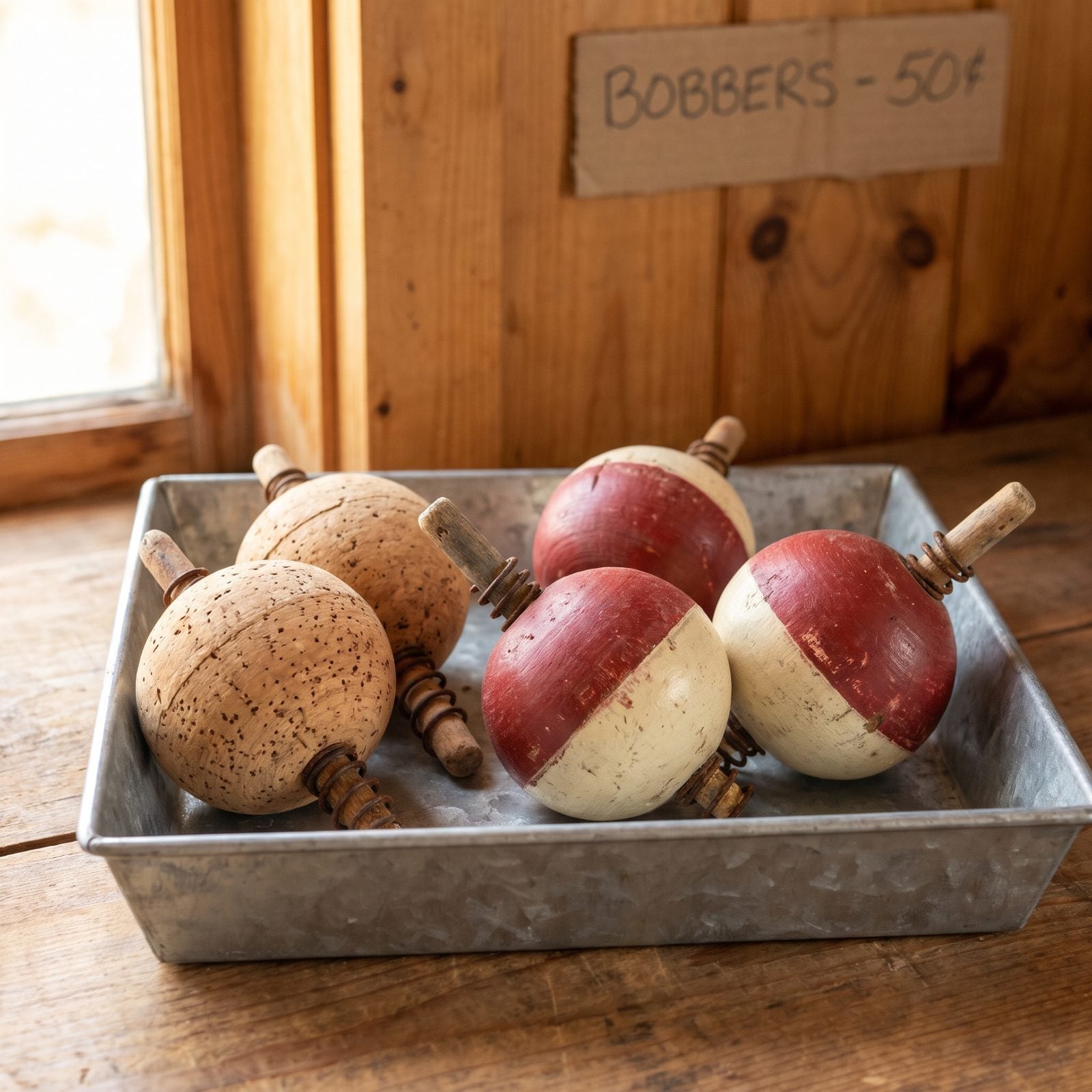
Before injection-molded plastic took over, your bobber was a chunk of real cork with a wooden peg jammed through the middle. Pull the peg, run your line through, push it back in and let it ride.
Cork fished differently than plastic. It was softer on the surface, splashed less when it dropped, and sat lower in the water so a timid bite was easier to read. The paint wore off after a season or two and you didn’t care. A worn cork bobber meant you’d been using it.
32. Compartmented Lead Sinker Assortments
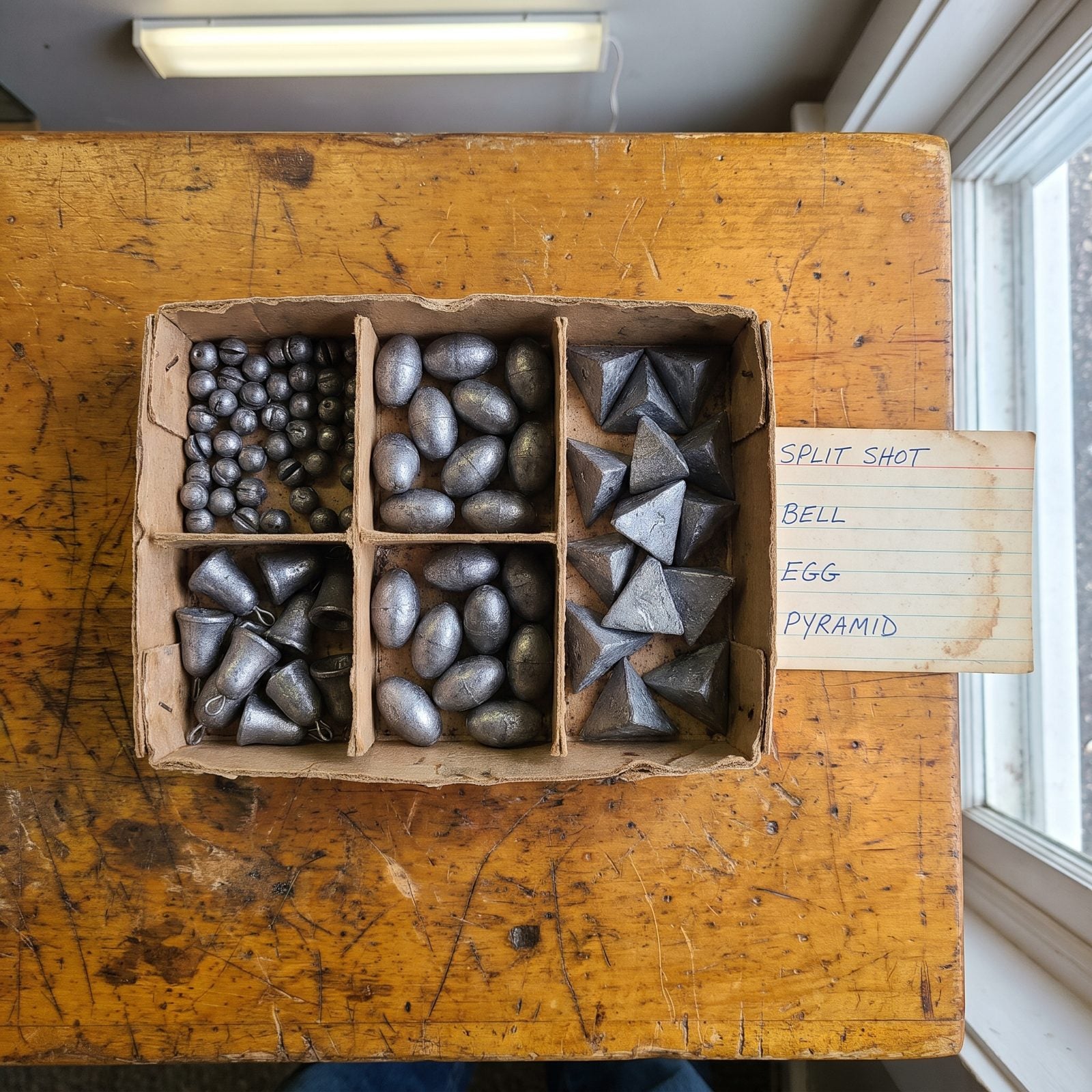
The weight tray was a lesson in physics you absorbed without noticing. Split shot for a gentle presentation. Bell sinkers held bottom in current, pyramids anchored in the surf, and egg sinkers let a fish run without feeling the drag.
You’d pick through the compartments with your fingers, feeling the heft, deciding how deep you wanted to go. Lead was cheap and nobody thought about it twice.
31. Coiled Wire Fishing Leaders
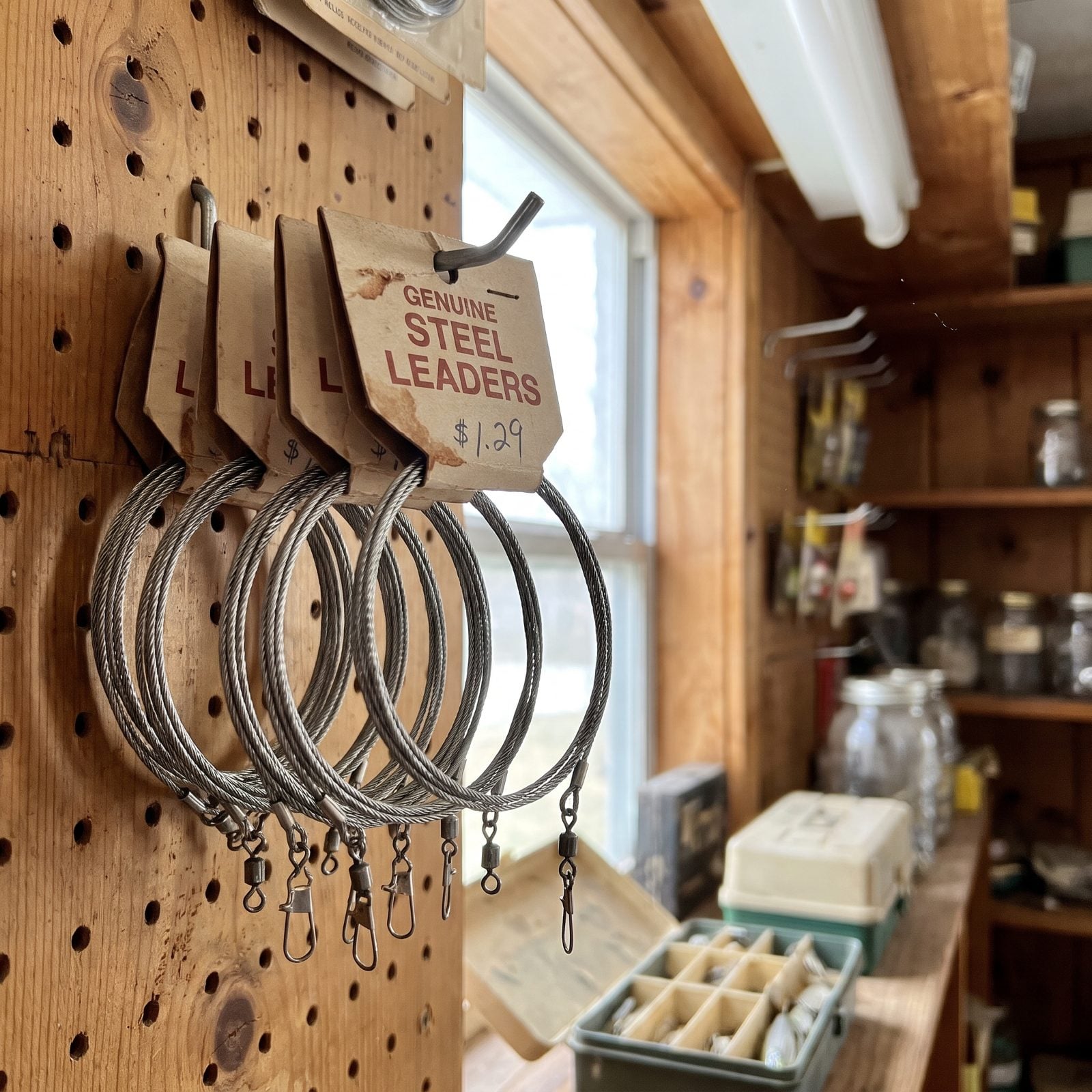
If you were after anything with teeth, you needed wire. Pike, muskie, and the toothy saltwater fish would shear through mono in a single headshake, so the steel leader sat between your line and the hook and took the abuse.
They came coiled tight on a card, a swivel on one end and a snap on the other so you could change lures without retying. The stiff ones kinked if you looked at them wrong. The braided ones flexed better and cost a little more. Worth it.
30. Chain-Clip Steel Fish Stringers
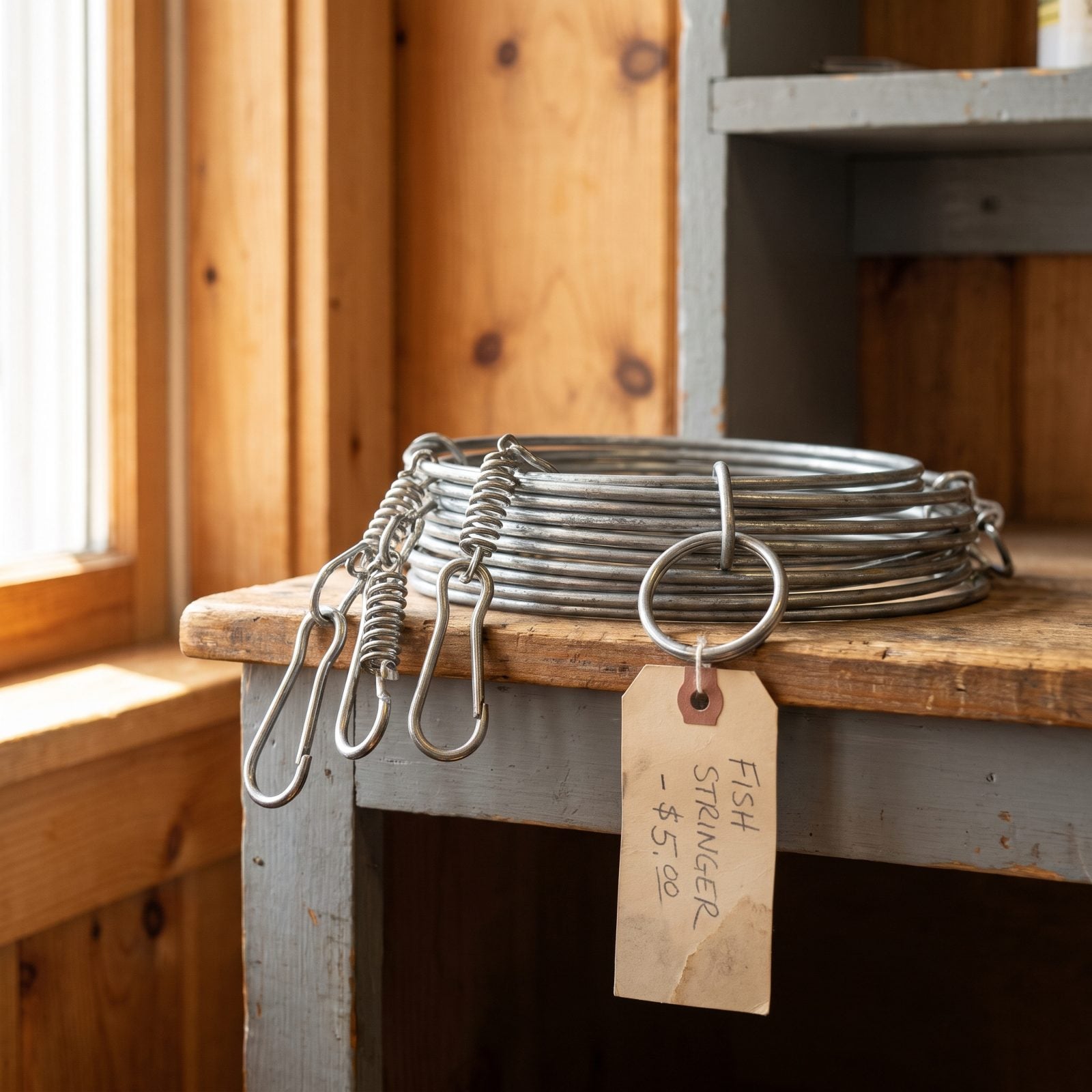
A good day ended with a heavy stringer. This was the coiled steel wire kind, with spring clips spaced along it, each one snapping through the fish’s lower lip so your catch rode alongside the boat or hung off the dock in the water, staying fresh.
The clip style was the upgrade over the old rope-and-single-needle stringers. You could add a fish without unloading the whole string, and nothing slid off. The downside? Weight, and the stiff coil of wire hoops that never wanted to fit in the tackle box. Still beat losing your limit.
29. Wood-Handled Landing Nets
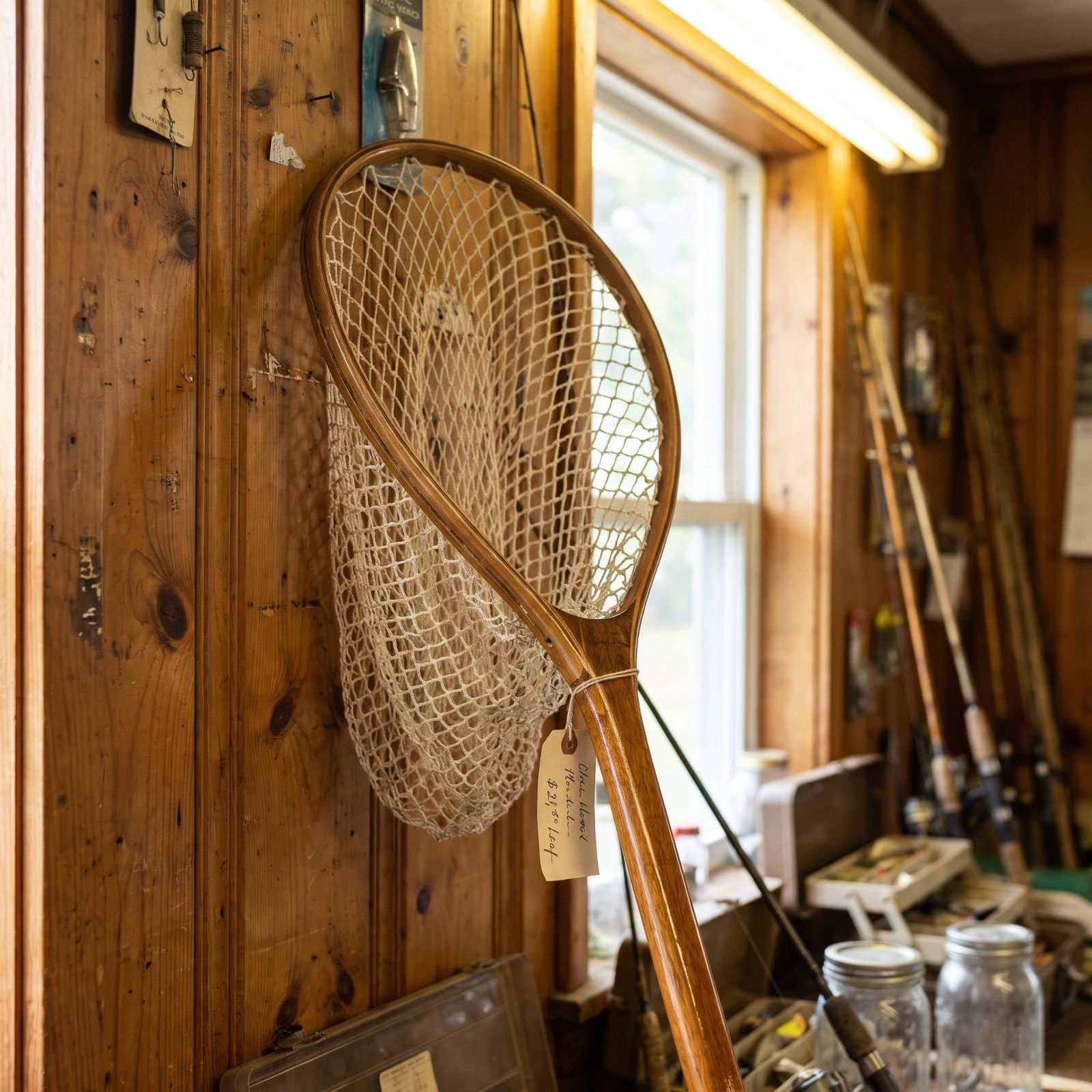
The net that leaned in the corner of every bait shop, handle worn smooth, mesh still carrying the faint smell of the last fish it held.
Wood handle, bent hoop, a deep cotton bag that soaked up water and got heavy. It wasn’t elegant, but it earned its keep at the one moment that mattered, when a good fish was thrashing boatside and your line was stretched thin.
28. Two-Piece Metal Minnow Buckets
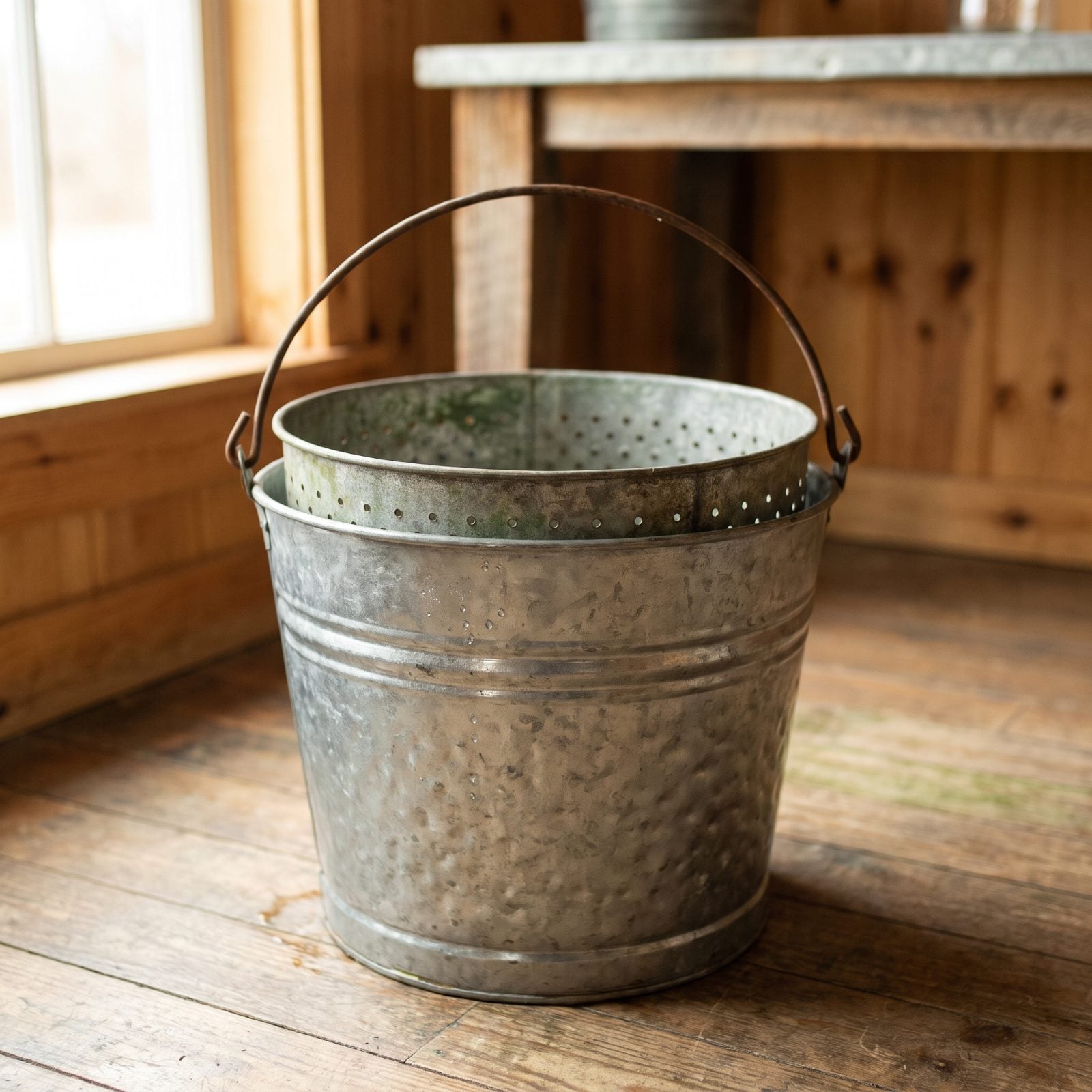
Two buckets in one. The perforated inner liner held your minnows and let you lift them out, and when you set the whole rig in the lake, fresh water flowed through the holes and kept the bait alive and lively.
Galvanized steel meant it lasted decades. The dents were a history of every tailgate it rode in and every rock it got set down on. Float versions came later; the classic sank low and sat in the shallows, bail handle sticking up like a little periscope.
27. Cantilever-Tray Tackle Boxes
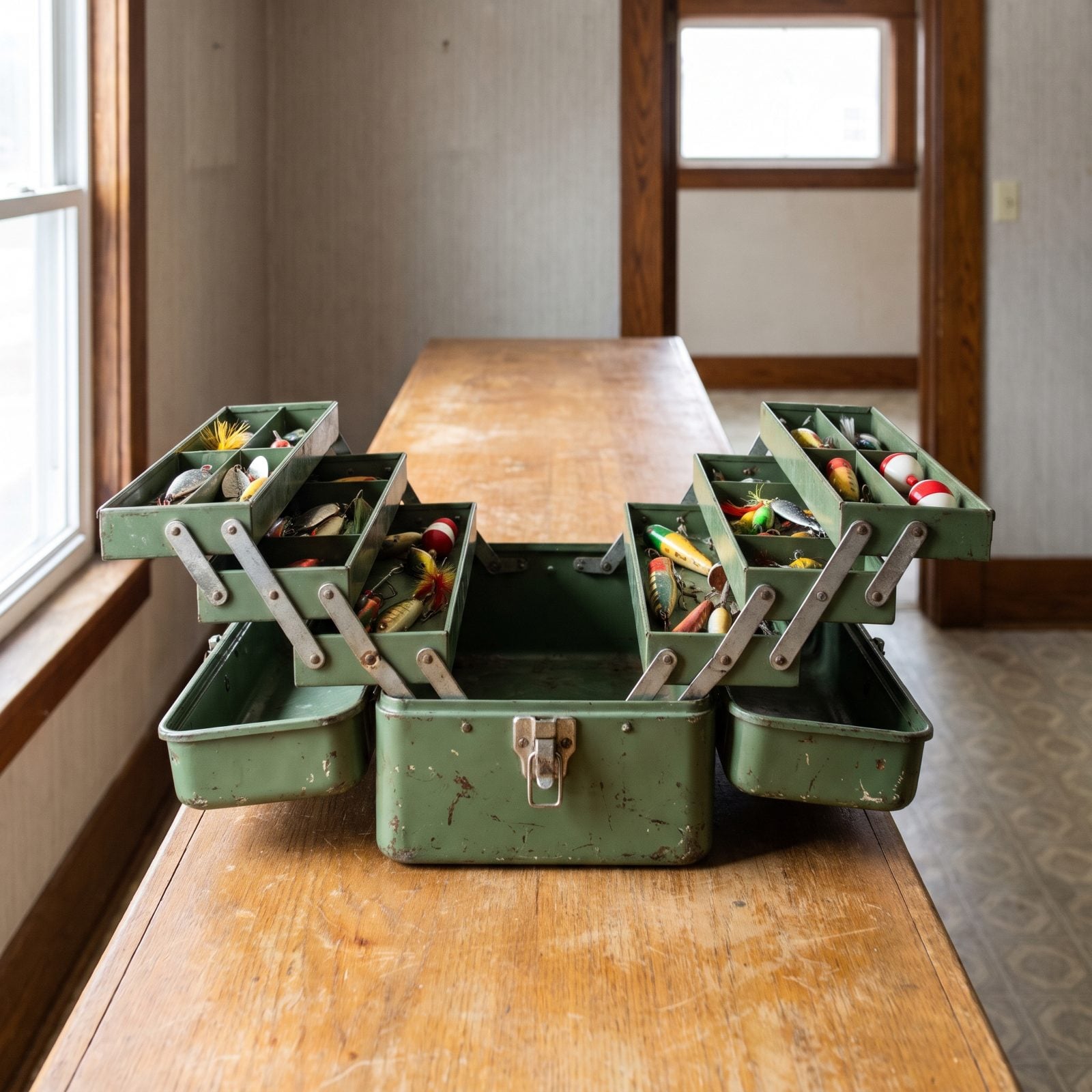
Open one of these and the trays fanned out like a toolmaker’s dream. This one spread its trays out to both sides, with three tiered trays on the right stacked out over a shallow extra compartment, so you saw your whole arsenal at once without digging.
Steel body, enamel paint that chipped at the corners, a latch you learned to trust your whole rig to. The weight alone told you it was serious. A full one was a workout to carry down to the water, and you knew a man by how organized his trays were.
26. Woven Wicker Fishing Creels
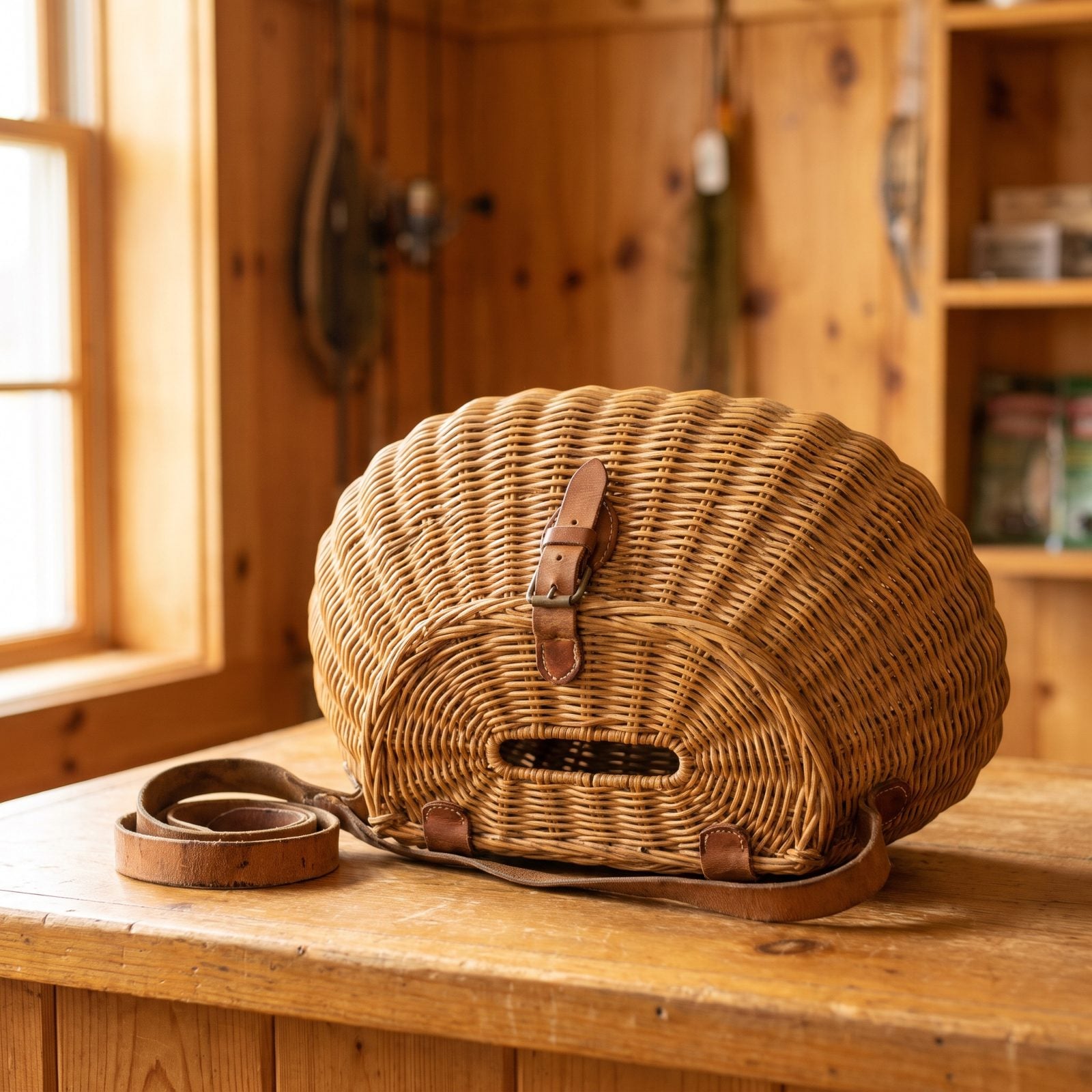
The most romantic object in the shop, and by the 1970s already fading into nostalgia. The wicker creel belonged to the fly fisherman working a trout stream, slung over one shoulder, lined with damp ferns to keep the catch cool.
Willow weave let air through so the fish didn’t go slimy in the heat. Leather strap, buckle lid, the whole thing looked like it walked out of a sporting print. By then, plenty of anglers kept one around more for the look than the catch. No shame in that.
25. Wood-Handled Fillet Knives
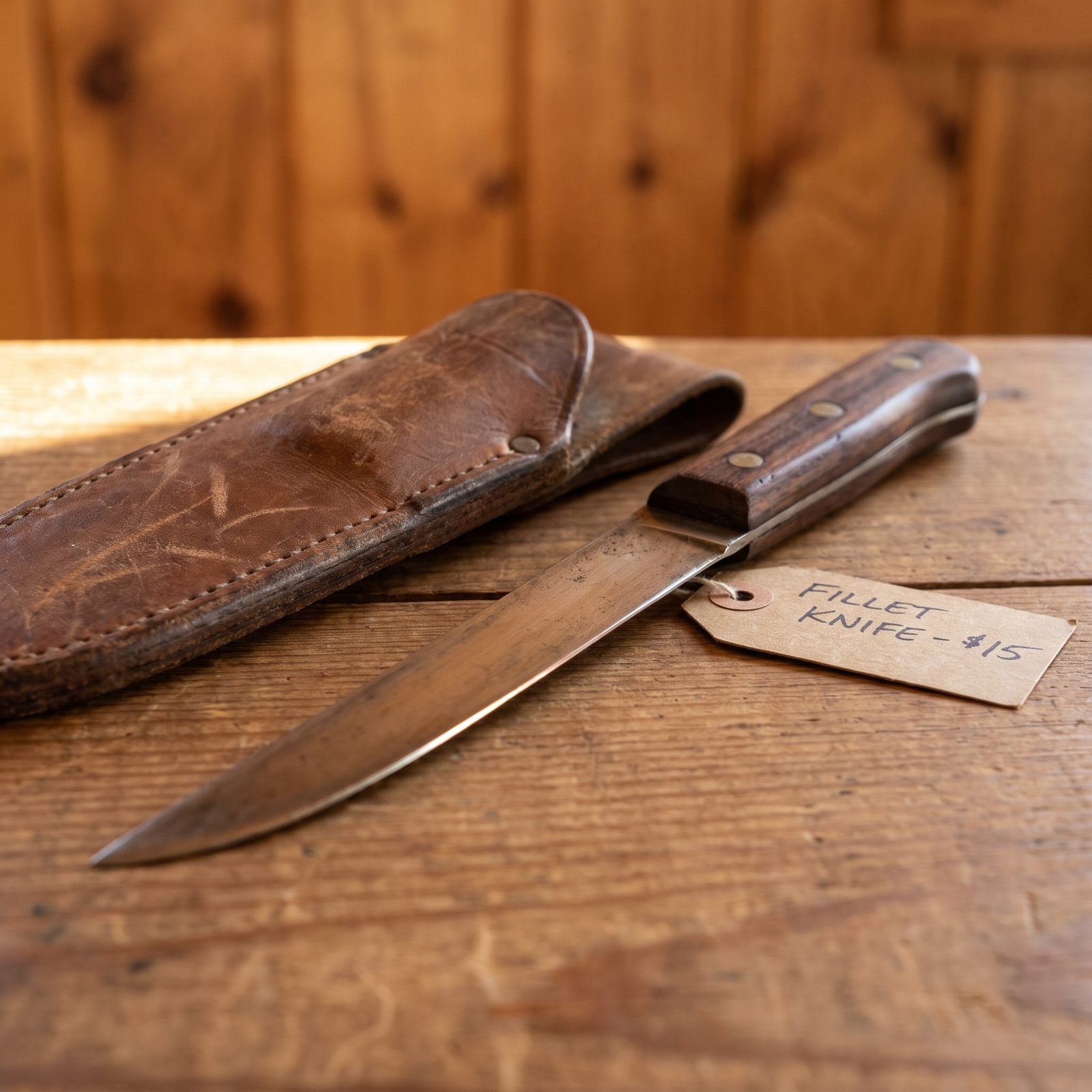
The knife you bought last, after the fish were caught and the hard work started. A thin, flexible carbon-steel blade that bent to follow the backbone and took an edge like nothing else.
Carbon steel rusted if you looked at it wrong, so you dried it the second you finished, and the blade carried a grey patina that said it had seen a lot of fish. Riveted wood handle, worn to fit your grip over the years. Kept in a leather sheath that smelled like the lake.
24. Glue-On Rod-Tip Repair Kits
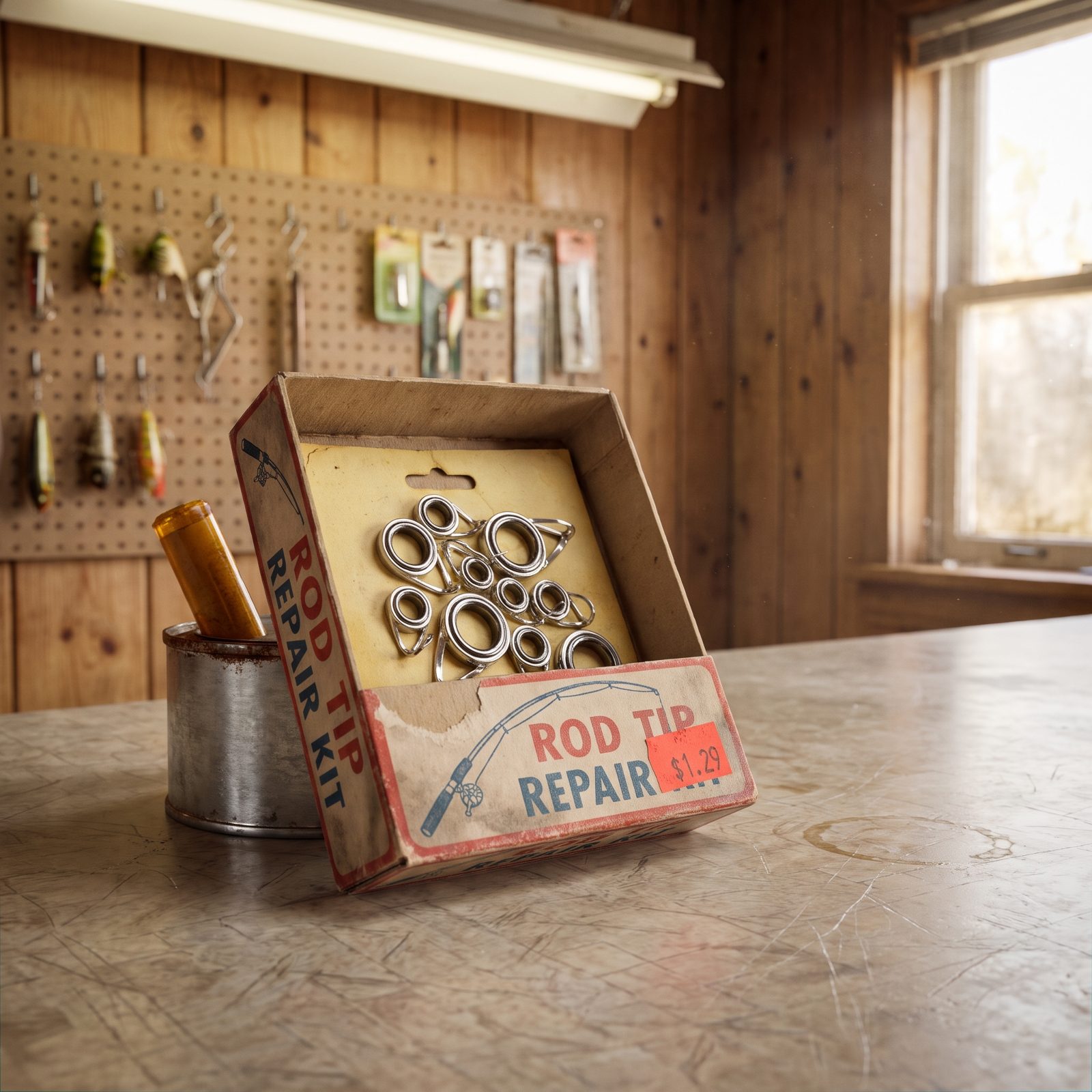
A snapped rod tip used to be a Saturday problem, not a season-ending one. For a buck or two you walked out with a card of assorted chrome rings and a stub of ferrule cement, and you were back on the water by afternoon.
Here’s the trick nobody bothers to tell you: heat the glue, not the blank. Too much flame and you scorch the graphite or cook old fiberglass soft. Plenty of rods got ruined learning that.
23. Small Cans of Fishing Reel Oil
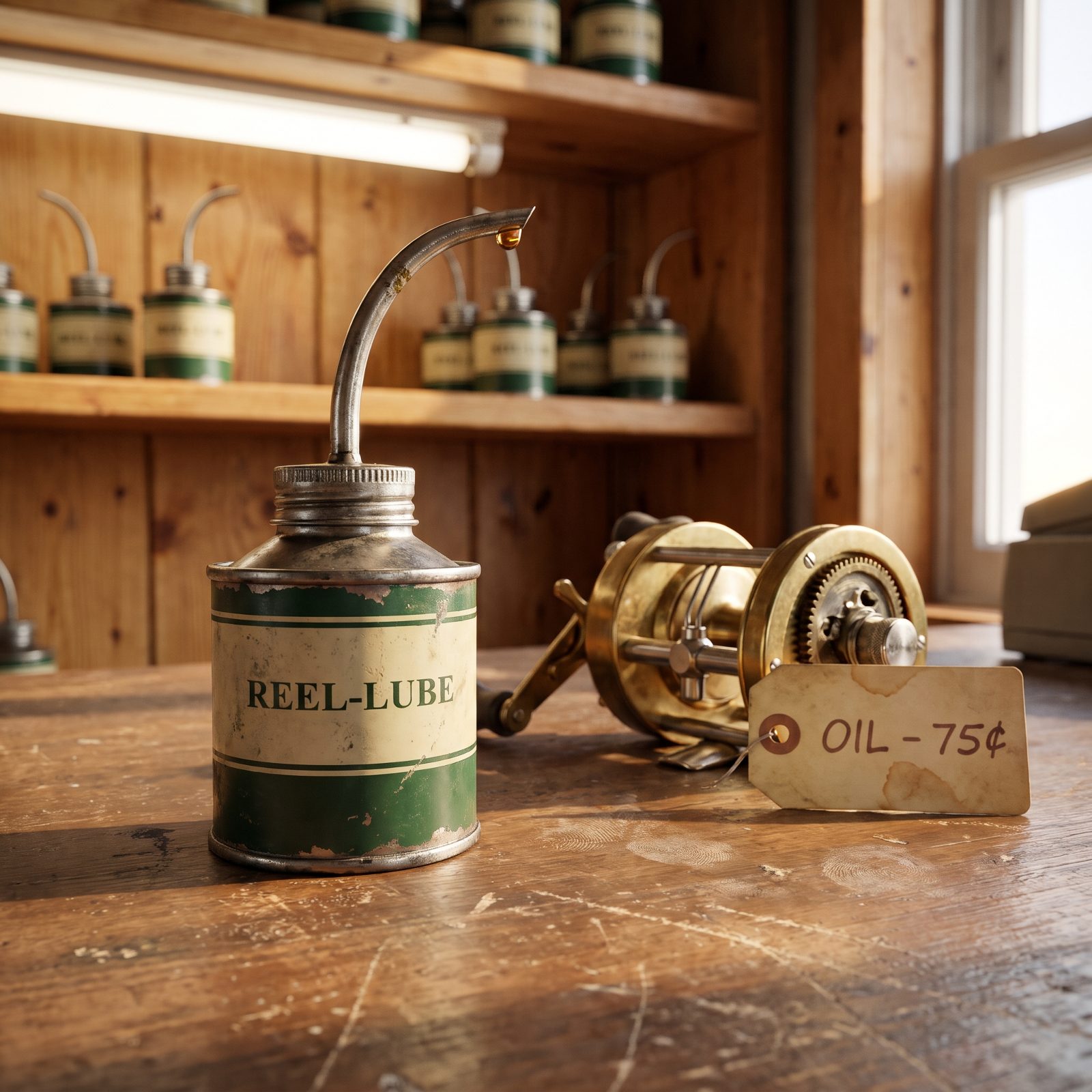
One drop. That was the whole lesson printed on the back of the can, and most folks ignored it.
These little needle-spout tins lived next to the register because everybody eventually drowned a reel in oil, gummed it up, then stood there wondering why the spool crawled. A drop on each bearing, a smear of grease on the gears, and a good reel ran quiet for years. Over-oil it and you packed the crevices full of grit instead of protecting them. Plenty of heavy-handed oilers learned that the hard way.
22. Clamp-On Metal Bite Bells
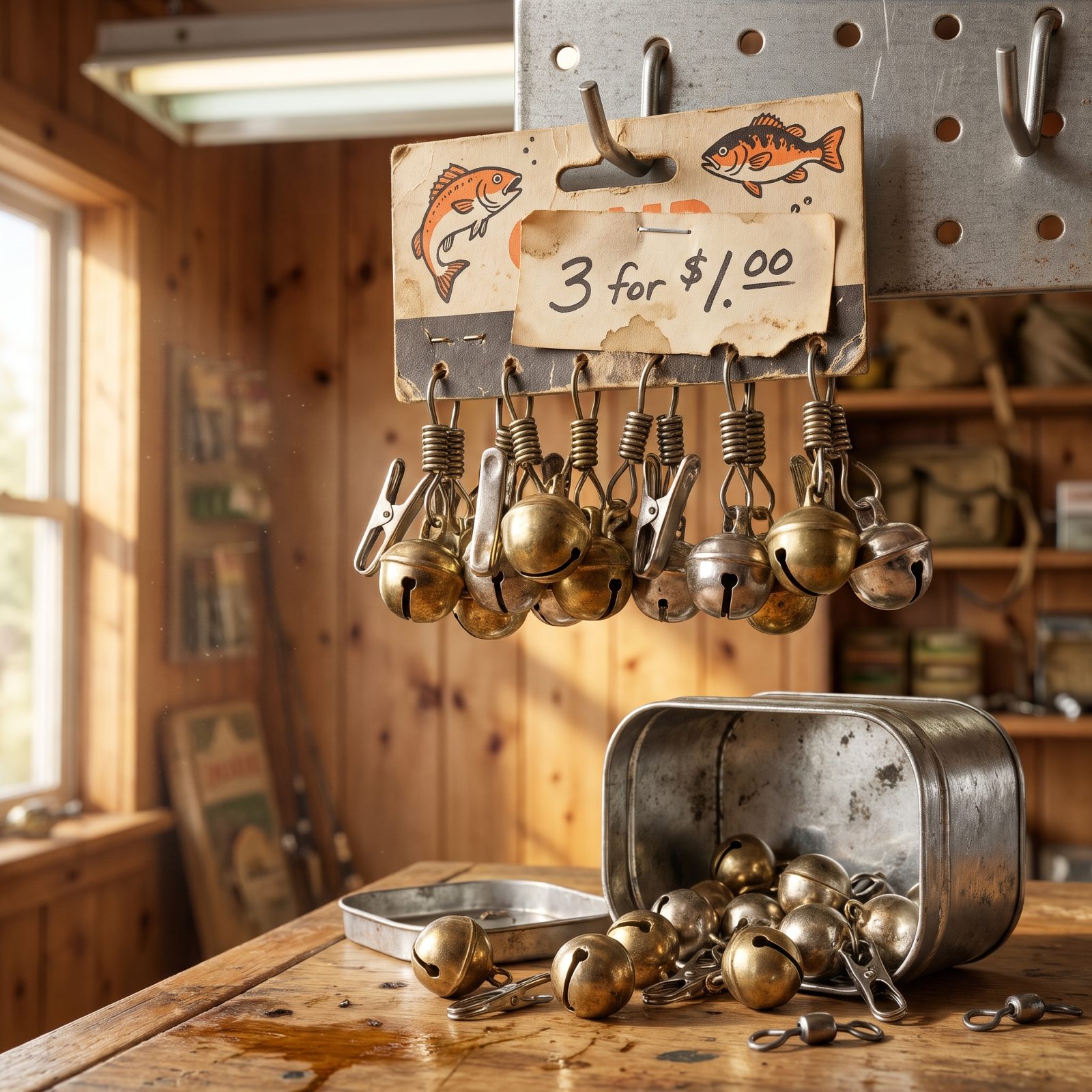
Night fishing got a soundtrack from these. You clamped a bell on the rod tip, propped the pole in a forked stick, cracked open a thermos, and let your ears do the watching.
They cost almost nothing and they worked, which is rare in tackle. Wind was the catch. A stiff breeze rang them all night and you’d set the hook on nothing a dozen times before you learned to tell a gust from a fish. Give it a season and you could call the difference half asleep.
21. Ready-Made Trotline Kits
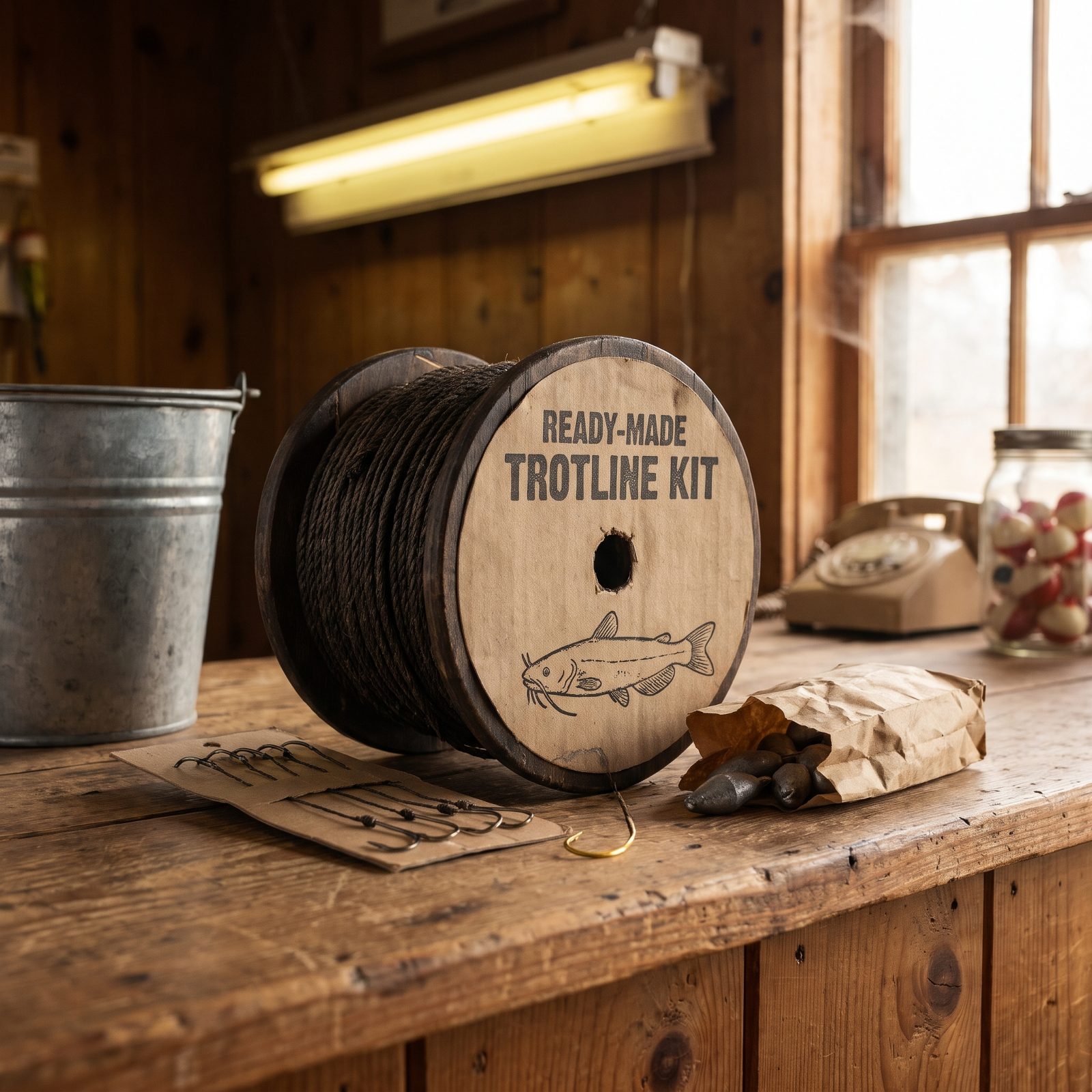
Trotlines are passive gear, which is exactly why they got complicated. Every state writes its own rules on how many hooks you can hang, how the line’s tagged, and where you can legally run one, and those rules keep shifting. Check your current regs before you tie into anything.
The old kits took the fiddly part off your hands. Tarred mainline, snelled hooks already dropped on short staging, weights, the works. You rigged it at the kitchen table and ran it at dusk.
20. Rubber-Skirted Spinnerbaits
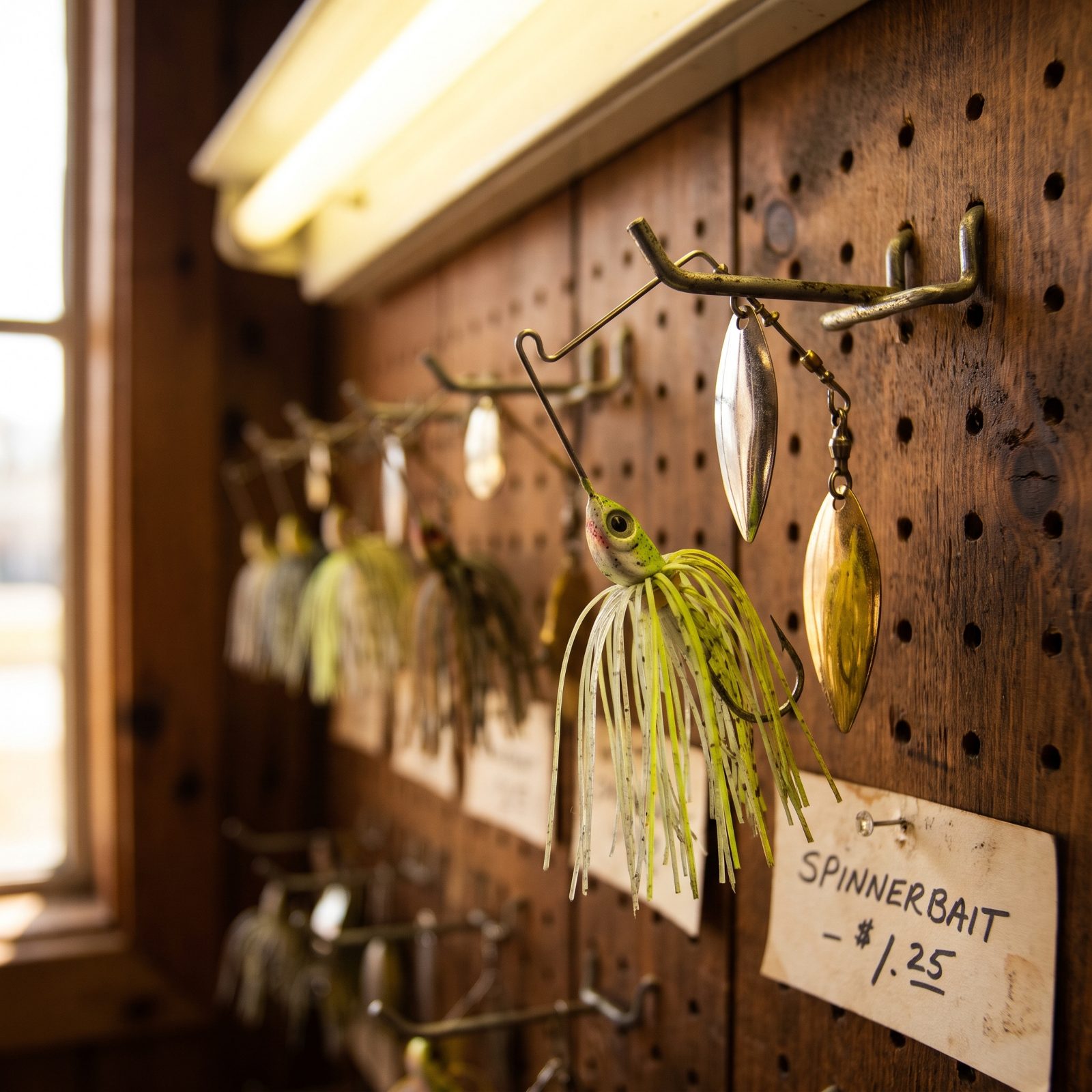
Ugly lure. Catches everything. That’s the honest review.
A spinnerbait doesn’t look like anything a fish eats, which bothers plenty of anglers until they accept that bass don’t study. The blade flashes, the skirt pulses, and something aggressive swims over to find out what’s trespassing. Chartreuse-and-white in stained water, plain white when it’s clear, a willow blade when you want to burn it fast.
What people get wrong is speed. Reel too slow and it fouls on the bottom. Keep that blade thumping just under the surface and you’ll feel the strike travel right up the line into your wrist.
19. Flashy In-Line Spinners
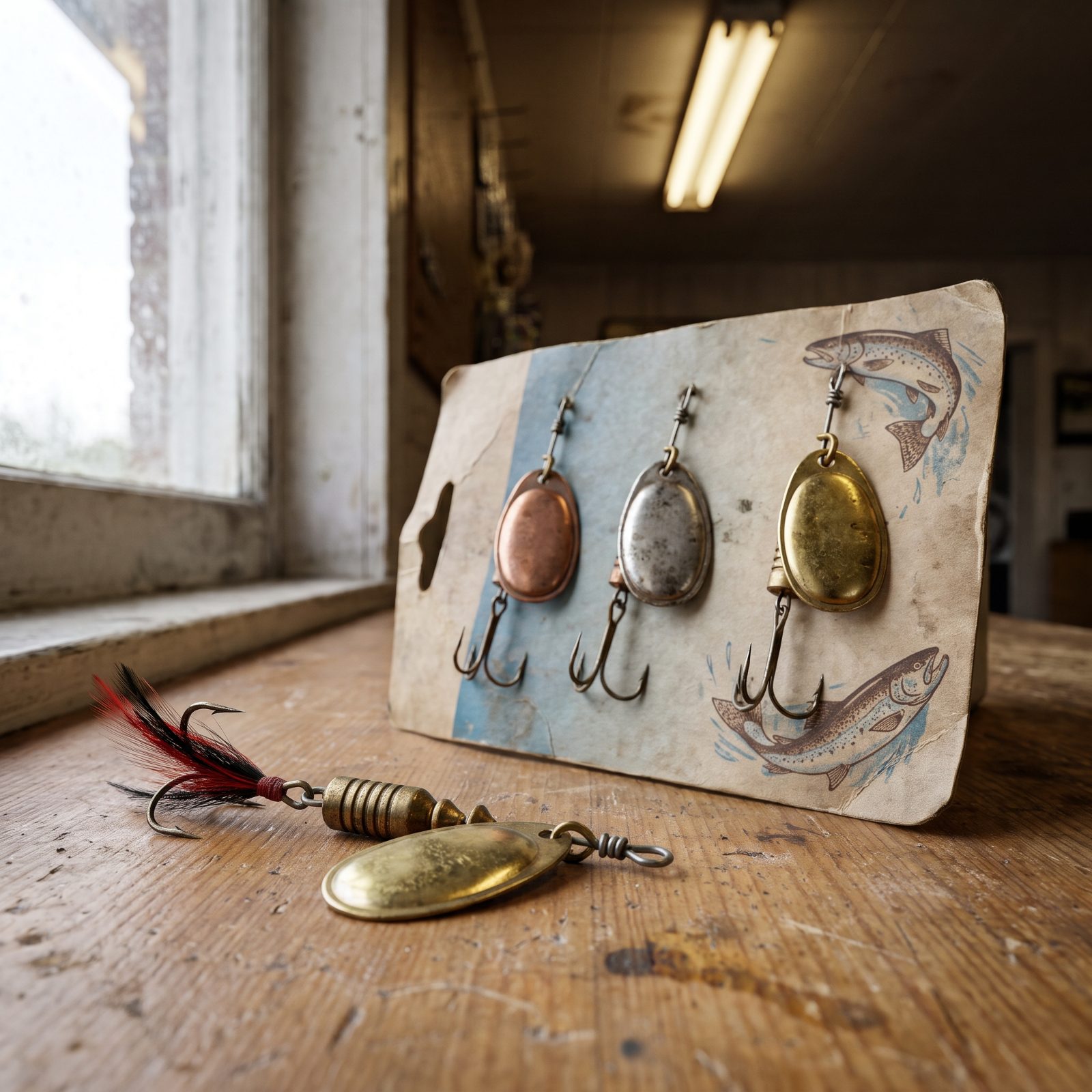
The in-line spinner is the first lure most of us ever tied on, and plenty of us never needed a second one.
Cast it upstream, let it swing down through the current, and that little blade never stops turning. Trout, smallmouth, panfish, the occasional startled pike. About as close to a sure thing as tackle gets.
18. Red-and-White Casting Spoons
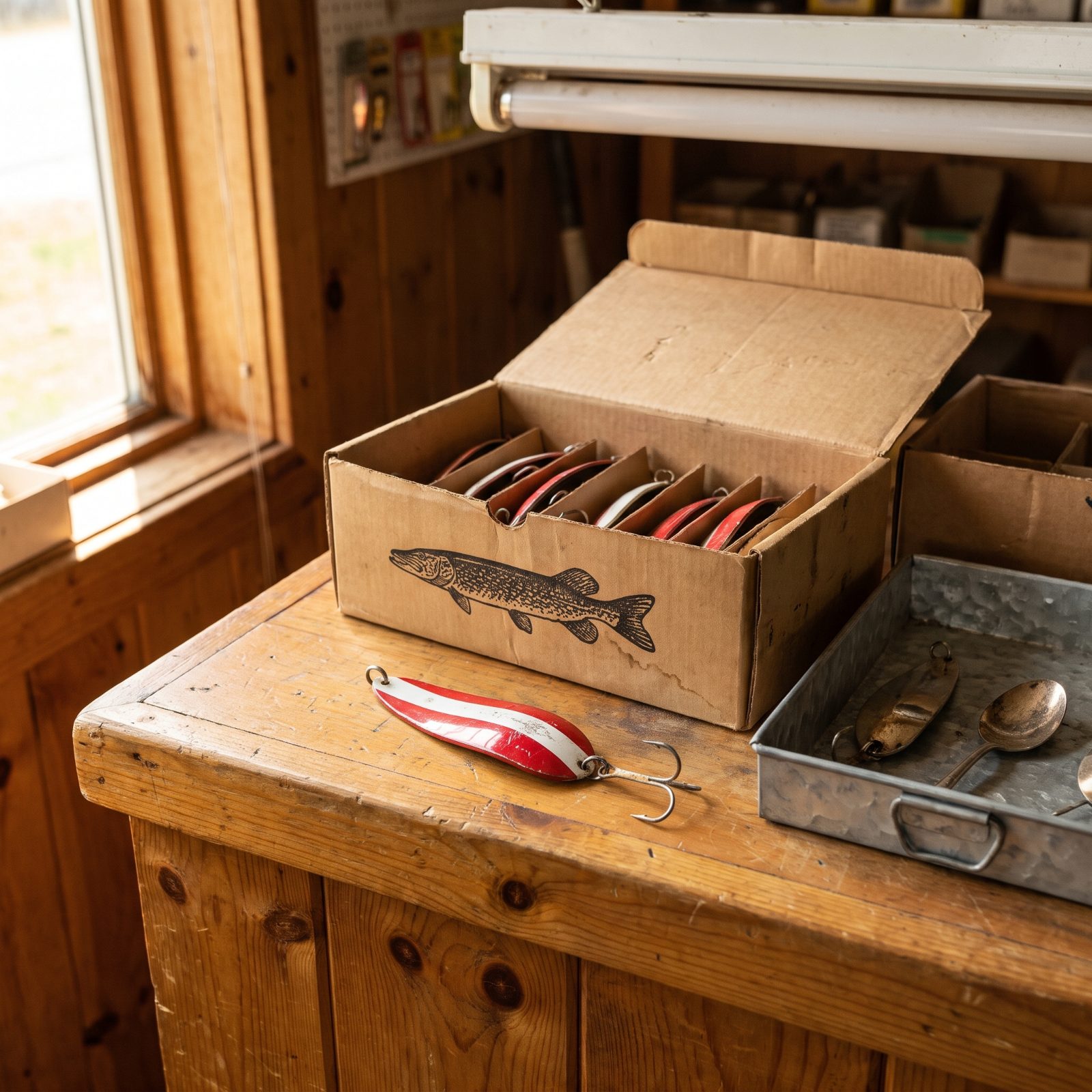
No lure has sold more copies on less reinvention. The red-and-white wobbler looked the same on the pegboard in 1935 as it did in 1975, because it worked and nobody could improve on it.
That hourglass wobble mimics a wounded baitfish, and northern pike lose their minds over it. Supposedly the red-and-white pattern marks the gill of an injured shad. Maybe. What I know is that when nothing else moves fish, this old thing still does.
17. Brightly Painted Wooden Crankbaits
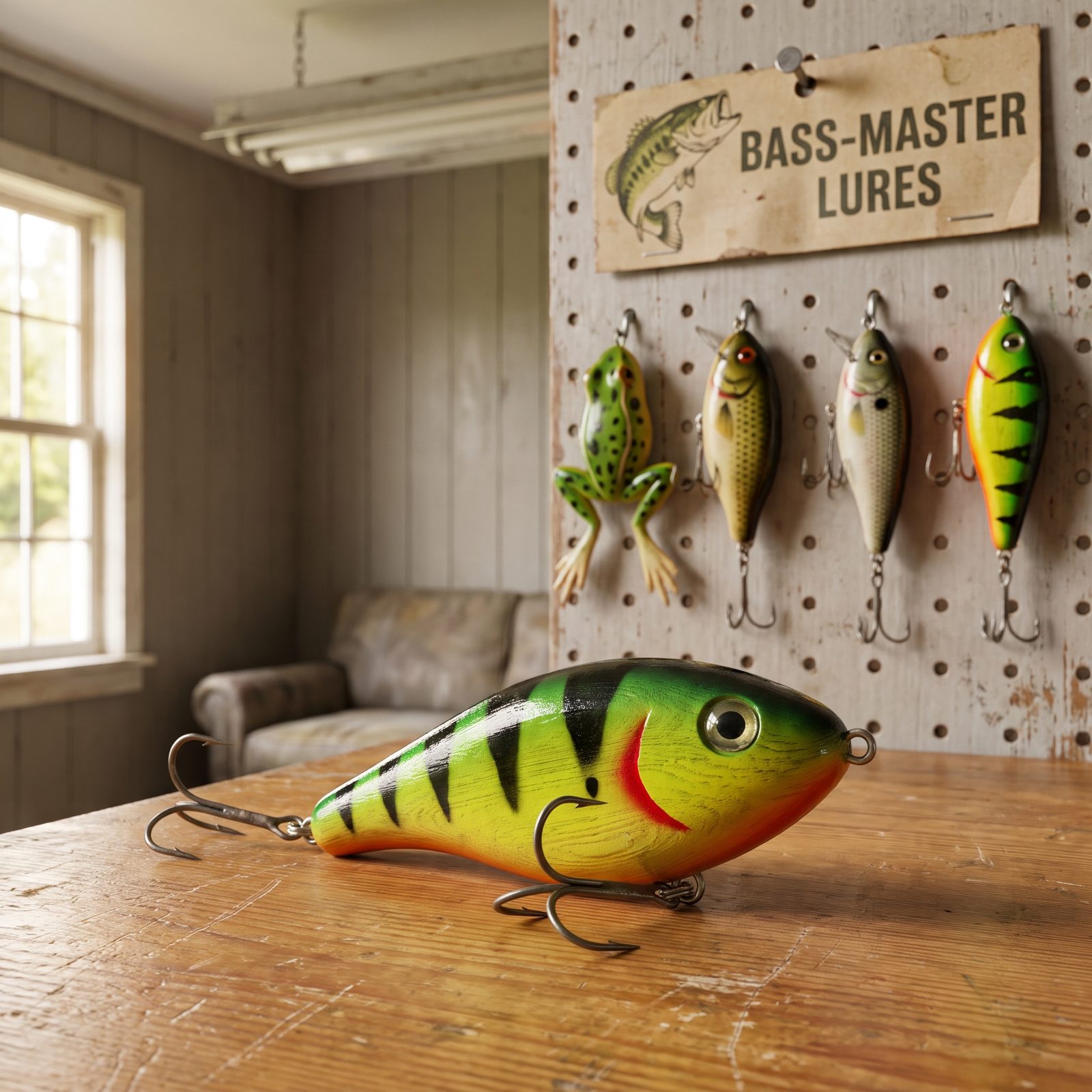
Wood swims different than plastic. Ask any old-timer and he’ll swear a cedar crankbait has a hunt to it, a little erratic wander the molded ones never quite copied.
Each one got painted by hand, so no two matched exactly. Glass eyes, a red gill slash, scale work that looked right because somebody had actually sat and studied a fish. The diving lip set the depth. Short lip ran shallow, long lip dug deep.
16. Wooden Topwater Plugs
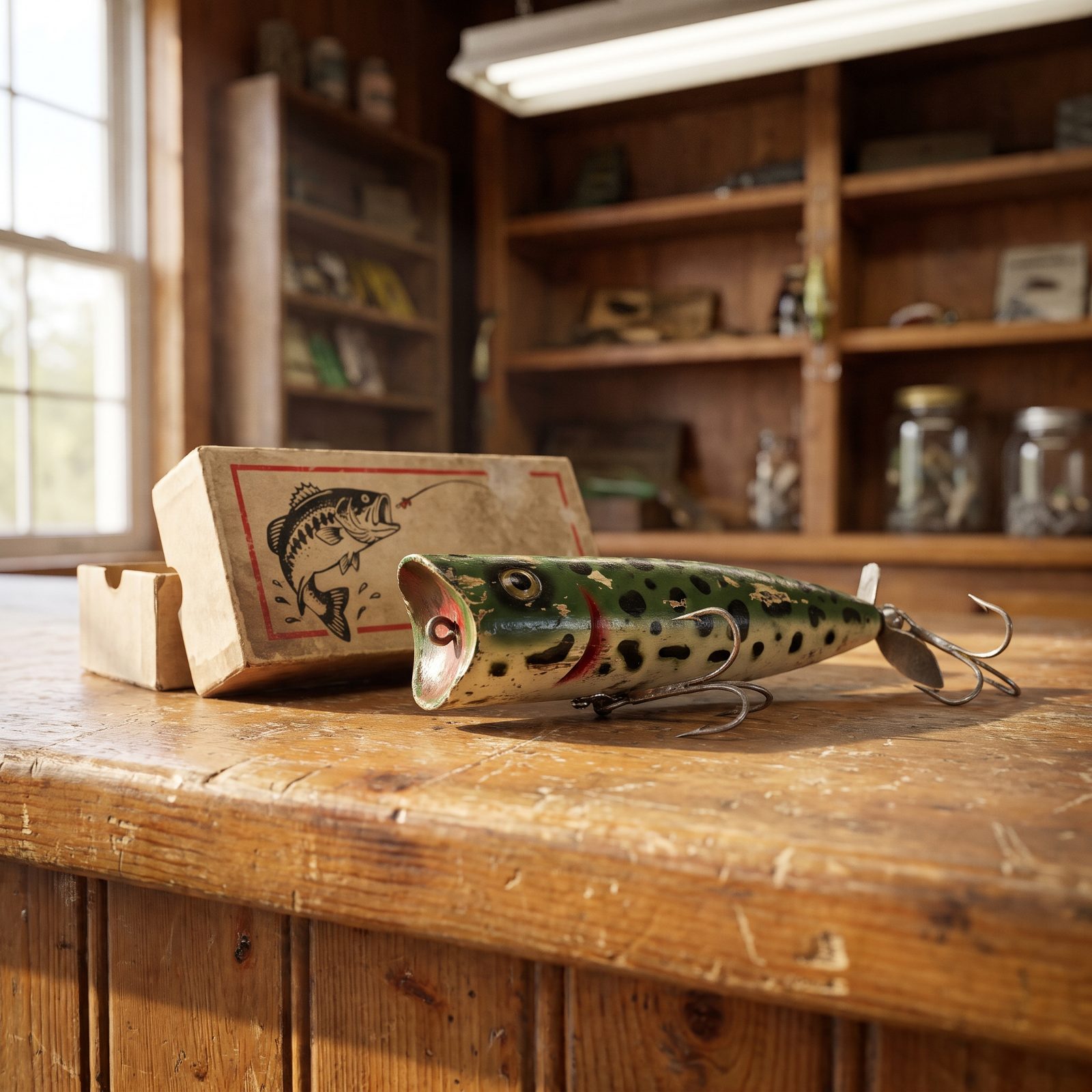
Nothing in fishing beats a topwater strike, and the wooden plug is where that addiction starts.
You throw it at dawn into a quiet pocket near the lily pads. Twitch, pause. Twitch, pause. The waiting is the whole game, and then the surface explodes and your heart stops for half a second. Cupped-face poppers chug and spit; the prop plugs gurgle. Hardest part is the pause, because every instinct in you screams to reel and bass hit it sitting dead still.
Patience is a lure the tackle shop never stocked, and it catches more than anything hanging on the pegboard.
15. Packages of Soft Rubber Worms
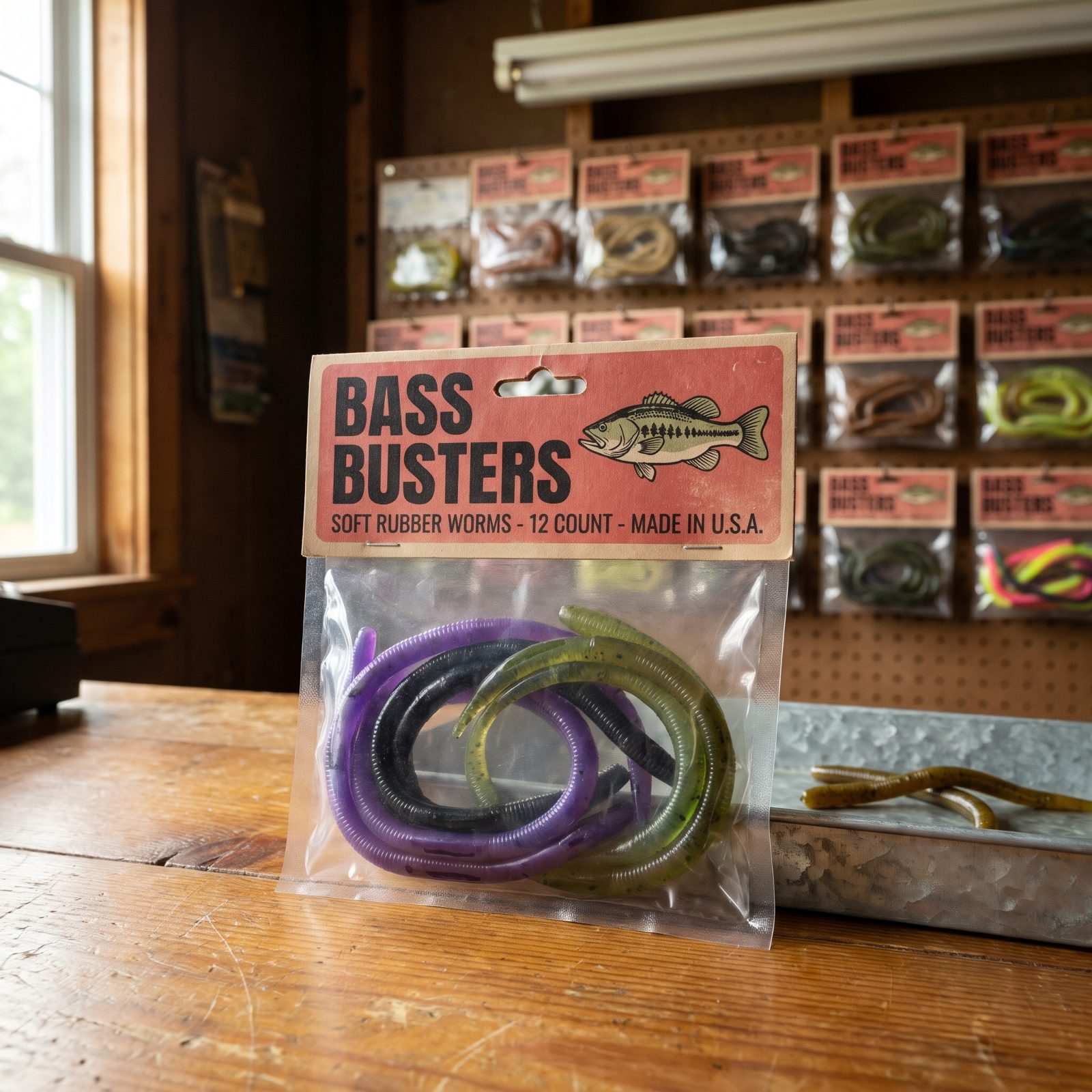
The plastic worm changed bass fishing more than any rod or reel ever did. A nickel’s worth of molded rubber pulled off what live nightcrawlers couldn’t: it hid the hook and let you crawl it slow through the thickest cover without fouling.
Purple, black, motor-oil for stained water. The whole method is patience. Cast it, let it sink on a slack line, and feel for the tap. That light tick is a bass picking it up, and by the time you feel it he’s already got the worm in his mouth, wondering what’s wrong with lunch.
14. Feathered Marabou Jigs on the Pegboard Card
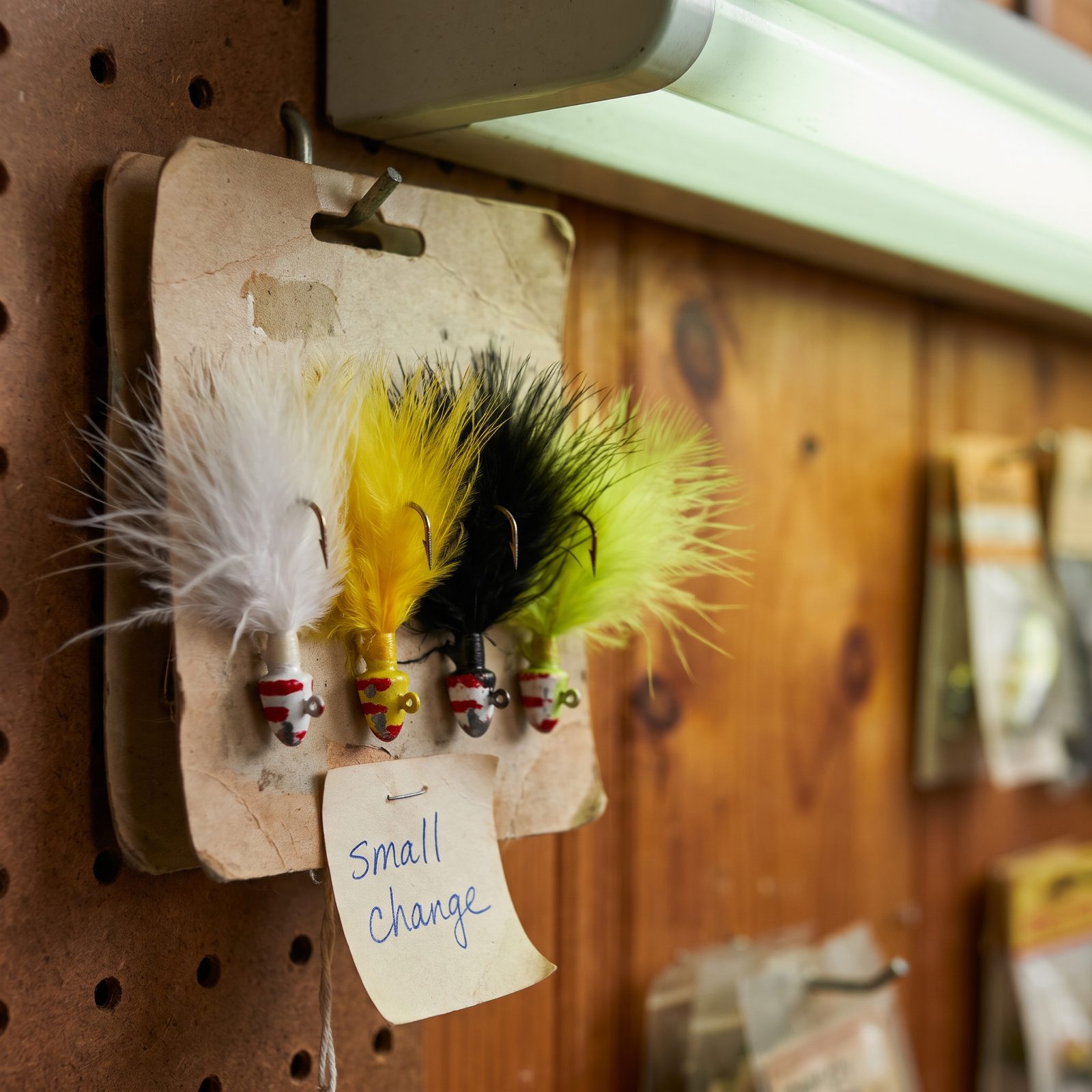
Nothing else moved like marabou. Tie one on, drop it still, and the turkey-feather fibers kept pulsing on their own, breathing with the current like something half alive. Crappie could not leave it alone.
The pegboard card held a dozen of them — white, chartreuse, a black one for muddy water, each lead head painted red at the collar. A quarter apiece, maybe less. You bought three because you knew you’d lose two to a snag before noon.
13. Jars of Pork-Rind Trailers by the Register
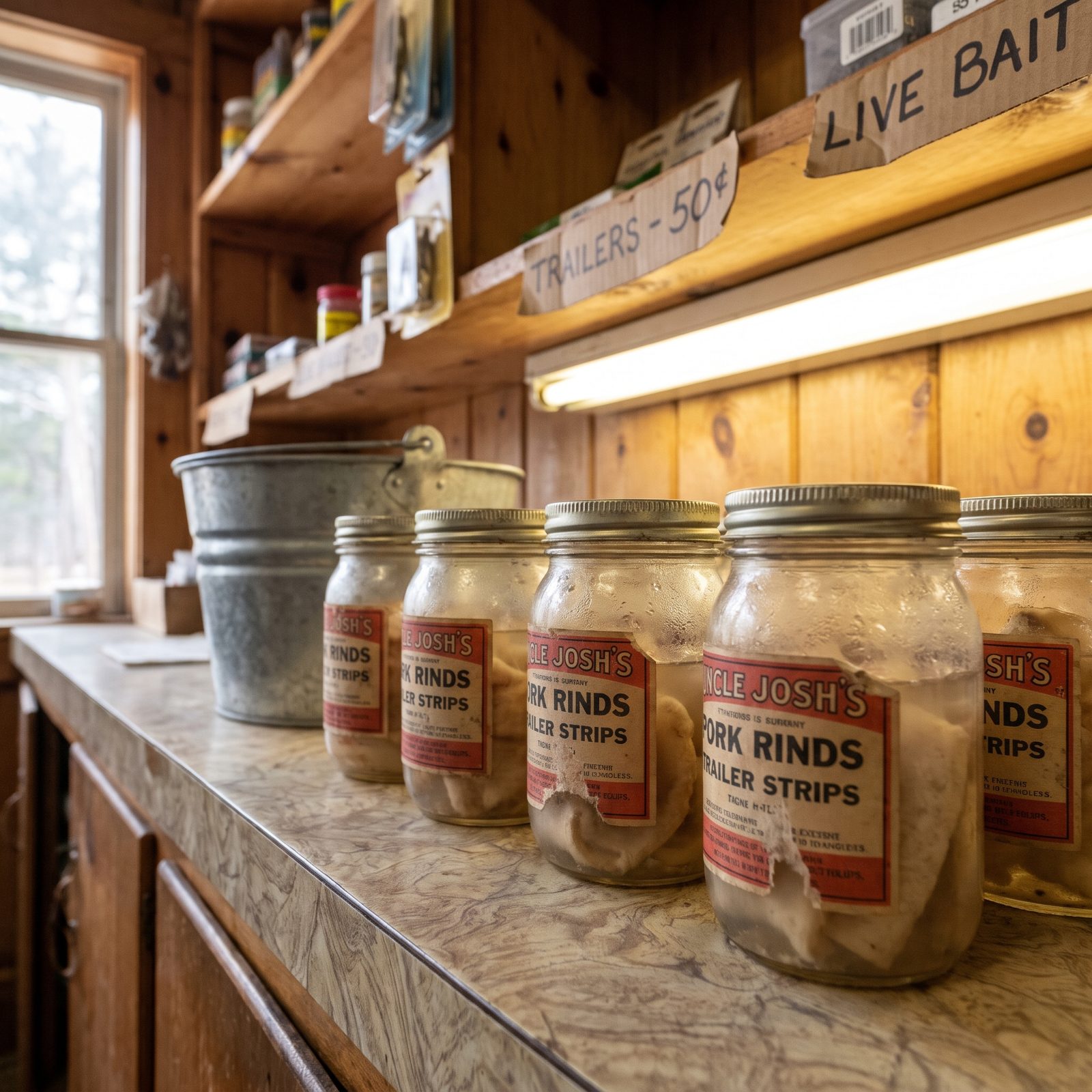
You smelled it before you saw it — that tang of brine the second the lid cracked.
Pork rind came in big quart mason jars that lived by the register, pale lumpy chunks suspended in cloudy liquid like specimens in a country doctor’s office. You’d cut a piece and thread it onto a weedless spoon and let it wobble through the lily pads for bass. The rind added scent, action, and a toughness no soft bait had back then.
Leave the lid loose and the whole tackle box reminded you about it for a week. Learned that one the hard way.
12. Folded Maps of the Nearby Lakes
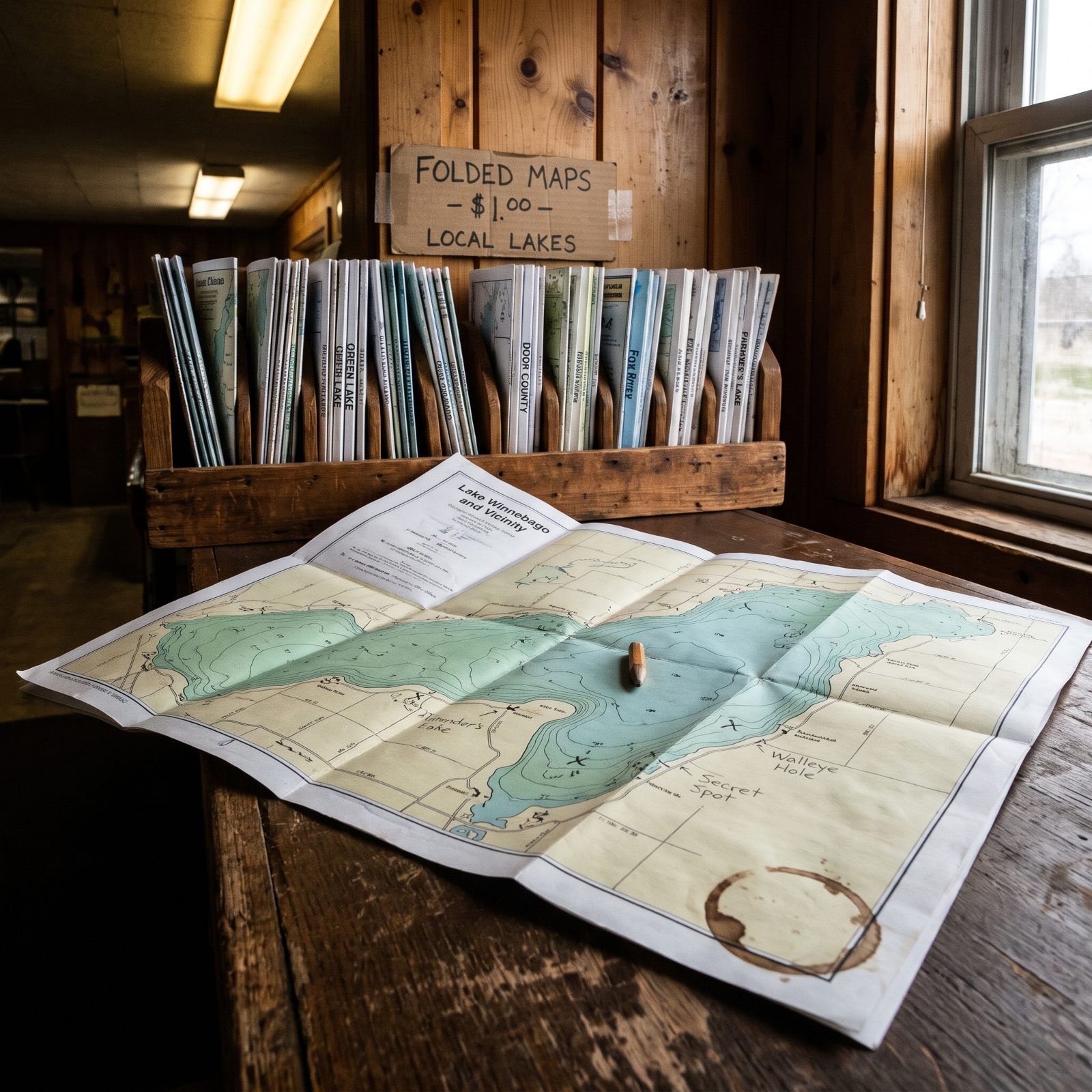
Before anyone had a screen telling them where the fish were, you had the map and the man behind the counter.
The folded lake maps showed depth contours, submerged creek channels, and the old roadbed that flooded when they dammed the river. The good ones came pre-ruined, soft at the creases, a coffee ring in one corner and little penciled X marks where somebody before you had done well.
And the shop owner knew more than the map did. Buy a map, buy some minnows, and if you were friendly he’d tell you where the brush piles sat. That conversation was worth more than the whole trip.
11. Black Rubber Hip Boots Hung by the Door
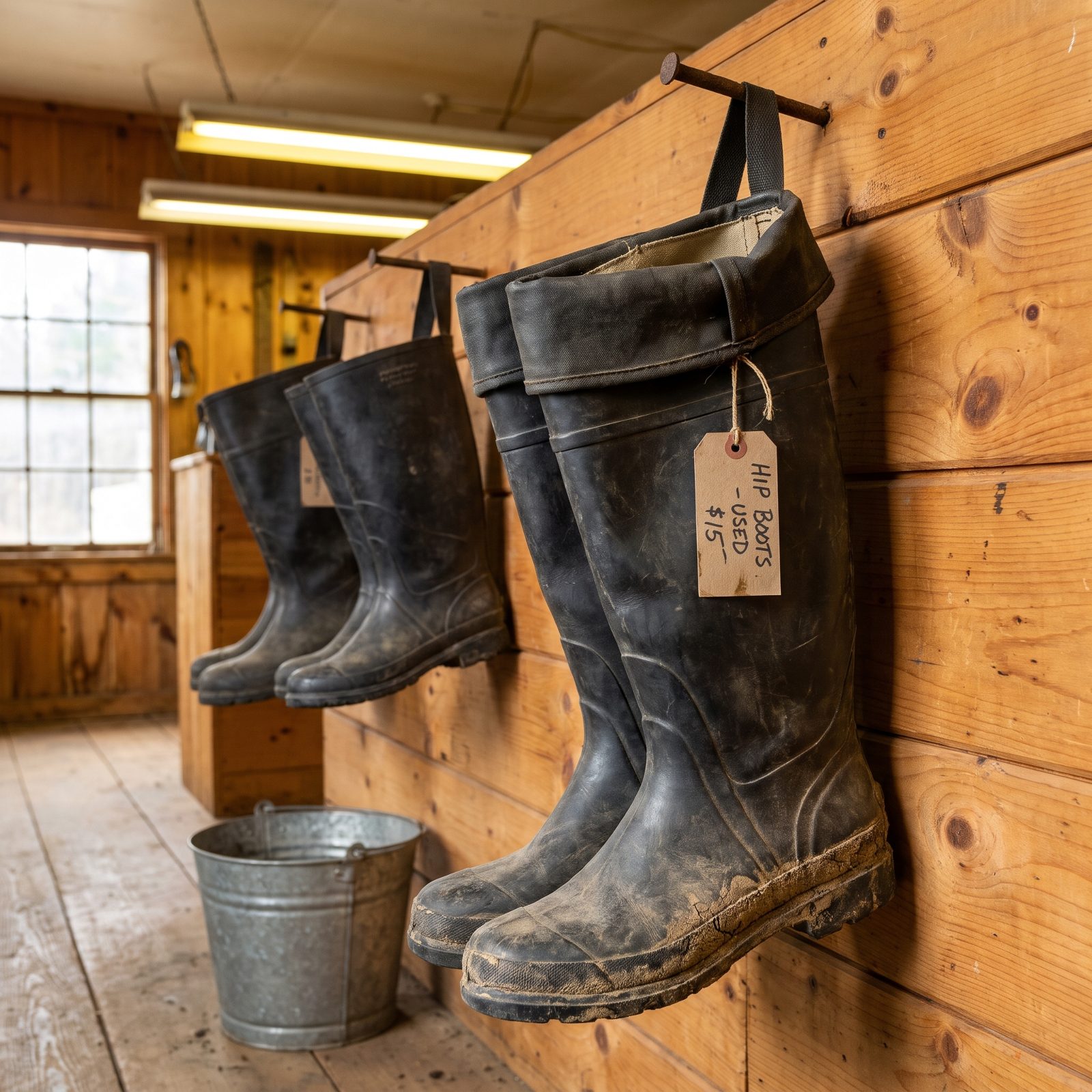
Heavy, hot, and absolutely essential. Hip boots were plain black rubber, tall enough to strap to your belt, and hung from a nail by the door in three or four sizes.
You wore them to wade a shallow, cold stream in April or to walk out to the stumps where the shore went soft. They weighed a ton and sweated you half to death by summer, but a leak meant a wet, miserable day, so folks held them up to the window light and hunted for pinholes before buying.
Step in a hole over the top and you’d remember the exact temperature of that water for years.
10. Bulky Kapok Life Jackets Stacked on the Shelf
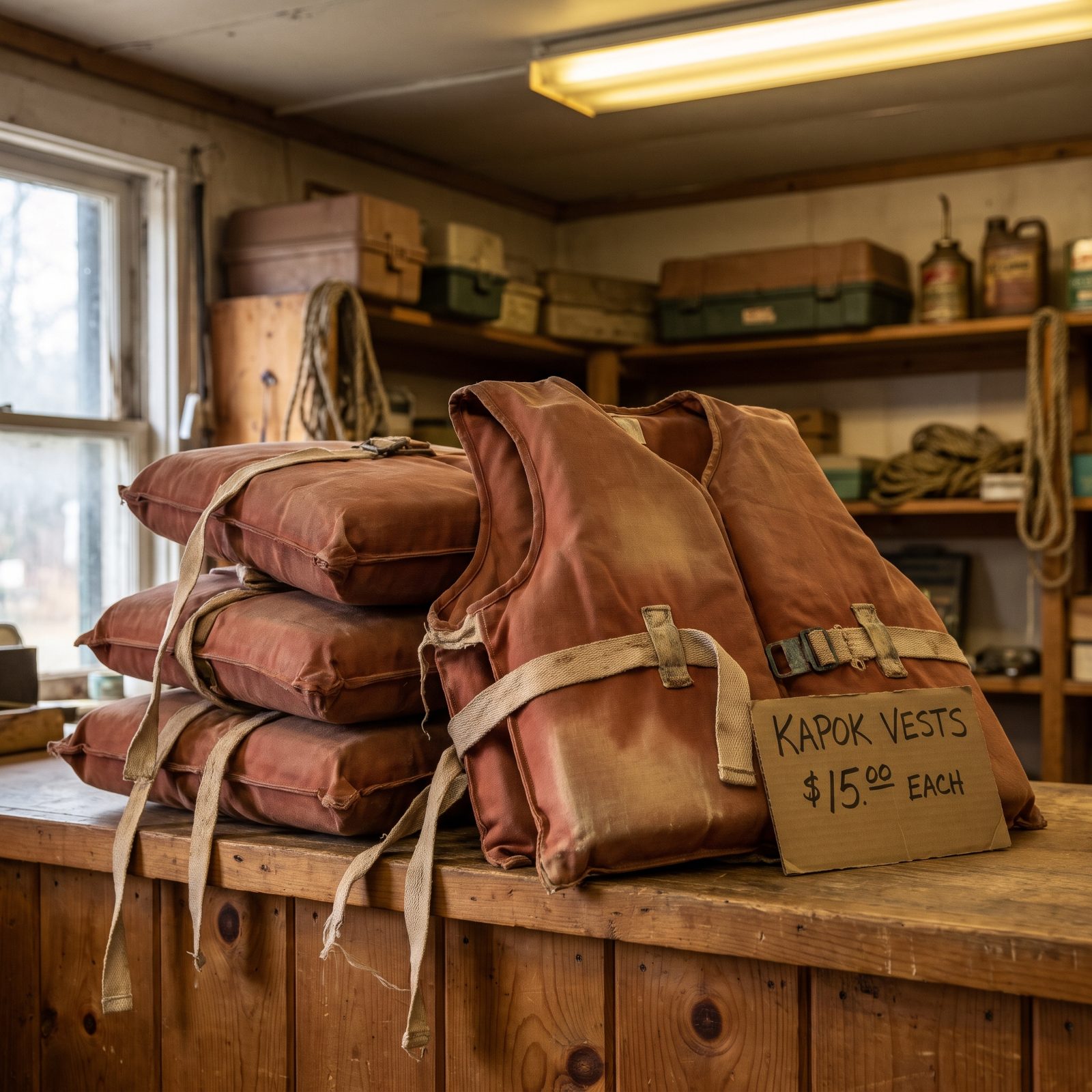
Orange, sleeveless, and stuffed like a sofa cushion. The kapok life vest, like its cousin the kapok seat cushion, was filled with the fluffy fiber from the kapok tree, and it floated you whether you wanted it to or not.
Comfortable they were not. The thick vest panels bunched up under your arms and the cotton straps always knotted. But that bulk did the job, and plenty of people are alive today because a stiff, unglamorous orange vest kept their head above water.
9. Cans of Two-Cycle Outboard Oil
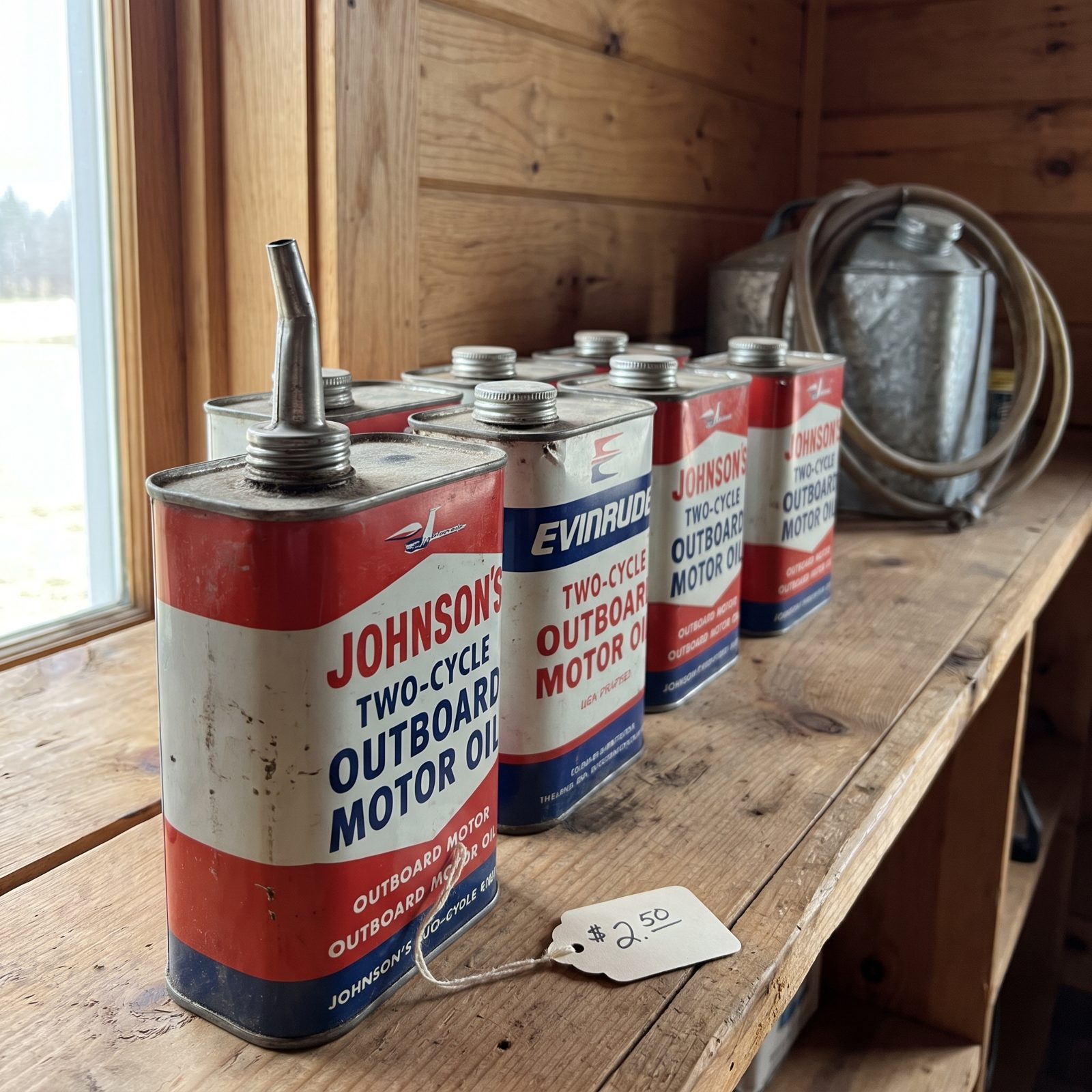
Outboards drank oil mixed right into the gas, and getting the ratio wrong cooked a motor or fouled every plug you owned. So the shelf held tall metal cans of two-cycle oil, printed in that bold red-white-and-blue that said marine before you read a word.
You measured it into the tank, sloshed it around, and ran a motor that smoked a blue cloud and smelled like a lawnmower crossed with a campfire. That smell is boating to anyone who grew up near a dock.
8. Replacement Kerosene Lantern Mantles
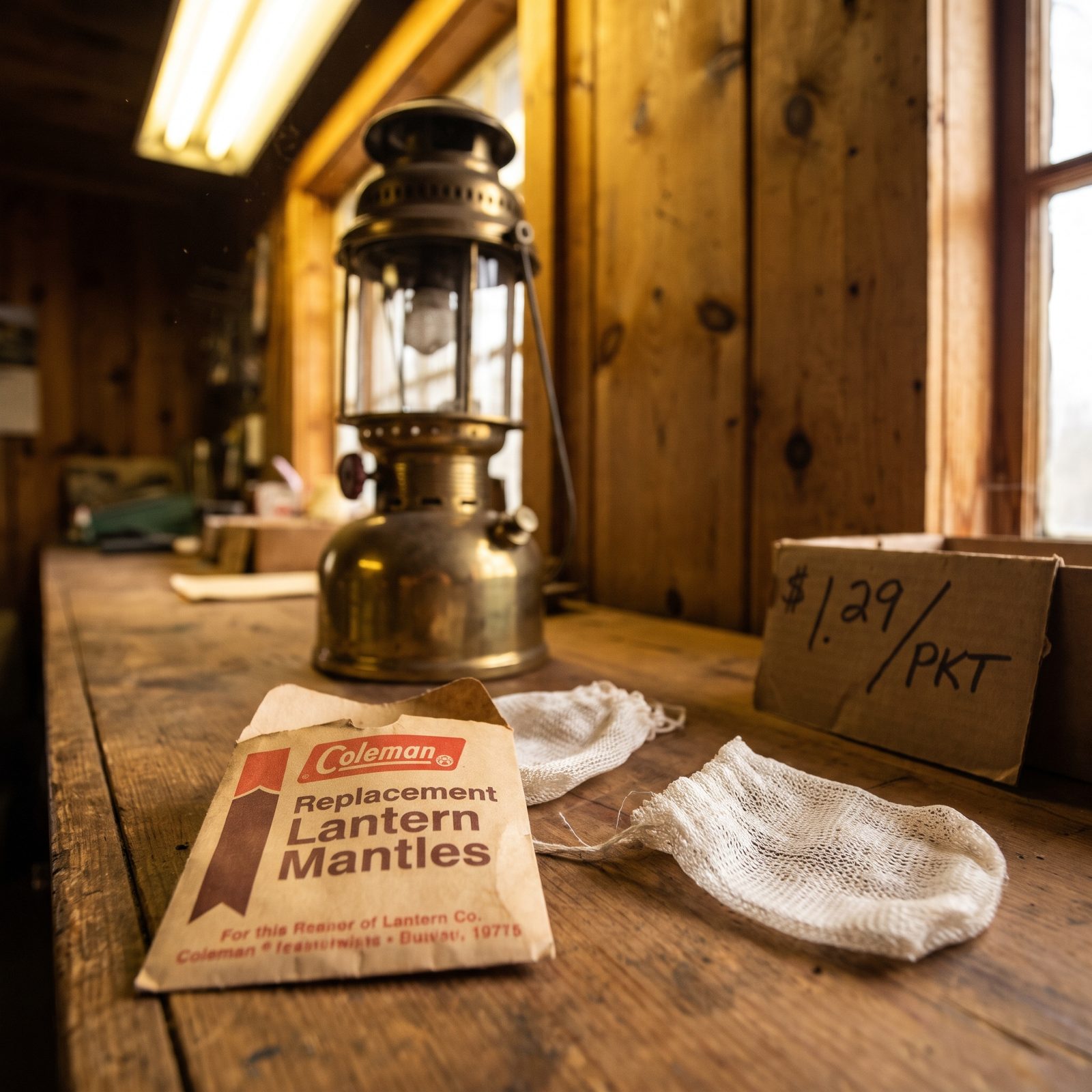
The fiddly little item nobody remembered until the lantern wouldn’t light.
Mantles were the mesh sacks that glowed inside a kerosene or white-gas lantern, and they were absurdly fragile. You tied one on, burned it off to a brittle gray ash, and after that a hard bump or a careless finger crumbled it to nothing.
Smart campers kept a spare packet in the tackle box or the glovebox. Running out at a dark campsite is a particular kind of lonely.
7. Ribbed Metal Flashlights in the Glass Case
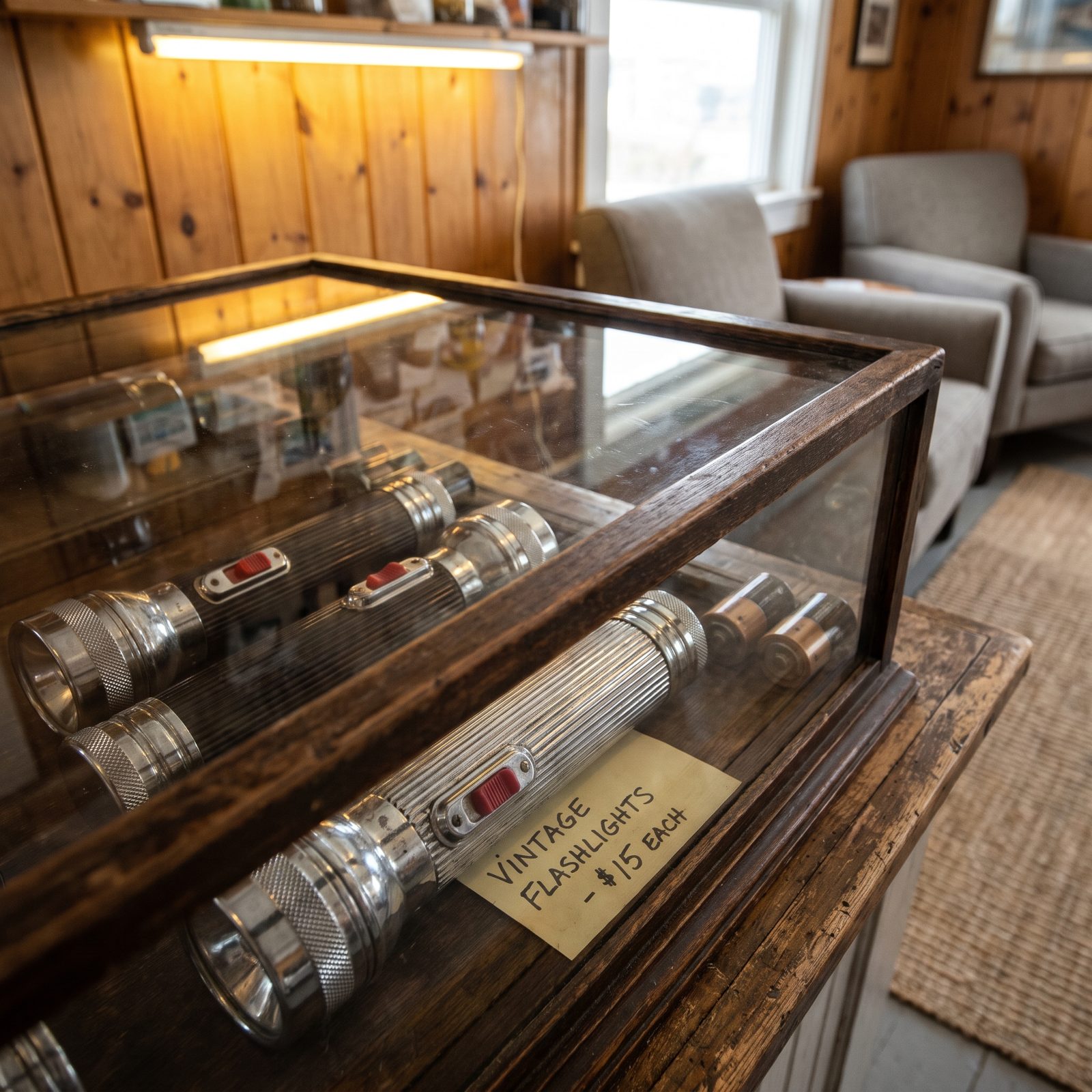
These had heft. The ribbed metal flashlight lived in the glass counter case — a chrome tube you could grip with cold wet hands, and it took two or three fat D-cell batteries that cost about as much as the light itself.
The ridges weren’t decoration. They gave you a grip when your fingers went numb at a boat ramp before dawn. A good one doubled as a club if a raccoon got into the cooler, and it survived being dropped on the dock more times than anyone bothered to count.
6. Glass Bottles of Mosquito Repellent
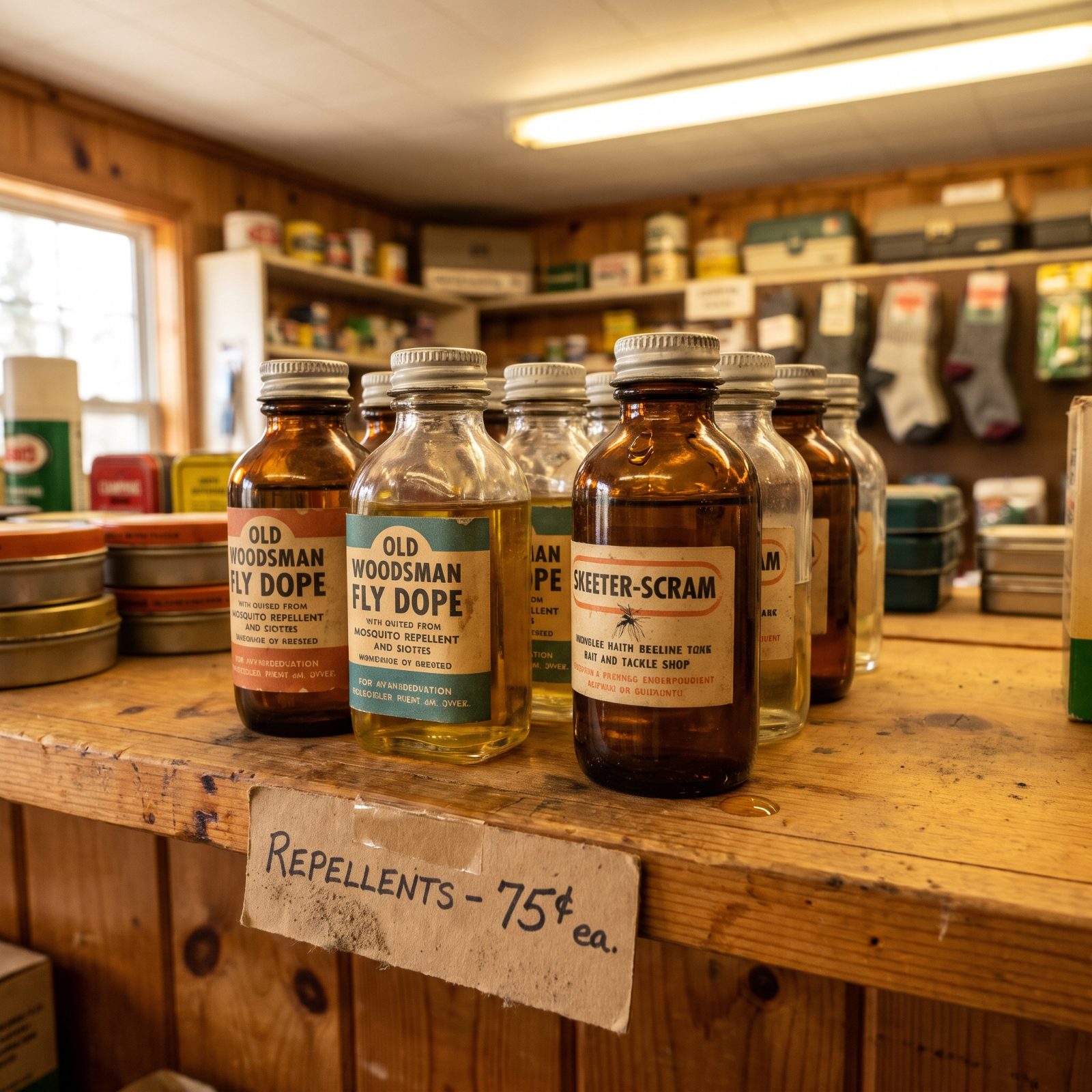
Before aerosol took over the shelf, repellent came in little glass bottles. You tipped it onto your palm and smeared it on — oily stuff that stung any cut you’d forgotten about and could melt the finish right off a fishing rod if you weren’t careful.
It worked, mostly, for an hour or two until you sweated it off. The smell was its own thing, sharp and medicinal, and it blended with cut bait and sunscreen into the exact perfume of a July evening on the water.
5. Paper-Wrapped Blocks of Ice
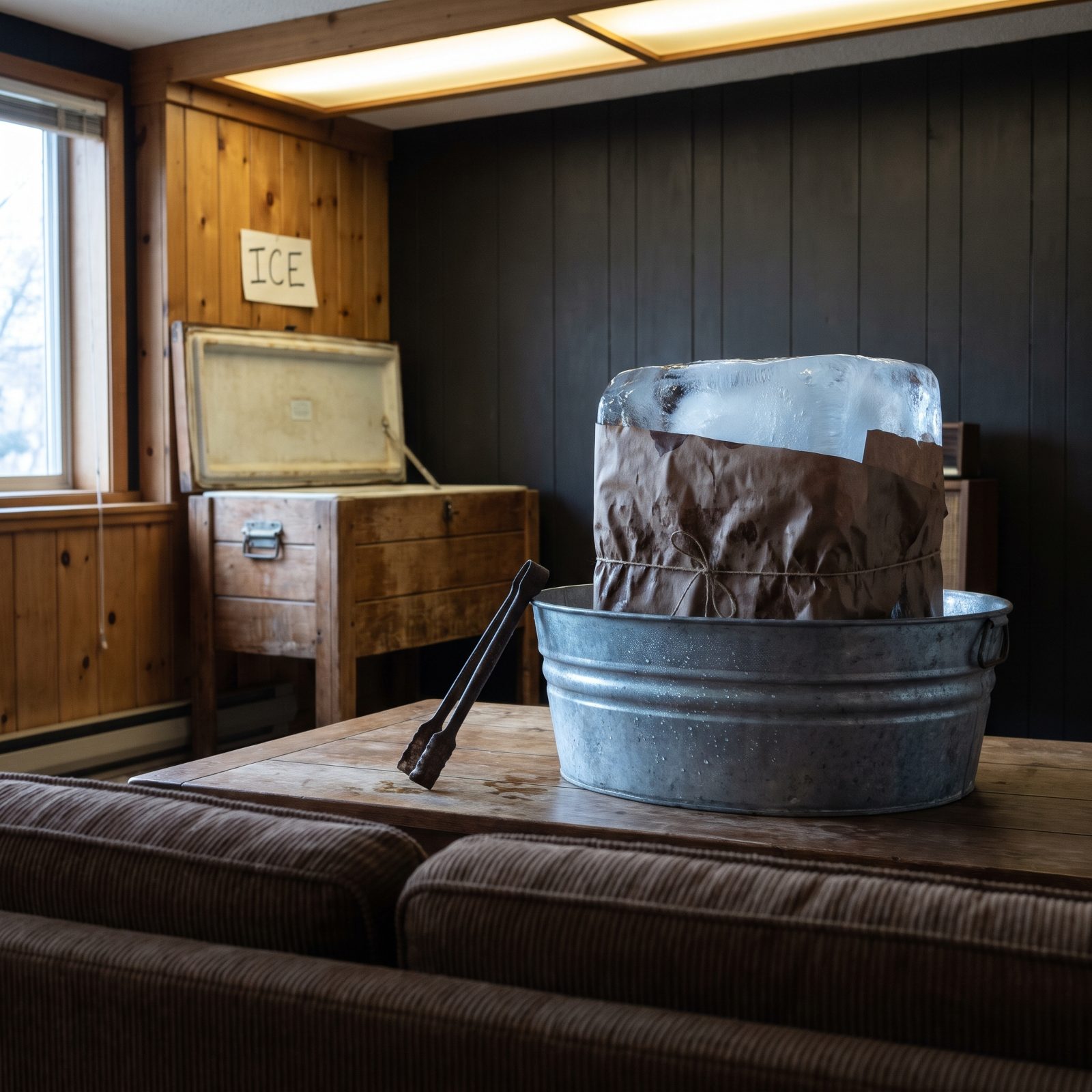
Ice came as a block, not a bag — a dense, slow-melting slab of ice, wrapped in brown paper tied with twine and set down in a galvanized washtub with a pair of iron tongs leaning beside it.
A block outlasted cubes by a country mile. It held through a long hot day on the lake and still had a cold core by the drive home, which is more than you can say for a sack of cubes that turns to slush by noon.
You’d hear it crack as it settled against the washtub wall. Then quiet. That was the sound of a good day starting.
4. Cold Bottles of Soda Sweating in the Floor Cooler
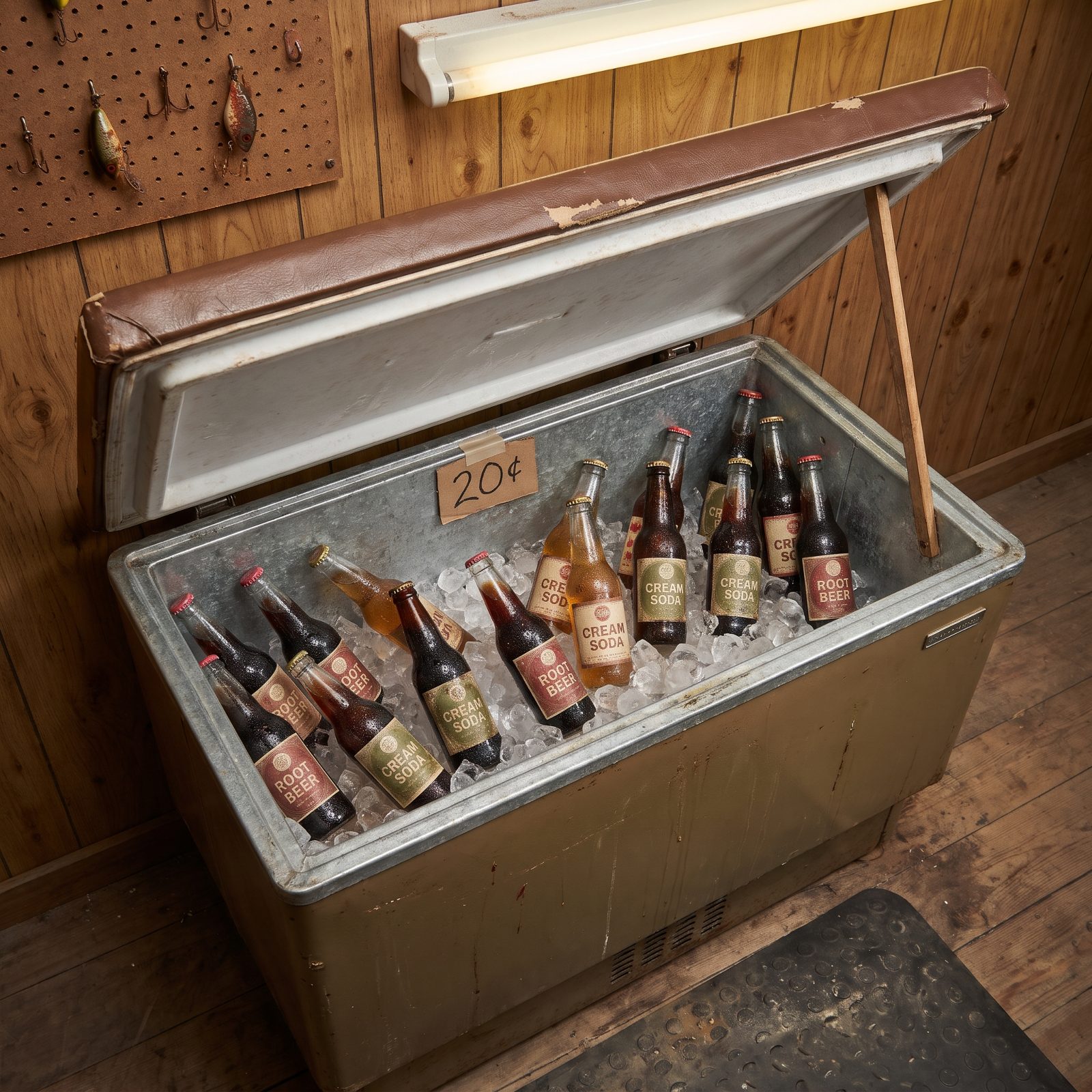
The sound came first — that dull clunk of a cap dragged across the metal teeth of the opener bolted to the cooler, then the hiss. You fished around in the ice up to your wrist, feeling for the bottle you wanted by its shape.
That floor cooler earned its spot. It ran on ice and a little electricity, held everything cold through a July afternoon, and doubled as a bench when the shop got busy. Glass took the cold better than anything else, which is a good part of why the soda tasted the way it did. A six-ounce bottle cost pocket change, and you drank it standing by the counter because the deposit on the empty mattered.
3. Candy Bars Wrapped in Wax Paper by the Register
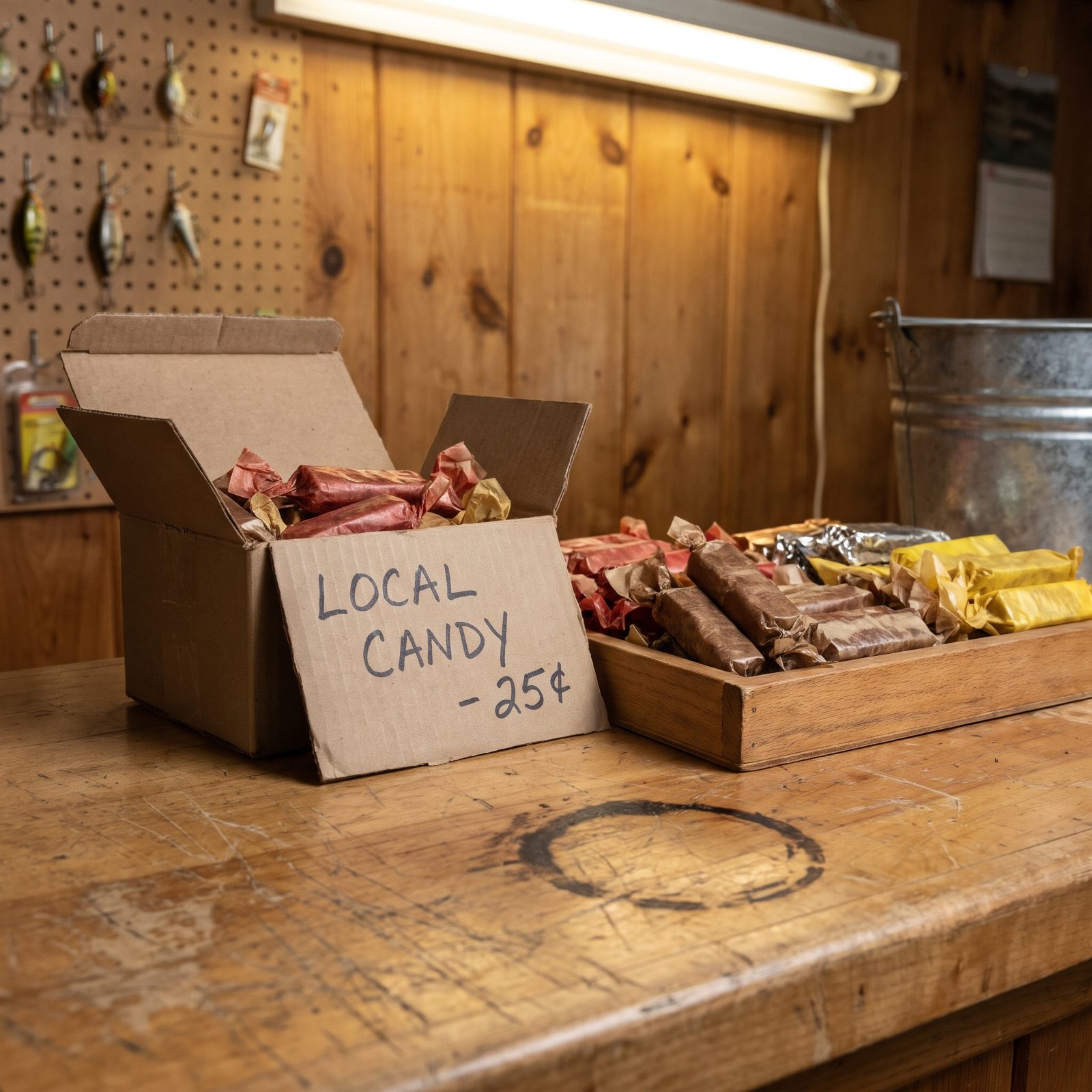
Impulse buys existed long before anybody measured them. The candy sat right at the register because that’s where your hand already was, counting out change for hooks and a bobber. By the time the man behind the counter rang up your total, you had a bar in your palm.
The wax-paper wrap did real work — it kept the chocolate from blooming and sweating in the heat off that humming light, and it crinkled loud enough that a kid couldn’t sneak one quiet. Half those bars have vanished from shelves entirely now. What you remember is the one you ate on the dock, melted a little, chewed with sandy fingers.
2. Cigarette Packs Stacked on the Shelf Behind the Counter
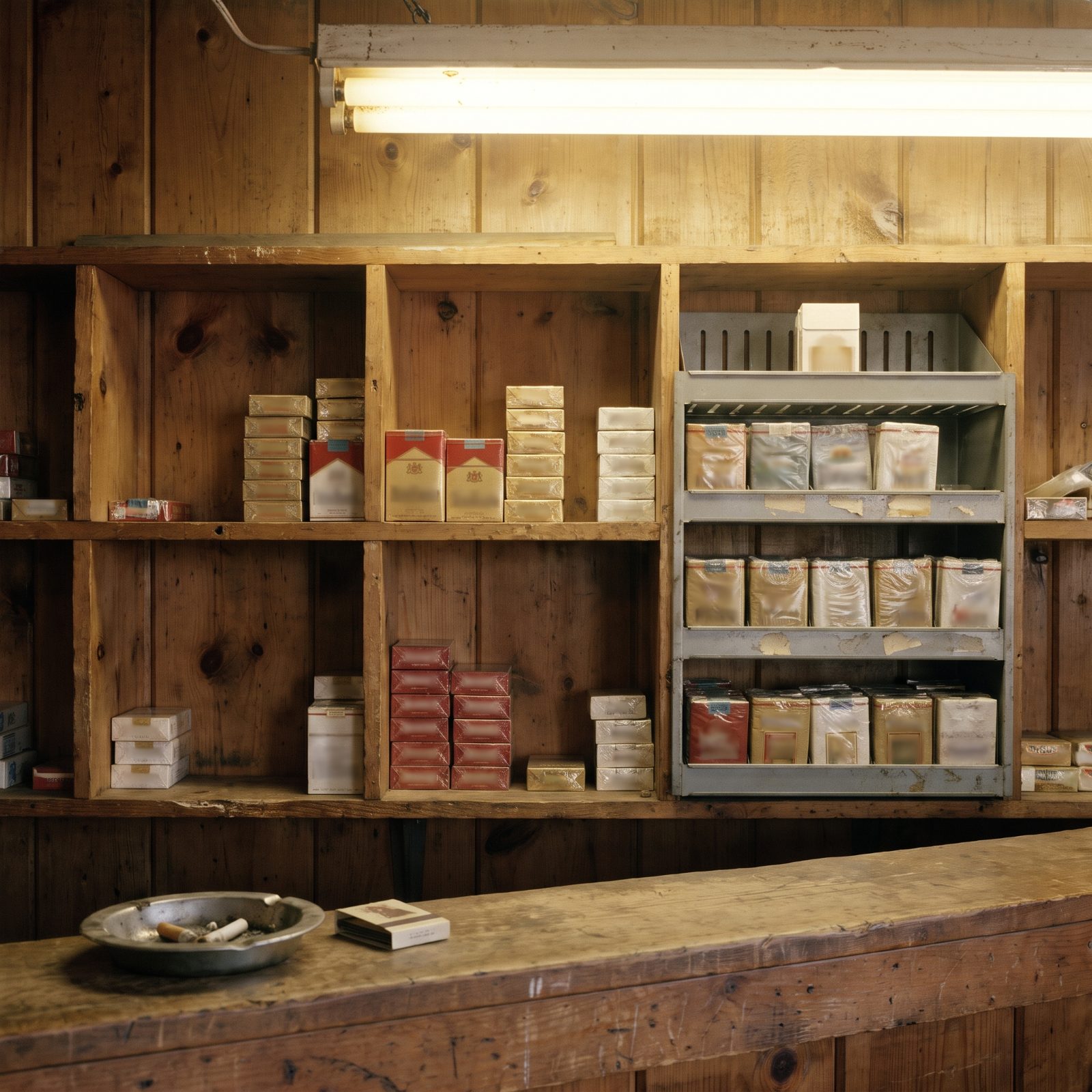
Nobody thought twice. The cigarettes lived on the shelf behind the register, within easy reach, stacked in wooden cubbies and a slotted metal rack, with an ashtray and a book of matches on the counter below. A pack cost less than a gallon of gas, and plenty of men bought both on the way to the ramp.
That shelf tells you how far the ground has shifted since. The graphic warnings, the taxes, the glass cases, the age checks — all of that came later. In a 1970s shop the smokes were just another thing behind the counter, cartons stacked high with an ashtray waiting right there.
1. State Fishing Licenses Filled Out by Hand at the Counter
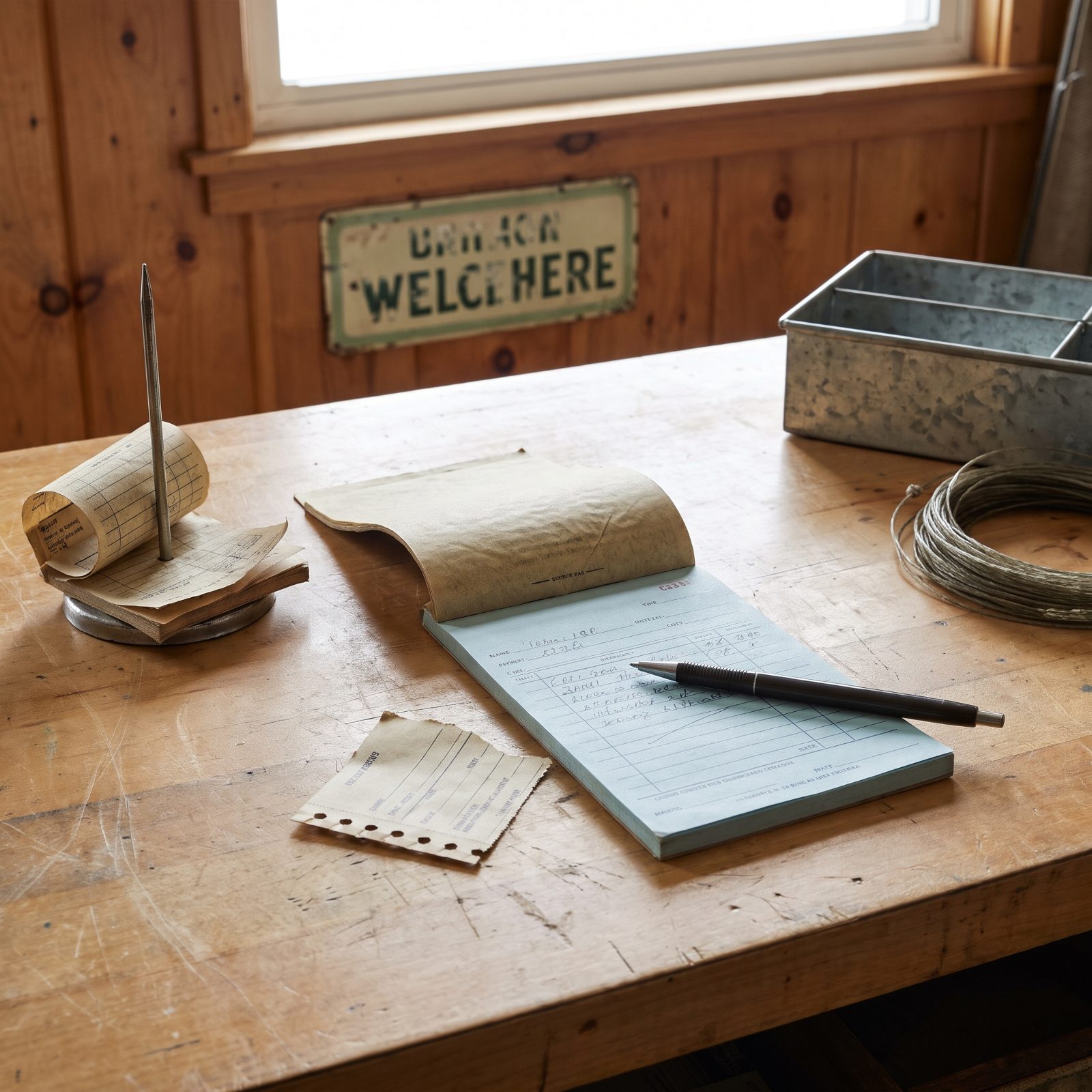
You didn’t print anything at home. You stood at the counter while the owner licked the tip of a ballpoint, pressed down hard enough to carry through the carbon sheet, and wrote out your name, your weight and your county by hand.
What you walked away with was a folded paper stub, and you kept it in your wallet until it fell apart. The shop took a small cut for selling it, which is a good part of why the little places could keep the lights on. It also meant the man selling you minnows knew the season dates, the slot limits, and whether the lake had been stocked that spring.
The counter was the license office, the weather report and the fishing report, all run by the same guy with ink on his thumb.
Rules still matter, and they still vary by state. Back then you learned them the slow way — standing there, waiting for your stub.